Lecture III
Work and Energy
Work
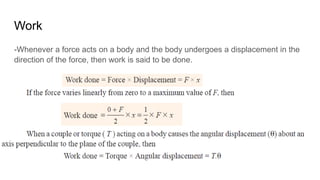
-Whenever a force acts on a body and the body undergoes a displacement in the
direction of the force, then work is said to be done.
Power
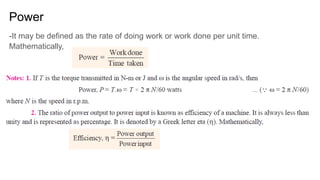
-It may be defined as the rate of doing work or work done per unit time.
Mathematically,
Energy
-It may be defined as the capacity to do work. The energy exists in many forms e.g.
mechanical, electrical, chemical, heat, light etc. But we are mainly concerned with
mechanical energy.
-The mechanical energy is equal to the work done on a body in altering either its
position or its velocity. The following three types of mechanical energies are
important from the subject point of view:
1. Potential Energy
2. Kinetic Energy
3. Strain Energy
Potential Energy
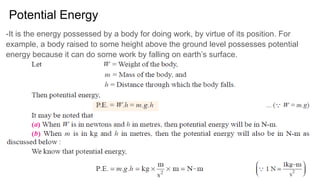
-It is the energy possessed by a body for doing work, by virtue of its position. For
example, a body raised to some height above the ground level possesses potential
energy because it can do some work by falling on earth’s surface.
Strain energy
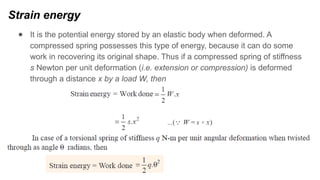
● It is the potential energy stored by an elastic body when deformed. A
compressed spring possesses this type of energy, because it can do some
work in recovering its original shape. Thus if a compressed spring of stiffness
s Newton per unit deformation (i.e. extension or compression) is deformed
through a distance x by a load W, then
Kinetic Energy
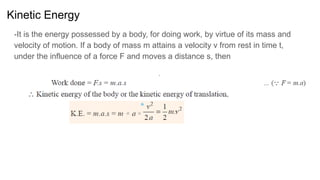
-It is the energy possessed by a body, for doing work, by virtue of its mass and
velocity of motion. If a body of mass m attains a velocity v from rest in time t,
under the influence of a force F and moves a distance s, then
Worked Examples
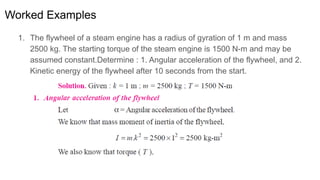
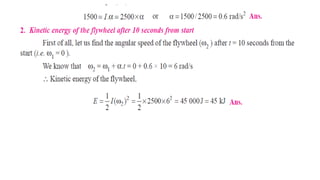
1. The flywheel of a steam engine has a radius of gyration of 1 m and mass
2500 kg. The starting torque of the steam engine is 1500 N-m and may be
assumed constant.Determine : 1. Angular acceleration of the flywheel, and 2.
Kinetic energy of the flywheel after 10 seconds from the start.
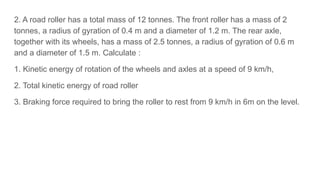
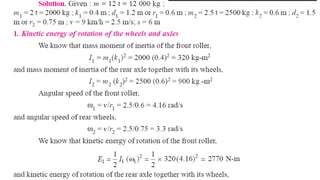
2. A road roller has a total mass of 12 tonnes. The front roller has a mass of 2
tonnes, a radius of gyration of 0.4 m and a diameter of 1.2 m. The rear axle,
together with its wheels, has a mass of 2.5 tonnes, a radius of gyration of 0.6 m
and a diameter of 1.5 m. Calculate :
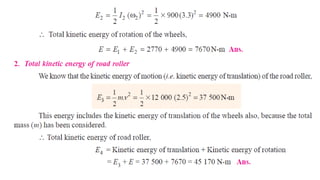
1. Kinetic energy of rotation of the wheels and axles at a speed of 9 km/h,
2. Total kinetic energy of road roller
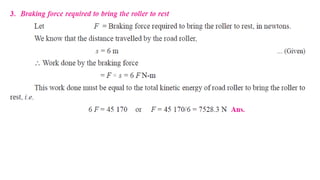
3. Braking force required to bring the roller to rest from 9 km/h in 6m on the level.
Work and energy notes for engineering mechanics 2

Work and energy notes for engineering mechanics 2

  • 1.
  • 2.
    Work -Whenever a forceacts on a body and the body undergoes a displacement in the direction of the force, then work is said to be done.
  • 3.
    Power -It may bedefined as the rate of doing work or work done per unit time. Mathematically,
  • 4.
    Energy -It may bedefined as the capacity to do work. The energy exists in many forms e.g. mechanical, electrical, chemical, heat, light etc. But we are mainly concerned with mechanical energy. -The mechanical energy is equal to the work done on a body in altering either its position or its velocity. The following three types of mechanical energies are important from the subject point of view: 1. Potential Energy 2. Kinetic Energy 3. Strain Energy
  • 5.
    Potential Energy -It isthe energy possessed by a body for doing work, by virtue of its position. For example, a body raised to some height above the ground level possesses potential energy because it can do some work by falling on earth’s surface.
  • 6.
    Strain energy ● Itis the potential energy stored by an elastic body when deformed. A compressed spring possesses this type of energy, because it can do some work in recovering its original shape. Thus if a compressed spring of stiffness s Newton per unit deformation (i.e. extension or compression) is deformed through a distance x by a load W, then
  • 7.
    Kinetic Energy -It isthe energy possessed by a body, for doing work, by virtue of its mass and velocity of motion. If a body of mass m attains a velocity v from rest in time t, under the influence of a force F and moves a distance s, then
  • 9.
    Worked Examples 1. Theflywheel of a steam engine has a radius of gyration of 1 m and mass 2500 kg. The starting torque of the steam engine is 1500 N-m and may be assumed constant.Determine : 1. Angular acceleration of the flywheel, and 2. Kinetic energy of the flywheel after 10 seconds from the start.
  • 11.
    2. A roadroller has a total mass of 12 tonnes. The front roller has a mass of 2 tonnes, a radius of gyration of 0.4 m and a diameter of 1.2 m. The rear axle, together with its wheels, has a mass of 2.5 tonnes, a radius of gyration of 0.6 m and a diameter of 1.5 m. Calculate : 1. Kinetic energy of rotation of the wheels and axles at a speed of 9 km/h, 2. Total kinetic energy of road roller 3. Braking force required to bring the roller to rest from 9 km/h in 6m on the level.