Mapping Words and Images: Writing Graphic Novels with Adolescents Nancy Frey, Bucky Carter, and Doug Fisher
Polling Question I can define a graphic novel and describe its characteristics. Strongly agree Agree Disagree Strongly disagree
Next question I currently or recently have used a graphic novel in my classroom. Yes No Not applicable
Last question  (for the moment) I have used graphic novels in my classroom for teaching elements of English language arts (other than reading): Yes No Not applicable
Today’s Purposes Participants will learn : Basic elements of the format The role of imagery in writing Linking words and images to prose content Ways to introduce  GN composition to learners Teaching literary devices through  GN composition
A Working Definition of a Graphic Novel
Common Use of GN Content Maus Reading Comprehension
They’re Already Doing It www.youtube.com/watch?v=Bj4gTPPq6Po
Introducing Graphic Novel  Composition to Students
Images and Words The best writers and artists are… observant able to draw inferences about the human condition skilled at capturing defining moments that tell universal stories “ Seeing comes before words.”  John Berger
Linking Words and Images Through Composition Graphic novels and prose texts do not replace one another--they foster deeper understanding of both Using short graphic novel compositions highlights the composition process  Link graphic and prose composition so that they enhance one another
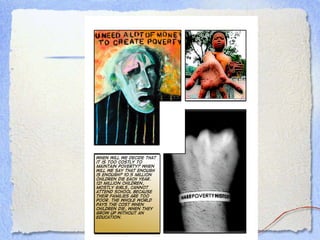
Observing Images What do you notice? What are the essential elements? What is the artist’s message? What feelings does it provoke? Do you agree or disagree?


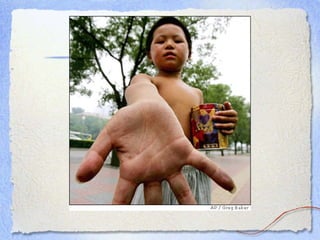
Writing to Images “ I see a child with his hand stretched out, pleading for a penny. The artist wants me to see the hand is huge, like it can never be filled. I think that’s his message, that the world’s hand can never be filled. I feel so discouraged by that. Why should we try?”
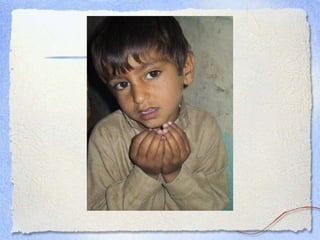
Synthesizing Images “ These three images are telling a story. Each has a hand in it, and it makes me think about ‘giving a hand’ to someone else. Hands can tell a lot about a person. The hands are praying, and demanding, and in a fist to fight poverty. That is what happens with a problem. First we pray because it’s really a bad problem, and then we demand that it gets fixed by someone. People have to see that a problem can be fixed only when we start fighting the problem instead of praying that someone else will fix it.”
 
Questions about introducing graphic novel composition?
Teaching Literary Devices Through  Graphic Novel Composition
Please refer to the lesson plan sent prior to this session
Teaching Literary Devices Introduce the literary device and model its use in illustration and prose texts Provide collaborative learning time for students to locate and identify similar examples Guide students in the construction of their own short story using the literary device Students provide a written summary of the story to accompany visual text Frey, N.  & Fisher, D. (2006).  Teaching literary devices with comics.  National Association of Comics Art Educators. Available at http://www.teachingcomics.org/lesson_plans/lit.php
 
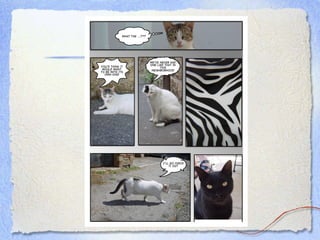
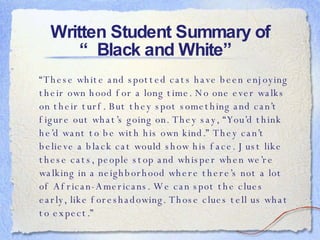
Written Student Summary of “Black and White” “ These white and spotted cats have been enjoying their own hood for a long time. No one ever walks on their turf. But they spot something and can’t figure out what’s going on. They say, “You’d think he’d want to be with his own kind.” They can’t believe a black cat would show his face. Just like these cats, people stop and whisper when we’re walking in a neighborhood where there’s not a lot of African-Americans. We can spot the clues early, like foreshadowing. Those clues tell us what to expect.”
Questions about writing  for literary devices?
Bucky: Add Lesson Plan
Questions about…?
Resources Eisner, W. (1985).  Comics and sequential art.  Tamarac, FL: Poorhouse Publications. Eisner, W. (1996).  Graphic storytelling and visual narrative.  Tamarac, FL: Poorhouse Publications. Frey, N.  & Fisher, D. (2006).  Teaching literary devices with comics.  National Association of Comics Art Educators. Available at http://www.teachingcomics.org/lesson_plans/lit.php McQuade, D., & McQuade, C. (2006).  Seeing and writing 3.  Boston: Bedford/St. Martin’s.

Words And Images Webinar Rev

  • 1.
    Mapping Words andImages: Writing Graphic Novels with Adolescents Nancy Frey, Bucky Carter, and Doug Fisher
  • 2.
    Polling Question Ican define a graphic novel and describe its characteristics. Strongly agree Agree Disagree Strongly disagree
  • 3.
    Next question Icurrently or recently have used a graphic novel in my classroom. Yes No Not applicable
  • 4.
    Last question (for the moment) I have used graphic novels in my classroom for teaching elements of English language arts (other than reading): Yes No Not applicable
  • 5.
    Today’s Purposes Participantswill learn : Basic elements of the format The role of imagery in writing Linking words and images to prose content Ways to introduce GN composition to learners Teaching literary devices through GN composition
  • 6.
    A Working Definitionof a Graphic Novel
  • 7.
    Common Use ofGN Content Maus Reading Comprehension
  • 8.
    They’re Already DoingIt www.youtube.com/watch?v=Bj4gTPPq6Po
  • 9.
    Introducing Graphic Novel Composition to Students
  • 10.
    Images and WordsThe best writers and artists are… observant able to draw inferences about the human condition skilled at capturing defining moments that tell universal stories “ Seeing comes before words.” John Berger
  • 11.
    Linking Words andImages Through Composition Graphic novels and prose texts do not replace one another--they foster deeper understanding of both Using short graphic novel compositions highlights the composition process Link graphic and prose composition so that they enhance one another
  • 12.
    Observing Images Whatdo you notice? What are the essential elements? What is the artist’s message? What feelings does it provoke? Do you agree or disagree?
  • 13.
  • 14.
  • 15.
  • 16.
    Writing to Images“ I see a child with his hand stretched out, pleading for a penny. The artist wants me to see the hand is huge, like it can never be filled. I think that’s his message, that the world’s hand can never be filled. I feel so discouraged by that. Why should we try?”
  • 17.
    Synthesizing Images “These three images are telling a story. Each has a hand in it, and it makes me think about ‘giving a hand’ to someone else. Hands can tell a lot about a person. The hands are praying, and demanding, and in a fist to fight poverty. That is what happens with a problem. First we pray because it’s really a bad problem, and then we demand that it gets fixed by someone. People have to see that a problem can be fixed only when we start fighting the problem instead of praying that someone else will fix it.”
  • 18.
  • 19.
    Questions about introducinggraphic novel composition?
  • 20.
    Teaching Literary DevicesThrough Graphic Novel Composition
  • 21.
    Please refer tothe lesson plan sent prior to this session
  • 22.
    Teaching Literary DevicesIntroduce the literary device and model its use in illustration and prose texts Provide collaborative learning time for students to locate and identify similar examples Guide students in the construction of their own short story using the literary device Students provide a written summary of the story to accompany visual text Frey, N. & Fisher, D. (2006). Teaching literary devices with comics. National Association of Comics Art Educators. Available at http://www.teachingcomics.org/lesson_plans/lit.php
  • 23.
  • 24.
    Written Student Summaryof “Black and White” “ These white and spotted cats have been enjoying their own hood for a long time. No one ever walks on their turf. But they spot something and can’t figure out what’s going on. They say, “You’d think he’d want to be with his own kind.” They can’t believe a black cat would show his face. Just like these cats, people stop and whisper when we’re walking in a neighborhood where there’s not a lot of African-Americans. We can spot the clues early, like foreshadowing. Those clues tell us what to expect.”
  • 25.
    Questions about writing for literary devices?
  • 26.
  • 27.
  • 28.
    Resources Eisner, W.(1985). Comics and sequential art. Tamarac, FL: Poorhouse Publications. Eisner, W. (1996). Graphic storytelling and visual narrative. Tamarac, FL: Poorhouse Publications. Frey, N. & Fisher, D. (2006). Teaching literary devices with comics. National Association of Comics Art Educators. Available at http://www.teachingcomics.org/lesson_plans/lit.php McQuade, D., & McQuade, C. (2006). Seeing and writing 3. Boston: Bedford/St. Martin’s.