ESL                        Marc
Teaching
Philosophy                McEwan
Lessons
Units                 695 Park Ave Apt 2
Assessments            Albany, NY 12208
                        (845) 321-2243
                     marcmcwn@gmail.co
                               m
              *Hyperlinks are clickable in Slide Show mode*
              Click Home on any page to return to this slide
My Teaching
          Philosophy
• To teach effectively one needs to get to
  know his/her students; Their
  strengths, needs, interests, etc.
• Promote independence
  wherever/whenever possible
• Collaboration is key; between teachers
  and also between students


                                             Home
Lessons
• Bugs! (Kindergarten- Intermediate)
• Elements of a Story– Writer’s workshop
  (Grades 2-4 Intermediate/Advanced)
• Colombian Exchange (Grade 7
  Sheltered US History, Mixed
  proficiency)


                                       Home
BUGS!

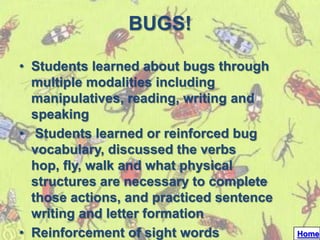
• Students learned about bugs through
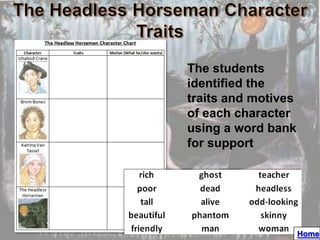
  multiple modalities including
  manipulatives, reading, writing and
  speaking
• Students learned or reinforced bug
  vocabulary, discussed the verbs
  hop, fly, walk and what physical
  structures are necessary to complete
  those actions, and practiced sentence
  writing and letter formation
• Reinforcement of sight words            Home
BUGS!
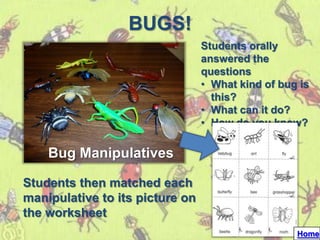
                                 Students orally
                                 answered the
                                 questions
                                 • What kind of bug is
                                   this?
                                 • What can it do?
                                 • How do you know?

    Bug Manipulatives

Students then matched each
manipulative to its picture on
the worksheet
                                                   Home
BUGS!

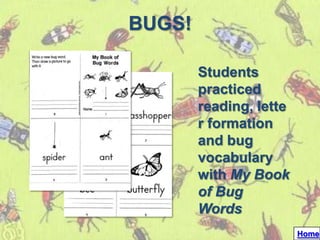
        Students
        practiced
        reading, lette
        r formation
        and bug
        vocabulary
        with My Book
        of Bug
        Words
                         Home
BUGS!
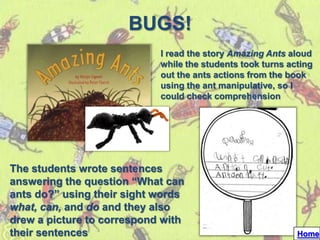
                            I read the story Amazing Ants aloud
                            while the students took turns acting
                            out the ants actions from the book
                            using the ant manipulative, so I
                            could check comprehension


The students wrote sentences
answering the question “What can
ants do?” using their sight words
what, can, and do and they also
drew a picture to correspond with
their sentences                                             Home
BUGS! Feedback
In this lesson/activity, Marc did an excellent job of:
• Using every minute of the class period for meaningful
   instruction
• Clearly setting the agenda at the beginning of class
• Preparing a lesson with several stimulating parts
   focusing on multiple ELA standards
• Capitalizing on high student interest in the topic
• Engaging the student in fluid and focused conversation
• Assisting the development of fine motor (printing) skills
   by using a model for reference and providing
   appropriately lined spaces on papers for guidance
• Using a variety of materials –
   models, pictures, ditto, story book, etc.
• Doing a quick assessment of recall after the story

       (Feedback from Clinical Supervisor- Dee Warner)
                                                         Home
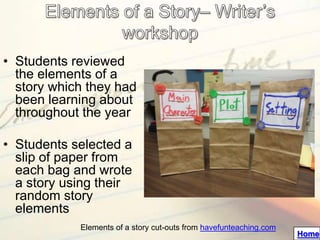
• Students reviewed
  the elements of a
  story which they had
  been learning about
  throughout the year

• Students selected a
  slip of paper from
  each bag and wrote
  a story using their
  random story
  elements
            Elements of a story cut-outs from havefunteaching.com
                                                                    Home
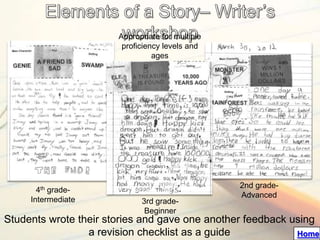
Appropriate for multiple
                        proficiency levels and
                                 ages


                                                  2nd grade-
       4th grade-
                                                  Advanced
     Intermediate            3rd grade-
                              Beginner
Students wrote their stories and gave one another feedback using
                 a revision checklist as a guide            Home
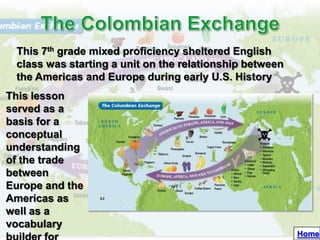
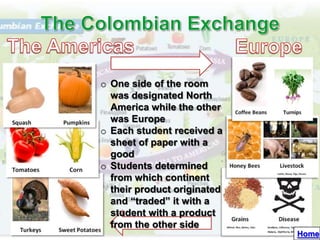
This 7th grade mixed proficiency sheltered English
 class was starting a unit on the relationship between
 the Americas and Europe during early U.S. History
This lesson
served as a
basis for a
conceptual
understanding
of the trade
between
Europe and the
Americas as
well as a
vocabulary
                                                         Home
o One side of the room
  was designated North
  America while the other
  was Europe
o Each student received a
  sheet of paper with a
  good
o Students determined
  from which continent
  their product originated
  and “traded” it with a
  student with a product
  from the other side
                             Home
Units of Study
• Space (3rd Grade- Beginner)
• Using Your Imagination (1st Grade-
  Advanced)
• The Headless Horseman (6th-8th Grade-
  Beginner)


                                          Home
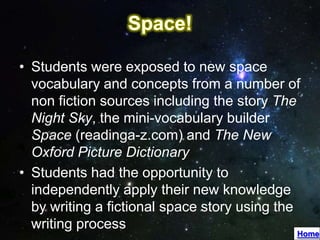
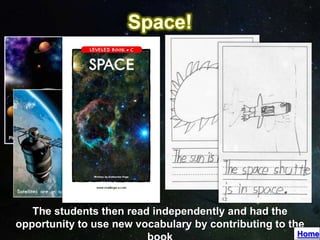
• Students were exposed to new space
  vocabulary and concepts from a number of
  non fiction sources including the story The
  Night Sky, the mini-vocabulary builder
  Space (readinga-z.com) and The New
  Oxford Picture Dictionary
• Students had the opportunity to
  independently apply their new knowledge
  by writing a fictional space story using the
  writing process
                                             Home
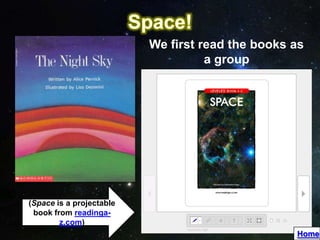
We first read the books as
                                    a group


(Space is a projectable
 book from readinga-
        z.com)
                                                  Home
The students then read independently and had the
opportunity to use new vocabulary by contributing to the
                                                      Home
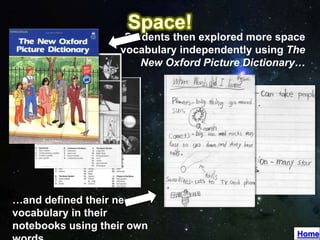
Students then explored more space
                   vocabulary independently using The
                       New Oxford Picture Dictionary…


…and defined their new
vocabulary in their
notebooks using their own
                                                   Home
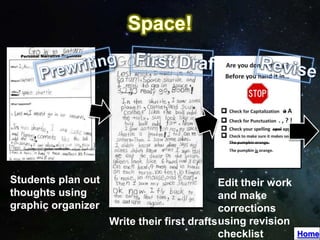
Students plan out                            Edit their work
thoughts using                               and make
graphic organizer                            corrections
                    Write their first drafts using revision
                                             checklist         Home
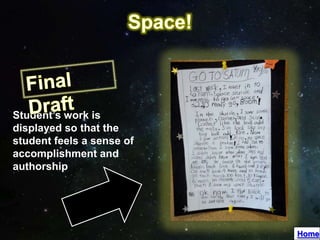
Student’s work is
displayed so that the
student feels a sense of
accomplishment and
authorship


                           Home
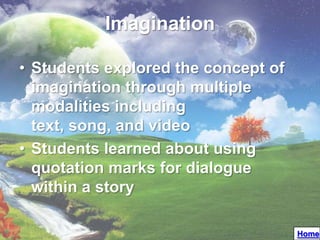
Imagination

• Students explored the concept of
  imagination through multiple
  modalities including
  text, song, and video
• Students learned about using
  quotation marks for dialogue
  within a story

                                     Home
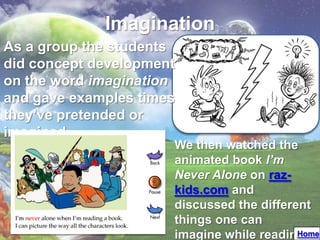
Imagination
As a group the students
did concept development
on the word imagination
and gave examples times
they’ve pretended or
imagined
                      We then watched the
                      animated book I’m
                      Never Alone on raz-
                      kids.com and
                      discussed the different
                      things one can
                      imagine while readingHome
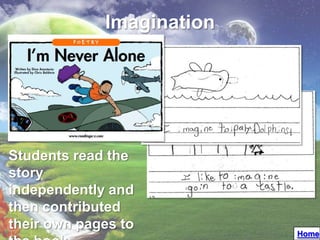
Imagination


Students read the
story
independently and
then contributed
their own pages to
                           Home
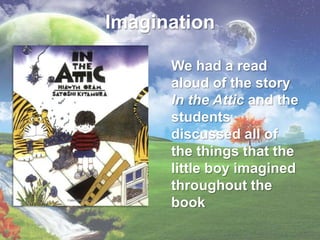
Imagination

      We had a read
      aloud of the story
      In the Attic and the
      students
      discussed all of
      the things that the
      little boy imagined
      throughout the
      book
Imagination
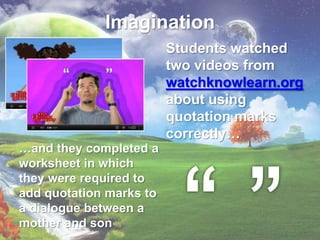
                         Students watched
                         two videos from
                         watchknowlearn.org
                         about using
                         quotation marks
                         correctly…
…and they completed a
worksheet in which
they were required to
add quotation marks to
a dialogue between a
mother and son
Imagination

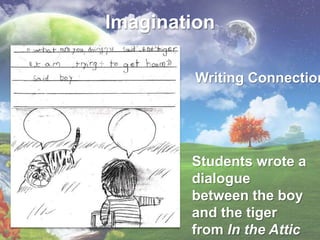
         Writing Connection


        Students wrote a
        dialogue
        between the boy
        and the tiger
        from In the Attic
Imagination Feedback
In this lesson/activity, Marc did an excellent job of:
• Creating a carefully scaffolded ELA lesson with a
   stimulating core
• Adapting easily to a potential change in plans due to
   unforeseen circumstances
• Encouraging student participation in a brainstorming
   activity
• Keeping a chatty child in focus
• Modeling the writing process and writing
   himself…remarked upon by students
• Tying examples of imagination or pretend games to
   students’ real experiences on the playground
• Interacting naturally and with gentle, but
   firm, expectations
                                                      Home
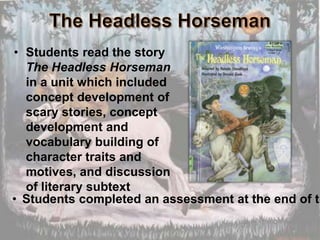
• Students read the story
  The Headless Horseman
  in a unit which included
  concept development of
  scary stories, concept
  development and
  vocabulary building of
  character traits and
  motives, and discussion
  of literary subtext
• Students completed an assessment at the end of th
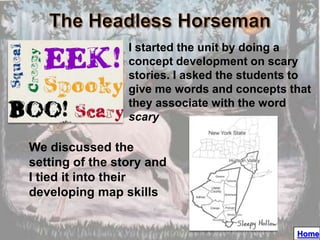
I started the unit by doing a
                 concept development on scary
                 stories. I asked the students to
                 give me words and concepts that
                 they associate with the word
                 scary

We discussed the
setting of the story and
I tied it into their
developing map skills


                                              Home
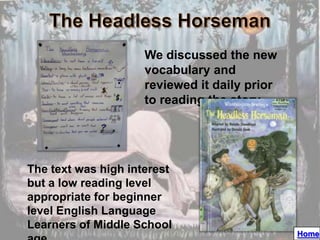
We discussed the new
                     vocabulary and
                     reviewed it daily prior
                     to reading the story


The text was high interest
but a low reading level
appropriate for beginner
level English Language
Learners of Middle School
                                               Home
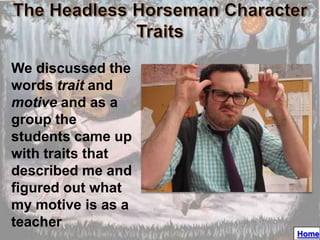
We discussed the
words trait and
motive and as a
group the
students came up
with traits that
described me and
figured out what
my motive is as a
teacher
                    Home
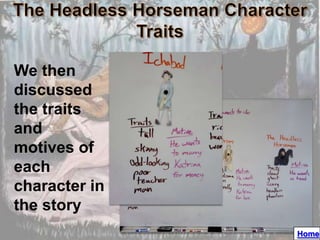
We then
discussed
the traits
and
motives of
each
character in
the story
               Home
The students
identified the
traits and motives
of each character
using a word bank
for support


                     Home
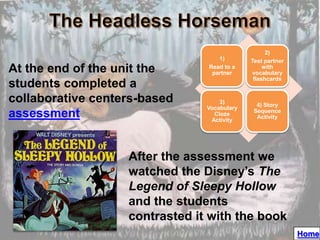
2)
                                   1)        Test partner
At the end of the unit the      Read to a
                                 partner
                                                  with
                                             vocabulary
                                              flashcards
students completed a
collaborative centers-based         3)
                                               4) Story
                                Vocabulary
assessment                        Cloze
                                 Activity
                                              Sequence
                                               Activity


                   After the assessment we
                   watched the Disney’s The
                   Legend of Sleepy Hollow
                   and the students
                   contrasted it with the book
                                                            Home
In this lesson/activity, Marc did an excellent job of:
• Creating an integrated unit with a highly engaging story
   as an anchor
• Using pictures, charts, moveable cutouts, graphic
   organizers, hand-drawn illustrations, acting out, and
   verbal clues to provide/stimulate recognition and build
   vocabulary
• Capitalizing on student interest in the form of word list
   generation to increase involvement
• Using cues from observing student understanding (or
   lack of) by using a concrete example of his own traits
• Eliciting student response from all students
• Managing materials and keeping the flow of the lesson on
   target
• Fostering verbalization by maintaining a
   respectful, friendly, interested response mode
                                                          Home
Assessments
• U.S. Regions Unit Assessment (Beginner
  6th-8th grade)
• The Headless Horseman Unit Assessment
  (Beginner 6th-8th grade)
• Modified 8th grade Industrialization Unit
  Test (Sheltered Social Studies)
• Quarter Progress Monitor (Elementary)


                                          Home
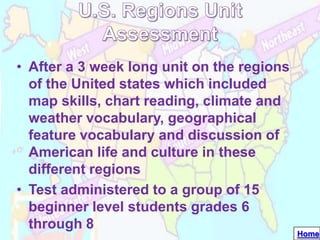
• After a 3 week long unit on the regions
  of the United states which included
  map skills, chart reading, climate and
  weather vocabulary, geographical
  feature vocabulary and discussion of
  American life and culture in these
  different regions
• Test administered to a group of 15
  beginner level students grades 6
  through 8
                                            Home
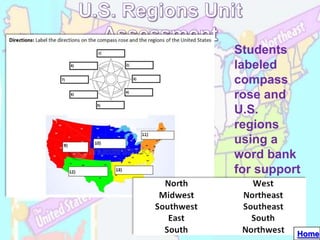
Students
labeled
compass
rose and
U.S.
regions
using a
word bank
for support


          Home
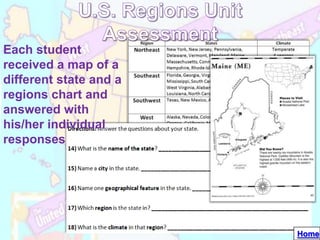
Each student
received a map of a
different state and a
regions chart and
answered with
his/her individual
responses


                        Home
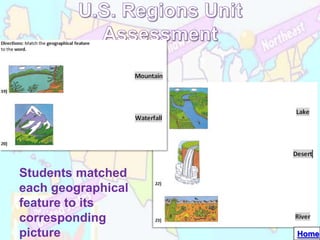
Students matched
each geographical
feature to its
corresponding
picture             Home
In this lesson/activity, Marc did a good job of:
• Preparing a summary quiz for his unit on geographical
   features
• Presenting materials in the quiz in a variety of ways to
   help learners with differing styles and different language
   capabilities
• Interacting with students in a positive, helpful, manner
• Working diligently with each reader, making sure
   progress is being made
• Managing a diverse group of students with humor and
   structure
• Creating a welcoming environment for all ESL
   students, including those from the classroom next door
• Partnering smoothly with his Cooperating Teacher, easily
   sharing space and students

       (Feedback from Clinical Supervisor- Dee Warner)      Home
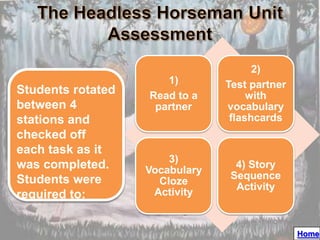
• After a week long unit on the story The
  Headless Horseman which included
  concept development of scary
  stories, concept development and
  vocabulary building of character traits
  and motives, and discussion of subtext
  students completed a unit assessment
• 14 beginner students rotated between 4
  stations with a partner and completed
  each task
                                            Home
2)
                      1)        Test partner
Students rotated   Read to a         with
between 4           partner     vocabulary
stations and                     flashcards
checked off
each task as it
                       3)
was completed.     Vocabulary
                                  4) Story
Students were                    Sequence
                     Cloze
                                  Activity
required to:        Activity


                                               Home
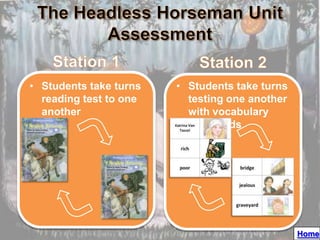
• Students take turns   • Students take turns
  reading test to one     testing one another
  another                 with vocabulary
                          flashcards


                                                Home
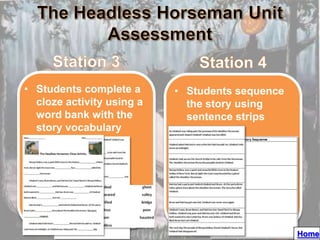
• Students complete a      • Students sequence
  cloze activity using a     the story using
  word bank with the         sentence strips
  story vocabulary


                                                 Home
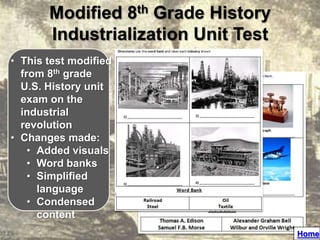
Modified 8th Grade History
       Industrialization Unit Test
• This test modified
  from 8th grade
  U.S. History unit
  exam on the
  industrial
  revolution
• Changes made:
    • Added visuals
    • Word banks
    • Simplified
      language
    • Condensed
      content
                                     Home
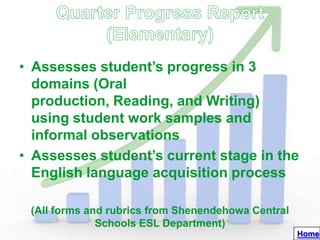
• Assesses student’s progress in 3
  domains (Oral
  production, Reading, and Writing)
  using student work samples and
  informal observations
• Assesses student’s current stage in the
  English language acquisition process

 (All forms and rubrics from Shenendehowa Central
              Schools ESL Department)
                                                    Home
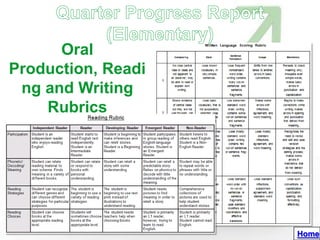
Oral
Production, Readi
 ng and Writing
    Rubrics


                    Home
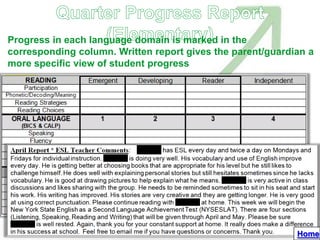
Progress in each language domain is marked in the
corresponding column. Written report gives the parent/guardian a
more specific view of student progress


                                                            Home
“The magic glasses of English enable speakers
  to behold the world on a global scale, and to
   shape life on our fast-changing planet in a
    language that is, itself, quickly changing.”
    -Leslie Dunton-Downer, The English is
                    Coming!


  Thank you for your
    consideration

                                                   Home

Marc McEwan- Portfolio May 2012

  • 1.
    ESL Marc Teaching Philosophy McEwan Lessons Units 695 Park Ave Apt 2 Assessments Albany, NY 12208 (845) 321-2243 marcmcwn@gmail.co m *Hyperlinks are clickable in Slide Show mode* Click Home on any page to return to this slide
  • 2.
    My Teaching Philosophy • To teach effectively one needs to get to know his/her students; Their strengths, needs, interests, etc. • Promote independence wherever/whenever possible • Collaboration is key; between teachers and also between students Home
  • 3.
    Lessons • Bugs! (Kindergarten-Intermediate) • Elements of a Story– Writer’s workshop (Grades 2-4 Intermediate/Advanced) • Colombian Exchange (Grade 7 Sheltered US History, Mixed proficiency) Home
  • 4.
    BUGS! • Students learnedabout bugs through multiple modalities including manipulatives, reading, writing and speaking • Students learned or reinforced bug vocabulary, discussed the verbs hop, fly, walk and what physical structures are necessary to complete those actions, and practiced sentence writing and letter formation • Reinforcement of sight words Home
  • 5.
    BUGS! Students orally answered the questions • What kind of bug is this? • What can it do? • How do you know? Bug Manipulatives Students then matched each manipulative to its picture on the worksheet Home
  • 6.
    BUGS! Students practiced reading, lette r formation and bug vocabulary with My Book of Bug Words Home
  • 7.
    BUGS! I read the story Amazing Ants aloud while the students took turns acting out the ants actions from the book using the ant manipulative, so I could check comprehension The students wrote sentences answering the question “What can ants do?” using their sight words what, can, and do and they also drew a picture to correspond with their sentences Home
  • 8.
    BUGS! Feedback In thislesson/activity, Marc did an excellent job of: • Using every minute of the class period for meaningful instruction • Clearly setting the agenda at the beginning of class • Preparing a lesson with several stimulating parts focusing on multiple ELA standards • Capitalizing on high student interest in the topic • Engaging the student in fluid and focused conversation • Assisting the development of fine motor (printing) skills by using a model for reference and providing appropriately lined spaces on papers for guidance • Using a variety of materials – models, pictures, ditto, story book, etc. • Doing a quick assessment of recall after the story (Feedback from Clinical Supervisor- Dee Warner) Home
  • 9.
    • Students reviewed the elements of a story which they had been learning about throughout the year • Students selected a slip of paper from each bag and wrote a story using their random story elements Elements of a story cut-outs from havefunteaching.com Home
  • 10.
    Appropriate for multiple proficiency levels and ages 2nd grade- 4th grade- Advanced Intermediate 3rd grade- Beginner Students wrote their stories and gave one another feedback using a revision checklist as a guide Home
  • 11.
    This 7th grademixed proficiency sheltered English class was starting a unit on the relationship between the Americas and Europe during early U.S. History This lesson served as a basis for a conceptual understanding of the trade between Europe and the Americas as well as a vocabulary Home
  • 12.
    o One sideof the room was designated North America while the other was Europe o Each student received a sheet of paper with a good o Students determined from which continent their product originated and “traded” it with a student with a product from the other side Home
  • 13.
    Units of Study •Space (3rd Grade- Beginner) • Using Your Imagination (1st Grade- Advanced) • The Headless Horseman (6th-8th Grade- Beginner) Home
  • 14.
    • Students wereexposed to new space vocabulary and concepts from a number of non fiction sources including the story The Night Sky, the mini-vocabulary builder Space (readinga-z.com) and The New Oxford Picture Dictionary • Students had the opportunity to independently apply their new knowledge by writing a fictional space story using the writing process Home
  • 15.
    We first readthe books as a group (Space is a projectable book from readinga- z.com) Home
  • 16.
    The students thenread independently and had the opportunity to use new vocabulary by contributing to the Home
  • 17.
    Students then exploredmore space vocabulary independently using The New Oxford Picture Dictionary… …and defined their new vocabulary in their notebooks using their own Home
  • 18.
    Students plan out Edit their work thoughts using and make graphic organizer corrections Write their first drafts using revision checklist Home
  • 19.
    Student’s work is displayedso that the student feels a sense of accomplishment and authorship Home
  • 20.
    Imagination • Students exploredthe concept of imagination through multiple modalities including text, song, and video • Students learned about using quotation marks for dialogue within a story Home
  • 21.
    Imagination As a groupthe students did concept development on the word imagination and gave examples times they’ve pretended or imagined We then watched the animated book I’m Never Alone on raz- kids.com and discussed the different things one can imagine while readingHome
  • 22.
    Imagination Students read the story independentlyand then contributed their own pages to Home
  • 23.
    Imagination We had a read aloud of the story In the Attic and the students discussed all of the things that the little boy imagined throughout the book
  • 24.
    Imagination Students watched two videos from watchknowlearn.org about using quotation marks correctly… …and they completed a worksheet in which they were required to add quotation marks to a dialogue between a mother and son
  • 25.
    Imagination Writing Connection Students wrote a dialogue between the boy and the tiger from In the Attic
  • 26.
    Imagination Feedback In thislesson/activity, Marc did an excellent job of: • Creating a carefully scaffolded ELA lesson with a stimulating core • Adapting easily to a potential change in plans due to unforeseen circumstances • Encouraging student participation in a brainstorming activity • Keeping a chatty child in focus • Modeling the writing process and writing himself…remarked upon by students • Tying examples of imagination or pretend games to students’ real experiences on the playground • Interacting naturally and with gentle, but firm, expectations Home
  • 27.
    • Students readthe story The Headless Horseman in a unit which included concept development of scary stories, concept development and vocabulary building of character traits and motives, and discussion of literary subtext • Students completed an assessment at the end of th
  • 28.
    I started theunit by doing a concept development on scary stories. I asked the students to give me words and concepts that they associate with the word scary We discussed the setting of the story and I tied it into their developing map skills Home
  • 29.
    We discussed thenew vocabulary and reviewed it daily prior to reading the story The text was high interest but a low reading level appropriate for beginner level English Language Learners of Middle School Home
  • 30.
    We discussed the wordstrait and motive and as a group the students came up with traits that described me and figured out what my motive is as a teacher Home
  • 31.
    We then discussed the traits and motivesof each character in the story Home
  • 32.
    The students identified the traitsand motives of each character using a word bank for support Home
  • 33.
    2) 1) Test partner At the end of the unit the Read to a partner with vocabulary flashcards students completed a collaborative centers-based 3) 4) Story Vocabulary assessment Cloze Activity Sequence Activity After the assessment we watched the Disney’s The Legend of Sleepy Hollow and the students contrasted it with the book Home
  • 34.
    In this lesson/activity,Marc did an excellent job of: • Creating an integrated unit with a highly engaging story as an anchor • Using pictures, charts, moveable cutouts, graphic organizers, hand-drawn illustrations, acting out, and verbal clues to provide/stimulate recognition and build vocabulary • Capitalizing on student interest in the form of word list generation to increase involvement • Using cues from observing student understanding (or lack of) by using a concrete example of his own traits • Eliciting student response from all students • Managing materials and keeping the flow of the lesson on target • Fostering verbalization by maintaining a respectful, friendly, interested response mode Home
  • 35.
    Assessments • U.S. RegionsUnit Assessment (Beginner 6th-8th grade) • The Headless Horseman Unit Assessment (Beginner 6th-8th grade) • Modified 8th grade Industrialization Unit Test (Sheltered Social Studies) • Quarter Progress Monitor (Elementary) Home
  • 36.
    • After a3 week long unit on the regions of the United states which included map skills, chart reading, climate and weather vocabulary, geographical feature vocabulary and discussion of American life and culture in these different regions • Test administered to a group of 15 beginner level students grades 6 through 8 Home
  • 37.
  • 38.
    Each student received amap of a different state and a regions chart and answered with his/her individual responses Home
  • 39.
    Students matched each geographical featureto its corresponding picture Home
  • 40.
    In this lesson/activity,Marc did a good job of: • Preparing a summary quiz for his unit on geographical features • Presenting materials in the quiz in a variety of ways to help learners with differing styles and different language capabilities • Interacting with students in a positive, helpful, manner • Working diligently with each reader, making sure progress is being made • Managing a diverse group of students with humor and structure • Creating a welcoming environment for all ESL students, including those from the classroom next door • Partnering smoothly with his Cooperating Teacher, easily sharing space and students (Feedback from Clinical Supervisor- Dee Warner) Home
  • 41.
    • After aweek long unit on the story The Headless Horseman which included concept development of scary stories, concept development and vocabulary building of character traits and motives, and discussion of subtext students completed a unit assessment • 14 beginner students rotated between 4 stations with a partner and completed each task Home
  • 42.
    2) 1) Test partner Students rotated Read to a with between 4 partner vocabulary stations and flashcards checked off each task as it 3) was completed. Vocabulary 4) Story Students were Sequence Cloze Activity required to: Activity Home
  • 43.
    • Students taketurns • Students take turns reading test to one testing one another another with vocabulary flashcards Home
  • 44.
    • Students completea • Students sequence cloze activity using a the story using word bank with the sentence strips story vocabulary Home
  • 45.
    Modified 8th GradeHistory Industrialization Unit Test • This test modified from 8th grade U.S. History unit exam on the industrial revolution • Changes made: • Added visuals • Word banks • Simplified language • Condensed content Home
  • 46.
    • Assesses student’sprogress in 3 domains (Oral production, Reading, and Writing) using student work samples and informal observations • Assesses student’s current stage in the English language acquisition process (All forms and rubrics from Shenendehowa Central Schools ESL Department) Home
  • 47.
    Oral Production, Readi ngand Writing Rubrics Home
  • 48.
    Progress in eachlanguage domain is marked in the corresponding column. Written report gives the parent/guardian a more specific view of student progress Home
  • 49.
    “The magic glassesof English enable speakers to behold the world on a global scale, and to shape life on our fast-changing planet in a language that is, itself, quickly changing.” -Leslie Dunton-Downer, The English is Coming! Thank you for your consideration Home