Biodiversity Heritage Library by Connie Rinaldo (crinaldo@fas.harvard.edu)
WHAT? MISSION:  Provide Open Access to Biodiversity Literature GOALS Digitize the core published literature of biodiversity  Collaborate with the global taxonomic community, rights holders and others “ The cultivation of natural science cannot be efficiently carried on without reference to an extensive library.” C. Darwin et al 1847 Darwin, C. R. et al. 1847.  Copy of Memorial to the First Lord of the Treasury [Lord John Russell], respecting the Management of the British Museum. Parliamentary Papers, Accounts and Papers 1847 , paper number (268), volume XXXIV.253 (13 April): 1-3. [Complete Works of Charles Darwin Online
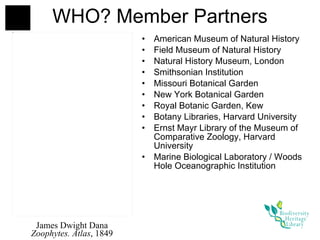
WHO? Member Partners American Museum of Natural History Field Museum of Natural History Natural History Museum, London Smithsonian Institution Missouri Botanical Garden New York Botanical Garden Royal Botanic Garden, Kew Botany Libraries, Harvard University Ernst Mayr Library of the Museum of Comparative Zoology, Harvard University Marine Biological Laboratory / Woods Hole Oceanographic Institution James Dwight Dana Zoophytes. Atlas , 1849
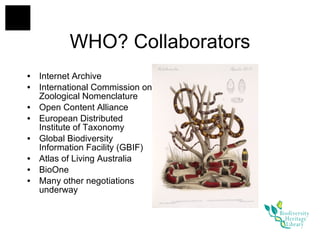
Internet Archive International Commission on Zoological Nomenclature Open Content Alliance European Distributed Institute of Taxonomy Global Biodiversity Information Facility (GBIF) Atlas of Living Australia BioOne Many other negotiations underway WHO? Collaborators
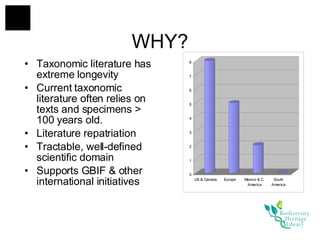
WHY? Taxonomic literature has extreme longevity Current taxonomic literature often relies on texts and specimens > 100 years old. Literature repatriation Tractable, well-defined scientific domain Supports GBIF & other international initiatives
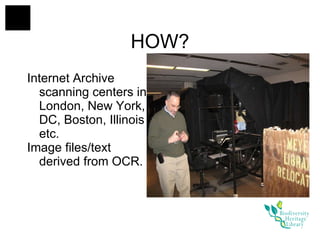
Internet Archive scanning centers in London, New York, DC, Boston, Illinois etc.  Image files/text derived from OCR. HOW?
GOVERNANCE & PROCESS BHL is not a legal entity  MOU with BHL (each member)  By-Laws Institutional Council Executive Committee: Chair attends EOL Steering Committee BHL Project Director & part-time Deputy Wiki Annual Meetings of the Library Directors Conference Calls Executive committee (weekly) Staff in the trenches (weekly) Other Business (meetings or calls) Special projects Collections Technical staff Local staff Directors and staff
BHL Portal http://www. biodiversitylibrary .org Serve image and text files, create volume, part, piece metatata; ingest page level metadata Globally Unique Identifiers (GUIDs) to link to other services Taxonomic Intelligence: developed at MBLWHOI Uses sophisticated algorithm to locate name strings from the 9.4 million in NameBank from OCR Iterative processing of texts increases number of names in Namebank and also the accuracy of recognition. More tools under development Portal prototype developed at Missouri Botanical Garden based on botanicus.org
Seek Permissions Opt in Copyright Model: The BHL actively works with professional societies & associations to integrate their publications into the BHL in a way that serves the societies’ missions and goals  BHL is digitizing learned society backfiles & serving them from the BHL Portal at no cost to the societies Files are available to the publishers for reuse as they see fit
Financial & Legal Sustainability Quick ramp-up: high early costs will drive long-term costs down. Derive some long-term costs from the operating budgets of the member institutions.  Integrate functions/tasks with wider efforts where appropriate, e.g. mass storage. Make the BHL absolutely essential. Avoid legal conflicts Keep copyright infringement risk low Obtain permissions when possible Negotiate alternative agreements Move on if necessary Future Structure
Future Directions Multiple languages Links back to EOL Expanded taxonomic intelligence Geolocation Global partnerships:  Malaysia, China, broader EU participation Beyond scientists: community needs Grey Literature & Archives Automated structural markup of journal literature

Muswebho

  • 1.
    Biodiversity Heritage Libraryby Connie Rinaldo (crinaldo@fas.harvard.edu)
  • 2.
    WHAT? MISSION: Provide Open Access to Biodiversity Literature GOALS Digitize the core published literature of biodiversity Collaborate with the global taxonomic community, rights holders and others “ The cultivation of natural science cannot be efficiently carried on without reference to an extensive library.” C. Darwin et al 1847 Darwin, C. R. et al. 1847. Copy of Memorial to the First Lord of the Treasury [Lord John Russell], respecting the Management of the British Museum. Parliamentary Papers, Accounts and Papers 1847 , paper number (268), volume XXXIV.253 (13 April): 1-3. [Complete Works of Charles Darwin Online
  • 3.
    WHO? Member PartnersAmerican Museum of Natural History Field Museum of Natural History Natural History Museum, London Smithsonian Institution Missouri Botanical Garden New York Botanical Garden Royal Botanic Garden, Kew Botany Libraries, Harvard University Ernst Mayr Library of the Museum of Comparative Zoology, Harvard University Marine Biological Laboratory / Woods Hole Oceanographic Institution James Dwight Dana Zoophytes. Atlas , 1849
  • 4.
    Internet Archive InternationalCommission on Zoological Nomenclature Open Content Alliance European Distributed Institute of Taxonomy Global Biodiversity Information Facility (GBIF) Atlas of Living Australia BioOne Many other negotiations underway WHO? Collaborators
  • 5.
    WHY? Taxonomic literaturehas extreme longevity Current taxonomic literature often relies on texts and specimens > 100 years old. Literature repatriation Tractable, well-defined scientific domain Supports GBIF & other international initiatives
  • 6.
    Internet Archive scanningcenters in London, New York, DC, Boston, Illinois etc. Image files/text derived from OCR. HOW?
  • 7.
    GOVERNANCE & PROCESSBHL is not a legal entity MOU with BHL (each member) By-Laws Institutional Council Executive Committee: Chair attends EOL Steering Committee BHL Project Director & part-time Deputy Wiki Annual Meetings of the Library Directors Conference Calls Executive committee (weekly) Staff in the trenches (weekly) Other Business (meetings or calls) Special projects Collections Technical staff Local staff Directors and staff
  • 8.
    BHL Portal http://www.biodiversitylibrary .org Serve image and text files, create volume, part, piece metatata; ingest page level metadata Globally Unique Identifiers (GUIDs) to link to other services Taxonomic Intelligence: developed at MBLWHOI Uses sophisticated algorithm to locate name strings from the 9.4 million in NameBank from OCR Iterative processing of texts increases number of names in Namebank and also the accuracy of recognition. More tools under development Portal prototype developed at Missouri Botanical Garden based on botanicus.org
  • 9.
    Seek Permissions Optin Copyright Model: The BHL actively works with professional societies & associations to integrate their publications into the BHL in a way that serves the societies’ missions and goals BHL is digitizing learned society backfiles & serving them from the BHL Portal at no cost to the societies Files are available to the publishers for reuse as they see fit
  • 10.
    Financial & LegalSustainability Quick ramp-up: high early costs will drive long-term costs down. Derive some long-term costs from the operating budgets of the member institutions. Integrate functions/tasks with wider efforts where appropriate, e.g. mass storage. Make the BHL absolutely essential. Avoid legal conflicts Keep copyright infringement risk low Obtain permissions when possible Negotiate alternative agreements Move on if necessary Future Structure
  • 11.
    Future Directions Multiplelanguages Links back to EOL Expanded taxonomic intelligence Geolocation Global partnerships: Malaysia, China, broader EU participation Beyond scientists: community needs Grey Literature & Archives Automated structural markup of journal literature

Editor's Notes

  • #2 Initially built for scientists-- Name and title