Chapter One
Data Communications Basics
1
 Data communication basics
 Components of data communication
 Characteristics of data transmission
 Types of transmission
 Direction of Data Flow
2
 The term data communications refers the transmission
of data to and from computers and components of
computer systems.
 More specifically data communication is transmitted via
mediums such as wires, coaxial cables, fiber optics, or
radiated electromagnetic waves such as broadcast radio,
infrared light, microwaves, and satellites.
3
 The word data refers to information presented in
whatever form is agreed upon by the parties creating and
using the data.
 When we communicate, we are sharing information.
 This sharing can be local or remote.
 For data communications to occur, the communicating
devices must be part of a communication system made
up of a combination of hardware (physical equipment)
and software (programs).
4
 A data communications system has five components.
 Message: is the information (data) to be
communicated.
 Popular forms of information include text,
numbers, pictures, audio, and video.
 Sender: is the device that sends the data message.
 Receiver: is the device that receives the message.
5
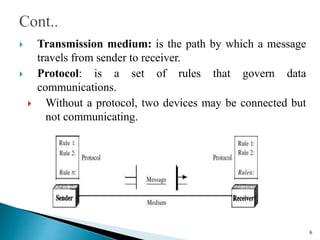
 Transmission medium: is the path by which a message
travels from sender to receiver.
 Protocol: is a set of rules that govern data
communications.
 Without a protocol, two devices may be connected but
not communicating.
6
 The effectiveness of a data communications system depends
on four fundamental characteristics:
 Delivery: Data must be received by the intended device or
user
 Accuracy: The system must deliver the data accurately.
 Timeliness:The system must deliver data in a timely manner.
Data delivered late are useless.
 Jitter: it refers to the variation in the packet arrival time.
7
 Data refers to the symbols that represent people,events,
things, and ideas.
 It can be a name, a number, the colors in a photograph, or
the notes in a musical composition.
 Data Representation refers to the form in which data is
stored, processed, and transmitted.
 Devices such as smartphones, iPods, and computers store
data in digital formats that can be handled by electronic
circuitry.
 Some of the forms of data used in communications are as
follows:
 Text,Numbers,Images,audio and video.
8
Data transmission refers to the movement of data in the form of bits
between two or more digital devices. This transfer of data takes
place via some form of transmission media (for example, coaxial
cable, fiber optics etc.)
Modes of data transmission
 Parallel transmission and
 Serial transmission
Serial transmission can be further categorized as
 Asynchronous Transmission
 Synchronous Transmission
9
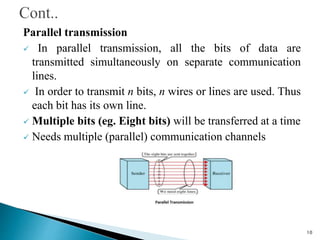
Parallel transmission
 In parallel transmission, all the bits of data are
transmitted simultaneously on separate communication
lines.
 In order to transmit n bits, n wires or lines are used. Thus
each bit has its own line.
 Multiple bits (eg. Eight bits) will be transferred at a time
 Needs multiple (parallel) communication channels
10
Serial Transmission
 When transferring data between two physically separate devices,
especially if the separation is more than a few kilometers, for
reasons of cost, it is more economical to use a single pair of lines.
Data is transmitted as a single bit at a time using a fixed time
interval for each bit. This mode of transmission is known as bit-
serial transmission.
 In serial transmission, the various bits of data are transmitted
serially one after the other.
11
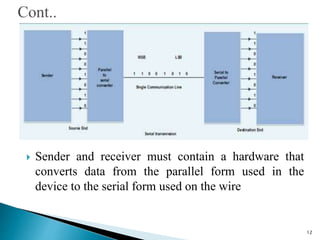
 Sender and receiver must contain a hardware that
converts data from the parallel form used in the
device to the serial form used on the wire
12
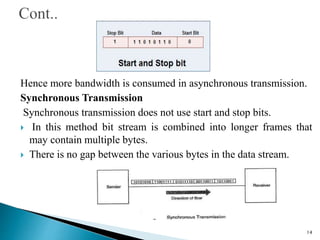
Asynchronous Transmission
 Asynchronous transmission sends only one character at a
time where a character is either a letter of the alphabet or
number.i.e. it sends one byte of data at a time. Bit
synchronization between two devices is made possible using
start bit and stop bit.
 Start bit indicates the beginning of data i.e. alerts the receiver
to the arrival of new group of bits. A start bit usually 0 is
added to the beginning of each byte.
 Stop bit indicates the end of data i.e. to let the receiver know
that byte is finished, one or more additional bits are appended
to the end of the byte. These bits, usually 1s are called stop
bits.
13
Hence more bandwidth is consumed in asynchronous transmission.
Synchronous Transmission
Synchronous transmission does not use start and stop bits.
 In this method bit stream is combined into longer frames that
may contain multiple bytes.
 There is no gap between the various bytes in the data stream.
14
 Signal can be any normalable action or gesture that encodes the
message.
 When data is sent over a physical medium it needs first converted
to electromagnetic signals.
 Like the data they represent, signals can be either analog or
digital.
 An analog signal has infinitely many levels of intensity over a
period of time.
 As the wave moves from value A to value B, it passes through and
includes an infinite number of values along its path.
 A digital signal, on the other hand, can have only a limited number
of defined values.
 Although each value can be any number, it is often as simple as 1 and 0.
15
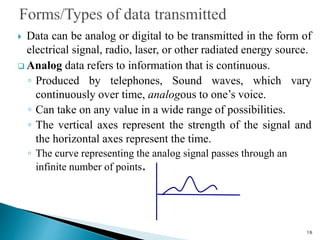
 Data can be analog or digital to be transmitted in the form of
electrical signal, radio, laser, or other radiated energy source.
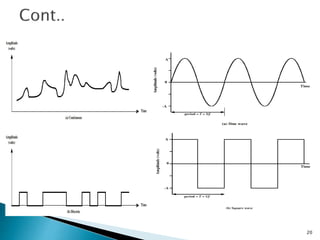
 Analog data refers to information that is continuous.
◦ Produced by telephones, Sound waves, which vary
continuously over time, analogous to one’s voice.
◦ Can take on any value in a wide range of possibilities.
◦ The vertical axes represent the strength of the signal and
the horizontal axes represent the time.
◦ The curve representing the analog signal passes through an
infinite number of points.
16
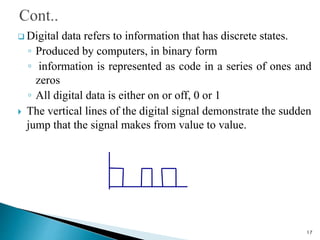
 Digital data refers to information that has discrete states.
◦ Produced by computers, in binary form
◦ information is represented as code in a series of ones and
zeros
◦ All digital data is either on or off, 0 or 1
 The vertical lines of the digital signal demonstrate the sudden
jump that the signal makes from value to value.
17
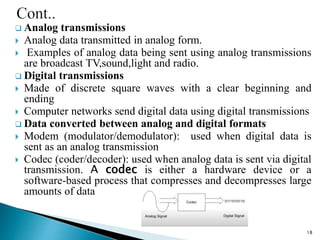
 Analog transmissions
 Analog data transmitted in analog form.
 Examples of analog data being sent using analog transmissions
are broadcast TV,sound,light and radio.
 Digital transmissions
 Made of discrete square waves with a clear beginning and
ending
 Computer networks send digital data using digital transmissions
 Data converted between analog and digital formats
 Modem (modulator/demodulator): used when digital data is
sent as an analog transmission
 Codec (coder/decoder): used when analog data is sent via digital
transmission. A codec is either a hardware device or a
software-based process that compresses and decompresses large
amounts of data
18
 Both analog and digital signal can be periodic or non periodic.
 A periodic signal completes a pattern within a measurable time
frame, called a period, and repeats that pattern over subsequent
identical periods.
 The completion of one full pattern is called a cycle.
 A non periodic signal changes without exhibiting a pattern or cycle
that repeats over time.
 The sine wave is the most fundamental form of a periodic analog
signal and represented in amplitude, frequency and phase.
19
20
 Are Continuous wave that carries information by altering the
characteristics of waves.
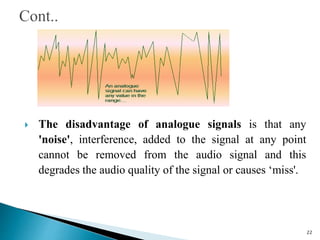
 It has infinite number of values within any interval.
 Analogue means that the original information is retransmitted to
the receiver/listener without any manipulation.
 Here the signal can take on any value (within the limits set by
the recording equipment and the transmitter).
 For instance, Voice and all sounds are analog, traveling to human
ears in the forms of waves.
21
 The disadvantage of analogue signals is that any
'noise', interference, added to the signal at any point
cannot be removed from the audio signal and this
degrades the audio quality of the signal or causes ‘miss'.
22
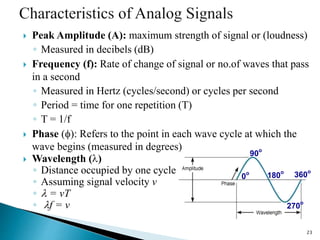
 Peak Amplitude (A): maximum strength of signal or (loudness)
◦ Measured in decibels (dB)
 Frequency (f): Rate of change of signal or no.of waves that pass
in a second
◦ Measured in Hertz (cycles/second) or cycles per second
◦ Period = time for one repetition (T)
◦ T = 1/f
 Phase (): Refers to the point in each wave cycle at which the
wave begins (measured in degrees)
 Wavelength ()
◦ Distance occupied by one cycle
◦ Assuming signal velocity v
◦  = vT
◦ f = v
23
0
o
90
o
360o
180
o
270
o
 Are a discrete series of pulses - either high or low - on or off
- sometimes expressed as binary code 1s and 0s.
 Discrete pluses of data transmission rather than continues
wave.
 More prevalent in computer based devices
 It counts but not measures
 Flashing light and telegraph message are traditional
examples of on-off pluses, although not in binary code.
24
 The advantage of digital signals is that
1. They are much less likely to be degraded by interference
(noise).
2. Also it is possible to send a lot more information digitally
(e.g. more television channels) than using analogue
technology.
3. They can be transmitted effectively along fiber optic
cables. (on - light signal, off - no light signal) and these are
cheaper to manufacture than copper wiring and can cope
with multiple signals without interference between them.
4. They can be sent directly to computers which use digital
systems themselves.
25
 A communications channel is classified as one of three
types:(depending on the direction of data transfer)
Simplex
Half-Duplex
Full-Duplex
 Simplex: a simplex mechanism can only transfer data in a single
direction
◦ It is analogous to broadcast radio or television
◦ Data sent to an electronic notice board found in train station and
air port.
 Half-Duplex: A half-duplex mechanism involves a shared
transmission medium
◦ The shared medium can be used for communication in each
direction
26
◦ But the communication cannot proceed simultaneously
◦ It is analogous to using walkie-talkies where only one
side can transmit at a time
 An additional mechanism is needed at each end of a half-
duplex communication that coordinates transmission to
insure that only one side transmits at a given time
 Full-Duplex: allows transmission in two directions
simultaneously
◦ It is analogous to a voice telephone conversation
◦ in which a participant can speak even if they are able to
hear background music at the other end
27
28
 Signals travel through transmission media, which are not
perfect.
 This means that the signal at the beginning of the medium is
not the same as the signal at the end of the medium. What is
sent is not what is received.
 Signal received may differ from signal transmitted
 Impairments exist in all forms of data transmission
Analog signal impairments degrade the signal quality
Digital signal impairments result in bit errors (1s and 0s
transposed)
29
Three causes of transmission impairment are:-
1. Attenuation
2. Distortion
3. Noise.
Attenuation
 Loss of power in a signal as it travels from the sending
device to the receiving device
 where the signal becomes weaker over distance
 Amplifiers are used to compensate for this loss of energy
by amplifying the signal.
30
Distortion
 Means that the signal changes its form or shape
 Distortion occurs in composite signals
 Each frequency component has its own propagation speed
traveling through a medium.
 The different components therefore arrive with different delays
at the receiver. That means that the signals have different phases
at the receiver than they did at the source.
Noise
 Additional unwanted signals inserted between transmitter and
receiver
 Undesirable signals added between the transmitter and the
receiver
31
 Errors in transmitted data can occur for a variety of reasons.
1. Some errors are due to equipment failure.
2. Some errors are due dispersion in optical fibers (i.e. light
pulses spread out).
3. Some errors are due to attenuation (loss of signal power
over a line).
4. Most errors are due to thermal noise that occurs naturally
on the line.
32
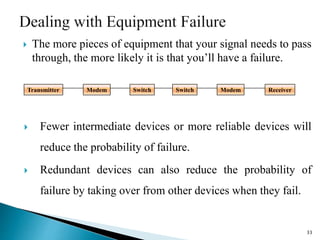
 The more pieces of equipment that your signal needs to pass
through, the more likely it is that you’ll have a failure.
 Fewer intermediate devices or more reliable devices will
reduce the probability of failure.
 Redundant devices can also reduce the probability of
failure by taking over from other devices when they fail.
Transmitter Receiver
Modem Switch Switch Modem
33
 Usually, noise levels are fairly low and most of the bits are
received correctly by the receiver.
 The question is, how can the receiver know when an error has
occurred?
 Because errors occur randomly, there is no way of knowing
with complete certainty if the data is correct.
 The best way we can do is detect most errors.
 We could try sending the data twice and comparing the two
transmissions to see where the errors are.
 This is inefficient, particularly if all we want to know if there is
an error in a particular block of data.
 Even when we detect an error, the next question is: what to do about it?
34
35

Wolkite polytechnic college ICT Department

  • 1.
  • 2.
     Data communicationbasics  Components of data communication  Characteristics of data transmission  Types of transmission  Direction of Data Flow 2
  • 3.
     The termdata communications refers the transmission of data to and from computers and components of computer systems.  More specifically data communication is transmitted via mediums such as wires, coaxial cables, fiber optics, or radiated electromagnetic waves such as broadcast radio, infrared light, microwaves, and satellites. 3
  • 4.
     The worddata refers to information presented in whatever form is agreed upon by the parties creating and using the data.  When we communicate, we are sharing information.  This sharing can be local or remote.  For data communications to occur, the communicating devices must be part of a communication system made up of a combination of hardware (physical equipment) and software (programs). 4
  • 5.
     A datacommunications system has five components.  Message: is the information (data) to be communicated.  Popular forms of information include text, numbers, pictures, audio, and video.  Sender: is the device that sends the data message.  Receiver: is the device that receives the message. 5
  • 6.
     Transmission medium:is the path by which a message travels from sender to receiver.  Protocol: is a set of rules that govern data communications.  Without a protocol, two devices may be connected but not communicating. 6
  • 7.
     The effectivenessof a data communications system depends on four fundamental characteristics:  Delivery: Data must be received by the intended device or user  Accuracy: The system must deliver the data accurately.  Timeliness:The system must deliver data in a timely manner. Data delivered late are useless.  Jitter: it refers to the variation in the packet arrival time. 7
  • 8.
     Data refersto the symbols that represent people,events, things, and ideas.  It can be a name, a number, the colors in a photograph, or the notes in a musical composition.  Data Representation refers to the form in which data is stored, processed, and transmitted.  Devices such as smartphones, iPods, and computers store data in digital formats that can be handled by electronic circuitry.  Some of the forms of data used in communications are as follows:  Text,Numbers,Images,audio and video. 8
  • 9.
    Data transmission refersto the movement of data in the form of bits between two or more digital devices. This transfer of data takes place via some form of transmission media (for example, coaxial cable, fiber optics etc.) Modes of data transmission  Parallel transmission and  Serial transmission Serial transmission can be further categorized as  Asynchronous Transmission  Synchronous Transmission 9
  • 10.
    Parallel transmission  Inparallel transmission, all the bits of data are transmitted simultaneously on separate communication lines.  In order to transmit n bits, n wires or lines are used. Thus each bit has its own line.  Multiple bits (eg. Eight bits) will be transferred at a time  Needs multiple (parallel) communication channels 10
  • 11.
    Serial Transmission  Whentransferring data between two physically separate devices, especially if the separation is more than a few kilometers, for reasons of cost, it is more economical to use a single pair of lines. Data is transmitted as a single bit at a time using a fixed time interval for each bit. This mode of transmission is known as bit- serial transmission.  In serial transmission, the various bits of data are transmitted serially one after the other. 11
  • 12.
     Sender andreceiver must contain a hardware that converts data from the parallel form used in the device to the serial form used on the wire 12
  • 13.
    Asynchronous Transmission  Asynchronoustransmission sends only one character at a time where a character is either a letter of the alphabet or number.i.e. it sends one byte of data at a time. Bit synchronization between two devices is made possible using start bit and stop bit.  Start bit indicates the beginning of data i.e. alerts the receiver to the arrival of new group of bits. A start bit usually 0 is added to the beginning of each byte.  Stop bit indicates the end of data i.e. to let the receiver know that byte is finished, one or more additional bits are appended to the end of the byte. These bits, usually 1s are called stop bits. 13
  • 14.
    Hence more bandwidthis consumed in asynchronous transmission. Synchronous Transmission Synchronous transmission does not use start and stop bits.  In this method bit stream is combined into longer frames that may contain multiple bytes.  There is no gap between the various bytes in the data stream. 14
  • 15.
     Signal canbe any normalable action or gesture that encodes the message.  When data is sent over a physical medium it needs first converted to electromagnetic signals.  Like the data they represent, signals can be either analog or digital.  An analog signal has infinitely many levels of intensity over a period of time.  As the wave moves from value A to value B, it passes through and includes an infinite number of values along its path.  A digital signal, on the other hand, can have only a limited number of defined values.  Although each value can be any number, it is often as simple as 1 and 0. 15
  • 16.
     Data canbe analog or digital to be transmitted in the form of electrical signal, radio, laser, or other radiated energy source.  Analog data refers to information that is continuous. ◦ Produced by telephones, Sound waves, which vary continuously over time, analogous to one’s voice. ◦ Can take on any value in a wide range of possibilities. ◦ The vertical axes represent the strength of the signal and the horizontal axes represent the time. ◦ The curve representing the analog signal passes through an infinite number of points. 16
  • 17.
     Digital datarefers to information that has discrete states. ◦ Produced by computers, in binary form ◦ information is represented as code in a series of ones and zeros ◦ All digital data is either on or off, 0 or 1  The vertical lines of the digital signal demonstrate the sudden jump that the signal makes from value to value. 17
  • 18.
     Analog transmissions Analog data transmitted in analog form.  Examples of analog data being sent using analog transmissions are broadcast TV,sound,light and radio.  Digital transmissions  Made of discrete square waves with a clear beginning and ending  Computer networks send digital data using digital transmissions  Data converted between analog and digital formats  Modem (modulator/demodulator): used when digital data is sent as an analog transmission  Codec (coder/decoder): used when analog data is sent via digital transmission. A codec is either a hardware device or a software-based process that compresses and decompresses large amounts of data 18
  • 19.
     Both analogand digital signal can be periodic or non periodic.  A periodic signal completes a pattern within a measurable time frame, called a period, and repeats that pattern over subsequent identical periods.  The completion of one full pattern is called a cycle.  A non periodic signal changes without exhibiting a pattern or cycle that repeats over time.  The sine wave is the most fundamental form of a periodic analog signal and represented in amplitude, frequency and phase. 19
  • 20.
  • 21.
     Are Continuouswave that carries information by altering the characteristics of waves.  It has infinite number of values within any interval.  Analogue means that the original information is retransmitted to the receiver/listener without any manipulation.  Here the signal can take on any value (within the limits set by the recording equipment and the transmitter).  For instance, Voice and all sounds are analog, traveling to human ears in the forms of waves. 21
  • 22.
     The disadvantageof analogue signals is that any 'noise', interference, added to the signal at any point cannot be removed from the audio signal and this degrades the audio quality of the signal or causes ‘miss'. 22
  • 23.
     Peak Amplitude(A): maximum strength of signal or (loudness) ◦ Measured in decibels (dB)  Frequency (f): Rate of change of signal or no.of waves that pass in a second ◦ Measured in Hertz (cycles/second) or cycles per second ◦ Period = time for one repetition (T) ◦ T = 1/f  Phase (): Refers to the point in each wave cycle at which the wave begins (measured in degrees)  Wavelength () ◦ Distance occupied by one cycle ◦ Assuming signal velocity v ◦  = vT ◦ f = v 23 0 o 90 o 360o 180 o 270 o
  • 24.
     Are adiscrete series of pulses - either high or low - on or off - sometimes expressed as binary code 1s and 0s.  Discrete pluses of data transmission rather than continues wave.  More prevalent in computer based devices  It counts but not measures  Flashing light and telegraph message are traditional examples of on-off pluses, although not in binary code. 24
  • 25.
     The advantageof digital signals is that 1. They are much less likely to be degraded by interference (noise). 2. Also it is possible to send a lot more information digitally (e.g. more television channels) than using analogue technology. 3. They can be transmitted effectively along fiber optic cables. (on - light signal, off - no light signal) and these are cheaper to manufacture than copper wiring and can cope with multiple signals without interference between them. 4. They can be sent directly to computers which use digital systems themselves. 25
  • 26.
     A communicationschannel is classified as one of three types:(depending on the direction of data transfer) Simplex Half-Duplex Full-Duplex  Simplex: a simplex mechanism can only transfer data in a single direction ◦ It is analogous to broadcast radio or television ◦ Data sent to an electronic notice board found in train station and air port.  Half-Duplex: A half-duplex mechanism involves a shared transmission medium ◦ The shared medium can be used for communication in each direction 26
  • 27.
    ◦ But thecommunication cannot proceed simultaneously ◦ It is analogous to using walkie-talkies where only one side can transmit at a time  An additional mechanism is needed at each end of a half- duplex communication that coordinates transmission to insure that only one side transmits at a given time  Full-Duplex: allows transmission in two directions simultaneously ◦ It is analogous to a voice telephone conversation ◦ in which a participant can speak even if they are able to hear background music at the other end 27
  • 28.
  • 29.
     Signals travelthrough transmission media, which are not perfect.  This means that the signal at the beginning of the medium is not the same as the signal at the end of the medium. What is sent is not what is received.  Signal received may differ from signal transmitted  Impairments exist in all forms of data transmission Analog signal impairments degrade the signal quality Digital signal impairments result in bit errors (1s and 0s transposed) 29
  • 30.
    Three causes oftransmission impairment are:- 1. Attenuation 2. Distortion 3. Noise. Attenuation  Loss of power in a signal as it travels from the sending device to the receiving device  where the signal becomes weaker over distance  Amplifiers are used to compensate for this loss of energy by amplifying the signal. 30
  • 31.
    Distortion  Means thatthe signal changes its form or shape  Distortion occurs in composite signals  Each frequency component has its own propagation speed traveling through a medium.  The different components therefore arrive with different delays at the receiver. That means that the signals have different phases at the receiver than they did at the source. Noise  Additional unwanted signals inserted between transmitter and receiver  Undesirable signals added between the transmitter and the receiver 31
  • 32.
     Errors intransmitted data can occur for a variety of reasons. 1. Some errors are due to equipment failure. 2. Some errors are due dispersion in optical fibers (i.e. light pulses spread out). 3. Some errors are due to attenuation (loss of signal power over a line). 4. Most errors are due to thermal noise that occurs naturally on the line. 32
  • 33.
     The morepieces of equipment that your signal needs to pass through, the more likely it is that you’ll have a failure.  Fewer intermediate devices or more reliable devices will reduce the probability of failure.  Redundant devices can also reduce the probability of failure by taking over from other devices when they fail. Transmitter Receiver Modem Switch Switch Modem 33
  • 34.
     Usually, noiselevels are fairly low and most of the bits are received correctly by the receiver.  The question is, how can the receiver know when an error has occurred?  Because errors occur randomly, there is no way of knowing with complete certainty if the data is correct.  The best way we can do is detect most errors.  We could try sending the data twice and comparing the two transmissions to see where the errors are.  This is inefficient, particularly if all we want to know if there is an error in a particular block of data.  Even when we detect an error, the next question is: what to do about it? 34
  • 35.