Linking and Loading 1
CS502 Spring 2006
Linking & Loading
CS-502 Operating Systems
{This topic is not covered in Tannenbaum.
Silbershatz et al devote about 2 pages to it in §8.1}
Linking and Loading 2
CS502 Spring 2006
What happens to your program …
…after it is compiled, but before it
can be run?
Linking and Loading 3
CS502 Spring 2006
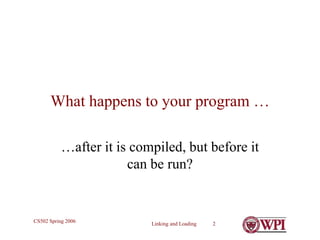
Executable files
• The OS expects executable files to have a
specific format
– Header info
• Code locations
• Data locations
– Code & data
– Symbol Table
• List of names of things defined in your program and
where they are defined
• List of names of things defined elsewhere that are
used by your program, and where they are used.
Linking and Loading 4
CS502 Spring 2006
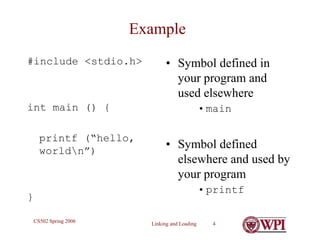
Example
#include <stdio.h>
int main () {
printf (“hello,
worldn”)
}
• Symbol defined in
your program and
used elsewhere
•main
• Symbol defined
elsewhere and used by
your program
•printf
Linking and Loading 5
CS502 Spring 2006
Example
#include <stdio.h>
extern int errno;
int main () {
printf (“hello,
worldn”)
<check errno for
errors>
}
• Symbol defined in
your program and
used elsewhere
•main
• Symbol defined
elsewhere and used by
your program
•printf
•errno
Linking and Loading 6
CS502 Spring 2006
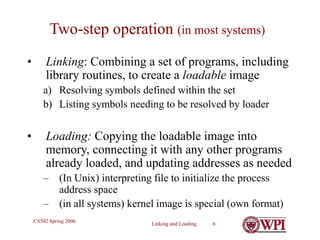
Two-step operation (in most systems)
• Linking: Combining a set of programs, including
library routines, to create a loadable image
a) Resolving symbols defined within the set
b) Listing symbols needing to be resolved by loader
• Loading: Copying the loadable image into
memory, connecting it with any other programs
already loaded, and updating addresses as needed
– (In Unix) interpreting file to initialize the process
address space
– (in all systems) kernel image is special (own format)
Linking and Loading 7
CS502 Spring 2006
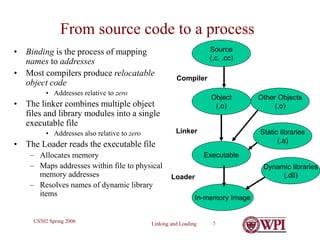
From source code to a process
• Binding is the process of mapping
names to addresses
• Most compilers produce relocatable
object code
• Addresses relative to zero
• The linker combines multiple object
files and library modules into a single
executable file
• Addresses also relative to zero
• The Loader reads the executable file
– Allocates memory
– Maps addresses within file to physical
memory addresses
– Resolves names of dynamic library
items
Source
(.c, .cc)
Object
(.o)
Executable
In-memory Image
Compiler
Linker
Loader
Other Objects
(.o)
Dynamic libraries
(.dll)
Static libraries
(.a)
Linking and Loading 8
CS502 Spring 2006
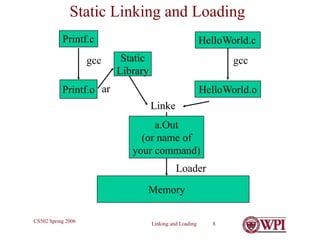
Static Linking and Loading
Printf.c
Printf.o
Static
Library
gcc
ar
Linke
r
Memory
HelloWorld.c
gcc
HelloWorld.o
Loader
a.Out
(or name of
your command)
Linking and Loading 9
CS502 Spring 2006
Classic Unix
• Linker is inside of gcc command
• Loader is part of exec system call
• Executable image contains all object and library
modules needed by program
• Entire image is loaded at once
• Every image contains copy of common library
routines
• Every loaded program contain duplicate copy of
library routines
Linking and Loading 10
CS502 Spring 2006
Dynamic Loading
• Routine is not loaded until it is called
• Better memory-space utilization; unused
routine is never loaded.
• Useful when large amounts of code are
needed to handle infrequently occurring
cases.
• Silbershatz says [incorrectly]
• No special support from the operating system is
required
• Must be implemented through program design
Linking and Loading 11
CS502 Spring 2006
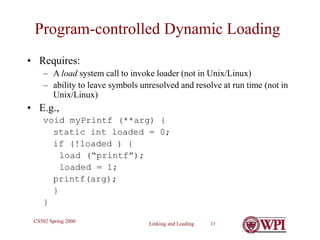
Program-controlled Dynamic Loading
• Requires:
– A load system call to invoke loader (not in Unix/Linux)
– ability to leave symbols unresolved and resolve at run time (not in
Unix/Linux)
• E.g.,
void myPrintf (**arg) {
static int loaded = 0;
if (!loaded ) {
load (“printf”);
loaded = 1;
printf(arg);
}
}
Linking and Loading 12
CS502 Spring 2006
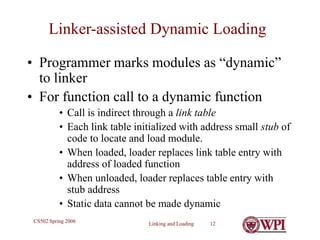
Linker-assisted Dynamic Loading
• Programmer marks modules as “dynamic”
to linker
• For function call to a dynamic function
• Call is indirect through a link table
• Each link table initialized with address small stub of
code to locate and load module.
• When loaded, loader replaces link table entry with
address of loaded function
• When unloaded, loader replaces table entry with
stub address
• Static data cannot be made dynamic
Linking and Loading 13
CS502 Spring 2006
Shared Libraries
• Observation – “everyone” links to standard
libraries (libc.a, etc.)
• Consume space in
• every executable image
• every process memory at runtime
• Would it be possible to share the common
libraries?
– Automatically load at runtime?
Linking and Loading 14
CS502 Spring 2006
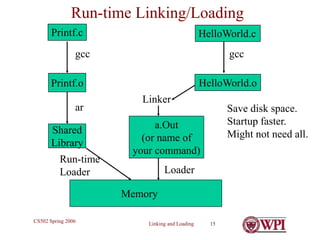
Shared libraries (continued)
• Libraries designated as “shared”
• .so, .dll, etc.
• Supported by corresponding “.a” libraries containing
symbol information
• Linker sets up symbols to be resolved at
runtime
• Loader: Is library already in memory?
– If so, map into new process space
• “map,” an operation to be defined
– If not, load and then map
Linking and Loading 15
CS502 Spring 2006
Run-time Linking/Loading
Printf.c
Printf.o
Shared
Library
gcc
ar
Linker
Memory
gcc
Loader
Save disk space.
Startup faster.
Might not need all.
Run-time
Loader
HelloWorld.c
HelloWorld.o
a.Out
(or name of
your command)
Linking and Loading 16
CS502 Spring 2006
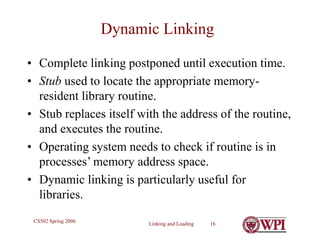
Dynamic Linking
• Complete linking postponed until execution time.
• Stub used to locate the appropriate memory-
resident library routine.
• Stub replaces itself with the address of the routine,
and executes the routine.
• Operating system needs to check if routine is in
processes’ memory address space.
• Dynamic linking is particularly useful for
libraries.
Linking and Loading 17
CS502 Spring 2006
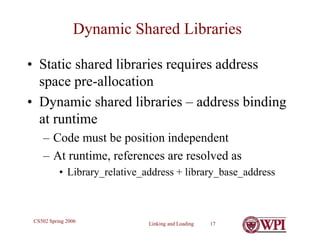
Dynamic Shared Libraries
• Static shared libraries requires address
space pre-allocation
• Dynamic shared libraries – address binding
at runtime
– Code must be position independent
– At runtime, references are resolved as
• Library_relative_address + library_base_address
Linking and Loading 18
CS502 Spring 2006
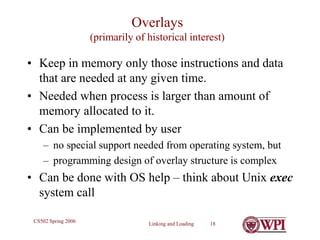
Overlays
(primarily of historical interest)
• Keep in memory only those instructions and data
that are needed at any given time.
• Needed when process is larger than amount of
memory allocated to it.
• Can be implemented by user
– no special support needed from operating system, but
– programming design of overlay structure is complex
• Can be done with OS help – think about Unix exec
system call
Linking and Loading 19
CS502 Spring 2006
Linking - Summary
• Linker – key part of OS – not in kernel
– Combines object files and libraries into a
“standard” format that the OS loader can
interpret
– Resolves references and does static relocation
of addresses
– Creates information for loader to complete
binding process
– Supports dynamic shared libraries

wk 4 -- linking.ppt

  • 1.
    Linking and Loading1 CS502 Spring 2006 Linking & Loading CS-502 Operating Systems {This topic is not covered in Tannenbaum. Silbershatz et al devote about 2 pages to it in §8.1}
  • 2.
    Linking and Loading2 CS502 Spring 2006 What happens to your program … …after it is compiled, but before it can be run?
  • 3.
    Linking and Loading3 CS502 Spring 2006 Executable files • The OS expects executable files to have a specific format – Header info • Code locations • Data locations – Code & data – Symbol Table • List of names of things defined in your program and where they are defined • List of names of things defined elsewhere that are used by your program, and where they are used.
  • 4.
    Linking and Loading4 CS502 Spring 2006 Example #include <stdio.h> int main () { printf (“hello, worldn”) } • Symbol defined in your program and used elsewhere •main • Symbol defined elsewhere and used by your program •printf
  • 5.
    Linking and Loading5 CS502 Spring 2006 Example #include <stdio.h> extern int errno; int main () { printf (“hello, worldn”) <check errno for errors> } • Symbol defined in your program and used elsewhere •main • Symbol defined elsewhere and used by your program •printf •errno
  • 6.
    Linking and Loading6 CS502 Spring 2006 Two-step operation (in most systems) • Linking: Combining a set of programs, including library routines, to create a loadable image a) Resolving symbols defined within the set b) Listing symbols needing to be resolved by loader • Loading: Copying the loadable image into memory, connecting it with any other programs already loaded, and updating addresses as needed – (In Unix) interpreting file to initialize the process address space – (in all systems) kernel image is special (own format)
  • 7.
    Linking and Loading7 CS502 Spring 2006 From source code to a process • Binding is the process of mapping names to addresses • Most compilers produce relocatable object code • Addresses relative to zero • The linker combines multiple object files and library modules into a single executable file • Addresses also relative to zero • The Loader reads the executable file – Allocates memory – Maps addresses within file to physical memory addresses – Resolves names of dynamic library items Source (.c, .cc) Object (.o) Executable In-memory Image Compiler Linker Loader Other Objects (.o) Dynamic libraries (.dll) Static libraries (.a)
  • 8.
    Linking and Loading8 CS502 Spring 2006 Static Linking and Loading Printf.c Printf.o Static Library gcc ar Linke r Memory HelloWorld.c gcc HelloWorld.o Loader a.Out (or name of your command)
  • 9.
    Linking and Loading9 CS502 Spring 2006 Classic Unix • Linker is inside of gcc command • Loader is part of exec system call • Executable image contains all object and library modules needed by program • Entire image is loaded at once • Every image contains copy of common library routines • Every loaded program contain duplicate copy of library routines
  • 10.
    Linking and Loading10 CS502 Spring 2006 Dynamic Loading • Routine is not loaded until it is called • Better memory-space utilization; unused routine is never loaded. • Useful when large amounts of code are needed to handle infrequently occurring cases. • Silbershatz says [incorrectly] • No special support from the operating system is required • Must be implemented through program design
  • 11.
    Linking and Loading11 CS502 Spring 2006 Program-controlled Dynamic Loading • Requires: – A load system call to invoke loader (not in Unix/Linux) – ability to leave symbols unresolved and resolve at run time (not in Unix/Linux) • E.g., void myPrintf (**arg) { static int loaded = 0; if (!loaded ) { load (“printf”); loaded = 1; printf(arg); } }
  • 12.
    Linking and Loading12 CS502 Spring 2006 Linker-assisted Dynamic Loading • Programmer marks modules as “dynamic” to linker • For function call to a dynamic function • Call is indirect through a link table • Each link table initialized with address small stub of code to locate and load module. • When loaded, loader replaces link table entry with address of loaded function • When unloaded, loader replaces table entry with stub address • Static data cannot be made dynamic
  • 13.
    Linking and Loading13 CS502 Spring 2006 Shared Libraries • Observation – “everyone” links to standard libraries (libc.a, etc.) • Consume space in • every executable image • every process memory at runtime • Would it be possible to share the common libraries? – Automatically load at runtime?
  • 14.
    Linking and Loading14 CS502 Spring 2006 Shared libraries (continued) • Libraries designated as “shared” • .so, .dll, etc. • Supported by corresponding “.a” libraries containing symbol information • Linker sets up symbols to be resolved at runtime • Loader: Is library already in memory? – If so, map into new process space • “map,” an operation to be defined – If not, load and then map
  • 15.
    Linking and Loading15 CS502 Spring 2006 Run-time Linking/Loading Printf.c Printf.o Shared Library gcc ar Linker Memory gcc Loader Save disk space. Startup faster. Might not need all. Run-time Loader HelloWorld.c HelloWorld.o a.Out (or name of your command)
  • 16.
    Linking and Loading16 CS502 Spring 2006 Dynamic Linking • Complete linking postponed until execution time. • Stub used to locate the appropriate memory- resident library routine. • Stub replaces itself with the address of the routine, and executes the routine. • Operating system needs to check if routine is in processes’ memory address space. • Dynamic linking is particularly useful for libraries.
  • 17.
    Linking and Loading17 CS502 Spring 2006 Dynamic Shared Libraries • Static shared libraries requires address space pre-allocation • Dynamic shared libraries – address binding at runtime – Code must be position independent – At runtime, references are resolved as • Library_relative_address + library_base_address
  • 18.
    Linking and Loading18 CS502 Spring 2006 Overlays (primarily of historical interest) • Keep in memory only those instructions and data that are needed at any given time. • Needed when process is larger than amount of memory allocated to it. • Can be implemented by user – no special support needed from operating system, but – programming design of overlay structure is complex • Can be done with OS help – think about Unix exec system call
  • 19.
    Linking and Loading19 CS502 Spring 2006 Linking - Summary • Linker – key part of OS – not in kernel – Combines object files and libraries into a “standard” format that the OS loader can interpret – Resolves references and does static relocation of addresses – Creates information for loader to complete binding process – Supports dynamic shared libraries