RESOURCE REVIEW 
AET/508 
Paula Anderson, Veronica Chaloupka, Earl 
Darby, Otis Sheppard, and Merton Stone
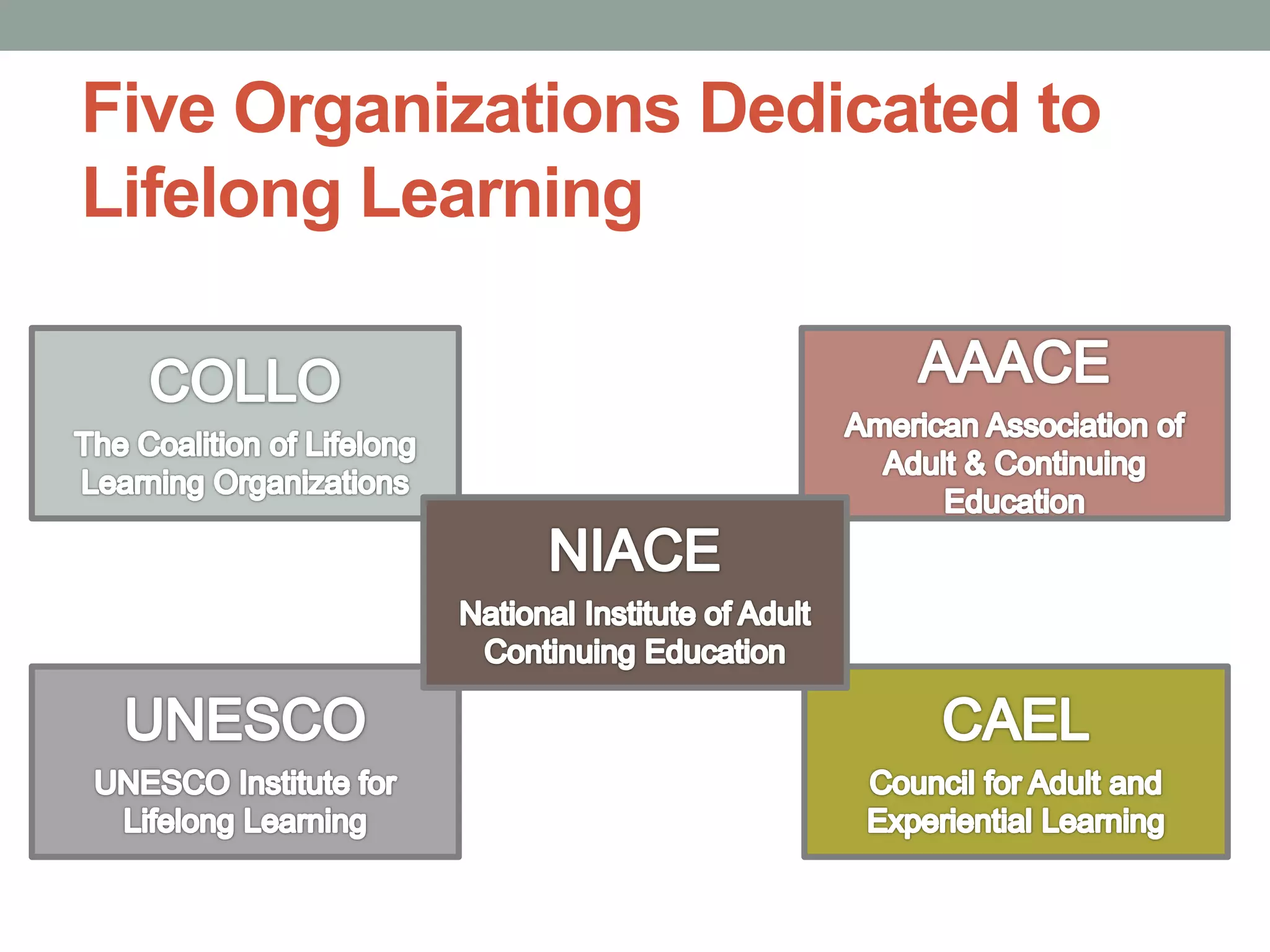
Five Organizations Dedicated to 
Lifelong Learning
The Coalition of Lifelong Learning 
Organizations (COLLO) 
EST. 1973 
• The Coalition of Lifelong 
Learning Organizations 
(COLLO) was established in 
1973. 
• COLLO consists of national 
associations and groups that 
share a common interest in 
enhancing the field of lifelong 
learning. 
• Currently, 18 organizations, 
are active members of 
COLLO (COLLO, 2014). 
MEMBERSHIP & BENEFITS 
• One significant benefit of 
COLLO is that it organizes 
efforts to develop, maintain, and 
improve the development of 
adult learning locally, nationally, 
and internationally (COLLO, 
2014). 
COLLO Logo (2014)
The Coalition of Lifelong Learning 
Organizations (COLLO) 
ELIGIBILITY & MEMBERSHIP 
• Applications for membership 
are considered from 
associations or organizations 
that have a major commitment 
to lifelong learning education. 
• Associations or organizations 
with a commitment to adult, 
continuing education, and 
lifelong learning are eligible 
for membership (COLLO, 
2014). 
PURPOSE 
• The purpose of the 
COLLO is to facilitate the 
exchange of information 
about various aspects of 
lifelong learning. 
• COLLO focuses on 
enhancing, supporting, and 
educating learning 
programs across the globe 
(COLLO, 2014).
AMERICAN ASSOCIATION OF ADULT 
AND CONTINUING EDUCATION (AAACE) 
Philosophy 
• Provide leadership in adult & continuing education 
• Unifying adult educators 
• Fostering the development & dissemination of 
theory, research, information, and best practices 
• Promoting identity & standards for the profession 
• Advocate relevant public policy & social change 
initiatives
AMERICAN ASSOCIATION OF ADULT 
AND CONTINUING EDUCATION (AAACE) 
Approach to Lifelong Learning 
• Belief in helping adults 
• Promote Knowledge, skills, & values 
• Lead to productive & satisfying lives 
• Past emphasis on young learners 
• Contribute to human fulfillment & social change
AMERICAN ASSOCIATION OF ADULT 
AND CONTINUING EDUCATION (AAACE) 
Programs Offered 
• Partners with several state organizations 
• Holds pre- & co-conferences 
• Offers two sub-groups: Commissions & SIGs 
1. Commissions facilitate research, policy, & 
initiatives 
2. SIGs represent levels of involvement in adult 
education issues 
• Special SIG dedicated to service members, 
veterans, & military spouses
AMERICAN ASSOCIATION OF ADULT 
AND CONTINUING EDUCATION (AAACE) 
Meeting Professional Development Needs 
• Promote productive, positive social change 
• Provide educators’ development in leadership, 
policy, & initiatives 
• Collaboration on an international level 
• Embraces development of educations skills
National Institute of Adult and 
Continuing Education (NIACE) 
• Originally formed in 1921 as the British Institute for Adult 
Education 
• Serves as a national voice for lifelong learning in England 
and Wales 
• Seeks to address inequalities and promote individual 
empowerment 
• Works with all age ranges - young and old alike
National Institute of Adult and 
Continuing Education (NIACE) 
Targeted Population 
• Dedicated to the fiscal recovery of the UK 
• Despite a willingness to work with a wide age 
range, the focus is post-16 students 
• Devoted to the UK’s economy by offering lifelong 
learning skills to working adults 
• Also trains adults upon exit from prison
National Institute of Adult and 
Continuing Education (NIACE) 
Programs Offered 
• Life Skills Programs 
• Families and Communities 
• Workplace Programs 
NIACE Logo (2014)
UNESCO INSTITUTE FOR LIFELONG 
LEARNING 
Philosophy 
• Concepts in lifelong learning and education for 
sustainable development 
• Competences for economic, social, political, 
environmental and cultural sustainability 
• Learning strategies for sustainable development; 
and institutional architecture (UNESCO institute for 
lifelong learning, 2013).
UNESCO Institute for Lifelong Learning 
Programs 
• Advocacy for literacy 
• Research on literacy policies and practices 
• Effective monitoring and evaluation systems 
• Effective literacy and numeracy programs 
• Adult literacy in multilingual contexts.
UNESCO Institute for Lifelong Learning 
Target Population: Priority Africa 
• Holistic Education System 
• Use of African Languages and Multilingual 
Education 
• Adult Literacy and Numerology 
• Adult Education
Council for Adult and 
Experiential Learning (CAEL) 
Philosophy 
• CAEL supports one goal: Making it easier for people to 
get the education and training they need. 
• This is done by finding practical ways to link education to 
jobs or future careers. 
• CAEL supports ways to link learning from their work and 
life experiences to their educational goals. 
CAEL Logo (2014)
Council for Adult and 
Experiential Learning (CAEL) 
Target Population 
• Adult Students 
• Military & Veterans 
• Low-income & 
Unemployed 
• Older Workers 
Programs Offered 
• College Credits 
• Degree 
Completion 
• Prior Learning 
Assessment 
• Consulting 
• Career Paths
Similarities and Differences 
Similitudes Variances
References 
American Association for Adult and Continued Education (2014). Who We Are. Retrieved on October 
11, 2014 from http://www.aaace.org/who-we-are. 
Artist Unknown (2014). CAEL Logo. Retrieved on October 11, 2014 from http://www.cael.org/. 
Artist Unknown (2014). COLLO Logo. Retrieved on October 11, 2014 from 
http://thecollo.org/aboutus.php#statements. 
Artist Unknown (2014). NIACE Logo. Retrieved on October 11, 2014 from http://www.niace.org.uk/ 
The Coalition of Lifelong Learning Organizations (COLLO) (2014). About COLLO. Retrieved on 
October 9, 2014 from http://thecollo.org/aboutus.php#statements. 
The Council for Adult & Experiential Learning (CAEL) (2014) About Us. Retrieved on October 11, 2014 
from http://www.cael.org/. 
UNESCO Institute for Lifelong Learning (2013). About UNESCO Institute for Lifelong Learning. 
Retrieved on October 11, 2014 from http://uil.unesco.org/home/. 
The National Voice of Lifelong Learning (NIACE) (2014). About Us. Retrieved on October 11, 2014 
from http://www.niace.org.uk/.

Wk 2 team_a_presentation

  • 1.
    RESOURCE REVIEW AET/508 Paula Anderson, Veronica Chaloupka, Earl Darby, Otis Sheppard, and Merton Stone
  • 2.
    Five Organizations Dedicatedto Lifelong Learning
  • 3.
    The Coalition ofLifelong Learning Organizations (COLLO) EST. 1973 • The Coalition of Lifelong Learning Organizations (COLLO) was established in 1973. • COLLO consists of national associations and groups that share a common interest in enhancing the field of lifelong learning. • Currently, 18 organizations, are active members of COLLO (COLLO, 2014). MEMBERSHIP & BENEFITS • One significant benefit of COLLO is that it organizes efforts to develop, maintain, and improve the development of adult learning locally, nationally, and internationally (COLLO, 2014). COLLO Logo (2014)
  • 4.
    The Coalition ofLifelong Learning Organizations (COLLO) ELIGIBILITY & MEMBERSHIP • Applications for membership are considered from associations or organizations that have a major commitment to lifelong learning education. • Associations or organizations with a commitment to adult, continuing education, and lifelong learning are eligible for membership (COLLO, 2014). PURPOSE • The purpose of the COLLO is to facilitate the exchange of information about various aspects of lifelong learning. • COLLO focuses on enhancing, supporting, and educating learning programs across the globe (COLLO, 2014).
  • 5.
    AMERICAN ASSOCIATION OFADULT AND CONTINUING EDUCATION (AAACE) Philosophy • Provide leadership in adult & continuing education • Unifying adult educators • Fostering the development & dissemination of theory, research, information, and best practices • Promoting identity & standards for the profession • Advocate relevant public policy & social change initiatives
  • 6.
    AMERICAN ASSOCIATION OFADULT AND CONTINUING EDUCATION (AAACE) Approach to Lifelong Learning • Belief in helping adults • Promote Knowledge, skills, & values • Lead to productive & satisfying lives • Past emphasis on young learners • Contribute to human fulfillment & social change
  • 7.
    AMERICAN ASSOCIATION OFADULT AND CONTINUING EDUCATION (AAACE) Programs Offered • Partners with several state organizations • Holds pre- & co-conferences • Offers two sub-groups: Commissions & SIGs 1. Commissions facilitate research, policy, & initiatives 2. SIGs represent levels of involvement in adult education issues • Special SIG dedicated to service members, veterans, & military spouses
  • 8.
    AMERICAN ASSOCIATION OFADULT AND CONTINUING EDUCATION (AAACE) Meeting Professional Development Needs • Promote productive, positive social change • Provide educators’ development in leadership, policy, & initiatives • Collaboration on an international level • Embraces development of educations skills
  • 9.
    National Institute ofAdult and Continuing Education (NIACE) • Originally formed in 1921 as the British Institute for Adult Education • Serves as a national voice for lifelong learning in England and Wales • Seeks to address inequalities and promote individual empowerment • Works with all age ranges - young and old alike
  • 10.
    National Institute ofAdult and Continuing Education (NIACE) Targeted Population • Dedicated to the fiscal recovery of the UK • Despite a willingness to work with a wide age range, the focus is post-16 students • Devoted to the UK’s economy by offering lifelong learning skills to working adults • Also trains adults upon exit from prison
  • 11.
    National Institute ofAdult and Continuing Education (NIACE) Programs Offered • Life Skills Programs • Families and Communities • Workplace Programs NIACE Logo (2014)
  • 12.
    UNESCO INSTITUTE FORLIFELONG LEARNING Philosophy • Concepts in lifelong learning and education for sustainable development • Competences for economic, social, political, environmental and cultural sustainability • Learning strategies for sustainable development; and institutional architecture (UNESCO institute for lifelong learning, 2013).
  • 13.
    UNESCO Institute forLifelong Learning Programs • Advocacy for literacy • Research on literacy policies and practices • Effective monitoring and evaluation systems • Effective literacy and numeracy programs • Adult literacy in multilingual contexts.
  • 14.
    UNESCO Institute forLifelong Learning Target Population: Priority Africa • Holistic Education System • Use of African Languages and Multilingual Education • Adult Literacy and Numerology • Adult Education
  • 15.
    Council for Adultand Experiential Learning (CAEL) Philosophy • CAEL supports one goal: Making it easier for people to get the education and training they need. • This is done by finding practical ways to link education to jobs or future careers. • CAEL supports ways to link learning from their work and life experiences to their educational goals. CAEL Logo (2014)
  • 16.
    Council for Adultand Experiential Learning (CAEL) Target Population • Adult Students • Military & Veterans • Low-income & Unemployed • Older Workers Programs Offered • College Credits • Degree Completion • Prior Learning Assessment • Consulting • Career Paths
  • 17.
    Similarities and Differences Similitudes Variances
  • 18.
    References American Associationfor Adult and Continued Education (2014). Who We Are. Retrieved on October 11, 2014 from http://www.aaace.org/who-we-are. Artist Unknown (2014). CAEL Logo. Retrieved on October 11, 2014 from http://www.cael.org/. Artist Unknown (2014). COLLO Logo. Retrieved on October 11, 2014 from http://thecollo.org/aboutus.php#statements. Artist Unknown (2014). NIACE Logo. Retrieved on October 11, 2014 from http://www.niace.org.uk/ The Coalition of Lifelong Learning Organizations (COLLO) (2014). About COLLO. Retrieved on October 9, 2014 from http://thecollo.org/aboutus.php#statements. The Council for Adult & Experiential Learning (CAEL) (2014) About Us. Retrieved on October 11, 2014 from http://www.cael.org/. UNESCO Institute for Lifelong Learning (2013). About UNESCO Institute for Lifelong Learning. Retrieved on October 11, 2014 from http://uil.unesco.org/home/. The National Voice of Lifelong Learning (NIACE) (2014). About Us. Retrieved on October 11, 2014 from http://www.niace.org.uk/.

Editor's Notes

  • #3 Today we’re going to discuss Five organizations which are dedicated to continued and lifelong learning. COLLO which is the Coalition of Lifelong Learning Organizations. American Association of Adult & Continuing Education National Institute of Adult Continuing Education UNESCO Institute for Lifelong Learning Council for Adult and Experiential Learning
  • #6 Schmidt (2014) defines the philosophy of the American Association of Adult and Continuing Education, “provide leadership for the field of adult and continuing education by expanding opportunities for adult growth and development; unifying adult educators; fostering the development and dissemination of theory, research, information, and best practices; promoting identity and standards for the profession; and advocating relevant public policy and social change initiatives” (p. 55). As a not-for-profit, AAACE is a nonpartisan organization as described in Section 501(c)(3). Therefore, AAACE can solicit for federal, state, and local grants to fund its operation and development of adult and continuing education practices.
  • #7 AAACE is an organization of diverse educators from various practices who believe it is possible to help adults acquire knowledge, skills, and values needed to lead productive and satisfying lives. For example, in the past the emphasis of education was directed toward young learners in a pedagogical setting while largely neglecting the contributions of adults through continuing education and life experiences. They approach lifelong with the belief that it contributes to human fulfillment and positive social change.
  • #8 AAACE partners with several state organizations to hold pre- and co-conferences to discuss the development and benefits of adult education initiatives and their effects on strengthening leadership. AAACE offers two types of subgroups within its membership; commissions and special interest. Commissions have a formal structure and are formed by directors and special interest groups (SIGs) formed by any member provided there is a high enough level of interest. Commissions facilitate research, discussion, and implementation of policies on adult basic education and literacy; coordinates relationships with affiliated state and regional associations; promote productive social change; believe that minority and non-formal life-long learners contribute to professional development, human fulfillment, and social change; advocates public policy, relevant initiatives, and programs; and provides a forum to discuss international issues related to adult education in general (Schmidt, 2014, pp. 56-57). Special Interest Groups (SIGs) represent levels of involvement in adult education issues. SIGs include the following: Staff development Cooperative extensions Distance learning Graduate students Religious education Community colleges Vocational and Career education Labor/workforce education Sustainability and Environmental education Education related to service members, veterans, and military spouses (Schmidt, 2014, pp. 57).
  • #9 AAACE is a result of a 1982 merger between two existing adult education associations: the National Association for Public and Continuing Adult Education (NAPCAE) and the Adult Education Association of the United States of America (AEA). The NAPCAE and AEA had similar initiatives in their histories, both 1945 and 1952, respectively. The adult and continuing education community provides leadership, policy, initiatives, development of educators, and collaboration on an international level. AAACE embraces the need to develop professional educational skills and positive social change.
  • #10 Originally established in 1921 as the British Institute of Adult Education. Finally setting up as the National institute of Adult Continuing Education (NIACE). As the national voice for lifelong learning in England and Wales, NIACE campaigns for the personal, social and economic benefits from lifelong learning, and fights for all adults to have opportunities throughout their lives to participate in and benefit from learning. Our research shows significant inequalities in who takes part in learning, and our work seeks to tackle these inequalities and empower individuals from under-represented groups to take control of their lives and realise their potential. Our Development and Research underpins our policy work, helping us to evidence what we campaign for (NIACE, 2014).
  • #11 The NIACE sets out to assist the fiscal revitalization of the United Kingdom by providing life long learning skills for the post-16 student (those earning an international baccalaureate diploma) and working adults. They also provide training for adults with families and those who are nearing their exit from prison.
  • #12 NIACE offers a variety of programs that enrich many individuals. They include: Life Skills – deals with financial literacy and other important daily life moments not traditionally taught within the educational system. Families and Communities – focuses on providing access to educational opportunities to all adult learners, thus helping improve families and communities. Workplace – provides programs to assist the young adult in transitioning themselves to work.
  • #13 Through programs with participating countries UNESCO promotes and monitors literacy and numerical learning programs that are presented in native languages and in an formal education setting for children and in an informal format for adults. By providing educational programs that promote better living conditions UNESCO can provide proven strategies that work for every culture based on need and cultural norms.
  • #14 UNESCO offers a wide verity of literacy and numerology programs for adults in “Mother Language” tongues to provide access to educational material by every person worldwide for member countries. UNESCO also provides monitoring and evaluations of literacy advancement of the target groups while promoting the programs to the people through placing teachers in the area.
  • #15 “Adult literacy is an inherent part of the right to education and an essential means of building people’s capabilities to cope with the evolving challenges and complexities of life, culture, economy and society” (UNESCO, 2013). UNESCO believes that by educating a populace the standard of living experienced by the people is directly impacted and raised through knowledge.
  • #16 At the Council for Adult and Experiential Learning (CAEL), everything we do supports one goal: Making it easier for people to get the education and training they need. We do this by finding practical ways to link people’s education to their jobs or future careers. We also support ways to link learning from their work and life experiences to their educational goals—so they earn their degrees and credentials faster.
  • #17 Adult Students: Work with colleges and higher education systems to improve the adult student experience. Military & Veterans: Work with colleges on creating military-friendly policies and advising structures, awarding credit for learning from military experiences, and offering career paths into appropriate fields. Low-income & Unemployed: Help workforce organizations provide low-income workers with access to job training, education for high-growth industries, and college credit for their life and work experience. Older Workers: helps businesses, higher education, and the public workforce system identify and prepare older workers for new job opportunities that meet their needs and leverage the skills and experience they have gained from both their professional and personal lives. College credits by helping adults earn college credit for what they already know. Degree completion is not just an issue with those searching for jobs. It’s an issue with employers as well, since a majority of future jobs will require workers with college credentials. Prior learning assessment is the process of earning college credit for college-level learning acquired from other sources, such as work experience, professional training, military training, or open source learning from the web. Consulting to address specific challenges. In career paths workers need clearly defined career paths to be able to plan their education and their futures.
  • #18 Similarities All organization possess an unwavering devotion to lifelong learning, education, and community involvement. Programs Offered: each program offers a variety of learning programs to assist their membership with personal and professional development. Differences Target Populations: Some programs such as NIACE are willing to work with older adolescents while other programs work exclusively with adults. Membership: some programs, such as COLLO, have membership bases that consist of organizations where as others consist of individuals.