Renewable Energy Solutions for East Africa
A recent study concluded that renewable energy is more economical than conventional power for off-grid generation of less than 5 kilowatts – exactly the sort of power needed by the majority of African users.African Competitiveness Report 2009
The ContextEast Africa’s Energy Situation
Power Landscape in KenyaProductionMostly hydro – has been a problem in recent drought yearsGeothermal, Wind, Thermal (Gas Turbines)Centralized production not expected to keep up with increasing demand – production shortfalls are commonDistributionRural power access: 0.5% – 5% Reliability issues: over 7 outages/month where there is powerDespite efforts of the Rural Electrification Authority, distribution network is expanding at a snail’s paceThere is a large and increasing demand for off-grid, renewable energy systems that can provide reliable power.
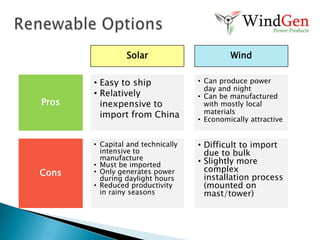
Renewable OptionsSolarWindProsEasy to ship
Relatively inexpensive to import from China
Can produce power day and night
Can be manufactured with mostly local materials
Economically attractiveConsCapital and technically intensive to manufacture
Must be imported
Only generates power during daylight hours
Reduced productivity in rainy seasons
Difficult to import due to bulk
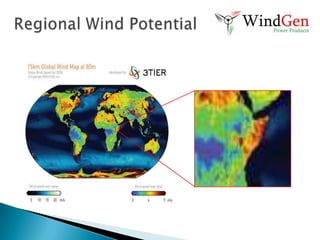
Slightly more complex installation process (mounted on mast/tower)Regional Wind Potential
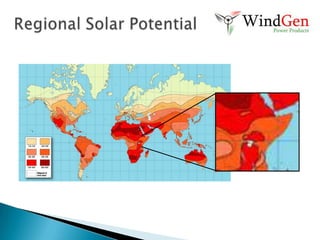
Regional Solar Potential
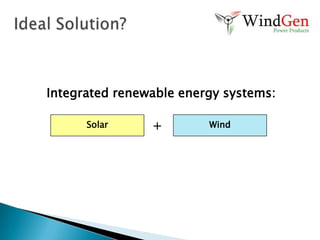
Ideal Solution?Integrated renewable energy systems:SolarWind+
The ProblemWhy Don’t More Kenyans Have Access to Renewable Power?
What’s Holding Back Solar?Consumer education – people do not understand renewable energy systems well enough to make an informed decision about investing in one
Access to credit – many off-grid consumers need financing to afford 10-20 years of power in one up-front payment
Logistical support and rural access – coordinating suppliers, installers, and transporters to install systems in rural areas can be difficult for the consumerWhat’s Holding Back Wind?Expensive to import due to bulk
Those that are imported tend to be low quality
Slightly more difficult to install than solar panels
Consumer education – people do not consider the wind option because of the lack of marketingof wind power products
All of the problems that hinder propagation of solar systems (consumer education, lack of credit, and logistical challenges)The Essential ProblemsThe Four “Gaps”Affordability Gap – consumers need a more affordable renewable energy option (wind).Expertise Gap - consumers need to better understand renewable energy systems and their benefits and limitations.Credit Gap – consumers need access to financing to afford the front-loaded cost of renewable energy.Logistics Gap – coordinating multiple suppliers, transporters, and installers is daunting.  Consumers need a one-stop-shop solution.
The SolutionWindGen Solves the Challenges that Limit Both Solar and Wind Systems
The WindGen SolutionThe Four “Gaps” - ResolvedAffordability GapWindGen manufactures a more affordable, locally produced source of renewable energy in our wind turbinesExpertise GapWindGen provides enhanced marketing, consulting, and energy auditing services Credit GapWindGen partners with local credit providers who provide financing for renewable energy consumersLogistics GapWindGen provides consulting, delivery, installation, and equipment procurement – everything our clients need in one place
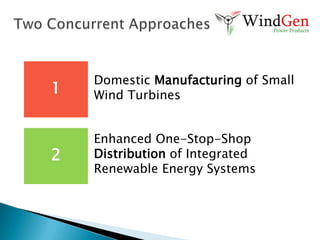
Two Concurrent Approaches1Domestic Manufacturing of Small Wind Turbines2Enhanced One-Stop-Shop Distribution of Integrated Renewable Energy Systems

WindGen Power Products

  • 1.
  • 2.
    A recent studyconcluded that renewable energy is more economical than conventional power for off-grid generation of less than 5 kilowatts – exactly the sort of power needed by the majority of African users.African Competitiveness Report 2009
  • 3.
  • 4.
    Power Landscape inKenyaProductionMostly hydro – has been a problem in recent drought yearsGeothermal, Wind, Thermal (Gas Turbines)Centralized production not expected to keep up with increasing demand – production shortfalls are commonDistributionRural power access: 0.5% – 5% Reliability issues: over 7 outages/month where there is powerDespite efforts of the Rural Electrification Authority, distribution network is expanding at a snail’s paceThere is a large and increasing demand for off-grid, renewable energy systems that can provide reliable power.
  • 5.
  • 6.
    Relatively inexpensive toimport from China
  • 7.
    Can produce powerday and night
  • 8.
    Can be manufacturedwith mostly local materials
  • 9.
    Economically attractiveConsCapital andtechnically intensive to manufacture
  • 10.
  • 11.
    Only generates powerduring daylight hours
  • 12.
  • 13.
  • 14.
    Slightly more complexinstallation process (mounted on mast/tower)Regional Wind Potential
  • 15.
  • 16.
    Ideal Solution?Integrated renewableenergy systems:SolarWind+
  • 17.
    The ProblemWhy Don’tMore Kenyans Have Access to Renewable Power?
  • 18.
    What’s Holding BackSolar?Consumer education – people do not understand renewable energy systems well enough to make an informed decision about investing in one
  • 19.
    Access to credit– many off-grid consumers need financing to afford 10-20 years of power in one up-front payment
  • 20.
    Logistical support andrural access – coordinating suppliers, installers, and transporters to install systems in rural areas can be difficult for the consumerWhat’s Holding Back Wind?Expensive to import due to bulk
  • 21.
    Those that areimported tend to be low quality
  • 22.
    Slightly more difficultto install than solar panels
  • 23.
    Consumer education –people do not consider the wind option because of the lack of marketingof wind power products
  • 24.
    All of theproblems that hinder propagation of solar systems (consumer education, lack of credit, and logistical challenges)The Essential ProblemsThe Four “Gaps”Affordability Gap – consumers need a more affordable renewable energy option (wind).Expertise Gap - consumers need to better understand renewable energy systems and their benefits and limitations.Credit Gap – consumers need access to financing to afford the front-loaded cost of renewable energy.Logistics Gap – coordinating multiple suppliers, transporters, and installers is daunting. Consumers need a one-stop-shop solution.
  • 25.
    The SolutionWindGen Solvesthe Challenges that Limit Both Solar and Wind Systems
  • 26.
    The WindGen SolutionTheFour “Gaps” - ResolvedAffordability GapWindGen manufactures a more affordable, locally produced source of renewable energy in our wind turbinesExpertise GapWindGen provides enhanced marketing, consulting, and energy auditing services Credit GapWindGen partners with local credit providers who provide financing for renewable energy consumersLogistics GapWindGen provides consulting, delivery, installation, and equipment procurement – everything our clients need in one place
  • 27.
    Two Concurrent Approaches1DomesticManufacturing of Small Wind Turbines2Enhanced One-Stop-Shop Distribution of Integrated Renewable Energy Systems