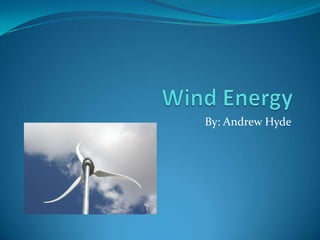
Wind EnergyBy: Andrew Hyde
Wind Energy History1 A.D.  Hero of Alexandria uses a wind machine to power an organ ~ 400 A.D. Wind driven Buddhist prayer wheels1200 to 1850 Golden era of windmills in western Europe – 50,0009,000 in Holland; 10,000 in England; 18,000 in Germany1850’sMultiblade turbines for water pumping made and marketed in U.S.1882 Thomas Edison commissions first commercial electric generating stations in NYC and London1900Competition from alternative energy sources reduces windmill population to fewer than 10,0001850 – 1930Heyday of the small multiblade turbines in the US midwastAs many as 6,000,000 units installed1936+US Rural Electrification Administration extends the grid to most formerly isolated rural sitesGrid electricity rapidly displaces multiblade turbine uses
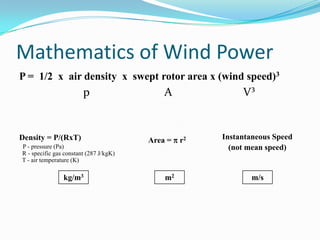
Mathematics of Wind PowerP =  1/2  x  air density  x  swept rotor area x (wind speed)3			p		      A			V³Density = P/(RxT)P - pressure (Pa)  R - specific gas constant (287 J/kgK)  T - air temperature (K)Area =  r2Instantaneous Speed(not mean speed)kg/m3m2m/s
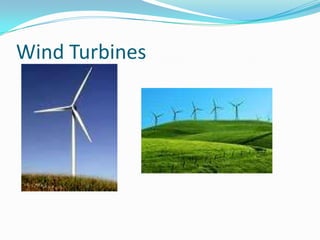
Wind Turbines
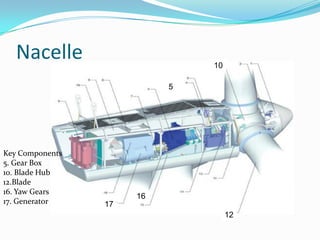
Nacelle105Key Components5. Gear Box10. Blade Hub12.Blade16. Yaw Gears17. Generator161712
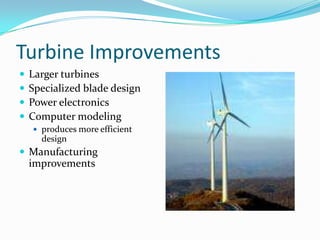
Turbine ImprovementsLarger turbinesSpecialized blade designPower electronicsComputer modeling produces more efficient designManufacturing improvements
Wind Energy StoragePumped hydroelectricGeorgetown facility – Completed 1967Two reservoirs separated by 1000 vertical feetPump water uphill at night or when wind energy production exceeds demandFlow water downhill through hydroelectric turbines during the day or when wind energy production is less than demandAbout 70 - 80% round trip efficiencyRaises cost of wind energy by 25%Difficult to find, obtain government approval and build new facilitiesCompressed Air Energy StorageUsing wind power to compress air in underground storage cavernsSalt domes, empty natural gas reservoirsCostly, inefficient Hydrogen storageUse wind power to electrolyze water into hydrogenStore hydrogen for use later in fuel cells50% losses in energy from wind to hydrogen and hydrogen to electricity25% round trip efficiencyRaises cost of wind energy by 4X
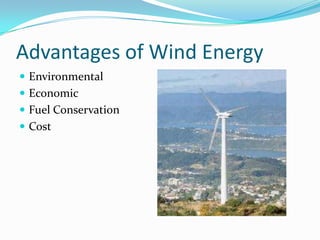
Advantages of Wind EnergyEnvironmentalEconomicFuel ConservationCost
Environmental BenefitsNo air pollutionNo greenhouse gasesNo destruction of habitats
Economic BenefitsIncreased development creates jobsIncreased tax revenue
Fuel Conservation BenefitsDomestic Energy SourceUnlimited Supply
Cost BenefitsHigh initial cost’s are paid off quicklyCost’s do not inflate
Disadvantages of Wind EnergyBird and Bat MortalityVisualNoiseLocationCostIntermittent OutputOnly when the wind blows.
The Bird and Bat ObstacleBirds of prey(hawks, owls, and eagles) in jeopardy
U.S Wind Power ChallengesBest wind sites distant from population centersmajor grid connectionsWind variability Can mitigate if forecasting improvesNon-firm powerDebate on how much backup generation is requiredLimited offshore sitesSea floor drops off rapidly on east and west coastsNorth Sea essentially a large lakeIntermittent federal tax incentives
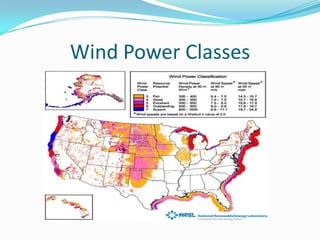
Wind Power Classes
Location of a Wind FarmWindsMinimum class 4 desired for utility-scale wind farm (>7 m/s at hub height)TransmissionDistance, voltage excess capacityPermit approvalLand-use compatibilityPublic acceptanceVisual, noise, and bird impacts are biggest concernLand areaEconomies of scale in constructionNumber of landowners
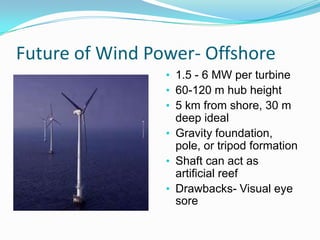
Future of Wind Power- Offshore1.5 - 6 MW per turbine
60-120 m hub height
5 km from shore, 30 m deep ideal

Wind Energy

  • 1.
  • 2.
    Wind Energy History1A.D. Hero of Alexandria uses a wind machine to power an organ ~ 400 A.D. Wind driven Buddhist prayer wheels1200 to 1850 Golden era of windmills in western Europe – 50,0009,000 in Holland; 10,000 in England; 18,000 in Germany1850’sMultiblade turbines for water pumping made and marketed in U.S.1882 Thomas Edison commissions first commercial electric generating stations in NYC and London1900Competition from alternative energy sources reduces windmill population to fewer than 10,0001850 – 1930Heyday of the small multiblade turbines in the US midwastAs many as 6,000,000 units installed1936+US Rural Electrification Administration extends the grid to most formerly isolated rural sitesGrid electricity rapidly displaces multiblade turbine uses
  • 3.
    Mathematics of WindPowerP = 1/2 x air density x swept rotor area x (wind speed)3 p A V³Density = P/(RxT)P - pressure (Pa) R - specific gas constant (287 J/kgK) T - air temperature (K)Area =  r2Instantaneous Speed(not mean speed)kg/m3m2m/s
  • 4.
  • 5.
    Nacelle105Key Components5. GearBox10. Blade Hub12.Blade16. Yaw Gears17. Generator161712
  • 6.
    Turbine ImprovementsLarger turbinesSpecializedblade designPower electronicsComputer modeling produces more efficient designManufacturing improvements
  • 7.
    Wind Energy StoragePumpedhydroelectricGeorgetown facility – Completed 1967Two reservoirs separated by 1000 vertical feetPump water uphill at night or when wind energy production exceeds demandFlow water downhill through hydroelectric turbines during the day or when wind energy production is less than demandAbout 70 - 80% round trip efficiencyRaises cost of wind energy by 25%Difficult to find, obtain government approval and build new facilitiesCompressed Air Energy StorageUsing wind power to compress air in underground storage cavernsSalt domes, empty natural gas reservoirsCostly, inefficient Hydrogen storageUse wind power to electrolyze water into hydrogenStore hydrogen for use later in fuel cells50% losses in energy from wind to hydrogen and hydrogen to electricity25% round trip efficiencyRaises cost of wind energy by 4X
  • 8.
    Advantages of WindEnergyEnvironmentalEconomicFuel ConservationCost
  • 9.
    Environmental BenefitsNo airpollutionNo greenhouse gasesNo destruction of habitats
  • 10.
    Economic BenefitsIncreased developmentcreates jobsIncreased tax revenue
  • 11.
    Fuel Conservation BenefitsDomesticEnergy SourceUnlimited Supply
  • 12.
    Cost BenefitsHigh initialcost’s are paid off quicklyCost’s do not inflate
  • 13.
    Disadvantages of WindEnergyBird and Bat MortalityVisualNoiseLocationCostIntermittent OutputOnly when the wind blows.
  • 14.
    The Bird andBat ObstacleBirds of prey(hawks, owls, and eagles) in jeopardy
  • 15.
    U.S Wind PowerChallengesBest wind sites distant from population centersmajor grid connectionsWind variability Can mitigate if forecasting improvesNon-firm powerDebate on how much backup generation is requiredLimited offshore sitesSea floor drops off rapidly on east and west coastsNorth Sea essentially a large lakeIntermittent federal tax incentives
  • 16.
  • 17.
    Location of aWind FarmWindsMinimum class 4 desired for utility-scale wind farm (>7 m/s at hub height)TransmissionDistance, voltage excess capacityPermit approvalLand-use compatibilityPublic acceptanceVisual, noise, and bird impacts are biggest concernLand areaEconomies of scale in constructionNumber of landowners
  • 18.
    Future of WindPower- Offshore1.5 - 6 MW per turbine
  • 19.
  • 20.
    5 km fromshore, 30 m deep ideal

Editor's Notes

  • #3 Humans have been harvesting energy from the wind for centuries. Ex. Sail boatsWind energy has a long history in North America also, stretching into the late 1800’s. Windmills could be found on tens of thousands of farms in the Great Plains. They were used to pump water for livestock, gardens, and humans. The difference between windmills and wind turbines is that a windmill drives a mechanical load such as a water pump but a wind turbine drives and electric generator.
  • #4 In this equation you are trying to find the power available in the wind.Air density- The weight of air per unit volume. Air density varies with elevation, but doesn’t have much effect on power until one reaches 2,500 feet above sea level. This is the least important of the three factor that influence power. Swept Area- the area of the circle the blades of a wind machine creates when spinning. It’s the machines collectors surface. The larger the swept area, the more energy a wind turbine can capture from the wind. Swept area is determined by the blade length, the longer the blades the greater the swept area. The relationship between swept area and power output is linear. Ex. Doubling the swept area doubles the output.Wind Speed- Wind speed is the most important when it comes to output of wind turbine. A small increase in wind speed results in a very large increase in the power availible to a wind turbine and the electrical output of the machine.Height- wind energy increases with height to the 1/7 power. 2x the height translates into 10.4% more electricity.
  • #5 The wind turbine is the key component of all wind-electrical systems. There are several types of wind turbines but most in use today are horizontal axis units. Most turbines have 3 blades attached to a central hub. The blades are made out of fiberglass, reinforced polyester, or wood- epoxy. Together the blades and the hub are called the rotor. The rotor is often connected to a shaft which is directly coupled to an electrical generator. This shaft runs horizontal to the ground, hence the name, horizontal axis wind turbine. When the rotor turns, the generator produces alternating current electricity.
  • #6 Behind the blades is the nacelle. This part of the turbine is about as big as a short school bus, and it holds all of the parts of the turbine that convert the mechanical energy from the wind into electrical energy. The main device that does this is called the generator. The blades and rotor are connected to a gearbox that makes the blades spin faster. The gearbox makes the shaft inside the generator spin quickly, and alternating current electricity (AC Electricity) is created. This energy is sent and stored into large batteries and is able to be used by and distributed among consumers. At the very top of the turbine tower, there is a Yaw system, which consists of a Yaw drive and a Yaw motor. These are used when wind direction changes, and it makes it so that the rotor can always be facing the direction of the wind, and can always be producing the maximum amount of energy. When the direction of the wind changes, the anemometer and wind vane notify the computer systems, which signal to the yaw motor to turn the yaw drive so that the blades can catch as much wind as possible. A computer system located in the bottom of the turbine tower controls and regulates the speed the rotor turns. An anemometer and a wind vane located at the top of the nacelle allows us to know the wind speed and direction. Through the computer systems in the turbines, entire wind farms have the ability to get the most energy possible out of the wind. The turbine also adapts itself to wind speed. Most wind turbines today are designed to capture energy from winds going 15 to 35 miles per hour. When the wind picks up occasionally, two types of controlling devices can be used. The first is pitch-control, where a pitch actuator in the nacelle adjusts the angle of the blades so that either more or less wind is captured. The second is a stall-control turbine, where the blades are locked into place and cannot spin during times of excessive wind speeds. Pitch-control allows for maximum turbine efficiency, stall-control, however, prevents turbine damage and is less complex than pitch-control. There is also a break in the nacelle that allows the rotor to completely stop incase of emergencies. This break can be applied mechanically, electrically, or hydraulically. Key components Blades – up to 120 meters – Vestas 4.5 MW offshore Blade hub – attaches blades to nacelle Gearbox – converts constant velocity/variable torque blade dynamics to constant velocity rotational speed Generator – generates AC current Yaw gears – keep turbine pointed directly into the wind
  • #7 Larger turbines produce exponentially more power, which reduces unit cost of electricityRotor blade airfoils specially designed for wind turbinesPower electronics improve turbine operations and maintenanceComputer modeling produces more efficient design