Type at Work Report
Type Dynamics Indicator
Version I
William Nelson
27th October 2016
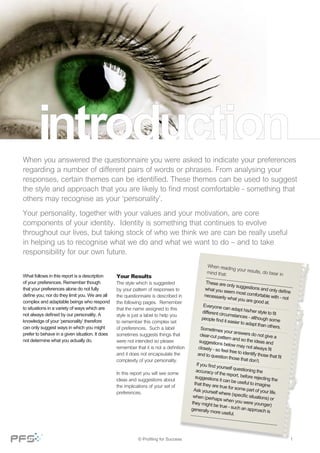
When you answered the questionnaire you were asked to indicate your preferences
regarding a number of different pairs of words or phrases. From analysing your
responses, certain themes can be identified. These themes can be used to suggest
the style and approach that you are likely to find most comfortable - something that
others may recognise as your ‘personality’.
Your personality, together with your values and your motivation, are core
components of your identity. Identity is something that continues to evolve
throughout our lives, but taking stock of who we think we are can be really useful
in helping us to recognise what we do and what we want to do – and to take
responsibility for our own future.
What follows in this report is a description
of your preferences. Remember though
that your preferences alone do not fully
define you; nor do they limit you. We are all
complex and adaptable beings who respond
to situations in a variety of ways which are
not always defined by our personality. A
knowledge of your ‘personality’ therefore
can only suggest ways in which you might
prefer to behave in a given situation. It does
not determine what you actually do.
Your Results
The style which is suggested
by your pattern of responses to
the questionnaire is described in
the following pages.  Remember
that the name assigned to this
style is just a label to help you
to remember this complex set
of preferences.  Such a label
sometimes suggests things that
were not intended so please
remember that it is not a definition
and it does not encapsulate the
complexity of your personality. 
In this report you will see some
ideas and suggestions about
the implications of your set of
preferences.
When reading your results, do bear inmind that:
These are only suggestions and only define
what you seem most comfortable with - not
necessarily what you are good at.
Everyone can adapt his/her style to fitdifferent circumstances - although somepeople find it easier to adapt than others.Sometimes your answers do not give aclear-cut pattern and so the ideas andsuggestions below may not always fitclosely - so feel free to identify those that fit
and to question those that don’t.
If you find yourself questioning theaccuracy of the report, before rejecting the
suggestions it can be useful to imaginethat they are true for some part of your life.
Ask yourself where (specific situations) or
when (perhaps when you were younger)they might be true - such an approach isgenerally more useful.
1© Profiling for Success
People with this style are one of the most organised,
responsible and dutiful of types who can be relied on to
focus on results. Co-ordinators like to take charge and be in
control – both of themselves and others. They are driven to
be efficient and are generally steady, bold and tough in the
execution of their duties.
They pursue the ‘right path’ by applying reason and logic – and
this can mean that they do not always take into account other
people’s feelings or their needs. However, they can be relied
on to evaluate what needs to be done and then make a clear
commitment to action. Procrastination and ambiguity are not
usually criticisms levied at Co-ordinators.
Co-ordinators are likely to:
•	 Be careful planners anticipating the steps and 	
	 the details required
•	 Approach things with a careful analysis and 	
	 critical evaluation
•	 Turn ideas into action plans - thinking requires 	
	 doing or it’s not worth thinking!
•	 Give clear and direct instructions with a 		
	 minimum of fuss
•	 Get things done
Co-ordinators may need to:
•	 Show greater flexibility around systems and 	
	procedures
•	 Listen and take account of others’ opinions
•	 Allow others the scope to do things their way 	
	 - even if it is not always the ‘best’ way
•	 Recognise that as well as dealing with 	 	
	 the needs of the task, getting things done	
	 involves acknowledging people’s personal 	
	 issues and reactions
•	 Tolerate situations that are less goal directed 	
	 or more ambiguous than they would normally 	
	like
A pen portrait of the Co-ordinator
2© Profiling for Success
is in this report?
The next few pages will now provide you with some
food for thought - they give suggestions and possible
implications of what your reported preferences could
mean.
This can help you to think about how you manage
work, home, your leisure and your relationships.
On the previous page, you read a
pen-portrait of your preferred style. The
remaining sections of this report describe
the meaning and implications of this style
in detail. They begin with a graphical
representation of your profile and then
further detail is provided under the
following headings:
As you read the report, make a note
of what you agree with and what you
disagree with. Where you disagree it
may be because your answers were not
reflecting your real style and motivation
or it may be that the report has over-
generalised from what is true of most
people but which does not actually
apply to you. You can use the ‘Summary
Descriptions of the 16 Types’ and the
‘Reflections and Learning’ sections at the
end of the report to consider alternatives
that may fit you better. Remember that the
report is to stimulate your thinking rather
than to limit your choices.
•	 Your profile
•	 Why do you work?
•	 What kind of work do you want?
•	 What is your style of working?
•	 Who do you want to work with?
•	 How might others see you?
•	 Your main assets
•	 Areas to consider developing
•	 Exploring your profile
•	 Summary descriptions of the 	 	
	 16 types
•	 Reflections and learning from 	 	
	 this report
3© Profiling for Success
© Profiling for Success 4
Your profile
Your answers to the questionnaire are shown
graphically below with a brief description of
each of the eight preferences grouped into 4
pairs.
Low Medium High
Where your energy comes from
What you pay attention to
How you decide to do something
How you like to live your life
People and things in the world around you
Your own ideas, thoughts and emotions
Your experience and what your senses tell you
Patterns, connections & future possibilities
By using thinking, logic & the facts
By using feelings, values and what seems fair
Being organised and having a plan of action
Letting things happen and seeing where it takes you
E: Extraversion
I: Introversion
S: Sensing
N: Intuition
T: Thinking
F: Feeling
J: Judging
P: Perception
The diagram shows the four pairs of preference which are investigated by the Type
Dynamics Indicator. These preference pairs are:
Extraversion - Introversion (E vs I) . . . . . .
Sensing - iNtuition (S vs N) . . . . . . . . .
Thinking - Feeling (T vs F) . . . . . . . . .
Judging - Perception (J vs P) . . . . . . . .
which is about where your energy comes from
which is about what you pay attention to
which is about how you decide something
which is about how you like to live your life
For each of the above pairs, you will probably prefer one side to the other. For example, if
the diagram above shows that the bar for Introversion is longer than the bar for Extraversion,
that would mean that you prefer to get your energy more from your own thoughts and ideas
rather than from people and things and the world around you. If the bar for Extraversion is
longer than the bar for Introversion, then the opposite would apply.
© Profiling for Success 5
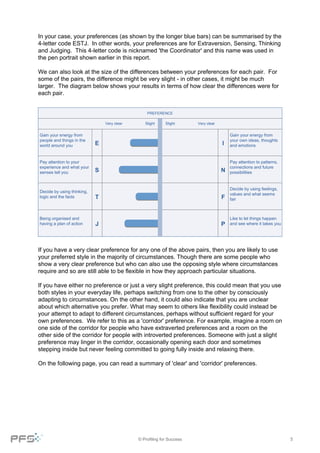
In your case, your preferences (as shown by the longer blue bars) can be summarised by the
4-letter code ESTJ. In other words, your preferences are for Extraversion, Sensing, Thinking
and Judging. This 4-letter code is nicknamed 'the Coordinator' and this name was used in
the pen portrait shown earlier in this report.
We can also look at the size of the differences between your preferences for each pair. For
some of the pairs, the difference might be very slight - in other cases, it might be much
larger. The diagram below shows your results in terms of how clear the differences were for
each pair.
E I
S N
T F
J P
PREFERENCE
Very clear Slight Slight Very clear
Gain your energy from
people and things in the
world around you
Gain your energy from
your own ideas, thoughts
and emotions
Pay attention to your
experience and what your
senses tell you
Pay attention to patterns,
connections and future
possibilities
Decide by using thinking,
logic and the facts
Decide by using feelings,
values and what seems
fair
Being organised and
having a plan of action
Like to let things happen
and see where it takes you
If you have a very clear preference for any one of the above pairs, then you are likely to use
your preferred style in the majority of circumstances. Though there are some people who
show a very clear preference but who can also use the opposing style where circumstances
require and so are still able to be flexible in how they approach particular situations.
If you have either no preference or just a very slight preference, this could mean that you use
both styles in your everyday life, perhaps switching from one to the other by consciously
adapting to circumstances. On the other hand, it could also indicate that you are unclear
about which alternative you prefer. What may seem to others like flexibility could instead be
your attempt to adapt to different circumstances, perhaps without sufficient regard for your
own preferences. We refer to this as a 'corridor' preference. For example, imagine a room on
one side of the corridor for people who have extraverted preferences and a room on the
other side of the corridor for people with introverted preferences. Someone with just a slight
preference may linger in the corridor, occasionally opening each door and sometimes
stepping inside but never feeling committed to going fully inside and relaxing there.
On the following page, you can read a summary of 'clear' and 'corridor' preferences.
© Profiling for Success 6
Summary of clear versus less clear (or 'corridor') preferences
When your results are clear When your results are less clear (or 'corridor')
This suggests that you have very little uncertainty
about your own preference. This makes it more
likely that this preference will be obvious and
recognised in the way you approach life. Such
clarity can sometimes be helpful and distinctive but
sometimes it can come across as a little rigid and
unappreciative of the other preference (both in
yourself and in your attitude to others). N.B. Being
clear about a preference is a different question to
that of how strong or weak the preference is.
This suggests that you recognise both preferences
in yourself. This can make you flexible in the way
you approach life and can help you appreciate other
people with different styles. Alternatively it could
mean that you are uncertain and this could make
you waver between the two depending on
circumstances or mood. If such wavering creates
tension for you, it can be useful to try to clarify which
of the two preferences is more fundamental for you.
Each of us is constantly developing and updating how we think about ourselves and it is
important therefore to realise that your profile of preferences, as depicted in the diagrams on
the previous pages, represents the way you answered the questions at the time - and this, in
turn, reflects how you are (or were) when you answered the questionnaire.
It is possible for your profile to change as you develop your ideas about what is most
important, natural and rewarding for you. Not only the direction of your preferences may
change over time but also the clarity of those preferences. Some preferences which are only
slight may become stronger over time and others which are currently strong may become
less clear. Please bear this in mind as you read the more detailed implications of your
preferences in the next few pages.
© Profiling for Success 7
Your preferences in detail
In the sections that follow, your preferences as
'a Coordinator' are discussed in more detail
under a number of separate headings.
Why do you work?
The purpose of work
Co-ordinators get most enjoyment when work fulfils their sense of duty and responsibility -
and this usually means creating a more structured environment where progress is tangible.
Usually adhering to more traditional values, they do not enjoy vague activities with uncertain
outcomes. Co-ordinators strive to bring order where there is chaos, efficiency where there is
waste and systems where there is a lack of structure. They prefer things to be black and
white - there is very little room for grey in their world. Being involved, making things happen
and bringing order are at the heart of the Co-ordinator's motivation and satisfaction.
In summary:
• To contribute and build traditional values and respect for authority
• To fulfil a clear sense of duty and responsibility
• To establish a strong, clear framework of order and rules.
The work environment
Co-ordinators prefer a work environment which is ordered and disciplined, where there is a
sense of delivery and where they can play a significant role. This usually means an
environment, which allows them a 'hands-on' role. They often have a good eye for detail and
consequently they will want their work to contribute in visible and tangible ways - making,
building, feeding, providing, transporting, organising. They also enjoy a high level of contact
with others and prefer to be easy, social and straightforward taking people as they find them.
In summary:
• Enjoy taking charge and assuming responsibility
• Need opportunities for action and contact with people
• Prefer working with facts and data - can get frustrated with ambiguity and
abstractions.
© Profiling for Success 8
What kind of work do you want?
Types of activity
Co-ordinators enjoy work which allows them to influence others and to work with
measurable, tangible things - areas where their eye for detail and taste for tough-minded
analysis and logical order serves them well. They prefer practical, hands-on activities where
they can interact with others. Of all the types, they can be the toughest negotiators because
they approach matters in a direct and no-nonsense way. It is not unusual to find them in
sales or retailing or running small businesses where they combine the authority to organise
and direct together with being close to the action. This allows them to exercise their
hands-on sense of detail and close grasp of administrative systems. Positions in the military
and in the police likewise give them a role where duty, courage and a sense of responsibility
are of the essence together with clarity of purpose, direction and delivery.
In summary:
• Taking action and influencing events
• Dealing with immediate issues and facts rather than abstract discussion, options and
theories
• Work which is practical and leads to tangible results
• The cut-and-thrust of action, reaction and negotiation.
Types of contribution
A Co-ordinator's need to instil order and stability in the world around them means that they
can make a large contribution towards creating a clear framework of activity, targets and
results. They often create or clarify the rules and procedures that people are supposed to
follow and they use these to monitor activity and drive out of waste and inefficiency. Their
legacy could well be a new, improved operating procedure which codifies the best of what is
known and practised.
In summary:
• Bringing order, structure, systems and efficiency
• Challenging unnecessary complexity and bringing clarity and simplicity
• Being organised, traditional, loyal and efficient
• Providing the practical, useful and familiar rather than the innovative and exploratory
• Being direct and logical rather than ambiguous and sentimental.
What is your style of working?
Managing time
Co-ordinators are outstanding time planners. They like to know what is happening, when it is
happening and how long it will take. They like to make use of planning systems (e.g. their
© Profiling for Success 9
mobile or some other 'organiser') - although sometimes this is their own brain, which can also
act as a well-organised data-retrieval system! Co-ordinators think that time is precious and
that every minute should be well used. Applying this to themselves, they work hard not to be
late and are unlikely to be found staring out of the window thinking about what to do. They
tend to expect this style from others which comes across as intolerant of people who do not
work at their pace. They abhor those who waste others' time - such as those who turn up
late or interrupt important work with seeming trivialities. They dislike interruptions although,
when convinced that it is necessary (such as "the boss needs me" or "the customer comes
first") they can adjust smoothly and take it in their stride.
In summary:
• Great time managers (sometimes ruthlessly), organised such that even the
unexpected is planned for!
• Hate time wasting and abhor inactivity
• Keep focussed on schedules and deliverables.
Getting results
Co-ordinators believe in setting goals and delivering results - not for any airy-fairy reasons,
but because results are what pays the bill: 'a day without work is a day without food'. They
remain focussed on the real world with clear targets and measurable data and are happy to
translate complexity into simple measures - financial or otherwise. Their willingness to deal
with a wide range of detail makes them excellent at keeping track of how they, their
department or their organisation are doing - and usually with a clear focus on the goals and
objectives. Their firmness of mind and refusal to be deterred mean that they make sure
targets are met and their hands-on orientation means that they usually lead by example.
They can sometimes focus too much on completeness. When this happens they sacrifice
brevity and they become long-winded which might lose their audience.
In summary:
• Thrive on a reputation for reliability and delivery
• Very focussed on the goal: well aware of the material world
• Get results by efficiency using clear milestones, regular reminders and well organised
data retrieval systems
• Finishers rather than starters; like to be given a clearly defined task which they see
through with determination and thoroughness.
Managing change
Co-ordinators are the masters at implementing change. They may not be the fastest to
appreciate the need for change because they focus on improving the known rather than
dreaming up the new. However, once convinced of the need, they want to make it happen.
They will think of ways to make anything new into something tangible, useable and
measurable by establishing rules and procedures - and they can be relied on to follow those
rules themselves.
In summary:
© Profiling for Success 10
• Less likely to be the initiators of change but are the ones to make it happen once they
have been convinced
• Resistant to interruptions and their delivery focus can mean that they fail to spot
opportunities for change
Who do you want to work with?
Interaction needs
Co-ordinators want to be with people who have a purpose. They enjoy interaction and make
a virtue of being outspoken and direct. They like big gatherings, Christmas parties, golf club
dinners, regimental reunions, sales conferences, and the kind of get-togethers which support
the social order and traditional values. Not ones to hide their light under a bushel, they often
seek positions of responsibility outside work - as school governors or as the secretary to a
club or society. In the workplace too they will often take responsibility directly or indirectly for
those they see as weaker or needier than themselves. However, they value people who have
the courage to sort out their own problems without asking for help - which, after all, is what
they do themselves. Their interaction tends to be active and friendly rather than personal and
intimate. They tend not to probe deeply into people's personal problems and issues - and
they may get uncomfortable if others probe too deeply into theirs.
In summary:
• Prefer interaction with a purpose
• Need to be actively involved with others by doing and achieving
• Prefer to maintain emotional distance longer than most
• Want to work hard and then play hard
• Enjoy a wide circle of acquaintances
• Happy being at the centre of attention.
Relationship style
In terms of interaction, Co-ordinators are usually friendly, warm and welcoming. Sometimes
their style is described as 'parental' - clear and authoritative. They like people to take them as
they are, to say what they mean and mean what they say - there are no half-measures. If
they have cause for criticism they don't usually hang back. They are good people to have on
your side, but you don't want to make enemies of them. Co-ordinators would not only
recognise this in themselves - they may even be proud of it. A common description for a
Co-ordinator is that they are straightforward, hearty, direct - and tough.
In summary:
• Cheerful, optimistic, hearty
• Team players, loyal to the organisation as they see it
• Direct and straightforward - neither offer nor ask for subtlety in relationships
• Not known for sensitivity or tolerance
© Profiling for Success 11
• Expect everyone to stand on their own two feet
• Considerate once they understand issues in practical terms.
How might others see you?
As a leader
Co-ordinators are happy both giving and receiving orders - what they really dislike is
uncertainty, where orders are either disobeyed or not even issued at all. They lead by
example, putting in a lot of personal effort and expecting respect and obedience in return.
They do not usually rely on inspiration and vision - instead they have their feet on the ground
and are respected for their confidence, energy, dedication and absolute commitment to
seeing things through to completion. More determined than resourceful, they place great
value on tradition, stability and loyalty to the cause. They use tried and trusted methods
building on shared values and common experiences. They see organisations as 'cradle to
grave' - they never forget that the firm pays the pensions as well as the bonuses and are
likely to avoid risk and err on the side of prudence.
In summary:
• Lead from the front: energetic, active, radiate confidence
• Give and demand respect for tradition, position, seniority, and 'rank'
• Tough, resolute, uncompromising
• Create a following by generating trust and respect rather than through vision and
inspiration.
As a manager
Co-ordinators make particularly effective managers - dedicated, thorough, dependable,
highly aware of detail, and above all prepared to work within the system. They provide clear
definitions of what is needed - goals, results, methods, processes, roles, responsibilities -
and then ensure that they are written down and carried out in a systematic, co-ordinated
way. This can be a strength or a weakness depending on the context. In situations of rapid
change their firmness and self-confidence can be a source of support to others, but it can
also inhibit change and put barriers in the way of organisational and personal learning.
In summary:
• Structured and organised - people know what, where, when, how and why
• Manage detail well - but may overdo explanations thus instructing rather than
delegating
• Know the value of material things, won't ignore the 'pay and rations' side
• Able to take as well as give orders: not too proud to follow
• Follow through, check, won't let go.
© Profiling for Success 12
As a decision-maker
Co-ordinators take decisions logically and rationally, using the evidence in front of them.
They are less prone to doubt than many other types. In fact, leaving matters undecided is
what is hard for them. Their motto might be "just do it - now" so that they leave nothing
hanging. It can be hard work to persuade them that certain things will benefit from further
reflection.
In summary:
• Not happy with uncertainty and ambiguity; may decide too soon
• Use logic and rely heavily on knowledge and experience - may ignore the new and
untried
• Realistic, practical, feet on the ground.
In resolving conflict
Co-ordinators do not allow conflict to cause them undue concern. They approach it like other
tasks, applying their objective logic and forming their opinions and judgements with
confidence. They may neglect some of the softer or emotional issues and this clarity and
decisiveness can turn from a strength to a weakness - especially when they move up the
management hierarchy and find themselves needing to pay more attention to the impact of
their behaviour on others.
In summary:
• Address issues promptly and directly but not always sensitively or effectively
• Handle conflict bluntly, forcefully and often fearlessly
• Deal with the logic of the issue rather than the impact on behaviour and feelings.
Your main assets
At their best
Co-ordinators are organised, disciplined and thorough - willing to take responsibility and
determined to see it through. They are cheerful and open in the face of adversities, patient
with detail and tedium, prepared to take orders and work within the system and ready to take
life as it comes without digging too far below the surface. If a task needs doing - however
unpromising - a Co-ordinator will come forward to take it on. The things they bring are:
In summary:
• A willingness to take control and create structure
• Anticipation of flaws, attention to detail and reaching their goals in a steady,
systematic and sequential way
• Reliability, dependability, and a willingness to take responsibility to organise, plan,
control and monitor events and people
© Profiling for Success 13
• A critical and analytical approach
• A willingness to lead by example.
Areas to consider developing
At their worst
Co-ordinators are bossy and narrow-minded, convinced that their way is the only way and
unwilling to take account of others' insights, suggestions, and feelings. The things to consider
are:
In summary:
• More listening and taking account of the opinions and contributions of others
• Slowing down before taking action and making decisions
• Recognising that not everything is measurable
• Showing greater appreciation of feelings and values - their own and others'
• Being more open to novelty and change
• Giving more praise and encouragement
• Allowing others do things their way
• Showing more flexibility around standard systems and procedures.
Your profile shows the set of preferences that you have developed and
which you are currently expressing. 
It sometimes helps to ask why we have developed particular
preferences. Do they reflect values we have absorbed from our
experiences or from others around us? Do they result from some sort of
pressure we may have experienced in the past? Do they reflect how we
really want to be or do we perhaps sometimes wish we were different? 
To help you understand more, try to answer the questions in each of the 6
boxes below.
We can think of a person’s preferences, as shown by
their profile, as their ‘comfort zone’. In your case:
1.	is this comfort zone a positive choice?
2. is this comfort zone a way of avoiding something 		
	 less comfortable?
Our preferences often change as we grow
and develop.  How different would you say the
preferences you now have are to those you had:
1. when you were growing up at home?
2. when you were at school?
3. in your early adulthood?
Our preferences sometimes change according to
where we are and what we are doing. Think about
how your preferences might be different:
1.	at work
2.	at home
3.	in your hobbies or leisure activities
How we are is not always how we want to be.  What
changes in your preferences would be needed to
make your profile:
1.	represent your ‘ideal’ of the person you want to be?
2.	reflect the potential you feel is within you?
3.	reflect the person you would like to see described in 		
	 your epitaph?
Sometimes, the person we say we would prefer to
be is based on the expectations of others. Thinking
in terms of the four preference pairs (or using the 16
summary profiles on the next page), consider how the
following might like you to be:
1. your parents?
2. your teachers?
3. other people who are significant in your life
There are always parts of ourselves that remain
relatively hidden or unexpressed. Thinking in
terms of the four preference pairs (or using the 16
summary profiles on the next page), do you think
there are elements in your profile which might:
1. be under-used or not be expressed?
2. become exaggerated when you are under pressure?
The answers above will help you think more about where your reported preferences are coming from.
your profile
14© Profiling for Success
The ideas in this report are based on your answers to
the questionnaire. As you reflect more about who you
are and how you behave, you may find that your ideas
become clearer or change.
Summary description of the 16 Types
Inspectors (ISTJ)
Inspectors are careful, thoughtful
and systematic. Outwardly
composed and matter-of-fact,
they can be people of few
words. However, they are
dependable, loyal and precise
making sure that responsibilities
are taken seriously and that
work is completed steadily and
systematically.
Surveyors (ISTP)
Surveyors are drawn to roles
requiring action and expertise.
Socially reserved and loving
action, they can be highly
energetic when interested. This
makes them expedient, realistic,
logical and practical. When
uninterested they can become
disorganised, impulsive and
detached.
Trouble-shooters (ESTP)
Trouble-shooters are sociable,
confident and adaptable
pragmatists. They love action
and happily use their experience
to make things happen. Often
charming, straightforward and
energetic, they live on the edge
treating life as an adventure.
Co-ordinators (ESTJ)
Co-ordinators are systematic
and delivery-focussed. They like
to take charge and get results.
Their style will generally be
steady and organised and they
are often described as tough
and efficient leaders. Practical,
rational and efficient they may
neglect people’s feelings and
may not champion change.
Protectors (ISFJ)
Protectors are patient, modest
and diligent. They show great
compassion and support for
others - often by taking care
of the day-to-day practical
details. They are not particularly
interested in logical or technical
things, preferring a more personal
touch and enjoying being
helpful, persistent, organised and
thorough.
Supporters (ISFP)
Supporters are quiet, friendly
people who do not need to force
themselves, or their views, on
others. Caring and sensitive, they
accept people and life’s realities
as they are. They do not need
to over-analyse, they live for
the present, being personable,
adaptable and sometimes
disorganised.
Energisers (ESFP)
Energisers are drawn towards
others, living their life by
engaging, interacting and
bringing optimism, hope, warmth
and fun to the situations they
encounter. They seek people and
action, are always ready to join in
themselves and usually create a
buzz which encourages others to
also get involved.
Harmonisers (ESFJ)
Harmonisers are sociable, friendly
and persevering. They bring
compassion and a focus on
others which creates a warm and
supportive environment. Generally
organised and able to attend
to practical issues, they are
nurturing, loyal and sympathetic
whilst keeping a clear focus on
getting things done.
Guides (INFJ)
Guides are warm, imaginative and
amiable. They can be guarded
in expressing their own feelings
though can show high levels of
concern and support for others.
They also like to get things
organised and completed. In fact,
when their values - often involving
people and social improvement
- are aligned they can become
extremely persistent without losing
the personal touch.
Idealists (INFP)
Idealists are drawn towards others
who share their values and who
feel deeply about certain issues.
These issues guide them in their
life and relationships. When all is
going well they are seen as warm
and gracious individuals who
care deeply and who contribute
interesting ideas and values.
Improvisers (ENFP)
Improvisers are personable,
imaginative and sociable types.
Willing to turn their hand to
anything, they enjoy exploring
ideas and building relationships.
Their style is generally enthusiastic,
engaging and persuasive, tending
to be spontaneous and flexible
rather than structured and detailed.
Advisers (ENFJ)
Advisers are enthusiastic,
personable and responsive types
who place the highest value on
building relationships and showing
commitment to people. Generally
comfortable in groups, they can be
good with words, happy to express
their feelings and strong in the
promotion of their values.
Investigators (INTJ)
Investigators are innovative
visionaries with a determination
to achieve results. They can be
highly independent, needing a
great deal of autonomy. Their
clear-sightedness and willingness
to take decisions makes them
conceptual, goal-focussed and
visionary leaders. They come
across as tough and incisive,
sometimes lacking the personal
touch.
Architects (INTP)
Architects are great thinkers
and problem-solvers. Usually
quiet and reflective, they like
to be left to work things out at
their own pace. They can be
complex, theoretical and curious,
seeking underlying principles and
fundamental understanding.
Catalysts (ENTP)
Catalysts are energetic change
agents who are always looking for
a new angle. Often pioneers and
promoters of change, they look
for active environments where
they can discuss and debate
new ideas. When with people
they inject energy, innovation and
fun into their activities.
Executives (ENTJ)
Executives are direct, goal-
focussed people who seek to
influence and get results. They
value good reasoning and
intellectual challenges. They
seek to achieve results and can
be tough, visionary leaders who
make things happen.
The theory of ‘Psychological Type’ tells us
that there are elements of all types within
each of us, but in different proportions.
It can therefore be useful to think about
each of the other types and to see if you
recognise some of them as part of you
- at least, perhaps for some of the time.
Pen-portraits of each of the 16 Types
are shown in the table below for you to
consider.
description of the 16 types
15© Profiling for Success
and learning from this report
Firstly, think about your results as described in
the report above and think about some possible
explanations for why you answered the questionnaire
the way you did. Then write some notes below about
what you feel you have now learnt about yourself.
1. On reflection, the preferences that feel more ‘core’ to who I am are: (circle one of the preferences in each pair)
(If necessary, continue on the back of this sheet or on a separate sheet)
2. If your are finding it hard to identify what is core, please instead list below those pen-portraits from the previous page that you most easily
identify with. For each pen-portrait you mention, give an example of the sort of situation in which you feel it comes to the fore and in which it
would be an appropriate description of your preferences
3. What I feel I have learnt about myself is:
Use the table on the previous page and write down the name which is
given to the combination of preferences you have indicated above:
The reasons these feel more ‘core’ are:
Extravert
Introvert
Thinking
Feeling
Sensing
Intuition
Judging
Perceiving
16© Profiling for Success
© Profiling for Success 17
If you would like to answer a few short questions to give us your opinion of this
report, please click on the link below:
Feedback questionnaire

William_Nelson_Type Dynamics Indicator_Type at Work Report

  • 1.
    Type at WorkReport Type Dynamics Indicator Version I William Nelson 27th October 2016
  • 2.
    When you answeredthe questionnaire you were asked to indicate your preferences regarding a number of different pairs of words or phrases. From analysing your responses, certain themes can be identified. These themes can be used to suggest the style and approach that you are likely to find most comfortable - something that others may recognise as your ‘personality’. Your personality, together with your values and your motivation, are core components of your identity. Identity is something that continues to evolve throughout our lives, but taking stock of who we think we are can be really useful in helping us to recognise what we do and what we want to do – and to take responsibility for our own future. What follows in this report is a description of your preferences. Remember though that your preferences alone do not fully define you; nor do they limit you. We are all complex and adaptable beings who respond to situations in a variety of ways which are not always defined by our personality. A knowledge of your ‘personality’ therefore can only suggest ways in which you might prefer to behave in a given situation. It does not determine what you actually do. Your Results The style which is suggested by your pattern of responses to the questionnaire is described in the following pages.  Remember that the name assigned to this style is just a label to help you to remember this complex set of preferences.  Such a label sometimes suggests things that were not intended so please remember that it is not a definition and it does not encapsulate the complexity of your personality.  In this report you will see some ideas and suggestions about the implications of your set of preferences. When reading your results, do bear inmind that: These are only suggestions and only define what you seem most comfortable with - not necessarily what you are good at. Everyone can adapt his/her style to fitdifferent circumstances - although somepeople find it easier to adapt than others.Sometimes your answers do not give aclear-cut pattern and so the ideas andsuggestions below may not always fitclosely - so feel free to identify those that fit and to question those that don’t. If you find yourself questioning theaccuracy of the report, before rejecting the suggestions it can be useful to imaginethat they are true for some part of your life. Ask yourself where (specific situations) or when (perhaps when you were younger)they might be true - such an approach isgenerally more useful. 1© Profiling for Success
  • 3.
    People with thisstyle are one of the most organised, responsible and dutiful of types who can be relied on to focus on results. Co-ordinators like to take charge and be in control – both of themselves and others. They are driven to be efficient and are generally steady, bold and tough in the execution of their duties. They pursue the ‘right path’ by applying reason and logic – and this can mean that they do not always take into account other people’s feelings or their needs. However, they can be relied on to evaluate what needs to be done and then make a clear commitment to action. Procrastination and ambiguity are not usually criticisms levied at Co-ordinators. Co-ordinators are likely to: • Be careful planners anticipating the steps and the details required • Approach things with a careful analysis and critical evaluation • Turn ideas into action plans - thinking requires doing or it’s not worth thinking! • Give clear and direct instructions with a minimum of fuss • Get things done Co-ordinators may need to: • Show greater flexibility around systems and procedures • Listen and take account of others’ opinions • Allow others the scope to do things their way - even if it is not always the ‘best’ way • Recognise that as well as dealing with the needs of the task, getting things done involves acknowledging people’s personal issues and reactions • Tolerate situations that are less goal directed or more ambiguous than they would normally like A pen portrait of the Co-ordinator 2© Profiling for Success
  • 4.
    is in thisreport? The next few pages will now provide you with some food for thought - they give suggestions and possible implications of what your reported preferences could mean. This can help you to think about how you manage work, home, your leisure and your relationships. On the previous page, you read a pen-portrait of your preferred style. The remaining sections of this report describe the meaning and implications of this style in detail. They begin with a graphical representation of your profile and then further detail is provided under the following headings: As you read the report, make a note of what you agree with and what you disagree with. Where you disagree it may be because your answers were not reflecting your real style and motivation or it may be that the report has over- generalised from what is true of most people but which does not actually apply to you. You can use the ‘Summary Descriptions of the 16 Types’ and the ‘Reflections and Learning’ sections at the end of the report to consider alternatives that may fit you better. Remember that the report is to stimulate your thinking rather than to limit your choices. • Your profile • Why do you work? • What kind of work do you want? • What is your style of working? • Who do you want to work with? • How might others see you? • Your main assets • Areas to consider developing • Exploring your profile • Summary descriptions of the 16 types • Reflections and learning from this report 3© Profiling for Success
  • 5.
    © Profiling forSuccess 4 Your profile Your answers to the questionnaire are shown graphically below with a brief description of each of the eight preferences grouped into 4 pairs. Low Medium High Where your energy comes from What you pay attention to How you decide to do something How you like to live your life People and things in the world around you Your own ideas, thoughts and emotions Your experience and what your senses tell you Patterns, connections & future possibilities By using thinking, logic & the facts By using feelings, values and what seems fair Being organised and having a plan of action Letting things happen and seeing where it takes you E: Extraversion I: Introversion S: Sensing N: Intuition T: Thinking F: Feeling J: Judging P: Perception The diagram shows the four pairs of preference which are investigated by the Type Dynamics Indicator. These preference pairs are: Extraversion - Introversion (E vs I) . . . . . . Sensing - iNtuition (S vs N) . . . . . . . . . Thinking - Feeling (T vs F) . . . . . . . . . Judging - Perception (J vs P) . . . . . . . . which is about where your energy comes from which is about what you pay attention to which is about how you decide something which is about how you like to live your life For each of the above pairs, you will probably prefer one side to the other. For example, if the diagram above shows that the bar for Introversion is longer than the bar for Extraversion, that would mean that you prefer to get your energy more from your own thoughts and ideas rather than from people and things and the world around you. If the bar for Extraversion is longer than the bar for Introversion, then the opposite would apply.
  • 6.
    © Profiling forSuccess 5 In your case, your preferences (as shown by the longer blue bars) can be summarised by the 4-letter code ESTJ. In other words, your preferences are for Extraversion, Sensing, Thinking and Judging. This 4-letter code is nicknamed 'the Coordinator' and this name was used in the pen portrait shown earlier in this report. We can also look at the size of the differences between your preferences for each pair. For some of the pairs, the difference might be very slight - in other cases, it might be much larger. The diagram below shows your results in terms of how clear the differences were for each pair. E I S N T F J P PREFERENCE Very clear Slight Slight Very clear Gain your energy from people and things in the world around you Gain your energy from your own ideas, thoughts and emotions Pay attention to your experience and what your senses tell you Pay attention to patterns, connections and future possibilities Decide by using thinking, logic and the facts Decide by using feelings, values and what seems fair Being organised and having a plan of action Like to let things happen and see where it takes you If you have a very clear preference for any one of the above pairs, then you are likely to use your preferred style in the majority of circumstances. Though there are some people who show a very clear preference but who can also use the opposing style where circumstances require and so are still able to be flexible in how they approach particular situations. If you have either no preference or just a very slight preference, this could mean that you use both styles in your everyday life, perhaps switching from one to the other by consciously adapting to circumstances. On the other hand, it could also indicate that you are unclear about which alternative you prefer. What may seem to others like flexibility could instead be your attempt to adapt to different circumstances, perhaps without sufficient regard for your own preferences. We refer to this as a 'corridor' preference. For example, imagine a room on one side of the corridor for people who have extraverted preferences and a room on the other side of the corridor for people with introverted preferences. Someone with just a slight preference may linger in the corridor, occasionally opening each door and sometimes stepping inside but never feeling committed to going fully inside and relaxing there. On the following page, you can read a summary of 'clear' and 'corridor' preferences.
  • 7.
    © Profiling forSuccess 6 Summary of clear versus less clear (or 'corridor') preferences When your results are clear When your results are less clear (or 'corridor') This suggests that you have very little uncertainty about your own preference. This makes it more likely that this preference will be obvious and recognised in the way you approach life. Such clarity can sometimes be helpful and distinctive but sometimes it can come across as a little rigid and unappreciative of the other preference (both in yourself and in your attitude to others). N.B. Being clear about a preference is a different question to that of how strong or weak the preference is. This suggests that you recognise both preferences in yourself. This can make you flexible in the way you approach life and can help you appreciate other people with different styles. Alternatively it could mean that you are uncertain and this could make you waver between the two depending on circumstances or mood. If such wavering creates tension for you, it can be useful to try to clarify which of the two preferences is more fundamental for you. Each of us is constantly developing and updating how we think about ourselves and it is important therefore to realise that your profile of preferences, as depicted in the diagrams on the previous pages, represents the way you answered the questions at the time - and this, in turn, reflects how you are (or were) when you answered the questionnaire. It is possible for your profile to change as you develop your ideas about what is most important, natural and rewarding for you. Not only the direction of your preferences may change over time but also the clarity of those preferences. Some preferences which are only slight may become stronger over time and others which are currently strong may become less clear. Please bear this in mind as you read the more detailed implications of your preferences in the next few pages.
  • 8.
    © Profiling forSuccess 7 Your preferences in detail In the sections that follow, your preferences as 'a Coordinator' are discussed in more detail under a number of separate headings. Why do you work? The purpose of work Co-ordinators get most enjoyment when work fulfils their sense of duty and responsibility - and this usually means creating a more structured environment where progress is tangible. Usually adhering to more traditional values, they do not enjoy vague activities with uncertain outcomes. Co-ordinators strive to bring order where there is chaos, efficiency where there is waste and systems where there is a lack of structure. They prefer things to be black and white - there is very little room for grey in their world. Being involved, making things happen and bringing order are at the heart of the Co-ordinator's motivation and satisfaction. In summary: • To contribute and build traditional values and respect for authority • To fulfil a clear sense of duty and responsibility • To establish a strong, clear framework of order and rules. The work environment Co-ordinators prefer a work environment which is ordered and disciplined, where there is a sense of delivery and where they can play a significant role. This usually means an environment, which allows them a 'hands-on' role. They often have a good eye for detail and consequently they will want their work to contribute in visible and tangible ways - making, building, feeding, providing, transporting, organising. They also enjoy a high level of contact with others and prefer to be easy, social and straightforward taking people as they find them. In summary: • Enjoy taking charge and assuming responsibility • Need opportunities for action and contact with people • Prefer working with facts and data - can get frustrated with ambiguity and abstractions.
  • 9.
    © Profiling forSuccess 8 What kind of work do you want? Types of activity Co-ordinators enjoy work which allows them to influence others and to work with measurable, tangible things - areas where their eye for detail and taste for tough-minded analysis and logical order serves them well. They prefer practical, hands-on activities where they can interact with others. Of all the types, they can be the toughest negotiators because they approach matters in a direct and no-nonsense way. It is not unusual to find them in sales or retailing or running small businesses where they combine the authority to organise and direct together with being close to the action. This allows them to exercise their hands-on sense of detail and close grasp of administrative systems. Positions in the military and in the police likewise give them a role where duty, courage and a sense of responsibility are of the essence together with clarity of purpose, direction and delivery. In summary: • Taking action and influencing events • Dealing with immediate issues and facts rather than abstract discussion, options and theories • Work which is practical and leads to tangible results • The cut-and-thrust of action, reaction and negotiation. Types of contribution A Co-ordinator's need to instil order and stability in the world around them means that they can make a large contribution towards creating a clear framework of activity, targets and results. They often create or clarify the rules and procedures that people are supposed to follow and they use these to monitor activity and drive out of waste and inefficiency. Their legacy could well be a new, improved operating procedure which codifies the best of what is known and practised. In summary: • Bringing order, structure, systems and efficiency • Challenging unnecessary complexity and bringing clarity and simplicity • Being organised, traditional, loyal and efficient • Providing the practical, useful and familiar rather than the innovative and exploratory • Being direct and logical rather than ambiguous and sentimental. What is your style of working? Managing time Co-ordinators are outstanding time planners. They like to know what is happening, when it is happening and how long it will take. They like to make use of planning systems (e.g. their
  • 10.
    © Profiling forSuccess 9 mobile or some other 'organiser') - although sometimes this is their own brain, which can also act as a well-organised data-retrieval system! Co-ordinators think that time is precious and that every minute should be well used. Applying this to themselves, they work hard not to be late and are unlikely to be found staring out of the window thinking about what to do. They tend to expect this style from others which comes across as intolerant of people who do not work at their pace. They abhor those who waste others' time - such as those who turn up late or interrupt important work with seeming trivialities. They dislike interruptions although, when convinced that it is necessary (such as "the boss needs me" or "the customer comes first") they can adjust smoothly and take it in their stride. In summary: • Great time managers (sometimes ruthlessly), organised such that even the unexpected is planned for! • Hate time wasting and abhor inactivity • Keep focussed on schedules and deliverables. Getting results Co-ordinators believe in setting goals and delivering results - not for any airy-fairy reasons, but because results are what pays the bill: 'a day without work is a day without food'. They remain focussed on the real world with clear targets and measurable data and are happy to translate complexity into simple measures - financial or otherwise. Their willingness to deal with a wide range of detail makes them excellent at keeping track of how they, their department or their organisation are doing - and usually with a clear focus on the goals and objectives. Their firmness of mind and refusal to be deterred mean that they make sure targets are met and their hands-on orientation means that they usually lead by example. They can sometimes focus too much on completeness. When this happens they sacrifice brevity and they become long-winded which might lose their audience. In summary: • Thrive on a reputation for reliability and delivery • Very focussed on the goal: well aware of the material world • Get results by efficiency using clear milestones, regular reminders and well organised data retrieval systems • Finishers rather than starters; like to be given a clearly defined task which they see through with determination and thoroughness. Managing change Co-ordinators are the masters at implementing change. They may not be the fastest to appreciate the need for change because they focus on improving the known rather than dreaming up the new. However, once convinced of the need, they want to make it happen. They will think of ways to make anything new into something tangible, useable and measurable by establishing rules and procedures - and they can be relied on to follow those rules themselves. In summary:
  • 11.
    © Profiling forSuccess 10 • Less likely to be the initiators of change but are the ones to make it happen once they have been convinced • Resistant to interruptions and their delivery focus can mean that they fail to spot opportunities for change Who do you want to work with? Interaction needs Co-ordinators want to be with people who have a purpose. They enjoy interaction and make a virtue of being outspoken and direct. They like big gatherings, Christmas parties, golf club dinners, regimental reunions, sales conferences, and the kind of get-togethers which support the social order and traditional values. Not ones to hide their light under a bushel, they often seek positions of responsibility outside work - as school governors or as the secretary to a club or society. In the workplace too they will often take responsibility directly or indirectly for those they see as weaker or needier than themselves. However, they value people who have the courage to sort out their own problems without asking for help - which, after all, is what they do themselves. Their interaction tends to be active and friendly rather than personal and intimate. They tend not to probe deeply into people's personal problems and issues - and they may get uncomfortable if others probe too deeply into theirs. In summary: • Prefer interaction with a purpose • Need to be actively involved with others by doing and achieving • Prefer to maintain emotional distance longer than most • Want to work hard and then play hard • Enjoy a wide circle of acquaintances • Happy being at the centre of attention. Relationship style In terms of interaction, Co-ordinators are usually friendly, warm and welcoming. Sometimes their style is described as 'parental' - clear and authoritative. They like people to take them as they are, to say what they mean and mean what they say - there are no half-measures. If they have cause for criticism they don't usually hang back. They are good people to have on your side, but you don't want to make enemies of them. Co-ordinators would not only recognise this in themselves - they may even be proud of it. A common description for a Co-ordinator is that they are straightforward, hearty, direct - and tough. In summary: • Cheerful, optimistic, hearty • Team players, loyal to the organisation as they see it • Direct and straightforward - neither offer nor ask for subtlety in relationships • Not known for sensitivity or tolerance
  • 12.
    © Profiling forSuccess 11 • Expect everyone to stand on their own two feet • Considerate once they understand issues in practical terms. How might others see you? As a leader Co-ordinators are happy both giving and receiving orders - what they really dislike is uncertainty, where orders are either disobeyed or not even issued at all. They lead by example, putting in a lot of personal effort and expecting respect and obedience in return. They do not usually rely on inspiration and vision - instead they have their feet on the ground and are respected for their confidence, energy, dedication and absolute commitment to seeing things through to completion. More determined than resourceful, they place great value on tradition, stability and loyalty to the cause. They use tried and trusted methods building on shared values and common experiences. They see organisations as 'cradle to grave' - they never forget that the firm pays the pensions as well as the bonuses and are likely to avoid risk and err on the side of prudence. In summary: • Lead from the front: energetic, active, radiate confidence • Give and demand respect for tradition, position, seniority, and 'rank' • Tough, resolute, uncompromising • Create a following by generating trust and respect rather than through vision and inspiration. As a manager Co-ordinators make particularly effective managers - dedicated, thorough, dependable, highly aware of detail, and above all prepared to work within the system. They provide clear definitions of what is needed - goals, results, methods, processes, roles, responsibilities - and then ensure that they are written down and carried out in a systematic, co-ordinated way. This can be a strength or a weakness depending on the context. In situations of rapid change their firmness and self-confidence can be a source of support to others, but it can also inhibit change and put barriers in the way of organisational and personal learning. In summary: • Structured and organised - people know what, where, when, how and why • Manage detail well - but may overdo explanations thus instructing rather than delegating • Know the value of material things, won't ignore the 'pay and rations' side • Able to take as well as give orders: not too proud to follow • Follow through, check, won't let go.
  • 13.
    © Profiling forSuccess 12 As a decision-maker Co-ordinators take decisions logically and rationally, using the evidence in front of them. They are less prone to doubt than many other types. In fact, leaving matters undecided is what is hard for them. Their motto might be "just do it - now" so that they leave nothing hanging. It can be hard work to persuade them that certain things will benefit from further reflection. In summary: • Not happy with uncertainty and ambiguity; may decide too soon • Use logic and rely heavily on knowledge and experience - may ignore the new and untried • Realistic, practical, feet on the ground. In resolving conflict Co-ordinators do not allow conflict to cause them undue concern. They approach it like other tasks, applying their objective logic and forming their opinions and judgements with confidence. They may neglect some of the softer or emotional issues and this clarity and decisiveness can turn from a strength to a weakness - especially when they move up the management hierarchy and find themselves needing to pay more attention to the impact of their behaviour on others. In summary: • Address issues promptly and directly but not always sensitively or effectively • Handle conflict bluntly, forcefully and often fearlessly • Deal with the logic of the issue rather than the impact on behaviour and feelings. Your main assets At their best Co-ordinators are organised, disciplined and thorough - willing to take responsibility and determined to see it through. They are cheerful and open in the face of adversities, patient with detail and tedium, prepared to take orders and work within the system and ready to take life as it comes without digging too far below the surface. If a task needs doing - however unpromising - a Co-ordinator will come forward to take it on. The things they bring are: In summary: • A willingness to take control and create structure • Anticipation of flaws, attention to detail and reaching their goals in a steady, systematic and sequential way • Reliability, dependability, and a willingness to take responsibility to organise, plan, control and monitor events and people
  • 14.
    © Profiling forSuccess 13 • A critical and analytical approach • A willingness to lead by example. Areas to consider developing At their worst Co-ordinators are bossy and narrow-minded, convinced that their way is the only way and unwilling to take account of others' insights, suggestions, and feelings. The things to consider are: In summary: • More listening and taking account of the opinions and contributions of others • Slowing down before taking action and making decisions • Recognising that not everything is measurable • Showing greater appreciation of feelings and values - their own and others' • Being more open to novelty and change • Giving more praise and encouragement • Allowing others do things their way • Showing more flexibility around standard systems and procedures.
  • 15.
    Your profile showsthe set of preferences that you have developed and which you are currently expressing.  It sometimes helps to ask why we have developed particular preferences. Do they reflect values we have absorbed from our experiences or from others around us? Do they result from some sort of pressure we may have experienced in the past? Do they reflect how we really want to be or do we perhaps sometimes wish we were different?  To help you understand more, try to answer the questions in each of the 6 boxes below. We can think of a person’s preferences, as shown by their profile, as their ‘comfort zone’. In your case: 1. is this comfort zone a positive choice? 2. is this comfort zone a way of avoiding something less comfortable? Our preferences often change as we grow and develop.  How different would you say the preferences you now have are to those you had: 1. when you were growing up at home? 2. when you were at school? 3. in your early adulthood? Our preferences sometimes change according to where we are and what we are doing. Think about how your preferences might be different: 1. at work 2. at home 3. in your hobbies or leisure activities How we are is not always how we want to be.  What changes in your preferences would be needed to make your profile: 1. represent your ‘ideal’ of the person you want to be? 2. reflect the potential you feel is within you? 3. reflect the person you would like to see described in your epitaph? Sometimes, the person we say we would prefer to be is based on the expectations of others. Thinking in terms of the four preference pairs (or using the 16 summary profiles on the next page), consider how the following might like you to be: 1. your parents? 2. your teachers? 3. other people who are significant in your life There are always parts of ourselves that remain relatively hidden or unexpressed. Thinking in terms of the four preference pairs (or using the 16 summary profiles on the next page), do you think there are elements in your profile which might: 1. be under-used or not be expressed? 2. become exaggerated when you are under pressure? The answers above will help you think more about where your reported preferences are coming from. your profile 14© Profiling for Success
  • 16.
    The ideas inthis report are based on your answers to the questionnaire. As you reflect more about who you are and how you behave, you may find that your ideas become clearer or change. Summary description of the 16 Types Inspectors (ISTJ) Inspectors are careful, thoughtful and systematic. Outwardly composed and matter-of-fact, they can be people of few words. However, they are dependable, loyal and precise making sure that responsibilities are taken seriously and that work is completed steadily and systematically. Surveyors (ISTP) Surveyors are drawn to roles requiring action and expertise. Socially reserved and loving action, they can be highly energetic when interested. This makes them expedient, realistic, logical and practical. When uninterested they can become disorganised, impulsive and detached. Trouble-shooters (ESTP) Trouble-shooters are sociable, confident and adaptable pragmatists. They love action and happily use their experience to make things happen. Often charming, straightforward and energetic, they live on the edge treating life as an adventure. Co-ordinators (ESTJ) Co-ordinators are systematic and delivery-focussed. They like to take charge and get results. Their style will generally be steady and organised and they are often described as tough and efficient leaders. Practical, rational and efficient they may neglect people’s feelings and may not champion change. Protectors (ISFJ) Protectors are patient, modest and diligent. They show great compassion and support for others - often by taking care of the day-to-day practical details. They are not particularly interested in logical or technical things, preferring a more personal touch and enjoying being helpful, persistent, organised and thorough. Supporters (ISFP) Supporters are quiet, friendly people who do not need to force themselves, or their views, on others. Caring and sensitive, they accept people and life’s realities as they are. They do not need to over-analyse, they live for the present, being personable, adaptable and sometimes disorganised. Energisers (ESFP) Energisers are drawn towards others, living their life by engaging, interacting and bringing optimism, hope, warmth and fun to the situations they encounter. They seek people and action, are always ready to join in themselves and usually create a buzz which encourages others to also get involved. Harmonisers (ESFJ) Harmonisers are sociable, friendly and persevering. They bring compassion and a focus on others which creates a warm and supportive environment. Generally organised and able to attend to practical issues, they are nurturing, loyal and sympathetic whilst keeping a clear focus on getting things done. Guides (INFJ) Guides are warm, imaginative and amiable. They can be guarded in expressing their own feelings though can show high levels of concern and support for others. They also like to get things organised and completed. In fact, when their values - often involving people and social improvement - are aligned they can become extremely persistent without losing the personal touch. Idealists (INFP) Idealists are drawn towards others who share their values and who feel deeply about certain issues. These issues guide them in their life and relationships. When all is going well they are seen as warm and gracious individuals who care deeply and who contribute interesting ideas and values. Improvisers (ENFP) Improvisers are personable, imaginative and sociable types. Willing to turn their hand to anything, they enjoy exploring ideas and building relationships. Their style is generally enthusiastic, engaging and persuasive, tending to be spontaneous and flexible rather than structured and detailed. Advisers (ENFJ) Advisers are enthusiastic, personable and responsive types who place the highest value on building relationships and showing commitment to people. Generally comfortable in groups, they can be good with words, happy to express their feelings and strong in the promotion of their values. Investigators (INTJ) Investigators are innovative visionaries with a determination to achieve results. They can be highly independent, needing a great deal of autonomy. Their clear-sightedness and willingness to take decisions makes them conceptual, goal-focussed and visionary leaders. They come across as tough and incisive, sometimes lacking the personal touch. Architects (INTP) Architects are great thinkers and problem-solvers. Usually quiet and reflective, they like to be left to work things out at their own pace. They can be complex, theoretical and curious, seeking underlying principles and fundamental understanding. Catalysts (ENTP) Catalysts are energetic change agents who are always looking for a new angle. Often pioneers and promoters of change, they look for active environments where they can discuss and debate new ideas. When with people they inject energy, innovation and fun into their activities. Executives (ENTJ) Executives are direct, goal- focussed people who seek to influence and get results. They value good reasoning and intellectual challenges. They seek to achieve results and can be tough, visionary leaders who make things happen. The theory of ‘Psychological Type’ tells us that there are elements of all types within each of us, but in different proportions. It can therefore be useful to think about each of the other types and to see if you recognise some of them as part of you - at least, perhaps for some of the time. Pen-portraits of each of the 16 Types are shown in the table below for you to consider. description of the 16 types 15© Profiling for Success
  • 17.
    and learning fromthis report Firstly, think about your results as described in the report above and think about some possible explanations for why you answered the questionnaire the way you did. Then write some notes below about what you feel you have now learnt about yourself. 1. On reflection, the preferences that feel more ‘core’ to who I am are: (circle one of the preferences in each pair) (If necessary, continue on the back of this sheet or on a separate sheet) 2. If your are finding it hard to identify what is core, please instead list below those pen-portraits from the previous page that you most easily identify with. For each pen-portrait you mention, give an example of the sort of situation in which you feel it comes to the fore and in which it would be an appropriate description of your preferences 3. What I feel I have learnt about myself is: Use the table on the previous page and write down the name which is given to the combination of preferences you have indicated above: The reasons these feel more ‘core’ are: Extravert Introvert Thinking Feeling Sensing Intuition Judging Perceiving 16© Profiling for Success
  • 18.
    © Profiling forSuccess 17 If you would like to answer a few short questions to give us your opinion of this report, please click on the link below: Feedback questionnaire