Copyright 2016 Innermetrix Incorporated • All rights reserved
Amber Bollinger
October 31, 2016
This Innermetrix Disc Index is a modern interpretation of Dr. William Marston's
behavioral dimensions. Marston's research uncovered four quadrants of behavior
which help to understand a person's behavioral preferences. This Disc Index will help
you understand your behavioral style and how to maximize your potential.
Anthony Robbins Coaching
www.tonyrobbins.com
The DISC Index Executive Summary
AmberBollinger
Copyright 2016 Innermetrix Incorporated • All rights reserved 2
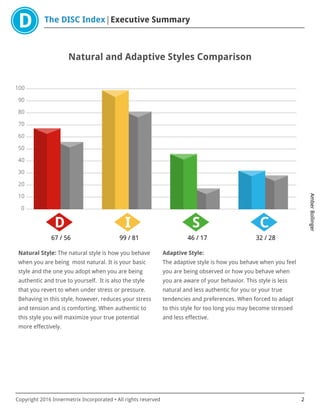
Natural and Adaptive Styles Comparison
0
10
20
30
40
50
60
70
80
90
100
D
67 / 56
I
99 / 81
S
46 / 17
C
32 / 28
Natural Style: The natural style is how you behave
when you are being most natural. It is your basic
style and the one you adopt when you are being
authentic and true to yourself. It is also the style
that you revert to when under stress or pressure.
Behaving in this style, however, reduces your stress
and tension and is comforting. When authentic to
this style you will maximize your true potential
more effectively.
Adaptive Style:
The adaptive style is how you behave when you feel
you are being observed or how you behave when
you are aware of your behavior. This style is less
natural and less authentic for you or your true
tendencies and preferences. When forced to adapt
to this style for too long you may become stressed
and less effective.
The DISC Index Introduction
AmberBollinger
Copyright 2016 Innermetrix Incorporated • All rights reserved 3
About This Report
Research conducted by Innermetrix shows that the most successful people share the common trait of
self-awareness. They recognize the situations that will make them successful, and this makes it easy for
them to find ways of achieving objectives that fit their behavioral style. They also understand their
limitations and where they are not effective and this helps them understand where not to go or how not
to be as well. Those who understand their natural behavioral preferences are far more likely to pursue
the right opportunities, in the right way, at the right time, and get the results they desire.
This report measures four dimensions of your behavioral style. They are:
• Decisive — your preference for problem solving and getting results
• Interactive — your preference for interacting with others and showing emotion
• Stability — your preference for pacing, persistence and steadiness
• Cautious — your preference for procedures, standards and protocols
This report includes:
• The Elements of DISC — Educational background behind the profile, the science and the four
dimensions of behavior
• The DISC Dimensions — A closer look at each of your four behavioral dimensions
• Style Summary — A comparison of your natural and adaptive behavioral styles
• Behavioral Strengths — A detailed strengths-based description of your overall behavioral style
• Communication — Tips on how you like to communicate and be communicated with
• Ideal Job Climate — Your ideal work environment
• Effectiveness — Insights into how you can be more effective by understanding your behavior
• Behavioral Motivations — Ways to ensure your environment is motivational
• Continual Improvement — Areas where you can focus on improving
• Training & Learning Style — Your preferred means of sharing and receiving styles
• Relevance Section — Making the information real and pertinent to you
• Success Connection — Connecting your style to your own life
The DISC Index Four Components of Behavior
AmberBollinger
Copyright 2016 Innermetrix Incorporated • All rights reserved 4
The Elements of the DISC-Index
This DISC-Index report is unique in the marketplace for a number of reasons. You just completed the
first ever click & drag DISC instrument on the market. This was constructed in a precise manner to allow
for ease of responses, even in the midst of many difficult decisions. This intuitive interface allows you to
focus on your answers, not the process.
Also, unlike other DISC instruments, this instrument allows you to rank all four items instead. As a result,
this instrument produces zero waste in responses. Some instruments ask you to choose two items out
of four, and leave two items blank. Those instruments have a 50% waste of terms, and do not provide
for an efficient response process. The DISC Index instrument eliminates that response problem.
Another unique aspect of this DISC-Index report is that we present the DISC aspects of your behavior
both as separate entities and as a dynamic combination of traits. This report presents the first time that
each of the DISC elements are separated and developed as pure entities of themselves. This can serve
as an important learning tool as you explore the deeper aspects of DISC. Your unique pattern of DISC
traits is developed through the context of this report. Additionally, the following four pages will be
devoted to exploring your DISC scores as separate components within the unique combination of traits
that you exhibit.
A comment on contradictions: You may read some areas of this report that may contradict other text.
This is due to the fact that many of us show contradictory behaviors in the normal course of our daily
operations. Each of us are at times talkative and other times more reflective, depending on how we are
adapting our behavior. The expression of these contradictions is a demonstration of the sensitivity of
this instrument to determine these subtle differences in our natural and adaptive style.
The DISC Index Four Components of Behavior
AmberBollinger
Copyright 2016 Innermetrix Incorporated • All rights reserved 5
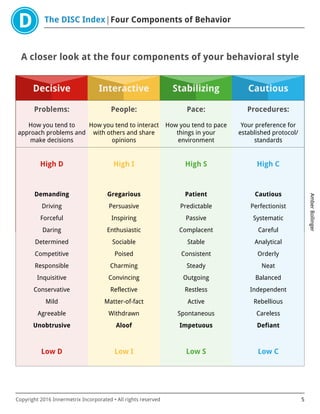
A closer look at the four components of your behavioral style
Decisive
Problems:
How you tend to
approach problems and
make decisions
High D
Demanding
Driving
Forceful
Daring
Determined
Competitive
Responsible
Inquisitive
Conservative
Mild
Agreeable
Unobtrusive
Low D
Interactive
People:
How you tend to interact
with others and share
opinions
High I
Gregarious
Persuasive
Inspiring
Enthusiastic
Sociable
Poised
Charming
Convincing
Reflective
Matter-of-fact
Withdrawn
Aloof
Low I
Stabilizing
Pace:
How you tend to pace
things in your
environment
High S
Patient
Predictable
Passive
Complacent
Stable
Consistent
Steady
Outgoing
Restless
Active
Spontaneous
Impetuous
Low S
Cautious
Procedures:
Your preference for
established protocol/
standards
High C
Cautious
Perfectionist
Systematic
Careful
Analytical
Orderly
Neat
Balanced
Independent
Rebellious
Careless
Defiant
Low C
The DISC Index Four Components of Behavior
AmberBollinger
Copyright 2016 Innermetrix Incorporated • All rights reserved 6
The DISC Index Four Components of Behavior
AmberBollinger
Copyright 2016 Innermetrix Incorporated • All rights reserved 7
Decisive
Your approach to problem-solving and obtaining results
The D in DISC represents Decisiveness. Your score on this scale, represented below, shows your location
on the D spectrum based on the pattern of your responses. A high score doesn't mean good, and a low
score doesn't mean bad, as this is a spectrum or continuum of behavioral traits. For example:
Higher D —
Tend to solve new problems very quickly and assertively. They take an active and direct approach to
obtaining results. The key here is new problems such as those that are unprecedented or haven't
happened before. There may also be an element of risk in taking the wrong approach or developing
an incorrect solution, but those with a High D score are willing to take those risks, even if they may be
incorrect.
Lower D —
Tend to solve new problems in a more deliberate, controlled, and organized manner. Again, the key
here is new and unprecedented problems. The Lower D style will solve routine problems very quickly
because the outcomes are already known. But, when the outcomes are unknown and the problem is
an uncertain one, the Lower D style will approach the new problem in a calculated and deliberate
manner by thinking things through very carefully before acting.
0
10
20
30
40
50
60
70
80
90
100
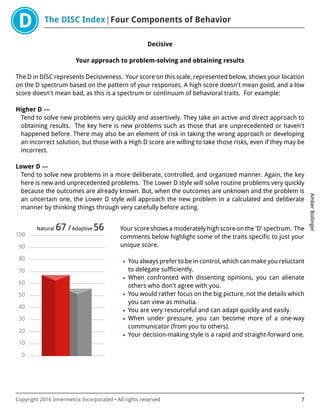
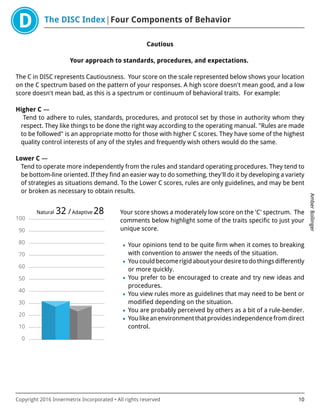
Natural 67 /Adaptive 56 Your score shows a moderately high score on the 'D' spectrum. The
comments below highlight some of the traits specific to just your
unique score.
• You always prefer to be in control, which can make you reluctant
to delegate sufficiently.
• When confronted with dissenting opinions, you can alienate
others who don't agree with you.
• You would rather focus on the big picture, not the details which
you can view as minutia.
• You are very resourceful and can adapt quickly and easily.
• When under pressure, you can become more of a one-way
communicator (from you to others).
• Your decision-making style is a rapid and straight-forward one.
The DISC Index Four Components of Behavior
AmberBollinger
Copyright 2016 Innermetrix Incorporated • All rights reserved 8
Interactive
Your approach to interacting with people and display of emotions.
The I in DISC represents Interactive. Your score on this scale represented below shows your location on
the I spectrum based on the pattern of your responses. A high score doesn't mean good, and a low score
doesn't mean bad, as this is a spectrum or continuum of behavioral traits. For example:
Higher I —
Tend to meet new people in an outgoing, gregarious, and socially assertive manner. The key here is
new people whom one hasn't met before. Many other styles are talkative, but more so with people
that they've known for some time. The Higher I scores are talkative, interactive and open even with
people whom they have just initially met. People scoring in this range may also be a bit impulsive.
Generally speaking, those with the Higher I scores are generally talkative and outgoing.
Lower I —
Tend to meet new people in a more controlled, quiet and reserved manner. Here's where the key word
"new people" enters the equation. Those with Lower I scores are talkative with their friends and close
associates, but tend to be more reserved with people they've just recently met. They tend to place a
premium on the control of emotions, and approach new relationships with a more reflective approach
than an emotional one.
0
10
20
30
40
50
60
70
80
90
100
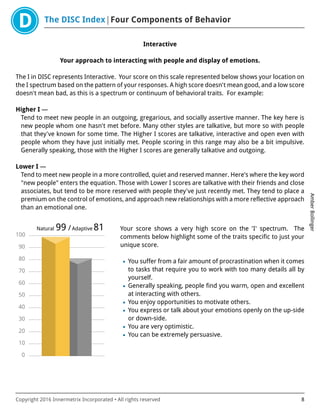
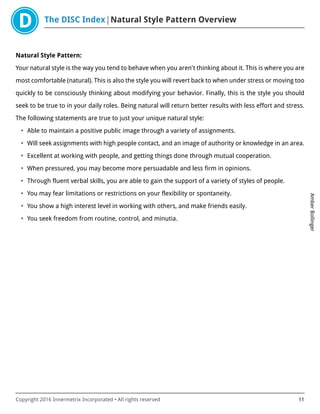
Natural 99 /Adaptive 81 Your score shows a very high score on the 'I' spectrum. The
comments below highlight some of the traits specific to just your
unique score.
• You suffer from a fair amount of procrastination when it comes
to tasks that require you to work with too many details all by
yourself.
• Generally speaking, people find you warm, open and excellent
at interacting with others.
• You enjoy opportunities to motivate others.
• You express or talk about your emotions openly on the up-side
or down-side.
• You are very optimistic.
• You can be extremely persuasive.
The DISC Index Four Components of Behavior
AmberBollinger
Copyright 2016 Innermetrix Incorporated • All rights reserved 9
Stabilizing
Your approach to the pace of the work environment
The S in DISC represents Stabilizing. Your score on this scale represented below shows your location on
the S spectrum based on the pattern of your responses. A high score doesn't mean good, and a low score
doesn't mean bad, as this is a spectrum or continuum of behavioral traits. For example:
Higher S —
Tend to prefer a more controlled, deliberative and predictable environment. They place a premium on
security of a work situation and disciplined behavior. They also tend to show a sense of loyalty to a
team or organization, and as a result, may have a greater longevity or tenure in a position than some
other styles. They have an excellent listening style and are very patient coaches and teachers for others
on the team.
Lower S —
Tend to prefer a more flexible, dynamic, unstructured work environment. They value freedom of
expression and the ability to change quickly from one activity to another. They tend to become bored
with the same routine that brings security to the Higher S traits. As a result, they will seek opportunities
and outlets for their high sense of urgency and high activity levels, as they have a preference for
spontaneity.
0
10
20
30
40
50
60
70
80
90
100
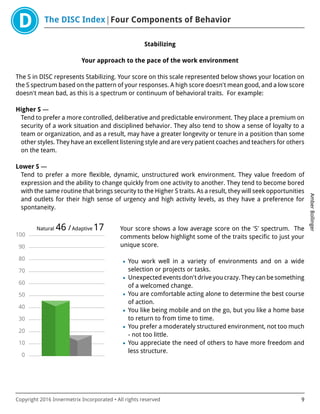
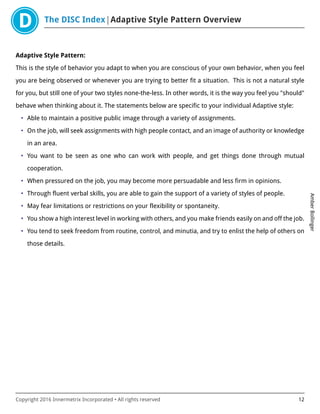
Natural 46 /Adaptive 17 Your score shows a low average score on the 'S' spectrum. The
comments below highlight some of the traits specific to just your
unique score.
• You work well in a variety of environments and on a wide
selection or projects or tasks.
• Unexpected events don't drive you crazy. They can be something
of a welcomed change.
• You are comfortable acting alone to determine the best course
of action.
• You like being mobile and on the go, but you like a home base
to return to from time to time.
• You prefer a moderately structured environment, not too much
- not too little.
• You appreciate the need of others to have more freedom and
less structure.
The DISC Index Four Components of Behavior
AmberBollinger
Copyright 2016 Innermetrix Incorporated • All rights reserved 10
Cautious
Your approach to standards, procedures, and expectations.
The C in DISC represents Cautiousness. Your score on the scale represented below shows your location
on the C spectrum based on the pattern of your responses. A high score doesn't mean good, and a low
score doesn't mean bad, as this is a spectrum or continuum of behavioral traits. For example:
Higher C —
Tend to adhere to rules, standards, procedures, and protocol set by those in authority whom they
respect. They like things to be done the right way according to the operating manual. "Rules are made
to be followed" is an appropriate motto for those with higher C scores. They have some of the highest
quality control interests of any of the styles and frequently wish others would do the same.
Lower C —
Tend to operate more independently from the rules and standard operating procedures. They tend to
be bottom-line oriented. If they find an easier way to do something, they'll do it by developing a variety
of strategies as situations demand. To the Lower C scores, rules are only guidelines, and may be bent
or broken as necessary to obtain results.
0
10
20
30
40
50
60
70
80
90
100
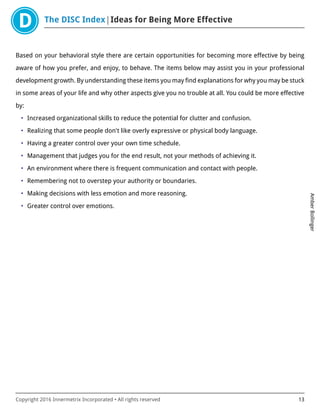
Natural 32 /Adaptive 28 Your score shows a moderately low score on the 'C' spectrum. The
comments below highlight some of the traits specific to just your
unique score.
• Your opinions tend to be quite firm when it comes to breaking
with convention to answer the needs of the situation.
• Youcouldbecomerigidaboutyourdesiretodothingsdifferently
or more quickly.
• You prefer to be encouraged to create and try new ideas and
procedures.
• You view rules more as guidelines that may need to be bent or
modified depending on the situation.
• You are probably perceived by others as a bit of a rule-bender.
• Youlikeanenvironmentthatprovidesindependencefromdirect
control.
The DISC Index Natural Style Pattern Overview
AmberBollinger
Copyright 2016 Innermetrix Incorporated • All rights reserved 11
Natural Style Pattern:
Your natural style is the way you tend to behave when you aren't thinking about it. This is where you are
most comfortable (natural). This is also the style you will revert back to when under stress or moving too
quickly to be consciously thinking about modifying your behavior. Finally, this is the style you should
seek to be true to in your daily roles. Being natural will return better results with less effort and stress.
The following statements are true to just your unique natural style:
• Able to maintain a positive public image through a variety of assignments.
• Will seek assignments with high people contact, and an image of authority or knowledge in an area.
• Excellent at working with people, and getting things done through mutual cooperation.
• When pressured, you may become more persuadable and less firm in opinions.
• Through fluent verbal skills, you are able to gain the support of a variety of styles of people.
• You may fear limitations or restrictions on your flexibility or spontaneity.
• You show a high interest level in working with others, and make friends easily.
• You seek freedom from routine, control, and minutia.
The DISC Index Adaptive Style Pattern Overview
AmberBollinger
Copyright 2016 Innermetrix Incorporated • All rights reserved 12
Adaptive Style Pattern:
This is the style of behavior you adapt to when you are conscious of your own behavior, when you feel
you are being observed or whenever you are trying to better fit a situation. This is not a natural style
for you, but still one of your two styles none-the-less. In other words, it is the way you feel you "should"
behave when thinking about it. The statements below are specific to your individual Adaptive style:
• Able to maintain a positive public image through a variety of assignments.
• On the job, will seek assignments with high people contact, and an image of authority or knowledge
in an area.
• You want to be seen as one who can work with people, and get things done through mutual
cooperation.
• When pressured on the job, you may become more persuadable and less firm in opinions.
• Through fluent verbal skills, you are able to gain the support of a variety of styles of people.
• May fear limitations or restrictions on your flexibility or spontaneity.
• You show a high interest level in working with others, and you make friends easily on and off the job.
• You tend to seek freedom from routine, control, and minutia, and try to enlist the help of others on
those details.
The DISC Index Ideas for Being More Effective
AmberBollinger
Copyright 2016 Innermetrix Incorporated • All rights reserved 13
Based on your behavioral style there are certain opportunities for becoming more effective by being
aware of how you prefer, and enjoy, to behave. The items below may assist you in your professional
development growth. By understanding these items you may find explanations for why you may be stuck
in some areas of your life and why other aspects give you no trouble at all. You could be more effective
by:
• Increased organizational skills to reduce the potential for clutter and confusion.
• Realizing that some people don't like overly expressive or physical body language.
• Having a greater control over your own time schedule.
• Management that judges you for the end result, not your methods of achieving it.
• An environment where there is frequent communication and contact with people.
• Remembering not to overstep your authority or boundaries.
• Making decisions with less emotion and more reasoning.
• Greater control over emotions.
The DISC Index Ideas for Staying More Motivated
AmberBollinger
Copyright 2016 Innermetrix Incorporated • All rights reserved 14
Your behavioral style will cause you to be motivated by certain factors in your environment. Having these
present may make you feel more motivated, and productive. The following are things that you may want
in your surroundings to feel optimally motivated:
• A democratic environment with a free exchange of ideas.
• Interesting activities outside of the work environment. Some peers with similar scores like to be
involved in volunteer and community activities.
• Someone else who you trust to do the detailed work and the follow through.
• Opportunity for advancement and career expansion.
• A variety of activities involving people, both on the job and off.
• Social recognition for success on a project or achieving a goal.
• Freedom of speech and people to listen.
• A strong, visible group or organization with which to identify.
The DISC Index Strength-based Insights
AmberBollinger
Copyright 2016 Innermetrix Incorporated • All rights reserved 15
Eachbehavioralstylecontainscertainuniquestrengthsasaresultofhowyourfourbehavioraldimensions
relate to each other. Understanding your own unique behavioral strengths is an important part of putting
your new level of self-awareness to work for your success and satisfaction. The following statements
highlight specific strengths of your behavioral style:
• You are very much at ease in making presentations to large or small groups.
• Able to react and adapt quickly to change in projects or activities.
• You work effectively with people through leadership, and work through people by providing them
long-term motivation through your natural optimism.
• A high sense of urgency to get things done… now.
• An excellent team-player, you are very effective at training or developing others.
• You have the rare ability to fit into a great many cultures or environments.
• A self-starter and active agent in all you do.
• You score like those known to be 'movers and shakers' in the workplace.
The DISC Index Ideal Job/Climate
AmberBollinger
Copyright 2016 Innermetrix Incorporated • All rights reserved 16
Your behavioral style plays a significant role in determining what aspects of an environment you like.
The items below will help you understand what will define an ideal working climate for you. Based on
how you prefer to behave, an ideal climate for you is one that provides you with:
• Challenging assignments.
• Opportunity to be heard on a variety of issues.
• Public recognition of accomplishments.
• Freedom from controls, details, and minutia.
• Mobility, and freedom to travel around the organization or around the country.
• Wide scope of involvement with a variety of people.
• Flexible environment, able to support changes and spontaneity.
• Opportunity to try new ideas.
The DISC Index Areas for Continual Improvement
AmberBollinger
Copyright 2016 Innermetrix Incorporated • All rights reserved 17
Along with strengths, all behavioral styles come with areas that could become weaknesses - if depended
upon or not acknowledged. The trick is not to manufacture a weakness in the first place by depending
on these things.
Here are a few items that could become problematic for you if not acknowledged or known. Your
awareness of the potentials below is your best step in making sure they remain only potential problems.
Due to your behavioral style, you may tend to:
• May have difficulty disciplining others, or bearing bad news.
• The high trust level may be extended to some others with fewer scruples, and you may get 'burned'
in the process.
• May sometimes act impulsively, emotions over facts.
• May be somewhat disorganized behind the scenes, but the public presence will maintain an orderly
image.
• The natural optimism may yield a tendency to over-forecast or over-estimate the success of the
project.
• Sometimes inattentive to details, and may need support in this area.
• You may overestimate you ability to influence people.
• Couldbemoreeffectivewithlargegroupsbybeingabitmorefirmindelegatingandsettingdeadlines.
The DISC Index Preferred Training and Learning Style
AmberBollinger
Copyright 2016 Innermetrix Incorporated • All rights reserved 18
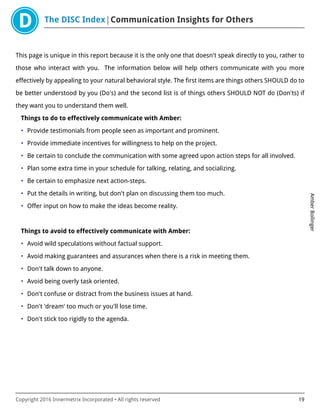
Based on how you tend to behave you have certain preferences for how you like to convey information,
teach, instruct or share knowledge with others. This is also true of how you like to receive information
and learn. Understanding your behavioral preferences here will help increase your effectiveness in
teaching or instructing others, and in being taught and learning.
How you prefer to share knowledge or teach:
• Enriches the content with stories and experiences.
• Leads the group by persuading, and inspiring them.
• Presents in a decisive, friendly, and authoritative manner.
• Shows authority by using rewards and punishments.
• Believes that knowledge gives the participants the ability to maximize their potential and share with
others.
• Shows a high sense of urgency to cover the content and have a good time doing so.
• Structures events to inspire participants to act on their ideas and visions.
How you prefer to receive knowledge or learn:
• Processes information actively.
• Develops own learning strategies.
• Responds actively to others, and tends to take learning risks.
• Likes self-discovery and trial and error methods.
• Tends to structure own learning.
• Likes active testing of ideas and experiences.
• Self-defined goals.
The DISC Index Communication Insights for Others
AmberBollinger
Copyright 2016 Innermetrix Incorporated • All rights reserved 19
This page is unique in this report because it is the only one that doesn't speak directly to you, rather to
those who interact with you. The information below will help others communicate with you more
effectively by appealing to your natural behavioral style. The first items are things others SHOULD do to
be better understood by you (Do's) and the second list is of things others SHOULD NOT do (Don'ts) if
they want you to understand them well.
Things to do to effectively communicate with Amber:
• Provide testimonials from people seen as important and prominent.
• Provide immediate incentives for willingness to help on the project.
• Be certain to conclude the communication with some agreed upon action steps for all involved.
• Plan some extra time in your schedule for talking, relating, and socializing.
• Be certain to emphasize next action-steps.
• Put the details in writing, but don't plan on discussing them too much.
• Offer input on how to make the ideas become reality.
Things to avoid to effectively communicate with Amber:
• Avoid wild speculations without factual support.
• Avoid making guarantees and assurances when there is a risk in meeting them.
• Don't talk down to anyone.
• Avoid being overly task oriented.
• Don't confuse or distract from the business issues at hand.
• Don't 'dream' too much or you'll lose time.
• Don't stick too rigidly to the agenda.
The DISC Index Relevance Section
AmberBollinger
Copyright 2016 Innermetrix Incorporated • All rights reserved 20
In order to make the most out of the information in this report it is important that you connect it to your
life in a tangible way. To help you make this information your own, and pull out the most relevant parts,
fill in the blanks below.
Decisiveness:
How is your 'D' score relevant to your life?
___________________________________________________________________________________________________________
Interacting:
How is your 'I' score relevant to your life?
___________________________________________________________________________________________________________
Stabilizing:
How is your 'S' score relevant to your life?
___________________________________________________________________________________________________________
Cautiousness:
How is your 'C' score relevant to your life?
___________________________________________________________________________________________________________
Overall Natural Style:
What is one way in which your natural style relates to your life?
___________________________________________________________________________________________________________
Overall Adaptive Style:
What is one way in which your adaptive style relates to your life?
___________________________________________________________________________________________________________
Strength-based insights:
What specific strengths do you think connect to your success more than any other?
___________________________________________________________________________________________________________
The DISC Index Relevance Section
AmberBollinger
Copyright 2016 Innermetrix Incorporated • All rights reserved 21
Communication Dos and Don'ts:
What did you learn from understanding your preferred communication style?
___________________________________________________________________________________________________________
Ideal Job Climate:
How well does your current climate fit your behavioral style?
___________________________________________________________________________________________________________
Effectiveness:
What is one way in which you could become more effective?
___________________________________________________________________________________________________________
Motivation:
How can you stay more motivated?
___________________________________________________________________________________________________________
Improvement:
What is something you learned that you can use to improve your performance?
___________________________________________________________________________________________________________
Training/Learning:
What did you learn that could help you instruct others better, or learn more effectively?
___________________________________________________________________________________________________________
The DISC Index Relevance Section
AmberBollinger
Copyright 2016 Innermetrix Incorporated • All rights reserved 22
Your final step to making sure you really benefit from the information in this report is to understand
how your behavioral style contributes to, and perhaps hinders, your overall success.
Supporting Success:
Overall, how can your unique behavioral style support your success? (cite specific examples)
___________________________________________________________________________________________________________
___________________________________________________________________________________________________________
___________________________________________________________________________________________________________
___________________________________________________________________________________________________________
___________________________________________________________________________________________________________
___________________________________________________________________________________________________________
___________________________________________________________________________________________________________
___________________________________________________________________________________________________________
Limiting Success:
Overall, how could your unique behavioral style get in the way of your success? (cite specific examples)
___________________________________________________________________________________________________________
___________________________________________________________________________________________________________
___________________________________________________________________________________________________________
___________________________________________________________________________________________________________
___________________________________________________________________________________________________________
___________________________________________________________________________________________________________
___________________________________________________________________________________________________________
___________________________________________________________________________________________________________

DISC-Amber_Bollinger

  • 1.
    Copyright 2016 InnermetrixIncorporated • All rights reserved Amber Bollinger October 31, 2016 This Innermetrix Disc Index is a modern interpretation of Dr. William Marston's behavioral dimensions. Marston's research uncovered four quadrants of behavior which help to understand a person's behavioral preferences. This Disc Index will help you understand your behavioral style and how to maximize your potential. Anthony Robbins Coaching www.tonyrobbins.com
  • 2.
    The DISC IndexExecutive Summary AmberBollinger Copyright 2016 Innermetrix Incorporated • All rights reserved 2 Natural and Adaptive Styles Comparison 0 10 20 30 40 50 60 70 80 90 100 D 67 / 56 I 99 / 81 S 46 / 17 C 32 / 28 Natural Style: The natural style is how you behave when you are being most natural. It is your basic style and the one you adopt when you are being authentic and true to yourself. It is also the style that you revert to when under stress or pressure. Behaving in this style, however, reduces your stress and tension and is comforting. When authentic to this style you will maximize your true potential more effectively. Adaptive Style: The adaptive style is how you behave when you feel you are being observed or how you behave when you are aware of your behavior. This style is less natural and less authentic for you or your true tendencies and preferences. When forced to adapt to this style for too long you may become stressed and less effective.
  • 3.
    The DISC IndexIntroduction AmberBollinger Copyright 2016 Innermetrix Incorporated • All rights reserved 3 About This Report Research conducted by Innermetrix shows that the most successful people share the common trait of self-awareness. They recognize the situations that will make them successful, and this makes it easy for them to find ways of achieving objectives that fit their behavioral style. They also understand their limitations and where they are not effective and this helps them understand where not to go or how not to be as well. Those who understand their natural behavioral preferences are far more likely to pursue the right opportunities, in the right way, at the right time, and get the results they desire. This report measures four dimensions of your behavioral style. They are: • Decisive — your preference for problem solving and getting results • Interactive — your preference for interacting with others and showing emotion • Stability — your preference for pacing, persistence and steadiness • Cautious — your preference for procedures, standards and protocols This report includes: • The Elements of DISC — Educational background behind the profile, the science and the four dimensions of behavior • The DISC Dimensions — A closer look at each of your four behavioral dimensions • Style Summary — A comparison of your natural and adaptive behavioral styles • Behavioral Strengths — A detailed strengths-based description of your overall behavioral style • Communication — Tips on how you like to communicate and be communicated with • Ideal Job Climate — Your ideal work environment • Effectiveness — Insights into how you can be more effective by understanding your behavior • Behavioral Motivations — Ways to ensure your environment is motivational • Continual Improvement — Areas where you can focus on improving • Training & Learning Style — Your preferred means of sharing and receiving styles • Relevance Section — Making the information real and pertinent to you • Success Connection — Connecting your style to your own life
  • 4.
    The DISC IndexFour Components of Behavior AmberBollinger Copyright 2016 Innermetrix Incorporated • All rights reserved 4 The Elements of the DISC-Index This DISC-Index report is unique in the marketplace for a number of reasons. You just completed the first ever click & drag DISC instrument on the market. This was constructed in a precise manner to allow for ease of responses, even in the midst of many difficult decisions. This intuitive interface allows you to focus on your answers, not the process. Also, unlike other DISC instruments, this instrument allows you to rank all four items instead. As a result, this instrument produces zero waste in responses. Some instruments ask you to choose two items out of four, and leave two items blank. Those instruments have a 50% waste of terms, and do not provide for an efficient response process. The DISC Index instrument eliminates that response problem. Another unique aspect of this DISC-Index report is that we present the DISC aspects of your behavior both as separate entities and as a dynamic combination of traits. This report presents the first time that each of the DISC elements are separated and developed as pure entities of themselves. This can serve as an important learning tool as you explore the deeper aspects of DISC. Your unique pattern of DISC traits is developed through the context of this report. Additionally, the following four pages will be devoted to exploring your DISC scores as separate components within the unique combination of traits that you exhibit. A comment on contradictions: You may read some areas of this report that may contradict other text. This is due to the fact that many of us show contradictory behaviors in the normal course of our daily operations. Each of us are at times talkative and other times more reflective, depending on how we are adapting our behavior. The expression of these contradictions is a demonstration of the sensitivity of this instrument to determine these subtle differences in our natural and adaptive style.
  • 5.
    The DISC IndexFour Components of Behavior AmberBollinger Copyright 2016 Innermetrix Incorporated • All rights reserved 5 A closer look at the four components of your behavioral style Decisive Problems: How you tend to approach problems and make decisions High D Demanding Driving Forceful Daring Determined Competitive Responsible Inquisitive Conservative Mild Agreeable Unobtrusive Low D Interactive People: How you tend to interact with others and share opinions High I Gregarious Persuasive Inspiring Enthusiastic Sociable Poised Charming Convincing Reflective Matter-of-fact Withdrawn Aloof Low I Stabilizing Pace: How you tend to pace things in your environment High S Patient Predictable Passive Complacent Stable Consistent Steady Outgoing Restless Active Spontaneous Impetuous Low S Cautious Procedures: Your preference for established protocol/ standards High C Cautious Perfectionist Systematic Careful Analytical Orderly Neat Balanced Independent Rebellious Careless Defiant Low C
  • 6.
    The DISC IndexFour Components of Behavior AmberBollinger Copyright 2016 Innermetrix Incorporated • All rights reserved 6
  • 7.
    The DISC IndexFour Components of Behavior AmberBollinger Copyright 2016 Innermetrix Incorporated • All rights reserved 7 Decisive Your approach to problem-solving and obtaining results The D in DISC represents Decisiveness. Your score on this scale, represented below, shows your location on the D spectrum based on the pattern of your responses. A high score doesn't mean good, and a low score doesn't mean bad, as this is a spectrum or continuum of behavioral traits. For example: Higher D — Tend to solve new problems very quickly and assertively. They take an active and direct approach to obtaining results. The key here is new problems such as those that are unprecedented or haven't happened before. There may also be an element of risk in taking the wrong approach or developing an incorrect solution, but those with a High D score are willing to take those risks, even if they may be incorrect. Lower D — Tend to solve new problems in a more deliberate, controlled, and organized manner. Again, the key here is new and unprecedented problems. The Lower D style will solve routine problems very quickly because the outcomes are already known. But, when the outcomes are unknown and the problem is an uncertain one, the Lower D style will approach the new problem in a calculated and deliberate manner by thinking things through very carefully before acting. 0 10 20 30 40 50 60 70 80 90 100 Natural 67 /Adaptive 56 Your score shows a moderately high score on the 'D' spectrum. The comments below highlight some of the traits specific to just your unique score. • You always prefer to be in control, which can make you reluctant to delegate sufficiently. • When confronted with dissenting opinions, you can alienate others who don't agree with you. • You would rather focus on the big picture, not the details which you can view as minutia. • You are very resourceful and can adapt quickly and easily. • When under pressure, you can become more of a one-way communicator (from you to others). • Your decision-making style is a rapid and straight-forward one.
  • 8.
    The DISC IndexFour Components of Behavior AmberBollinger Copyright 2016 Innermetrix Incorporated • All rights reserved 8 Interactive Your approach to interacting with people and display of emotions. The I in DISC represents Interactive. Your score on this scale represented below shows your location on the I spectrum based on the pattern of your responses. A high score doesn't mean good, and a low score doesn't mean bad, as this is a spectrum or continuum of behavioral traits. For example: Higher I — Tend to meet new people in an outgoing, gregarious, and socially assertive manner. The key here is new people whom one hasn't met before. Many other styles are talkative, but more so with people that they've known for some time. The Higher I scores are talkative, interactive and open even with people whom they have just initially met. People scoring in this range may also be a bit impulsive. Generally speaking, those with the Higher I scores are generally talkative and outgoing. Lower I — Tend to meet new people in a more controlled, quiet and reserved manner. Here's where the key word "new people" enters the equation. Those with Lower I scores are talkative with their friends and close associates, but tend to be more reserved with people they've just recently met. They tend to place a premium on the control of emotions, and approach new relationships with a more reflective approach than an emotional one. 0 10 20 30 40 50 60 70 80 90 100 Natural 99 /Adaptive 81 Your score shows a very high score on the 'I' spectrum. The comments below highlight some of the traits specific to just your unique score. • You suffer from a fair amount of procrastination when it comes to tasks that require you to work with too many details all by yourself. • Generally speaking, people find you warm, open and excellent at interacting with others. • You enjoy opportunities to motivate others. • You express or talk about your emotions openly on the up-side or down-side. • You are very optimistic. • You can be extremely persuasive.
  • 9.
    The DISC IndexFour Components of Behavior AmberBollinger Copyright 2016 Innermetrix Incorporated • All rights reserved 9 Stabilizing Your approach to the pace of the work environment The S in DISC represents Stabilizing. Your score on this scale represented below shows your location on the S spectrum based on the pattern of your responses. A high score doesn't mean good, and a low score doesn't mean bad, as this is a spectrum or continuum of behavioral traits. For example: Higher S — Tend to prefer a more controlled, deliberative and predictable environment. They place a premium on security of a work situation and disciplined behavior. They also tend to show a sense of loyalty to a team or organization, and as a result, may have a greater longevity or tenure in a position than some other styles. They have an excellent listening style and are very patient coaches and teachers for others on the team. Lower S — Tend to prefer a more flexible, dynamic, unstructured work environment. They value freedom of expression and the ability to change quickly from one activity to another. They tend to become bored with the same routine that brings security to the Higher S traits. As a result, they will seek opportunities and outlets for their high sense of urgency and high activity levels, as they have a preference for spontaneity. 0 10 20 30 40 50 60 70 80 90 100 Natural 46 /Adaptive 17 Your score shows a low average score on the 'S' spectrum. The comments below highlight some of the traits specific to just your unique score. • You work well in a variety of environments and on a wide selection or projects or tasks. • Unexpected events don't drive you crazy. They can be something of a welcomed change. • You are comfortable acting alone to determine the best course of action. • You like being mobile and on the go, but you like a home base to return to from time to time. • You prefer a moderately structured environment, not too much - not too little. • You appreciate the need of others to have more freedom and less structure.
  • 10.
    The DISC IndexFour Components of Behavior AmberBollinger Copyright 2016 Innermetrix Incorporated • All rights reserved 10 Cautious Your approach to standards, procedures, and expectations. The C in DISC represents Cautiousness. Your score on the scale represented below shows your location on the C spectrum based on the pattern of your responses. A high score doesn't mean good, and a low score doesn't mean bad, as this is a spectrum or continuum of behavioral traits. For example: Higher C — Tend to adhere to rules, standards, procedures, and protocol set by those in authority whom they respect. They like things to be done the right way according to the operating manual. "Rules are made to be followed" is an appropriate motto for those with higher C scores. They have some of the highest quality control interests of any of the styles and frequently wish others would do the same. Lower C — Tend to operate more independently from the rules and standard operating procedures. They tend to be bottom-line oriented. If they find an easier way to do something, they'll do it by developing a variety of strategies as situations demand. To the Lower C scores, rules are only guidelines, and may be bent or broken as necessary to obtain results. 0 10 20 30 40 50 60 70 80 90 100 Natural 32 /Adaptive 28 Your score shows a moderately low score on the 'C' spectrum. The comments below highlight some of the traits specific to just your unique score. • Your opinions tend to be quite firm when it comes to breaking with convention to answer the needs of the situation. • Youcouldbecomerigidaboutyourdesiretodothingsdifferently or more quickly. • You prefer to be encouraged to create and try new ideas and procedures. • You view rules more as guidelines that may need to be bent or modified depending on the situation. • You are probably perceived by others as a bit of a rule-bender. • Youlikeanenvironmentthatprovidesindependencefromdirect control.
  • 11.
    The DISC IndexNatural Style Pattern Overview AmberBollinger Copyright 2016 Innermetrix Incorporated • All rights reserved 11 Natural Style Pattern: Your natural style is the way you tend to behave when you aren't thinking about it. This is where you are most comfortable (natural). This is also the style you will revert back to when under stress or moving too quickly to be consciously thinking about modifying your behavior. Finally, this is the style you should seek to be true to in your daily roles. Being natural will return better results with less effort and stress. The following statements are true to just your unique natural style: • Able to maintain a positive public image through a variety of assignments. • Will seek assignments with high people contact, and an image of authority or knowledge in an area. • Excellent at working with people, and getting things done through mutual cooperation. • When pressured, you may become more persuadable and less firm in opinions. • Through fluent verbal skills, you are able to gain the support of a variety of styles of people. • You may fear limitations or restrictions on your flexibility or spontaneity. • You show a high interest level in working with others, and make friends easily. • You seek freedom from routine, control, and minutia.
  • 12.
    The DISC IndexAdaptive Style Pattern Overview AmberBollinger Copyright 2016 Innermetrix Incorporated • All rights reserved 12 Adaptive Style Pattern: This is the style of behavior you adapt to when you are conscious of your own behavior, when you feel you are being observed or whenever you are trying to better fit a situation. This is not a natural style for you, but still one of your two styles none-the-less. In other words, it is the way you feel you "should" behave when thinking about it. The statements below are specific to your individual Adaptive style: • Able to maintain a positive public image through a variety of assignments. • On the job, will seek assignments with high people contact, and an image of authority or knowledge in an area. • You want to be seen as one who can work with people, and get things done through mutual cooperation. • When pressured on the job, you may become more persuadable and less firm in opinions. • Through fluent verbal skills, you are able to gain the support of a variety of styles of people. • May fear limitations or restrictions on your flexibility or spontaneity. • You show a high interest level in working with others, and you make friends easily on and off the job. • You tend to seek freedom from routine, control, and minutia, and try to enlist the help of others on those details.
  • 13.
    The DISC IndexIdeas for Being More Effective AmberBollinger Copyright 2016 Innermetrix Incorporated • All rights reserved 13 Based on your behavioral style there are certain opportunities for becoming more effective by being aware of how you prefer, and enjoy, to behave. The items below may assist you in your professional development growth. By understanding these items you may find explanations for why you may be stuck in some areas of your life and why other aspects give you no trouble at all. You could be more effective by: • Increased organizational skills to reduce the potential for clutter and confusion. • Realizing that some people don't like overly expressive or physical body language. • Having a greater control over your own time schedule. • Management that judges you for the end result, not your methods of achieving it. • An environment where there is frequent communication and contact with people. • Remembering not to overstep your authority or boundaries. • Making decisions with less emotion and more reasoning. • Greater control over emotions.
  • 14.
    The DISC IndexIdeas for Staying More Motivated AmberBollinger Copyright 2016 Innermetrix Incorporated • All rights reserved 14 Your behavioral style will cause you to be motivated by certain factors in your environment. Having these present may make you feel more motivated, and productive. The following are things that you may want in your surroundings to feel optimally motivated: • A democratic environment with a free exchange of ideas. • Interesting activities outside of the work environment. Some peers with similar scores like to be involved in volunteer and community activities. • Someone else who you trust to do the detailed work and the follow through. • Opportunity for advancement and career expansion. • A variety of activities involving people, both on the job and off. • Social recognition for success on a project or achieving a goal. • Freedom of speech and people to listen. • A strong, visible group or organization with which to identify.
  • 15.
    The DISC IndexStrength-based Insights AmberBollinger Copyright 2016 Innermetrix Incorporated • All rights reserved 15 Eachbehavioralstylecontainscertainuniquestrengthsasaresultofhowyourfourbehavioraldimensions relate to each other. Understanding your own unique behavioral strengths is an important part of putting your new level of self-awareness to work for your success and satisfaction. The following statements highlight specific strengths of your behavioral style: • You are very much at ease in making presentations to large or small groups. • Able to react and adapt quickly to change in projects or activities. • You work effectively with people through leadership, and work through people by providing them long-term motivation through your natural optimism. • A high sense of urgency to get things done… now. • An excellent team-player, you are very effective at training or developing others. • You have the rare ability to fit into a great many cultures or environments. • A self-starter and active agent in all you do. • You score like those known to be 'movers and shakers' in the workplace.
  • 16.
    The DISC IndexIdeal Job/Climate AmberBollinger Copyright 2016 Innermetrix Incorporated • All rights reserved 16 Your behavioral style plays a significant role in determining what aspects of an environment you like. The items below will help you understand what will define an ideal working climate for you. Based on how you prefer to behave, an ideal climate for you is one that provides you with: • Challenging assignments. • Opportunity to be heard on a variety of issues. • Public recognition of accomplishments. • Freedom from controls, details, and minutia. • Mobility, and freedom to travel around the organization or around the country. • Wide scope of involvement with a variety of people. • Flexible environment, able to support changes and spontaneity. • Opportunity to try new ideas.
  • 17.
    The DISC IndexAreas for Continual Improvement AmberBollinger Copyright 2016 Innermetrix Incorporated • All rights reserved 17 Along with strengths, all behavioral styles come with areas that could become weaknesses - if depended upon or not acknowledged. The trick is not to manufacture a weakness in the first place by depending on these things. Here are a few items that could become problematic for you if not acknowledged or known. Your awareness of the potentials below is your best step in making sure they remain only potential problems. Due to your behavioral style, you may tend to: • May have difficulty disciplining others, or bearing bad news. • The high trust level may be extended to some others with fewer scruples, and you may get 'burned' in the process. • May sometimes act impulsively, emotions over facts. • May be somewhat disorganized behind the scenes, but the public presence will maintain an orderly image. • The natural optimism may yield a tendency to over-forecast or over-estimate the success of the project. • Sometimes inattentive to details, and may need support in this area. • You may overestimate you ability to influence people. • Couldbemoreeffectivewithlargegroupsbybeingabitmorefirmindelegatingandsettingdeadlines.
  • 18.
    The DISC IndexPreferred Training and Learning Style AmberBollinger Copyright 2016 Innermetrix Incorporated • All rights reserved 18 Based on how you tend to behave you have certain preferences for how you like to convey information, teach, instruct or share knowledge with others. This is also true of how you like to receive information and learn. Understanding your behavioral preferences here will help increase your effectiveness in teaching or instructing others, and in being taught and learning. How you prefer to share knowledge or teach: • Enriches the content with stories and experiences. • Leads the group by persuading, and inspiring them. • Presents in a decisive, friendly, and authoritative manner. • Shows authority by using rewards and punishments. • Believes that knowledge gives the participants the ability to maximize their potential and share with others. • Shows a high sense of urgency to cover the content and have a good time doing so. • Structures events to inspire participants to act on their ideas and visions. How you prefer to receive knowledge or learn: • Processes information actively. • Develops own learning strategies. • Responds actively to others, and tends to take learning risks. • Likes self-discovery and trial and error methods. • Tends to structure own learning. • Likes active testing of ideas and experiences. • Self-defined goals.
  • 19.
    The DISC IndexCommunication Insights for Others AmberBollinger Copyright 2016 Innermetrix Incorporated • All rights reserved 19 This page is unique in this report because it is the only one that doesn't speak directly to you, rather to those who interact with you. The information below will help others communicate with you more effectively by appealing to your natural behavioral style. The first items are things others SHOULD do to be better understood by you (Do's) and the second list is of things others SHOULD NOT do (Don'ts) if they want you to understand them well. Things to do to effectively communicate with Amber: • Provide testimonials from people seen as important and prominent. • Provide immediate incentives for willingness to help on the project. • Be certain to conclude the communication with some agreed upon action steps for all involved. • Plan some extra time in your schedule for talking, relating, and socializing. • Be certain to emphasize next action-steps. • Put the details in writing, but don't plan on discussing them too much. • Offer input on how to make the ideas become reality. Things to avoid to effectively communicate with Amber: • Avoid wild speculations without factual support. • Avoid making guarantees and assurances when there is a risk in meeting them. • Don't talk down to anyone. • Avoid being overly task oriented. • Don't confuse or distract from the business issues at hand. • Don't 'dream' too much or you'll lose time. • Don't stick too rigidly to the agenda.
  • 20.
    The DISC IndexRelevance Section AmberBollinger Copyright 2016 Innermetrix Incorporated • All rights reserved 20 In order to make the most out of the information in this report it is important that you connect it to your life in a tangible way. To help you make this information your own, and pull out the most relevant parts, fill in the blanks below. Decisiveness: How is your 'D' score relevant to your life? ___________________________________________________________________________________________________________ Interacting: How is your 'I' score relevant to your life? ___________________________________________________________________________________________________________ Stabilizing: How is your 'S' score relevant to your life? ___________________________________________________________________________________________________________ Cautiousness: How is your 'C' score relevant to your life? ___________________________________________________________________________________________________________ Overall Natural Style: What is one way in which your natural style relates to your life? ___________________________________________________________________________________________________________ Overall Adaptive Style: What is one way in which your adaptive style relates to your life? ___________________________________________________________________________________________________________ Strength-based insights: What specific strengths do you think connect to your success more than any other? ___________________________________________________________________________________________________________
  • 21.
    The DISC IndexRelevance Section AmberBollinger Copyright 2016 Innermetrix Incorporated • All rights reserved 21 Communication Dos and Don'ts: What did you learn from understanding your preferred communication style? ___________________________________________________________________________________________________________ Ideal Job Climate: How well does your current climate fit your behavioral style? ___________________________________________________________________________________________________________ Effectiveness: What is one way in which you could become more effective? ___________________________________________________________________________________________________________ Motivation: How can you stay more motivated? ___________________________________________________________________________________________________________ Improvement: What is something you learned that you can use to improve your performance? ___________________________________________________________________________________________________________ Training/Learning: What did you learn that could help you instruct others better, or learn more effectively? ___________________________________________________________________________________________________________
  • 22.
    The DISC IndexRelevance Section AmberBollinger Copyright 2016 Innermetrix Incorporated • All rights reserved 22 Your final step to making sure you really benefit from the information in this report is to understand how your behavioral style contributes to, and perhaps hinders, your overall success. Supporting Success: Overall, how can your unique behavioral style support your success? (cite specific examples) ___________________________________________________________________________________________________________ ___________________________________________________________________________________________________________ ___________________________________________________________________________________________________________ ___________________________________________________________________________________________________________ ___________________________________________________________________________________________________________ ___________________________________________________________________________________________________________ ___________________________________________________________________________________________________________ ___________________________________________________________________________________________________________ Limiting Success: Overall, how could your unique behavioral style get in the way of your success? (cite specific examples) ___________________________________________________________________________________________________________ ___________________________________________________________________________________________________________ ___________________________________________________________________________________________________________ ___________________________________________________________________________________________________________ ___________________________________________________________________________________________________________ ___________________________________________________________________________________________________________ ___________________________________________________________________________________________________________ ___________________________________________________________________________________________________________