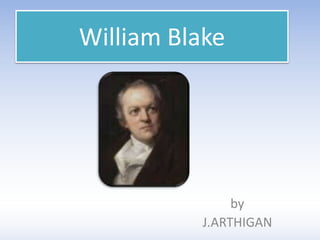
William Blake
by
J.ARTHIGAN
History of William Blake
• William Blake was born in London on November 28,
1757
• James Blake and Catherine Blake are his parents.
• Two of his six siblings died in infancy.
• From early childhood, Blake spoke of having visions
at four he saw God "put his head to the window";
• Around the age nine, while walking through the
countryside, he saw a tree filled with angels.
• Although his parents tried to discourage him from
"lying," they did observe that he was different from his
peers and did not force him to attend conventional
school.
William Blake 2
• At age ten, Blake expressed a wish to become a painter,
so his parents sent him to drawing school. Two years
later, Blake began writing poetry.
• When he turned fourteen, he apprenticed with an
engraver because art school proved too costly.
• After his seven-year term ended, he studied briefly at
the Royal Academy.
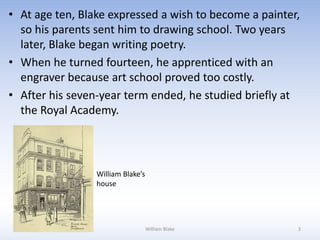
William Blake’s
house
William Blake 3
Married life
• In 1782, he married an illiterate woman
named Catherine Boucher.
• Blake taught her to read and to write, and also
instructed her in draftsmanship.
• Later, she helped him print the illuminated
poetry for which he is remembered today; the
couple had no children.
• In 1784 he set up a print shop with a friend
and former fellow apprentice, James Parker,
but this venture failed after several years.
William Blake 4
• Blake's first printed work, Poetical
Sketches (1783), is a collection of apprentice
verse, mostly imitating classical models.
• Blake's poetry was not well known by the general
public, but he was mentioned in A Biographical
Dictionary of the Living Authors of Great Britain
and Ireland, published in 1816.
William Blake
• Samuel Taylor Coleridge, who had been lent a copy
of Songs of Innocence and songs of Experience,
considered Blake a "man of Genius,"
and Wordsworth made his own copies of several
songs.
• Charles Lamb sent a copy of "The Chimney Sweeper"
from Songs of Innocence to James Montgomery for
his Chimney-Sweeper's Friend, and Climbing Boys'
Album (1824), and Robert Southey
• Wordsworth attended Blake's exhibition and included
the "Mad Song" from Poetical Sketches in his
miscellany, The Doctor (1834-1837).
William Blake 6
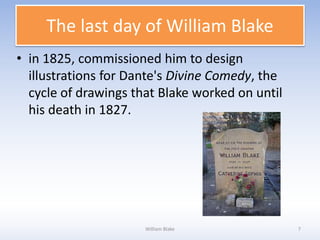
• in 1825, commissioned him to design
illustrations for Dante's Divine Comedy, the
cycle of drawings that Blake worked on until
his death in 1827.
William Blake 7
The last day of William Blake
Poetry
• All Religions Are One (1788)
• America, a Prophecy (1793)
• Europe, a Prophecy (1794)
• For Children: The Gates of Paradise (1793)
• For the Sexes: The Gates of Paradise (1820)
• Poetical Sketches (1783)
• Songs of Experience (1794)
• Songs of Innocence (1789)
• The Book of Ahania (1795)
• The Book of Los (1795)
• The First Book of Urizen (1794)
• The Marriage of Heaven and Hell (1790)
• The Song of Los (1795)
• There Is No Natural Religion (1788)
• Visions of the Daughters of Albion (1793)
William Blake 8

William Blake

  • 1.
  • 2.
    History of WilliamBlake • William Blake was born in London on November 28, 1757 • James Blake and Catherine Blake are his parents. • Two of his six siblings died in infancy. • From early childhood, Blake spoke of having visions at four he saw God "put his head to the window"; • Around the age nine, while walking through the countryside, he saw a tree filled with angels. • Although his parents tried to discourage him from "lying," they did observe that he was different from his peers and did not force him to attend conventional school. William Blake 2
  • 3.
    • At ageten, Blake expressed a wish to become a painter, so his parents sent him to drawing school. Two years later, Blake began writing poetry. • When he turned fourteen, he apprenticed with an engraver because art school proved too costly. • After his seven-year term ended, he studied briefly at the Royal Academy. William Blake’s house William Blake 3
  • 4.
    Married life • In1782, he married an illiterate woman named Catherine Boucher. • Blake taught her to read and to write, and also instructed her in draftsmanship. • Later, she helped him print the illuminated poetry for which he is remembered today; the couple had no children. • In 1784 he set up a print shop with a friend and former fellow apprentice, James Parker, but this venture failed after several years. William Blake 4
  • 5.
    • Blake's firstprinted work, Poetical Sketches (1783), is a collection of apprentice verse, mostly imitating classical models. • Blake's poetry was not well known by the general public, but he was mentioned in A Biographical Dictionary of the Living Authors of Great Britain and Ireland, published in 1816. William Blake
  • 6.
    • Samuel TaylorColeridge, who had been lent a copy of Songs of Innocence and songs of Experience, considered Blake a "man of Genius," and Wordsworth made his own copies of several songs. • Charles Lamb sent a copy of "The Chimney Sweeper" from Songs of Innocence to James Montgomery for his Chimney-Sweeper's Friend, and Climbing Boys' Album (1824), and Robert Southey • Wordsworth attended Blake's exhibition and included the "Mad Song" from Poetical Sketches in his miscellany, The Doctor (1834-1837). William Blake 6
  • 7.
    • in 1825,commissioned him to design illustrations for Dante's Divine Comedy, the cycle of drawings that Blake worked on until his death in 1827. William Blake 7 The last day of William Blake
  • 8.
    Poetry • All ReligionsAre One (1788) • America, a Prophecy (1793) • Europe, a Prophecy (1794) • For Children: The Gates of Paradise (1793) • For the Sexes: The Gates of Paradise (1820) • Poetical Sketches (1783) • Songs of Experience (1794) • Songs of Innocence (1789) • The Book of Ahania (1795) • The Book of Los (1795) • The First Book of Urizen (1794) • The Marriage of Heaven and Hell (1790) • The Song of Los (1795) • There Is No Natural Religion (1788) • Visions of the Daughters of Albion (1793) William Blake 8