ECCB 2012 Glasgow, Scotland
      Chair: Zoltan Kun, PAN-Parks

Session: Wilderness at the Edge of
             Survival

     "Wilderness": A Suitable
      designation for Central
      European Landscapes?
            Gerd Lupp*, Franz Hoechtl**

* Leibniz Institute of Ecological Urban and Regional Development/
     Institute for Landscape Management, Freiburg University
    **Alfred Toepfer Academy for Nature Conservation (NNA)
What is
“Wilderness”?
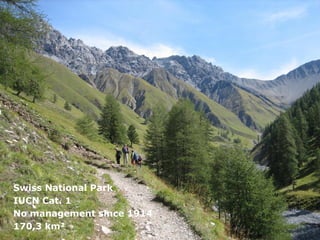
Swiss National Park
IUCN Cat. 1
No management since 1914
170,3 km²
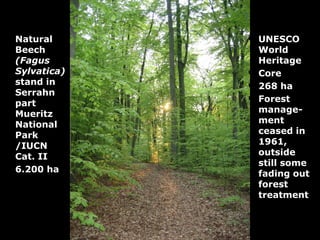
Natural      UNESCO
Beech        World
(Fagus       Heritage
Sylvatica)   Core
stand in     268 ha
Serrahn
part         Forest
Mueritz      manage-
National     ment
Park         ceased in
/IUCN        1961,
Cat. II      outside
             still some
6.200 ha     fading out
             forest
             treatment
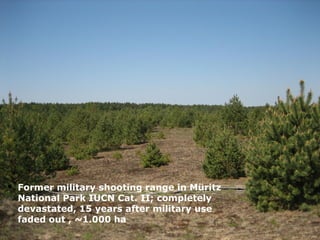
Former military shooting range in Müritz
National Park IUCN Cat. II; completely
devastated, 15 years after military use
faded out , ~1.000 ha
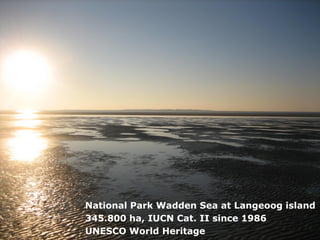
National Park Wadden Sea at Langeoog island
345.800 ha, IUCN Cat. II since 1986
UNESCO World Heritage
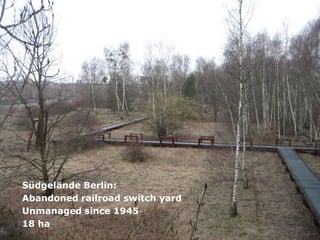
Südgelände Berlin:
  Abandoned railroad switch yard
Natural Beech
  Unmanaged since 1945
(Fagus
  18 ha
Sylvatica)
stand
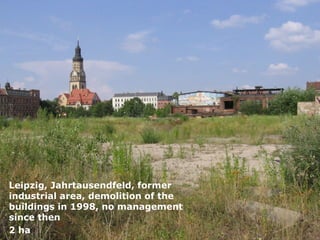
Leipzig, Jahrtausendfeld, former
industrial area, demolition of the
buildings in 1998, no management
since then
2 ha
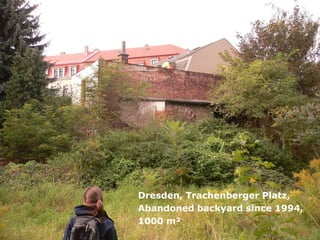
Dresden, Trachenberger Platz,
Abandoned backyard since 1994,
1000 m²
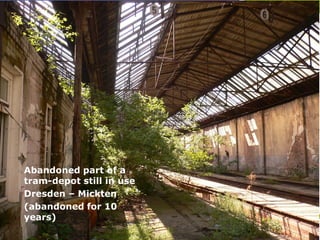
Abandoned part of a
tram-depot still in use
Dresden – Mickten
(abandoned for 10
years)
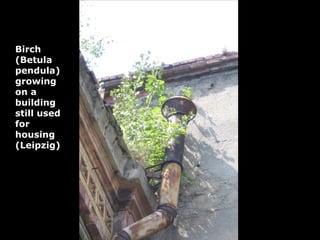
Birch
(Betula
pendula)
growing
on a
building
still used
for
housing
(Leipzig)
Statement
    All this might be considered “wilderness”!
              But what is in common?

In Central Europe, there is nothing like the US wilderness
act, also comparable sizes without settlements are difficult
to find in Central Europe
Are there suitable definitions for “wilderness” in a Central
European context? What do all these areas mentioned
have in common?
Are areas set aside for natural processes being perceived
as “wilderness”?
Is “wilderness” a suiting term for communication for
Central European National Parks?
Introduction
Scientific definitons of “Wilderness”
(KOWARIK & KOERNER 2005)
Traditional Wilderness
  Remnants of virgin forests (do not really exist) and land
  set aside for natural processes in former managed forests
  German strategy for CBD biodiversity goal: 2% of forests

New Wilderness
  Fallow, unmanaged land in cities and suburban areas due
  to structural changes in the industrial sector (1970ies), but
  also demographic change (1990ies), as well on former
  military training ranges when cold war period ended
  “Nature experience parks” for environmental education
Introduction

“Naturalness”

Retrospective Naturalness
  Assumes a composition of vegetation, before man shaped
  the land

Prospective Naturalness
  Self establishment of ecosystems, including Neophytes and
  new approached animals
Introduction

Wilderness and its value for biodiversity

  Old unmanaged forests with its specific spectrum of
  species are rare, but in general, beech forests that would
  dominate Central Europe contain less (endangered)
  species than many man-made managed ecosystems like
  high value grasslands, oak-forests etc.

  Spontaneous vegetation especially in urban surroundings
  are often dominated by non-native species; e.g. many
  examples from Berlin with up to 90% non-native share
  (KOWARIK & KOERNER 2005)
Methods

Literature surveys, expert quotes on wilderness and its
perception and, if possible, a physical definition

Mueritz National Park is one of the most “natural” places
in Germany with large forests not being used for timber
production for over 50 years, which is one of the longest
periods documented for Central Europe

Survey among 605 visitors in Mueritz National Park,
quantitative approach, systematic, objective selection of
the interviewees
What is “Wilderness”? – Results from
             Literature
 A physical definition with means and measurement of
 Natural Sciences does not really exist; most “wilderness”
 species mentioned like wolves (Canis lupus) are not
 dependent on one of the types of “wilderness”

 “unregulated self-reproduction of nature” is also not a
 suitable definition

 Biased: Important are values and perspectives of the
 authors (ethical/religious, pedagogic, …)

 However, there is a kind of “character” of
 “wilderness” common to most authors analyzed
What is “Wilderness”? – First
             Summary
Unplanned, unpredictable, spontaneous, surprising,
unexpected encounters with nature
Often related with attributes like gaining experience,
emotions, feelings, challenges, inspiration, contemplation,
being curious, fear, physical strains, happiness, joy, …
Contrast to rational, predictable, manmade, planned
human environment
Has a gradient that might even stretch down to plants
growing in a crack of a paved road (BROUNS 2004).
Object of projection and for feelings  a cultural
(KANGLER & VICENZOTTI 2007) or mental construct
Not quantifiable and reproducible  “Myth”  “Logos”
A Need for User-Based Surveys

But what about “real” people?

Some studies have been carried out, e.g. HUNZIKER
2000, WASEM 2002, HOECHTL et al. 2005, BAUER 2005.
Focus on alpine space

Natural processes are seen positive, however the
consequences are perceived negative:  loss of
biodiversity on alpine meadows and loss of identity in
alpine valleys (HUNZIKER 2000, HOECHTL et al. 2005)
A Need for User-Based Surveys

Some studies for urban “wilderness” (e.g. RINK 2003,
SCHEMEL 2005, HOHN et al. 2005, KEIL et al. 2005), focus
on certain user groups, often no broader, quantitative
approaches

BREUSTE 2001, RINK 2003 for East German cities:
perceived negative, “danger”, “loitering”, often seen as
symbol of economic collapse; not as “Wilderness”

KEIL 1998, 2002 (Ruhr region); SCHEMEL 2005 (towns in
South West Germany): little aesthetic attractiveness,
however perceived as valuable places for recreation, for
children and for nature protection
A User-Based Survey in Müritz
              National Park
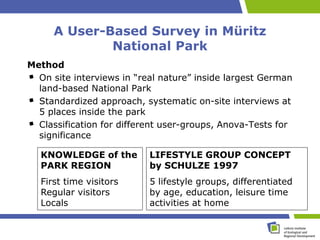
Method
  On site interviews in “real nature” inside largest German
  land-based National Park
  Standardized approach, systematic on-site interviews at
  5 places inside the park
  Classification for different user-groups, Anova-Tests for
  significance

   KNOWLEDGE of the        LIFESTYLE GROUP CONCEPT
   PARK REGION             by SCHULZE 1997
   First time visitors     5 lifestyle groups, differentiated
   Regular visitors        by age, education, leisure time
   Locals                  activities at home
A User-Based Survey in Müritz
                 National Park
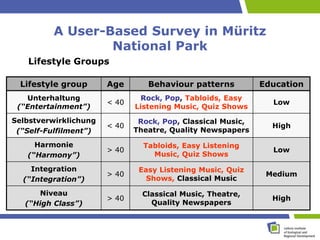
   Lifestyle Groups

  Lifestyle group      Age       Behaviour patterns          Education
   Unterhaltung                 Rock, Pop, Tabloids, Easy
                       < 40                                    Low
 (“Entertainment”)            Listening Music, Quiz Shows
Selbstverwirklichung           Rock, Pop, Classical Music,
                       < 40                                    High
 (“Self-Fulfilment”)          Theatre, Quality Newspapers

     Harmonie                   Tabloids, Easy Listening
                       > 40                                    Low
   (“Harmony”)                    Music, Quiz Shows

    Integration                Easy Listening Music, Quiz
                       > 40                                   Medium
  (“Integration”)                Shows, Classical Music

      Niveau                    Classical Music, Theatre,
                       > 40                                    High
   (“High Class”)                 Quality Newspapers
A User-Based Survey in Müritz
             National Park
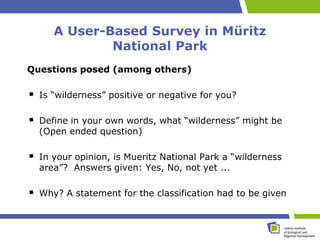
Questions posed (among others)

  Is “wilderness” positive or negative for you?

  Define in your own words, what “wilderness” might be
  (Open ended question)

  In your opinion, is Mueritz National Park a “wilderness
  area”? Answers given: Yes, No, not yet ...

  Why? A statement for the classification had to be given
A User-Based Survey in Müritz
            National Park
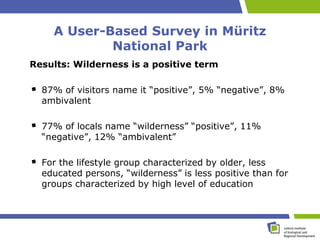
Results: Wilderness is a positive term

  87% of visitors name it “positive”, 5% “negative”, 8%
  ambivalent

  77% of locals name “wilderness” “positive”, 11%
  “negative”, 12% “ambivalent”

  For the lifestyle group characterized by older, less
  educated persons, “wilderness” is less positive than for
  groups characterized by high level of education
A User-Based Survey in Müritz
             National Park
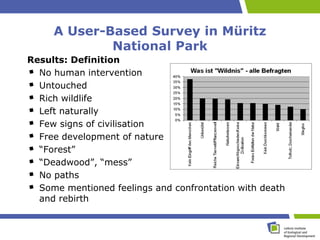
Results: Definition
  No human intervention
  Untouched
  Rich wildlife
  Left naturally
  Few signs of civilisation
  Free development of nature
  “Forest”
  “Deadwood”, “mess”
  No paths
  Some mentioned feelings and confrontation with death
  and rebirth
A User-Based Survey in Müritz
              National Park

Results: Definition

Significant differences between lifestyles

  Lifestyles characterized by high education levels
  mentioned more frequently “untouched” and “few signs
  of civilisation”

  Lifestyle characterized by young, less educated persons
  more frequently mentioned “Rich wildlife”
A User-Based Survey in Müritz
             National Park
Comparison of Terms

  “Untouched”, “left naturally” used mainly by persons
  perceiving “wilderness” positive

  “Not possible to get through” and “mess/ deadwood”
  were used by persons connoting “wilderness” more
  frequently mentioned by persons quoting a negative
  connotation with “wilderness”
  However: When asked for evaluating the real on-site scenic
  quality of the old, unmanaged beech forest, “deadwood
  visible” was one of the most frequently mentioned positive
  features for liking this place (~ 4,7 on 5 step scale)
A User-Based Survey in Müritz
           National Park
Wilderness in Central Europe: Is Mueritz National
Park “Wilderness”?

Yes      58 %
No       37 %
Not yet   3%
No answer 2 %

Lifestyle Group characterized by young, well educated
persons perceived the park less frequently being a
“Wilderness Area”
A User-Based Survey in Müritz
             National Park
Reasons Mueritz National Park being wilderness

  “No more human interference”, “No possibility to get
  through”, “Rich wildlife”

  “(Vast) Forests”

  Water courses and wetlands

  Geographical descriptions: unmanaged beech forests in
  Serrahn, large bogs along Mueritz lake shoreline
A User-Based Survey in Müritz
             National Park
Reasons given against wilderness

  Too much interference of mankind visible
  Too many people visible
  To much infrastructure
  Not large enough for being “wilderness”
  Land management in the past is still visible
  Lifestyle characterized by older, well educated persons
  significantly more often mentioned “too much interference
  of mankind visible”
  Lifestyle characterized by younger, well educated persons
  more often mentioned “too many people visible”
Conclusions
“Wilderness” is a suiting concept and designation for
larger unmanaged forests and wetlands in a densely
populated area like Central Europe
 perceived positive! But be careful when just
communicating “Wilderness”

Different values and criteria for different lifestyles

Uncritical use may cause disappointment between
expectation and reality (e.g. “rich wildlife”), best
combined with “No intervention by human activities”.
Conclusions
Difference between mental picture in mind compared to
interviewing real on site scenic qualities (e.g. deadwood),
information and communication

“Solitude” is an important positive attribute for
“wilderness”, important for visitor management
Conclusions
  In urban areas, “Wilderness” needs more advocates
  and linkage with positive connotation, although many
  attributes of “wilderness” for broader public are missing
  like “solitude” or a certain felt extent

  Wilderness in urban area has different values far
  beyond seeking some red-list species among a sea of
  neophytes as a right for its existence

 Space for “a glimpse of wilderness” with unexpected,
  emotional, inspirational, unplanned contacts with nature
  in urban areas
Thank You Very Much For Your
              Attention!

Dr. Gerd Lupp
Leibniz Institute of Ecological
Urban and Regional
Development (IÖR)
Weberplatz 1
DE-01217 Dresden
Phone: +49 (0)351 4679-279

E-Mail: g.lupp@ioer.de
Internet: www.ioer.de
References

Lupp, G.; Konold, W.; Bastian, O. (in press): Landscape
management and landscape changes towards more naturalness
and wilderness: Effects on scenic qualities - The case of the
Müritz National Park in Germany. Journal for Nature Conservation

Lupp, G.; Hoechtl, F.; Wende, W. (2011): "Wilderness" - a
designation for Central European landscapes? In: Land Use Policy
28 (2011), 594-603

Höchtl, F.; Lehringer, S.; Konold, W. (2005): “Wilderness”: What
it means when it becomes a reality – A case study from the
southwestern Alps. Landscape and Urban Planning, 70, 85-95

Wilderness lupp hoechtl

  • 1.
    ECCB 2012 Glasgow,Scotland Chair: Zoltan Kun, PAN-Parks Session: Wilderness at the Edge of Survival "Wilderness": A Suitable designation for Central European Landscapes? Gerd Lupp*, Franz Hoechtl** * Leibniz Institute of Ecological Urban and Regional Development/ Institute for Landscape Management, Freiburg University **Alfred Toepfer Academy for Nature Conservation (NNA)
  • 2.
  • 3.
    Swiss National Park IUCNCat. 1 No management since 1914 170,3 km²
  • 4.
    Natural UNESCO Beech World (Fagus Heritage Sylvatica) Core stand in 268 ha Serrahn part Forest Mueritz manage- National ment Park ceased in /IUCN 1961, Cat. II outside still some 6.200 ha fading out forest treatment
  • 5.
    Former military shootingrange in Müritz National Park IUCN Cat. II; completely devastated, 15 years after military use faded out , ~1.000 ha
  • 6.
    National Park WaddenSea at Langeoog island 345.800 ha, IUCN Cat. II since 1986 UNESCO World Heritage
  • 7.
    Südgelände Berlin: Abandoned railroad switch yard Natural Beech Unmanaged since 1945 (Fagus 18 ha Sylvatica) stand
  • 8.
    Leipzig, Jahrtausendfeld, former industrialarea, demolition of the buildings in 1998, no management since then 2 ha
  • 9.
    Dresden, Trachenberger Platz, Abandonedbackyard since 1994, 1000 m²
  • 10.
    Abandoned part ofa tram-depot still in use Dresden – Mickten (abandoned for 10 years)
  • 11.
  • 12.
    Statement All this might be considered “wilderness”! But what is in common? In Central Europe, there is nothing like the US wilderness act, also comparable sizes without settlements are difficult to find in Central Europe Are there suitable definitions for “wilderness” in a Central European context? What do all these areas mentioned have in common? Are areas set aside for natural processes being perceived as “wilderness”? Is “wilderness” a suiting term for communication for Central European National Parks?
  • 13.
    Introduction Scientific definitons of“Wilderness” (KOWARIK & KOERNER 2005) Traditional Wilderness Remnants of virgin forests (do not really exist) and land set aside for natural processes in former managed forests German strategy for CBD biodiversity goal: 2% of forests New Wilderness Fallow, unmanaged land in cities and suburban areas due to structural changes in the industrial sector (1970ies), but also demographic change (1990ies), as well on former military training ranges when cold war period ended “Nature experience parks” for environmental education
  • 14.
    Introduction “Naturalness” Retrospective Naturalness Assumes a composition of vegetation, before man shaped the land Prospective Naturalness Self establishment of ecosystems, including Neophytes and new approached animals
  • 15.
    Introduction Wilderness and itsvalue for biodiversity Old unmanaged forests with its specific spectrum of species are rare, but in general, beech forests that would dominate Central Europe contain less (endangered) species than many man-made managed ecosystems like high value grasslands, oak-forests etc. Spontaneous vegetation especially in urban surroundings are often dominated by non-native species; e.g. many examples from Berlin with up to 90% non-native share (KOWARIK & KOERNER 2005)
  • 16.
    Methods Literature surveys, expertquotes on wilderness and its perception and, if possible, a physical definition Mueritz National Park is one of the most “natural” places in Germany with large forests not being used for timber production for over 50 years, which is one of the longest periods documented for Central Europe Survey among 605 visitors in Mueritz National Park, quantitative approach, systematic, objective selection of the interviewees
  • 17.
    What is “Wilderness”?– Results from Literature A physical definition with means and measurement of Natural Sciences does not really exist; most “wilderness” species mentioned like wolves (Canis lupus) are not dependent on one of the types of “wilderness” “unregulated self-reproduction of nature” is also not a suitable definition Biased: Important are values and perspectives of the authors (ethical/religious, pedagogic, …) However, there is a kind of “character” of “wilderness” common to most authors analyzed
  • 18.
    What is “Wilderness”?– First Summary Unplanned, unpredictable, spontaneous, surprising, unexpected encounters with nature Often related with attributes like gaining experience, emotions, feelings, challenges, inspiration, contemplation, being curious, fear, physical strains, happiness, joy, … Contrast to rational, predictable, manmade, planned human environment Has a gradient that might even stretch down to plants growing in a crack of a paved road (BROUNS 2004). Object of projection and for feelings  a cultural (KANGLER & VICENZOTTI 2007) or mental construct Not quantifiable and reproducible  “Myth”  “Logos”
  • 19.
    A Need forUser-Based Surveys But what about “real” people? Some studies have been carried out, e.g. HUNZIKER 2000, WASEM 2002, HOECHTL et al. 2005, BAUER 2005. Focus on alpine space Natural processes are seen positive, however the consequences are perceived negative:  loss of biodiversity on alpine meadows and loss of identity in alpine valleys (HUNZIKER 2000, HOECHTL et al. 2005)
  • 20.
    A Need forUser-Based Surveys Some studies for urban “wilderness” (e.g. RINK 2003, SCHEMEL 2005, HOHN et al. 2005, KEIL et al. 2005), focus on certain user groups, often no broader, quantitative approaches BREUSTE 2001, RINK 2003 for East German cities: perceived negative, “danger”, “loitering”, often seen as symbol of economic collapse; not as “Wilderness” KEIL 1998, 2002 (Ruhr region); SCHEMEL 2005 (towns in South West Germany): little aesthetic attractiveness, however perceived as valuable places for recreation, for children and for nature protection
  • 21.
    A User-Based Surveyin Müritz National Park Method On site interviews in “real nature” inside largest German land-based National Park Standardized approach, systematic on-site interviews at 5 places inside the park Classification for different user-groups, Anova-Tests for significance KNOWLEDGE of the LIFESTYLE GROUP CONCEPT PARK REGION by SCHULZE 1997 First time visitors 5 lifestyle groups, differentiated Regular visitors by age, education, leisure time Locals activities at home
  • 22.
    A User-Based Surveyin Müritz National Park Lifestyle Groups Lifestyle group Age Behaviour patterns Education Unterhaltung Rock, Pop, Tabloids, Easy < 40 Low (“Entertainment”) Listening Music, Quiz Shows Selbstverwirklichung Rock, Pop, Classical Music, < 40 High (“Self-Fulfilment”) Theatre, Quality Newspapers Harmonie Tabloids, Easy Listening > 40 Low (“Harmony”) Music, Quiz Shows Integration Easy Listening Music, Quiz > 40 Medium (“Integration”) Shows, Classical Music Niveau Classical Music, Theatre, > 40 High (“High Class”) Quality Newspapers
  • 23.
    A User-Based Surveyin Müritz National Park Questions posed (among others) Is “wilderness” positive or negative for you? Define in your own words, what “wilderness” might be (Open ended question) In your opinion, is Mueritz National Park a “wilderness area”? Answers given: Yes, No, not yet ... Why? A statement for the classification had to be given
  • 24.
    A User-Based Surveyin Müritz National Park Results: Wilderness is a positive term 87% of visitors name it “positive”, 5% “negative”, 8% ambivalent 77% of locals name “wilderness” “positive”, 11% “negative”, 12% “ambivalent” For the lifestyle group characterized by older, less educated persons, “wilderness” is less positive than for groups characterized by high level of education
  • 25.
    A User-Based Surveyin Müritz National Park Results: Definition No human intervention Untouched Rich wildlife Left naturally Few signs of civilisation Free development of nature “Forest” “Deadwood”, “mess” No paths Some mentioned feelings and confrontation with death and rebirth
  • 26.
    A User-Based Surveyin Müritz National Park Results: Definition Significant differences between lifestyles Lifestyles characterized by high education levels mentioned more frequently “untouched” and “few signs of civilisation” Lifestyle characterized by young, less educated persons more frequently mentioned “Rich wildlife”
  • 27.
    A User-Based Surveyin Müritz National Park Comparison of Terms “Untouched”, “left naturally” used mainly by persons perceiving “wilderness” positive “Not possible to get through” and “mess/ deadwood” were used by persons connoting “wilderness” more frequently mentioned by persons quoting a negative connotation with “wilderness” However: When asked for evaluating the real on-site scenic quality of the old, unmanaged beech forest, “deadwood visible” was one of the most frequently mentioned positive features for liking this place (~ 4,7 on 5 step scale)
  • 28.
    A User-Based Surveyin Müritz National Park Wilderness in Central Europe: Is Mueritz National Park “Wilderness”? Yes 58 % No 37 % Not yet 3% No answer 2 % Lifestyle Group characterized by young, well educated persons perceived the park less frequently being a “Wilderness Area”
  • 29.
    A User-Based Surveyin Müritz National Park Reasons Mueritz National Park being wilderness “No more human interference”, “No possibility to get through”, “Rich wildlife” “(Vast) Forests” Water courses and wetlands Geographical descriptions: unmanaged beech forests in Serrahn, large bogs along Mueritz lake shoreline
  • 30.
    A User-Based Surveyin Müritz National Park Reasons given against wilderness Too much interference of mankind visible Too many people visible To much infrastructure Not large enough for being “wilderness” Land management in the past is still visible Lifestyle characterized by older, well educated persons significantly more often mentioned “too much interference of mankind visible” Lifestyle characterized by younger, well educated persons more often mentioned “too many people visible”
  • 31.
    Conclusions “Wilderness” is asuiting concept and designation for larger unmanaged forests and wetlands in a densely populated area like Central Europe  perceived positive! But be careful when just communicating “Wilderness” Different values and criteria for different lifestyles Uncritical use may cause disappointment between expectation and reality (e.g. “rich wildlife”), best combined with “No intervention by human activities”.
  • 32.
    Conclusions Difference between mentalpicture in mind compared to interviewing real on site scenic qualities (e.g. deadwood), information and communication “Solitude” is an important positive attribute for “wilderness”, important for visitor management
  • 33.
    Conclusions Inurban areas, “Wilderness” needs more advocates and linkage with positive connotation, although many attributes of “wilderness” for broader public are missing like “solitude” or a certain felt extent Wilderness in urban area has different values far beyond seeking some red-list species among a sea of neophytes as a right for its existence  Space for “a glimpse of wilderness” with unexpected, emotional, inspirational, unplanned contacts with nature in urban areas
  • 34.
    Thank You VeryMuch For Your Attention! Dr. Gerd Lupp Leibniz Institute of Ecological Urban and Regional Development (IÖR) Weberplatz 1 DE-01217 Dresden Phone: +49 (0)351 4679-279 E-Mail: g.lupp@ioer.de Internet: www.ioer.de
  • 35.
    References Lupp, G.; Konold,W.; Bastian, O. (in press): Landscape management and landscape changes towards more naturalness and wilderness: Effects on scenic qualities - The case of the Müritz National Park in Germany. Journal for Nature Conservation Lupp, G.; Hoechtl, F.; Wende, W. (2011): "Wilderness" - a designation for Central European landscapes? In: Land Use Policy 28 (2011), 594-603 Höchtl, F.; Lehringer, S.; Konold, W. (2005): “Wilderness”: What it means when it becomes a reality – A case study from the southwestern Alps. Landscape and Urban Planning, 70, 85-95