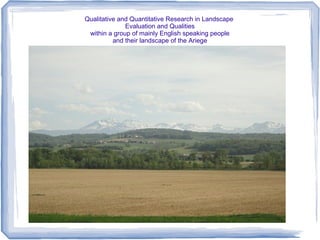
Qualitative and Quantitative Research in Landscape
              Evaluation and Qualities
 within a group of mainly English speaking people
          and their landscape of the Ariege


 Qualitative and Quantitative Research in Landscape
                Evaluation and Qualities
        within a group of mainly English speaking people
               and their landscape of the Ariege


                               .
Introduction

●   Within the English speaking community, what
    qualities in the landscape played a role in their
    decision to move here?
●   What landscape factors/features do they
    perceive , appreciate and continue to play a
    role in their daily lives?
●   And how do these perceptions and valuations
    relate to the character of this area?
Motivation
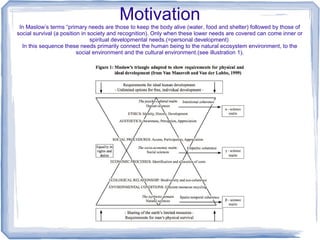
 In Maslow’s terms “primary needs are those to keep the body alive (water, food and shelter) followed by those of
social survival (a position in society and recognition). Only when these lower needs are covered can come inner or
                                spiritual developmental needs.(=personal development)
  In this sequence these needs primarily connect the human being to the natural ecosystem environment, to the
                          social environment and the cultural environment.(see illustration 1).
Jacobs (2004)
First there is Matterscape which refers to the physical aspects of the landscape. One
can also call it the factual or true landscape; It is the landscape, which is the object of
geographers and natural scientist and the action ground for civil engineers.


Then we have Powerscapes, which refer to the values and rules a certain group of
people hold at a certain time; One can call it the right or just landscape, it is the inter-
subjective landscape, which is the domain of action-groups, lawyers and politicians.


And then there is the Mindscape, this is the landscape how people experience it, which
is for each individual different. One can call it the real or inner landscape, it is the
subjective landscape, it is the landscape how we actually experience it, including the
meaning it has for us.( and memories, associations, etc. or ground for action, activities
etc.).
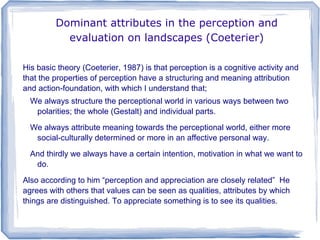
Dominant attributes in the perception and
           evaluation on landscapes (Coeterier)

His basic theory (Coeterier, 1987) is that perception is a cognitive activity and
that the properties of perception have a structuring and meaning attribution
and action-foundation, with which I understand that;
  We always structure the perceptional world in various ways between two
   polarities; the whole (Gestalt) and individual parts.
  We always attribute meaning towards the perceptional world, either more
   social-culturally determined or more in an affective personal way.
  And thirdly we always have a certain intention, motivation in what we want to
   do.
Also according to him “perception and appreciation are closely related” He
agrees with others that values can be seen as qualities, attributes by which
things are distinguished. To appreciate something is to see its qualities.
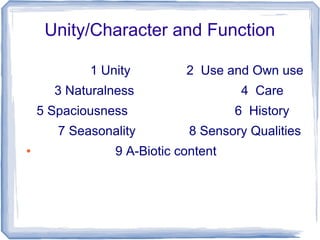
Unity/Character and Function

            1 Unity         2 Use and Own use
      3 Naturalness                   4 Care
    5 Spaciousness                   6 History
       7 Seasonality         8 Sensory Qualities
●               9 A-Biotic content
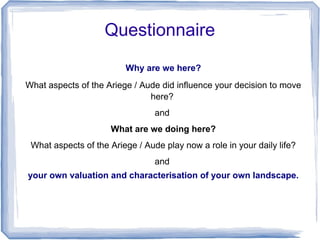
Questionnaire
                         Why are we here?
What aspects of the Ariege / Aude did influence your decision to move
                               here?
                                 and
                     What are we doing here?
 What aspects of the Ariege / Aude play now a role in your daily life?
                                 and
your own valuation and characterisation of your own landscape.
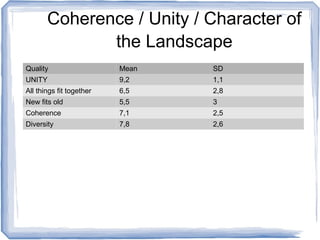
Coherence / Unity / Character of
              the Landscape
Quality                   Mean   SD
UNITY                     9,2    1,1
All things fit together   6,5    2,8
New fits old              5,5    3
Coherence                 7,1    2,5
Diversity                 7,8    2,6
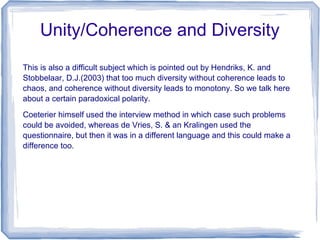
Unity/Coherence and Diversity
This is also a difficult subject which is pointed out by Hendriks, K. and
Stobbelaar, D.J.(2003) that too much diversity without coherence leads to
chaos, and coherence without diversity leads to monotony. So we talk here
about a certain paradoxical polarity.
Coeterier himself used the interview method in which case such problems
could be avoided, whereas de Vries, S. & an Kralingen used the
questionnaire, but then it was in a different language and this could make a
difference too.
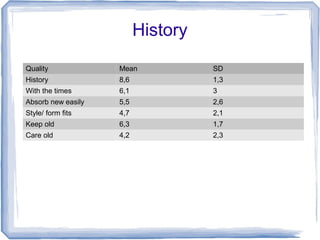
History
Quality             Mean            SD
History             8,6             1,3
With the times      6,1             3
Absorb new easily   5,5             2,6
Style/ form fits    4,7             2,1
Keep old            6,3             1,7
Care old            4,2             2,3
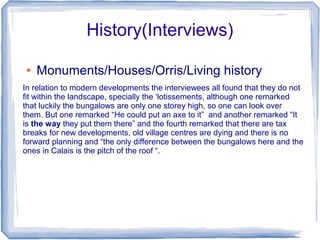
History(Interviews)

●   Monuments/Houses/Orris/Living history
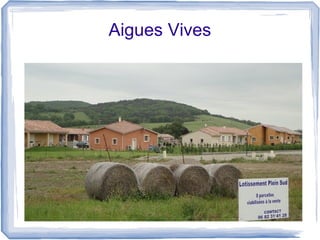
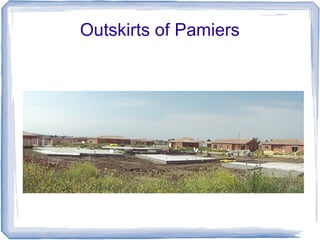
In relation to modern developments the interviewees all found that they do not
fit within the landscape, specially the ‘lotissements, although one remarked
that luckily the bungalows are only one storey high, so one can look over
them. But one remarked “He could put an axe to it” and another remarked “It
is the way they put them there” and the fourth remarked that there are tax
breaks for new developments, old village centres are dying and there is no
forward planning and “the only difference between the bungalows here and the
ones in Calais is the pitch of the roof “.
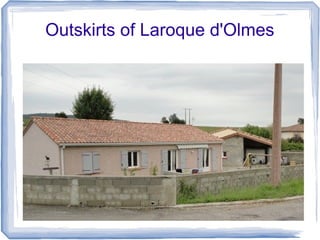
Outskirts of Laroque d'Olmes
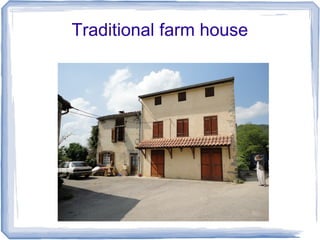
Traditional farm house
Aigues Vives
Outskirts of Pamiers
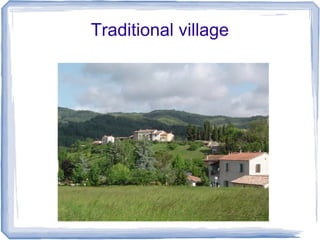
Traditional village
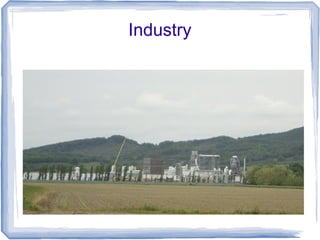
Industry
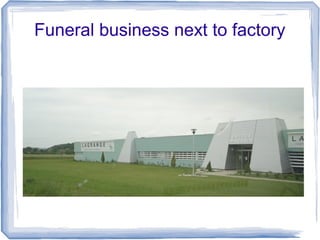
Funeral business next to factory
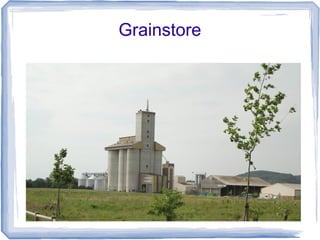
Grainstore
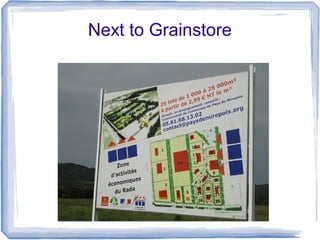
Next to Grainstore
Motivation

●   France; Country neither too foreign nor too far
    from England
●   Climate better then England
    Although winters longer and colder then expected
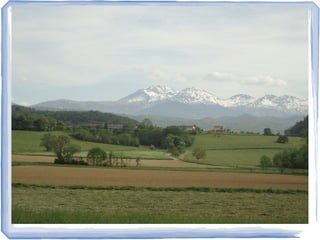
●   One of the main factors which determined the wish to live
    here is the landscape of the Ariege, with its diverse, rural and
    underpopulated landscape with vast tracts of mountains and
    wild areas.
●   It was the view of the rural landscape with the background of
    the rising mountains that prompted most people to decide to
    come here.
Motivation
While they sat on a terrace regarding the Mont d’Olmes area, his wife fell in
love with the place.


Was first attracted by the ‘Tuscanian’ landscape of the Aude on a visit, but
then discovered the more savage wild nature of the Ariegois landscape, which
she preferred


When they were south of Toulouse and her husband saw the mountains, he
said “let’s go there”


“When we came over from Fanjaux ,we saw the wonderful vista of the
mountains in front of us, in September, a clear blue sky and I said to my wife;
This is it”
Discussion
I came to the thought that through life there is a certain sequence of the three
levels of needs mentioned by Maslow.
First our basic need is to find our place in the physical world and to be able to
look after ourselves (provision of food, shelter etc.), then comes a time when
we have the need to be part of the social fabric and be recognised as a
capable person and make our stamp on the world and then comes a time
when we need to do something we want to do, something more for ourselves,
more in a creative way.
Conclusion
In relation to the three original questions, we have seen that this
group of people came here for a change in the later part of their
life and were mainly in a situation, where they don't have to work
and were looking for a life within a country not too far or too
foreign, with a nice climate and where they can appreciate and
use the landscape for leisure or creative purposes.
So their valuation of the perceptional properties the landscape is
seen very much from the point of view of enjoyment and re-
creative use.
The group highly appreciated the landscape and agreed very
much with each other that the Ariege is a wonderful, rural and
peaceful landscape, whose character gives a rich experience of
spaciousness, seasonality, naturalness, rich in sense-
impressions and history.

Landscape experiences in the Ariege

  • 1.
    Qualitative and QuantitativeResearch in Landscape Evaluation and Qualities within a group of mainly English speaking people and their landscape of the Ariege Qualitative and Quantitative Research in Landscape Evaluation and Qualities within a group of mainly English speaking people and their landscape of the Ariege .
  • 2.
    Introduction ● Within the English speaking community, what qualities in the landscape played a role in their decision to move here? ● What landscape factors/features do they perceive , appreciate and continue to play a role in their daily lives? ● And how do these perceptions and valuations relate to the character of this area?
  • 3.
    Motivation In Maslow’sterms “primary needs are those to keep the body alive (water, food and shelter) followed by those of social survival (a position in society and recognition). Only when these lower needs are covered can come inner or spiritual developmental needs.(=personal development) In this sequence these needs primarily connect the human being to the natural ecosystem environment, to the social environment and the cultural environment.(see illustration 1).
  • 4.
    Jacobs (2004) First thereis Matterscape which refers to the physical aspects of the landscape. One can also call it the factual or true landscape; It is the landscape, which is the object of geographers and natural scientist and the action ground for civil engineers. Then we have Powerscapes, which refer to the values and rules a certain group of people hold at a certain time; One can call it the right or just landscape, it is the inter- subjective landscape, which is the domain of action-groups, lawyers and politicians. And then there is the Mindscape, this is the landscape how people experience it, which is for each individual different. One can call it the real or inner landscape, it is the subjective landscape, it is the landscape how we actually experience it, including the meaning it has for us.( and memories, associations, etc. or ground for action, activities etc.).
  • 5.
    Dominant attributes inthe perception and evaluation on landscapes (Coeterier) His basic theory (Coeterier, 1987) is that perception is a cognitive activity and that the properties of perception have a structuring and meaning attribution and action-foundation, with which I understand that; We always structure the perceptional world in various ways between two polarities; the whole (Gestalt) and individual parts. We always attribute meaning towards the perceptional world, either more social-culturally determined or more in an affective personal way. And thirdly we always have a certain intention, motivation in what we want to do. Also according to him “perception and appreciation are closely related” He agrees with others that values can be seen as qualities, attributes by which things are distinguished. To appreciate something is to see its qualities.
  • 6.
    Unity/Character and Function 1 Unity 2 Use and Own use 3 Naturalness 4 Care 5 Spaciousness 6 History 7 Seasonality 8 Sensory Qualities ● 9 A-Biotic content
  • 7.
    Questionnaire Why are we here? What aspects of the Ariege / Aude did influence your decision to move here? and What are we doing here? What aspects of the Ariege / Aude play now a role in your daily life? and your own valuation and characterisation of your own landscape.
  • 8.
    Coherence / Unity/ Character of the Landscape Quality Mean SD UNITY 9,2 1,1 All things fit together 6,5 2,8 New fits old 5,5 3 Coherence 7,1 2,5 Diversity 7,8 2,6
  • 9.
    Unity/Coherence and Diversity Thisis also a difficult subject which is pointed out by Hendriks, K. and Stobbelaar, D.J.(2003) that too much diversity without coherence leads to chaos, and coherence without diversity leads to monotony. So we talk here about a certain paradoxical polarity. Coeterier himself used the interview method in which case such problems could be avoided, whereas de Vries, S. & an Kralingen used the questionnaire, but then it was in a different language and this could make a difference too.
  • 10.
    History Quality Mean SD History 8,6 1,3 With the times 6,1 3 Absorb new easily 5,5 2,6 Style/ form fits 4,7 2,1 Keep old 6,3 1,7 Care old 4,2 2,3
  • 11.
    History(Interviews) ● Monuments/Houses/Orris/Living history In relation to modern developments the interviewees all found that they do not fit within the landscape, specially the ‘lotissements, although one remarked that luckily the bungalows are only one storey high, so one can look over them. But one remarked “He could put an axe to it” and another remarked “It is the way they put them there” and the fourth remarked that there are tax breaks for new developments, old village centres are dying and there is no forward planning and “the only difference between the bungalows here and the ones in Calais is the pitch of the roof “.
  • 12.
  • 13.
  • 14.
  • 15.
  • 16.
  • 17.
  • 18.
  • 19.
  • 20.
  • 21.
    Motivation ● France; Country neither too foreign nor too far from England ● Climate better then England Although winters longer and colder then expected ● One of the main factors which determined the wish to live here is the landscape of the Ariege, with its diverse, rural and underpopulated landscape with vast tracts of mountains and wild areas. ● It was the view of the rural landscape with the background of the rising mountains that prompted most people to decide to come here.
  • 23.
    Motivation While they saton a terrace regarding the Mont d’Olmes area, his wife fell in love with the place. Was first attracted by the ‘Tuscanian’ landscape of the Aude on a visit, but then discovered the more savage wild nature of the Ariegois landscape, which she preferred When they were south of Toulouse and her husband saw the mountains, he said “let’s go there” “When we came over from Fanjaux ,we saw the wonderful vista of the mountains in front of us, in September, a clear blue sky and I said to my wife; This is it”
  • 24.
    Discussion I came tothe thought that through life there is a certain sequence of the three levels of needs mentioned by Maslow. First our basic need is to find our place in the physical world and to be able to look after ourselves (provision of food, shelter etc.), then comes a time when we have the need to be part of the social fabric and be recognised as a capable person and make our stamp on the world and then comes a time when we need to do something we want to do, something more for ourselves, more in a creative way.
  • 25.
    Conclusion In relation tothe three original questions, we have seen that this group of people came here for a change in the later part of their life and were mainly in a situation, where they don't have to work and were looking for a life within a country not too far or too foreign, with a nice climate and where they can appreciate and use the landscape for leisure or creative purposes. So their valuation of the perceptional properties the landscape is seen very much from the point of view of enjoyment and re- creative use. The group highly appreciated the landscape and agreed very much with each other that the Ariege is a wonderful, rural and peaceful landscape, whose character gives a rich experience of spaciousness, seasonality, naturalness, rich in sense- impressions and history.