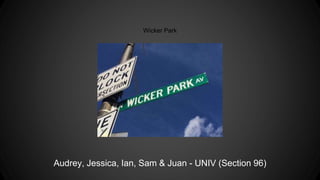
Wicker Park 
Audrey, Jessica, Ian, Sam & Juan - UNIV (Section 96)
History 
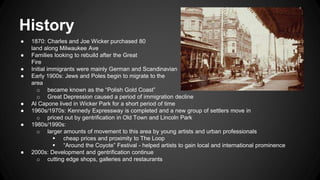
● 1870: Charles and Joe Wicker purchased 80 acres of 
land along Milwaukee Ave 
● Families looking to rebuild after the Great Chicago 
Fire 
● Initial immigrants were mainly German and Scandinavian 
● Early 1900s: Jews and Poles begin to migrate to the 
area 
o became known as the “Polish Gold Coast” 
o Great Depression caused a period of immigration decline 
● Al Capone lived in Wicker Park for a short period of time 
● 1960s/1970s: Kennedy Expressway is completed and a new group of settlers move in 
o priced out by gentrification in Old Town and Lincoln Park 
● 1980s/1990s: 
o larger amounts of movement to this area by young artists and urban professionals 
 cheap prices and proximity to The Loop 
 “Around the Coyote” Festival - helped artists to gain local and international prominence 
● 2000s: Development and gentrification continue 
o cutting edge shops, galleries and restaurants
Demographics 
● Wicker park has 25,008 residents with a median 
income of $77,357 
● The majority of residents are young adults, with a 
median age for the neighborhood being 30 years 
old. The two largest age groups are 20-29 year 
olds and 30-39 year olds. 
● The male to female ratio is 5,734:5,484, which is 
9% above the Chicago average 
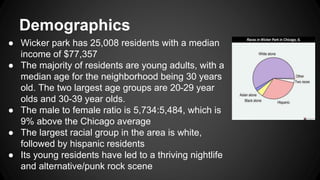
● The largest racial group in the area is white, 
followed by hispanic residents 
● Its young residents have led to a thriving nightlife 
and alternative/punk rock scene
Transportation 
1.Take Red Line at Loyola towards 95th/Dan Ryan. 
2.Get off on Monroe and switch to the Blue Line towards O’Hare. 
3.Get off at Damen. 
OR 
1.Take Red Line at Loyola towards 95th/Dan Ryan 
2.Get off at North/Clyborn 
3.Walk to North Ave and Halsted 
4.Take the 72 bus 
5.Get off bus at North Ave and Hoyne
Wicker Park 
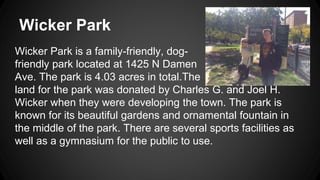
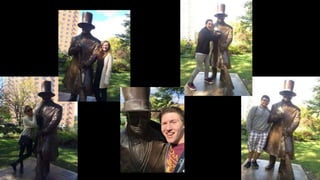
Wicker Park is a family-friendly, dog-friendly 
park located at 1425 N Damen 
Ave. The park is 4.03 acres in total.The 
land for the park was donated by Charles G. and Joel H. 
Wicker when they were developing the town. The park is 
known for its beautiful gardens and ornamental fountain in 
the middle of the park. There are several sports facilities as 
well as a gymnasium for the public to use.
Hoyne Ave. 
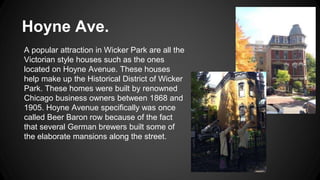
A popular attraction in Wicker Park are all the 
Victorian style houses such as the ones 
located on Hoyne Avenue. These houses 
help make up the Historical District of Wicker 
Park. These homes were built by renowned 
Chicago business owners between 1868 and 
1905. Hoyne Avenue specifically was once 
called Beer Baron row because of the fact 
that several German brewers built some of 
the elaborate mansions along the street.
Northwest Tower 
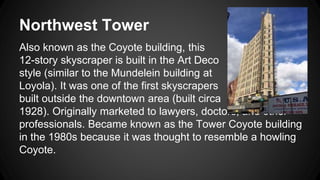
Also known as the Coyote building, this 
12-story skyscraper is built in the Art Deco 
style (similar to the Mundelein building at 
Loyola). It was one of the first skyscrapers 
built outside the downtown area (built circa 
1928). Originally marketed to lawyers, doctors, and other 
professionals. Became known as the Tower Coyote building 
in the 1980s because it was thought to resemble a howling 
Coyote.
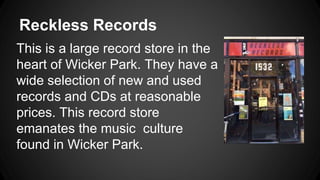
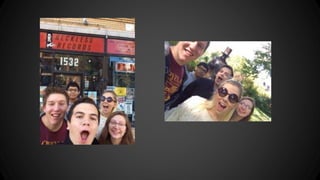
Reckless Records 
This is a large record store in the 
heart of Wicker Park. They have a 
wide selection of new and used 
records and CDs at reasonable 
prices. This record store 
emanates the music culture 
found in Wicker Park.
Works Cited 
"Community Area 2000 Census Profiles." City of Chicago ::. City of Chicago, n.d. Web. 21 Oct. 2014. 
"Wicker Park Neighborhood in Chicago, Illinois (IL), 60622, 60647 Detailed Profile."Wicker Park Neighborhood in Chicago, Illinois 
(IL), 60622, 60647 Subdivision Profile. Citydata.com, n.d. Web. 23 Oct. 2014. 
Heidemann, Jason A. "A History of Wicker Park and Bucktown." Time Out Chicago. N.p., 17 Apr. 2013. Web. 23 Oct. 2014. 
"Things to Do in Wicker Park / Bucktown." Choose Chicago. N.p., n.d. Web. 20 Oct. 2014. 
"Wicker Park." Chicago Park District. N.p., n.d. Web. 20 Oct. 2014.

Wicker park Project n

  • 1.
    Wicker Park Audrey,Jessica, Ian, Sam & Juan - UNIV (Section 96)
  • 2.
    History ● 1870:Charles and Joe Wicker purchased 80 acres of land along Milwaukee Ave ● Families looking to rebuild after the Great Chicago Fire ● Initial immigrants were mainly German and Scandinavian ● Early 1900s: Jews and Poles begin to migrate to the area o became known as the “Polish Gold Coast” o Great Depression caused a period of immigration decline ● Al Capone lived in Wicker Park for a short period of time ● 1960s/1970s: Kennedy Expressway is completed and a new group of settlers move in o priced out by gentrification in Old Town and Lincoln Park ● 1980s/1990s: o larger amounts of movement to this area by young artists and urban professionals  cheap prices and proximity to The Loop  “Around the Coyote” Festival - helped artists to gain local and international prominence ● 2000s: Development and gentrification continue o cutting edge shops, galleries and restaurants
  • 3.
    Demographics ● Wickerpark has 25,008 residents with a median income of $77,357 ● The majority of residents are young adults, with a median age for the neighborhood being 30 years old. The two largest age groups are 20-29 year olds and 30-39 year olds. ● The male to female ratio is 5,734:5,484, which is 9% above the Chicago average ● The largest racial group in the area is white, followed by hispanic residents ● Its young residents have led to a thriving nightlife and alternative/punk rock scene
  • 4.
    Transportation 1.Take RedLine at Loyola towards 95th/Dan Ryan. 2.Get off on Monroe and switch to the Blue Line towards O’Hare. 3.Get off at Damen. OR 1.Take Red Line at Loyola towards 95th/Dan Ryan 2.Get off at North/Clyborn 3.Walk to North Ave and Halsted 4.Take the 72 bus 5.Get off bus at North Ave and Hoyne
  • 5.
    Wicker Park WickerPark is a family-friendly, dog-friendly park located at 1425 N Damen Ave. The park is 4.03 acres in total.The land for the park was donated by Charles G. and Joel H. Wicker when they were developing the town. The park is known for its beautiful gardens and ornamental fountain in the middle of the park. There are several sports facilities as well as a gymnasium for the public to use.
  • 7.
    Hoyne Ave. Apopular attraction in Wicker Park are all the Victorian style houses such as the ones located on Hoyne Avenue. These houses help make up the Historical District of Wicker Park. These homes were built by renowned Chicago business owners between 1868 and 1905. Hoyne Avenue specifically was once called Beer Baron row because of the fact that several German brewers built some of the elaborate mansions along the street.
  • 8.
    Northwest Tower Alsoknown as the Coyote building, this 12-story skyscraper is built in the Art Deco style (similar to the Mundelein building at Loyola). It was one of the first skyscrapers built outside the downtown area (built circa 1928). Originally marketed to lawyers, doctors, and other professionals. Became known as the Tower Coyote building in the 1980s because it was thought to resemble a howling Coyote.
  • 9.
    Reckless Records Thisis a large record store in the heart of Wicker Park. They have a wide selection of new and used records and CDs at reasonable prices. This record store emanates the music culture found in Wicker Park.
  • 11.
    Works Cited "CommunityArea 2000 Census Profiles." City of Chicago ::. City of Chicago, n.d. Web. 21 Oct. 2014. "Wicker Park Neighborhood in Chicago, Illinois (IL), 60622, 60647 Detailed Profile."Wicker Park Neighborhood in Chicago, Illinois (IL), 60622, 60647 Subdivision Profile. Citydata.com, n.d. Web. 23 Oct. 2014. Heidemann, Jason A. "A History of Wicker Park and Bucktown." Time Out Chicago. N.p., 17 Apr. 2013. Web. 23 Oct. 2014. "Things to Do in Wicker Park / Bucktown." Choose Chicago. N.p., n.d. Web. 20 Oct. 2014. "Wicker Park." Chicago Park District. N.p., n.d. Web. 20 Oct. 2014.