City of Chicago 
Neighborhood 
Wicker Park 
{ 
Keisha Batra, Krupa Patel, Rick Emig, 
Giulia Mezzabotta & Daniel Golaszewski
 Wicker Park is a Chicago neighborhood 
 Northwest of the Loop 
 South of Bucktown 
 West of Pulaski Park within West Town. 
Location
 Take Red Line from Granville and go towards 
95th 
 Get off at North/Clybourn 
 Take Bus 72 at North Ave & Clybourn/Halsted 
towards Narragansett 
 Get off at North Ave & Damen 
 Estimated time of travel: 51 minutes 
How do I get there?
 Been a district of Chicago since 1837 
 This area is named for the triangular-shaped public park that 
developer-politician Charles Wicker, and his brother Joel, 
donated to the city in 1870. 
 Industry first came to Wicker Park in 1857 when the Rolling 
Mill Steel Works opened along the river near Ashland and 
Armitage 
 Went through two distinct periods: 
 The first from the mid 1800s to 1929 was the establishment 
and growth period. 
 The second from 1930 to approximately 1973-5 was a 
steady, slow decline climaxing in a depressed community. 
 A slow rebirth was followed by a blowout of development 
that continues today 
 Now, restaurants and entertainment work with classy 
shops that offer everything from vintage garments to 
contemporary and antique home furnishings. 
History
 “Hipster” town 
 Flatiron Arts Building- Triangular Building that has retail, 
studios, and galleries 
 Holy Trinity Cathedral 
 Intelligentsia Coffee- Roasts their own coffee beans in the 
store 
Landmarks
 Keisha: Very “hipster” town. It’s interesting to see the 
different types of shops at Wicker Park. 
 Krupa: Exploring Wicker Park opened my eyes as to how 
diverse the city of Chicago is. It was indeed a fun place to 
visit and explore. 
 Rick: Wicker Park was a very up to style town. Good food 
with an even better atmosphere. Wicker Park is a great 
place to spend a day. 
 Giulia: The food was delicious, and I like the chill 
atmosphere Wicker Park gives. 
 Dan: It was interesting to experience a town that has a 
much more “hipster” vibe compared to the type of people 
we see at Loyola. 
Personal Reflections
 Group Reflection: We were surprised to see how 
“hipster” the people really are. This was an 
authentic Chicago experience because we got to 
engage in a cultural experience. We would definitely 
go back again to explore more restaurants and 
shops. 
Group Reflection
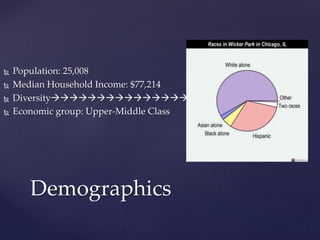
 Population: 25,008 
 Median Household Income: $77,214 
 Diversity 
 Economic group: Upper-Middle Class 
Demographics
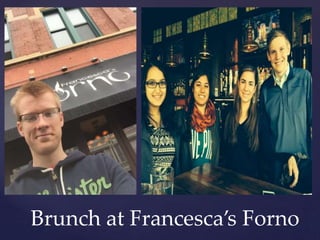
Brunch at Francesca’s Forno
 "History of the Wicker Park District." Neighborhood 
History. N.p., n.d. Web. 19 Oct. 2014. 
 "Wicker Park Neighborhood in Chicago, Illinois (IL), 
60622, 60647 Detailed Profile." Wicker Park Neighborhood 
in Chicago, Illinois (IL), 60622, 60647 Subdivision Profile. 
N.p., n.d. Web. 17 Oct. 2014. 
 "Wicker Park District." COC. N.p., n.d. Web. 20 Oct. 2014. 
Works Cited

Wicker park presentation 2

  • 1.
    City of Chicago Neighborhood Wicker Park { Keisha Batra, Krupa Patel, Rick Emig, Giulia Mezzabotta & Daniel Golaszewski
  • 2.
     Wicker Parkis a Chicago neighborhood  Northwest of the Loop  South of Bucktown  West of Pulaski Park within West Town. Location
  • 3.
     Take RedLine from Granville and go towards 95th  Get off at North/Clybourn  Take Bus 72 at North Ave & Clybourn/Halsted towards Narragansett  Get off at North Ave & Damen  Estimated time of travel: 51 minutes How do I get there?
  • 4.
     Been adistrict of Chicago since 1837  This area is named for the triangular-shaped public park that developer-politician Charles Wicker, and his brother Joel, donated to the city in 1870.  Industry first came to Wicker Park in 1857 when the Rolling Mill Steel Works opened along the river near Ashland and Armitage  Went through two distinct periods:  The first from the mid 1800s to 1929 was the establishment and growth period.  The second from 1930 to approximately 1973-5 was a steady, slow decline climaxing in a depressed community.  A slow rebirth was followed by a blowout of development that continues today  Now, restaurants and entertainment work with classy shops that offer everything from vintage garments to contemporary and antique home furnishings. History
  • 5.
     “Hipster” town  Flatiron Arts Building- Triangular Building that has retail, studios, and galleries  Holy Trinity Cathedral  Intelligentsia Coffee- Roasts their own coffee beans in the store Landmarks
  • 6.
     Keisha: Very“hipster” town. It’s interesting to see the different types of shops at Wicker Park.  Krupa: Exploring Wicker Park opened my eyes as to how diverse the city of Chicago is. It was indeed a fun place to visit and explore.  Rick: Wicker Park was a very up to style town. Good food with an even better atmosphere. Wicker Park is a great place to spend a day.  Giulia: The food was delicious, and I like the chill atmosphere Wicker Park gives.  Dan: It was interesting to experience a town that has a much more “hipster” vibe compared to the type of people we see at Loyola. Personal Reflections
  • 7.
     Group Reflection:We were surprised to see how “hipster” the people really are. This was an authentic Chicago experience because we got to engage in a cultural experience. We would definitely go back again to explore more restaurants and shops. Group Reflection
  • 8.
     Population: 25,008  Median Household Income: $77,214  Diversity  Economic group: Upper-Middle Class Demographics
  • 9.
  • 10.
     "History ofthe Wicker Park District." Neighborhood History. N.p., n.d. Web. 19 Oct. 2014.  "Wicker Park Neighborhood in Chicago, Illinois (IL), 60622, 60647 Detailed Profile." Wicker Park Neighborhood in Chicago, Illinois (IL), 60622, 60647 Subdivision Profile. N.p., n.d. Web. 17 Oct. 2014.  "Wicker Park District." COC. N.p., n.d. Web. 20 Oct. 2014. Works Cited