Wicker Park :) 
by: 
Wicker Park 
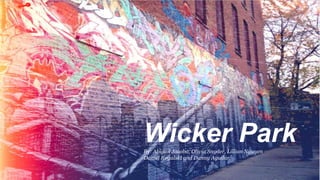
By: Abigail Jacoba, Olivia Snyder, Lillian Nguyen 
Daniel Rogalski and Danny Aguilar 
Abigail Jacoba 
Olivia Snyder 
Lillian Nguyen
Where is Wicker Park? 
Loyola University 
of Chicago 
Wicker Park
How to get There! 
From Loyola University Chicago 54min: 
CTA and BUS (the route we took!) 
1. Take the red line towards 95th 
2. Get off at North and Clybourn 
3. Leave the station and go to the 
“North Ave & Clybourn/Halstead” 
stop toward harlem 
4. Take the #72 for 10 stops 
5. Get off at North Ave & Damen 
From Loyola University Chicago 59min: 
ONLY CTA 
1. Take the red line towards 95th 
2. Get off at Lake and transfer to the 
blue line 
3. Take the Blue line toward O’Hare 
4. After 4 stops get off at Damen 
From Loyola University Chicago 86 min: 
1. From the bus stop on Devon & 
Magnolia take the #36 for 48 stops 
and get off at Clark and North Ave 
2. Switch to the #72 for 16 stops 
towards Harlem and get off at 
North Ave & Damen 
From Loyola University Chicago: 
(Other transit options) 
● 14 min taxi ride 
● 59 min bike ride 
● 147 min walk 
Transit directions from “Citymapper App”
Wicker Park 
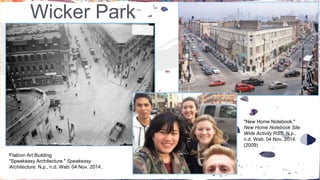
Flatiron Art Building 
"Speakeasy Architecture." Speakeasy 
Architecture. N.p., n.d. Web. 04 Nov. 2014. 
"New Home Notebook." 
New Home Notebook Site 
Wide Activity RSS. N.p., 
n.d. Web. 04 Nov. 2014. 
(2009)
History of Wicker Park 
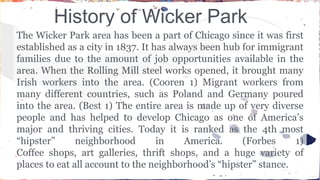
The Wicker Park area has been a part of Chicago since it was first 
established as a city in 1837. It has always been hub for immigrant 
families due to the amount of job opportunities available in the 
area. When the Rolling Mill steel works opened, it brought many 
Irish workers into the area. (Cooren 1) Migrant workers from 
many different countries, such as Poland and Germany poured 
into the area. (Best 1) The entire area is made up of very diverse 
people and has helped to develop Chicago as one of America’s 
major and thriving cities. Today it is ranked as the 4th most 
“hipster” neighborhood in America. (Forbes 1) 
Coffee shops, art galleries, thrift shops, and a huge variety of 
places to eat all account to the neighborhood’s “hipster” stance.
Demographics 
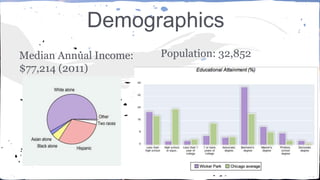
Median Annual Income: 
$77,214 (2011) 
Population: 32,852
Group Reflection 
Olivia: I loved the vibe that the neighborhood had. It was really cool to see the street art, the unique architecture, and 
all the little shops. Wicker Park would be a really great place to live because it has everything! It was a great visit and I’m 
glad I am now familiar with the hipster side of Chicago. 
Abigail: The neighborhood was really cool, I personally have not seen anything like it. It has a kind of hipster meets 
rodeo drive feel to the neighborhood. There were a lot of unique shops particular to that area that added real character 
to the neighborhood. Wicker Park is a really area that I would definitely return to, especially on a sunny day! 
Lillian: I loved the variety of Wicker Park in general. There were so many things to do there and I regret only having a 
few hours to cram it all into. I really loved that fact that there were so many art galleries in the area to check out and I 
will definitely have to go back to check out a few of them, along with visiting the coffee shops on almost every corner! 
Danny: I thought I was familiar with most of the Chicago area, especially Wicker Park since i always passed this 
neighborhood on my way to work, but that wasn't the case. This neighborhood offers much diversity and many 
resturants! On Milwaukee Ave, there restaurants on any side of the street. Also many stores. I felt as if downtown is 
slowly coming in the Wicker Park area. 
Daniel: The diversity of different cultures in a few blocks was outstanding to see, and I believe being in Chicago we 
have one of the only opportunities to view such different culture in the same community. Latino, Irish, and Polish in 
one community is something that cannot be seen in a lot of places around the world.
the things you’ll see…! 
O the places you’ll go…
Landmarks 
Polish Museum of America: Located on 984 N. 
Milwaukee Avenue, the Museum has been a front-runner 
in polish artifacts and knowledge. Founded 
in 1935, since Wicker Park used to be a 
predominantly white neighborhood, the museum 
incorporated a lot of the old polish customs, cultures, 
and artifacts into the densely polish populated area 
of Chicago.
Landmarks… continued 
Holy Trinity Cathedral: Designed by Louis Sullivan 
in 1905 and stands today as one of the most beautiful 
cathedrals in the state of Illinois. Other than the 
scenic intake, the fact that Czar Nicholas II partly 
funded the building of the Cathedral stands for some 
intellectual gain.
Attractions 
The Handlebar: A modest location in Wicker 
Park, somewhere where if you’re a vegetarian 
or vegan you might want to attend. What I 
found interesting about this location is the 
variety of things you can order, and the fact you 
can find a vegan restaurant in the middle of 
Wicker Park.
Random Selfies
Sources 
"Realtor.com." Realtor.com. N.p., n.d. Web. 03 Nov. 2014. <http://www.realtor.com/local/Wicker- 
Park_Chicago_IL/lifestyle>. 
"Wicker Park Neighborhood in Chicago, Illinois (IL), 60622, 60647 Detailed Profile." Wicker Park Neighborhood in 
Chicago, Illinois (IL), 60622, 60647 Subdivision Profile. N.p., n.d. Web. 02 Nov. 2014. <http://www.city-data. 
com/neighborhood/Wicker-Park-Chicago-IL.html>. 
Coorens, Elaine A. "History of the Wicker Park District." Neighborhood History. Marian Williams Design, n.d. Web. 04 
Nov. 2014. 
Best, Wallace. “Wicker Park.” Encyclopedia of Chicago. 17 February 2008. http://www.encyclopedia. 
chicagohistory.org/pages/2159.html 
Forbes. Forbes Magazine. Web. 06 Nov. 2014. <http://www.forbes.com/pictures/mhj45jmeh/4-wicker-park-chicago-il- 
2/>.
fin

Connections to Community in Wicker Park

  • 1.
    Wicker Park :) by: Wicker Park By: Abigail Jacoba, Olivia Snyder, Lillian Nguyen Daniel Rogalski and Danny Aguilar Abigail Jacoba Olivia Snyder Lillian Nguyen
  • 2.
    Where is WickerPark? Loyola University of Chicago Wicker Park
  • 3.
    How to getThere! From Loyola University Chicago 54min: CTA and BUS (the route we took!) 1. Take the red line towards 95th 2. Get off at North and Clybourn 3. Leave the station and go to the “North Ave & Clybourn/Halstead” stop toward harlem 4. Take the #72 for 10 stops 5. Get off at North Ave & Damen From Loyola University Chicago 59min: ONLY CTA 1. Take the red line towards 95th 2. Get off at Lake and transfer to the blue line 3. Take the Blue line toward O’Hare 4. After 4 stops get off at Damen From Loyola University Chicago 86 min: 1. From the bus stop on Devon & Magnolia take the #36 for 48 stops and get off at Clark and North Ave 2. Switch to the #72 for 16 stops towards Harlem and get off at North Ave & Damen From Loyola University Chicago: (Other transit options) ● 14 min taxi ride ● 59 min bike ride ● 147 min walk Transit directions from “Citymapper App”
  • 4.
    Wicker Park FlatironArt Building "Speakeasy Architecture." Speakeasy Architecture. N.p., n.d. Web. 04 Nov. 2014. "New Home Notebook." New Home Notebook Site Wide Activity RSS. N.p., n.d. Web. 04 Nov. 2014. (2009)
  • 5.
    History of WickerPark The Wicker Park area has been a part of Chicago since it was first established as a city in 1837. It has always been hub for immigrant families due to the amount of job opportunities available in the area. When the Rolling Mill steel works opened, it brought many Irish workers into the area. (Cooren 1) Migrant workers from many different countries, such as Poland and Germany poured into the area. (Best 1) The entire area is made up of very diverse people and has helped to develop Chicago as one of America’s major and thriving cities. Today it is ranked as the 4th most “hipster” neighborhood in America. (Forbes 1) Coffee shops, art galleries, thrift shops, and a huge variety of places to eat all account to the neighborhood’s “hipster” stance.
  • 6.
    Demographics Median AnnualIncome: $77,214 (2011) Population: 32,852
  • 7.
    Group Reflection Olivia:I loved the vibe that the neighborhood had. It was really cool to see the street art, the unique architecture, and all the little shops. Wicker Park would be a really great place to live because it has everything! It was a great visit and I’m glad I am now familiar with the hipster side of Chicago. Abigail: The neighborhood was really cool, I personally have not seen anything like it. It has a kind of hipster meets rodeo drive feel to the neighborhood. There were a lot of unique shops particular to that area that added real character to the neighborhood. Wicker Park is a really area that I would definitely return to, especially on a sunny day! Lillian: I loved the variety of Wicker Park in general. There were so many things to do there and I regret only having a few hours to cram it all into. I really loved that fact that there were so many art galleries in the area to check out and I will definitely have to go back to check out a few of them, along with visiting the coffee shops on almost every corner! Danny: I thought I was familiar with most of the Chicago area, especially Wicker Park since i always passed this neighborhood on my way to work, but that wasn't the case. This neighborhood offers much diversity and many resturants! On Milwaukee Ave, there restaurants on any side of the street. Also many stores. I felt as if downtown is slowly coming in the Wicker Park area. Daniel: The diversity of different cultures in a few blocks was outstanding to see, and I believe being in Chicago we have one of the only opportunities to view such different culture in the same community. Latino, Irish, and Polish in one community is something that cannot be seen in a lot of places around the world.
  • 8.
    the things you’llsee…! O the places you’ll go…
  • 9.
    Landmarks Polish Museumof America: Located on 984 N. Milwaukee Avenue, the Museum has been a front-runner in polish artifacts and knowledge. Founded in 1935, since Wicker Park used to be a predominantly white neighborhood, the museum incorporated a lot of the old polish customs, cultures, and artifacts into the densely polish populated area of Chicago.
  • 10.
    Landmarks… continued HolyTrinity Cathedral: Designed by Louis Sullivan in 1905 and stands today as one of the most beautiful cathedrals in the state of Illinois. Other than the scenic intake, the fact that Czar Nicholas II partly funded the building of the Cathedral stands for some intellectual gain.
  • 11.
    Attractions The Handlebar:A modest location in Wicker Park, somewhere where if you’re a vegetarian or vegan you might want to attend. What I found interesting about this location is the variety of things you can order, and the fact you can find a vegan restaurant in the middle of Wicker Park.
  • 12.
  • 13.
    Sources "Realtor.com." Realtor.com.N.p., n.d. Web. 03 Nov. 2014. <http://www.realtor.com/local/Wicker- Park_Chicago_IL/lifestyle>. "Wicker Park Neighborhood in Chicago, Illinois (IL), 60622, 60647 Detailed Profile." Wicker Park Neighborhood in Chicago, Illinois (IL), 60622, 60647 Subdivision Profile. N.p., n.d. Web. 02 Nov. 2014. <http://www.city-data. com/neighborhood/Wicker-Park-Chicago-IL.html>. Coorens, Elaine A. "History of the Wicker Park District." Neighborhood History. Marian Williams Design, n.d. Web. 04 Nov. 2014. Best, Wallace. “Wicker Park.” Encyclopedia of Chicago. 17 February 2008. http://www.encyclopedia. chicagohistory.org/pages/2159.html Forbes. Forbes Magazine. Web. 06 Nov. 2014. <http://www.forbes.com/pictures/mhj45jmeh/4-wicker-park-chicago-il- 2/>.
  • 14.

Editor's Notes

  • #3 “Wicker Park, Chicago” Map. Google Maps. Google, 4 November 2014. Web. 4 November 2014.