The Mona Lisa 
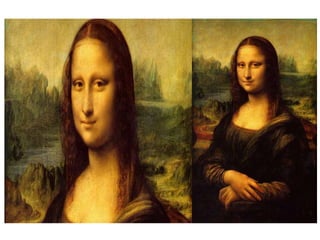
The Mona Lisa (Monna Lisa or La Gioconda in Italian; La Joconde 
in French) is a half-length portrait of a woman by the Italian 
artist Leonardo da Vinci, which has been acclaimed as "the best 
known, the most visited, the most written about, the most sung 
about, the most parodied work of art in the world". The painting, 
thought to be a portrait of Lisa Gherardini, the wife of Francesco 
del Giocondo, is in oil on a white Lombardy poplar panel, and is 
believed to have been painted between 1503 and 1506, 
although Leonardo may have continued working on it as late as 
1517. It was acquired by King Francis I of France and is now the 
property of the French Republic, on permanent display at The 
Louvre museum in Paris since 1797.
History of Mona Lisa 
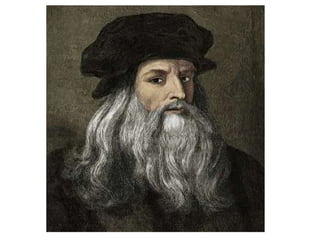
Leonardo da Vinci began painting the Mona Lisa in 1503 or 1504 
in Florence, Italy. Although the Louvre states that it was 
"doubtless painted between 1503 and 1506", the art historian 
Martin Kemp says there is some difficulty in confirming the 
actual dates with certainty. According to Leonardo‘s 
contemporary, Giorgio Vasari, "after he had lingered over it four 
years, left it unfinished". Leonardo, later in his life, is said to have 
regretted "never having completed a single work". In 1516 
Leonardo was invited by King François I to work at the Clos Lucé 
near the king's castle in Amboise. It is believed that he took the 
Mona Lisa with him and continued to work after he moved to 
France. Art historian Carmen C. Bambach has concluded that da 
Vinci probably continued refining the work until 1516 or 1517.
The Mystery of Mona Lisa
10 Worst Things That Happened To The Mona Lisa
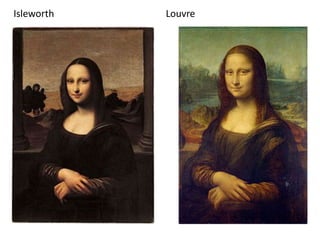
Isleworth Louvre
Isleworth’s Mona Lisa 
The Isleworth Mona Lisa is wider than the Mona Lisa in the Louvre, 
having columns on either side which also appear in some other 
versions. The Louvre painting merely has the projecting bases of 
columns on either side, suggesting that the picture was originally 
framed by columns but was trimmed. However, experts who examined 
the Mona Lisa in 2004–2005 stated that the original painting had not 
been trimmed. The figure of the Isleworth Mona Lisa closely resembles 
that of the Mona Lisa, being identically composed and lit. However, 
the face of the Isleworth Mona Lisa appears younger, leading to 
speculation that it is an earlier version by the artist. According to 
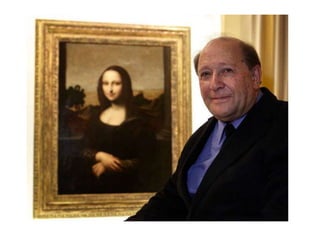
Pulitzer, multiple art experts agreed that the neck of the Isleworth 
Mona Lisa is inferior to the necks of other Leonardo subjects. 
Furthermore, the background in the Isleworth painting is considerably 
less detailed than the background in the Louvre painting. For these 
reasons, several people Pulitzer consulted believed that the hands and 
face of the portrait were done by Leonardo, but the rest may have 
been finished by another or others.
Mona lisa

Mona lisa

  • 2.
    The Mona Lisa The Mona Lisa (Monna Lisa or La Gioconda in Italian; La Joconde in French) is a half-length portrait of a woman by the Italian artist Leonardo da Vinci, which has been acclaimed as "the best known, the most visited, the most written about, the most sung about, the most parodied work of art in the world". The painting, thought to be a portrait of Lisa Gherardini, the wife of Francesco del Giocondo, is in oil on a white Lombardy poplar panel, and is believed to have been painted between 1503 and 1506, although Leonardo may have continued working on it as late as 1517. It was acquired by King Francis I of France and is now the property of the French Republic, on permanent display at The Louvre museum in Paris since 1797.
  • 4.
    History of MonaLisa Leonardo da Vinci began painting the Mona Lisa in 1503 or 1504 in Florence, Italy. Although the Louvre states that it was "doubtless painted between 1503 and 1506", the art historian Martin Kemp says there is some difficulty in confirming the actual dates with certainty. According to Leonardo‘s contemporary, Giorgio Vasari, "after he had lingered over it four years, left it unfinished". Leonardo, later in his life, is said to have regretted "never having completed a single work". In 1516 Leonardo was invited by King François I to work at the Clos Lucé near the king's castle in Amboise. It is believed that he took the Mona Lisa with him and continued to work after he moved to France. Art historian Carmen C. Bambach has concluded that da Vinci probably continued refining the work until 1516 or 1517.
  • 5.
    The Mystery ofMona Lisa
  • 6.
    10 Worst ThingsThat Happened To The Mona Lisa
  • 7.
  • 9.
    Isleworth’s Mona Lisa The Isleworth Mona Lisa is wider than the Mona Lisa in the Louvre, having columns on either side which also appear in some other versions. The Louvre painting merely has the projecting bases of columns on either side, suggesting that the picture was originally framed by columns but was trimmed. However, experts who examined the Mona Lisa in 2004–2005 stated that the original painting had not been trimmed. The figure of the Isleworth Mona Lisa closely resembles that of the Mona Lisa, being identically composed and lit. However, the face of the Isleworth Mona Lisa appears younger, leading to speculation that it is an earlier version by the artist. According to Pulitzer, multiple art experts agreed that the neck of the Isleworth Mona Lisa is inferior to the necks of other Leonardo subjects. Furthermore, the background in the Isleworth painting is considerably less detailed than the background in the Louvre painting. For these reasons, several people Pulitzer consulted believed that the hands and face of the portrait were done by Leonardo, but the rest may have been finished by another or others.