Why we Matter
When astronomers
announce the discovery
of an “earth-like planet,”
they’re usually talking
about planets with
roughly earth-like
gravity that are close
enough to their star to
be warm—but not too
hot—and that may (or
may not) have liquid
water. But there’s a
whole lot beyond those
three “must-have”
ingredients that makes
our home planet special.
Here’s an incomplete list
of why, out of all the
many celestial bodies,
earth matters.
• The moon: The earth has a
slight tilt and teeters like a
top as it spins, which could
cause drastic shifts in
climate. But because
of the moon’s
stabilizing effect
on our orbit, our
climate is a lot
more stable.
• Stable
rotation: The
regularity and
frequency of
day and night on
this planet play a
significant role in
preventing extreme
temperatures and
encouraging life.
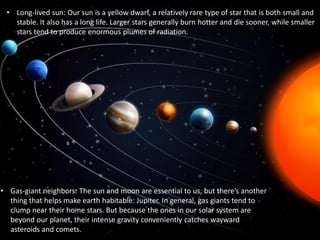
• Long-lived sun: Our sun is a yellow dwarf, a relatively rare type of star that is both small and
stable. It also has a long life. Larger stars generally burn hotter and die sooner, while smaller
stars tend to produce enormous plumes of radiation.
• Gas-giant neighbors: The sun and moon are essential to us, but there’s another
thing that helps make earth habitable: Jupiter. In general, gas giants tend to
clump near their home stars. But because the ones in our solar system are
beyond our planet, their intense gravity conveniently catches wayward
asteroids and comets.
• A magnetic field: Earth is blessed with a strong, stable
magnetic field, which staves off the cosmic rays and solar flares
that would otherwise fry the planet every now and then.
• Atmosphere: That high-altitude layer of gas shields us from
much lethal radiation.
These are just a few of the items on the long list of features that make earth uniquely
habitable in comparison to every other planet we know of. The fact that the list of essential
features is so long could suggest that life is incredibly rare, and ours may be the only planet
that satisfies all the necessary conditions.
Of course, we can’t
know either way for
sure. But the fact that
the many conditions for
life as we know it are all
present on earth in
perfect form points me
toward a wonderful
Creator who knew just
what He was doing.
He laid out the stars
and set the planets in
their orbits. He caused
water and snow, light
and dark, laughter and
love to exist for a
purpose. Each of us is
unique and created by
a loving Creator who
provided a beautiful
and intricately designed
planet for us to live on
and enjoy.
www.freekidstories.org
Text courtesy of Activated magazine. Used by permission.
Image Credits:
Images 1-2,6: Courtesy of Vecteezy; used by permission
Image 3: Image designed by Macrovector/Freepik
Image 4-5: Image designed by brgfx/Freepik

Why we Matter

  • 1.
    Why we Matter Whenastronomers announce the discovery of an “earth-like planet,” they’re usually talking about planets with roughly earth-like gravity that are close enough to their star to be warm—but not too hot—and that may (or may not) have liquid water. But there’s a whole lot beyond those three “must-have” ingredients that makes our home planet special. Here’s an incomplete list of why, out of all the many celestial bodies, earth matters.
  • 2.
    • The moon:The earth has a slight tilt and teeters like a top as it spins, which could cause drastic shifts in climate. But because of the moon’s stabilizing effect on our orbit, our climate is a lot more stable. • Stable rotation: The regularity and frequency of day and night on this planet play a significant role in preventing extreme temperatures and encouraging life.
  • 3.
    • Long-lived sun:Our sun is a yellow dwarf, a relatively rare type of star that is both small and stable. It also has a long life. Larger stars generally burn hotter and die sooner, while smaller stars tend to produce enormous plumes of radiation. • Gas-giant neighbors: The sun and moon are essential to us, but there’s another thing that helps make earth habitable: Jupiter. In general, gas giants tend to clump near their home stars. But because the ones in our solar system are beyond our planet, their intense gravity conveniently catches wayward asteroids and comets.
  • 4.
    • A magneticfield: Earth is blessed with a strong, stable magnetic field, which staves off the cosmic rays and solar flares that would otherwise fry the planet every now and then. • Atmosphere: That high-altitude layer of gas shields us from much lethal radiation.
  • 5.
    These are justa few of the items on the long list of features that make earth uniquely habitable in comparison to every other planet we know of. The fact that the list of essential features is so long could suggest that life is incredibly rare, and ours may be the only planet that satisfies all the necessary conditions.
  • 6.
    Of course, wecan’t know either way for sure. But the fact that the many conditions for life as we know it are all present on earth in perfect form points me toward a wonderful Creator who knew just what He was doing. He laid out the stars and set the planets in their orbits. He caused water and snow, light and dark, laughter and love to exist for a purpose. Each of us is unique and created by a loving Creator who provided a beautiful and intricately designed planet for us to live on and enjoy.
  • 7.
    www.freekidstories.org Text courtesy ofActivated magazine. Used by permission. Image Credits: Images 1-2,6: Courtesy of Vecteezy; used by permission Image 3: Image designed by Macrovector/Freepik Image 4-5: Image designed by brgfx/Freepik