
Why we do what we do &
why it matters for Business
Leaders, governments,
business owners & marketers
all have the
same basic desire
…participate, follow,
engage, buy, tell, stop doing,
do more of…
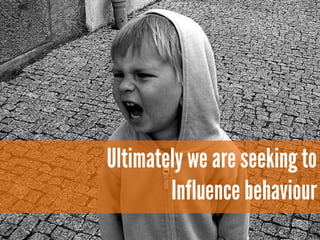
Ultimately we are seeking to
        Influence behaviour
So how can we do that?
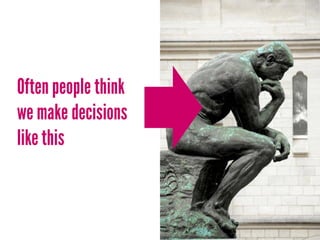
Often people think
we make decisions
like this
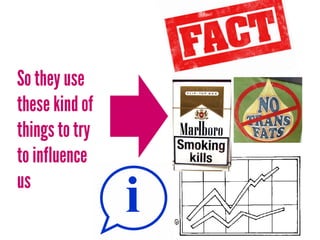
So they use
these kind of
things to try
to influence
us
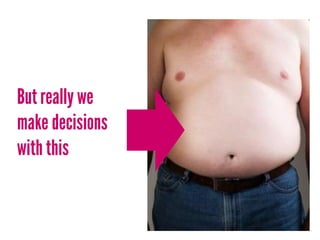
But really we
make decisions
with this
Because If we had to think through every decision
We’d be exhausted most of the time
.


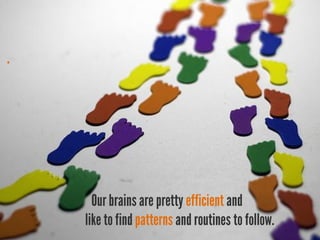
      Our brains are pretty efficient and
    like to find patterns and routines to follow.
Most of our decision making is   automatic.
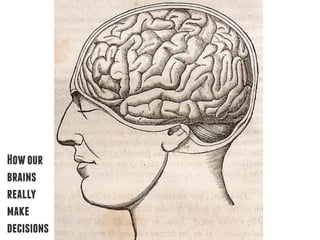
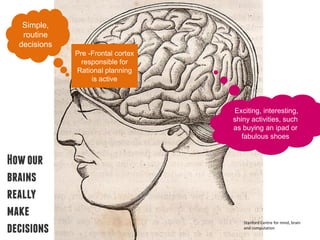
How our
brains
really
make
decisions
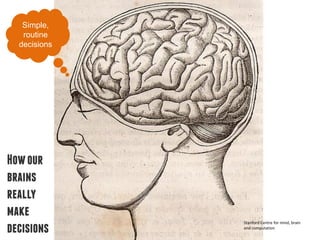
Simple,
   routine
  decisions


How our
brains
really
make
              Stanford Centre for mind, brain
decisions     and computation
Simple,
   routine
  decisions
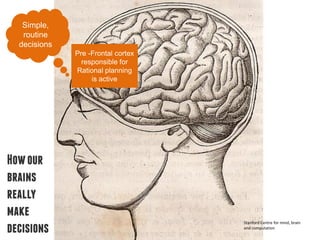
              Pre -Frontal cortex
                responsible for
              Rational planning
                   is active


How our
brains
really
make
                                    Stanford Centre for mind, brain
decisions                           and computation
Simple,
   routine
  decisions
              Pre -Frontal cortex
                responsible for
              Rational planning
                   is active


                                    Exciting, interesting,
                                    shiny activities, such
                                    as buying an ipad or
                                       fabulous shoes


How our
brains
really
make
                                       Stanford Centre for mind, brain
decisions                              and computation
Simple,
   routine
  decisions
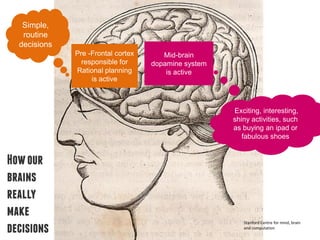
              Pre -Frontal cortex      Mid-brain
                responsible for     dopamine system
              Rational planning         is active
                   is active


                                                      Exciting, interesting,
                                                      shiny activities, such
                                                      as buying an ipad or
                                                         fabulous shoes


How our
brains
really
make
                                                         Stanford Centre for mind, brain
decisions                                                and computation
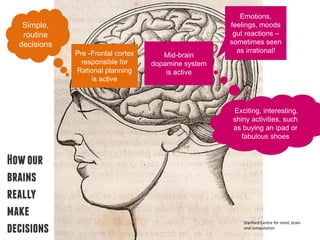
Emotions,
   Simple,                                            feelings, moods
   routine                                             gut reactions –
  decisions                                           sometimes seen
              Pre -Frontal cortex                       as irrational!
                                       Mid-brain
                responsible for     dopamine system
              Rational planning         is active
                   is active


                                                      Exciting, interesting,
                                                      shiny activities, such
                                                      as buying an ipad or
                                                         fabulous shoes


How our
brains
really
make
                                                          Stanford Centre for mind, brain
decisions                                                 and computation
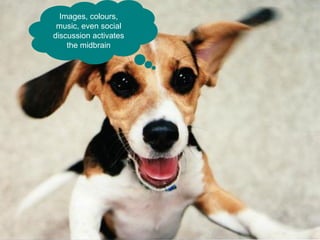
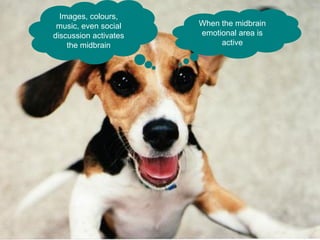
Images, colours,
 music, even social
discussion activates
    the midbrain
Images, colours,
 music, even social    When the midbrain
discussion activates   emotional area is
    the midbrain            active
Images, colours,
     music, even social                    When the midbrain
    discussion activates                   emotional area is
        the midbrain                            active


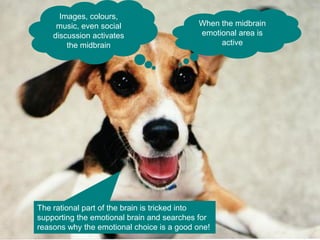
The rational part of the brain is tricked into
supporting the emotional brain and searches for
reasons why the emotional choice is a good one!
If we acknowledge these automatic
responses in decision making we can
      better influence behaviour
Here are some of the   quirky things   that make us do what we do
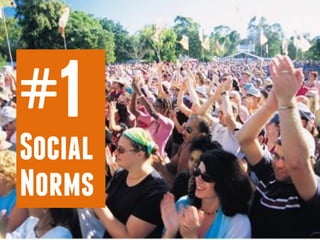
#1
Social
Norms
We all like
to think we
are individual
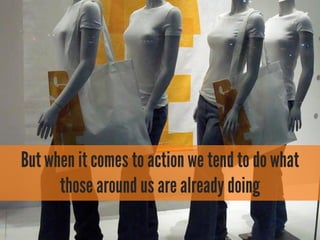
But when it comes to action we tend to do what
      those around us are already doing
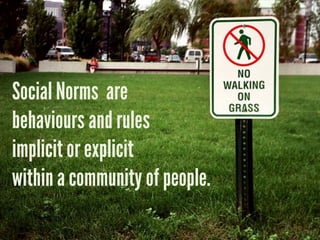
Social Norms are
behaviours and rules
implicit or explicit
within a community of people.
A little
research
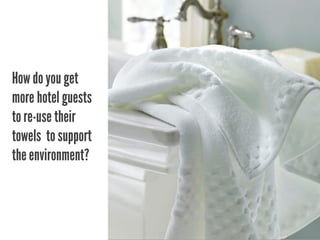
How do you get
more hotel guests
to re-use their
towels to support
the environment?
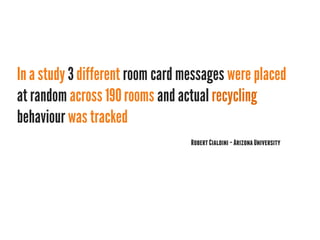
In a study 3 different room card messages were placed
at random across 190 rooms and actual recycling
behaviour was tracked
                                  Robert Cialdini – Arizona University
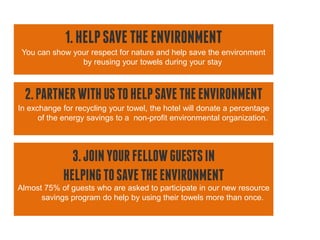
1. HELP SAVE THE ENVIRONMENT
 You can show your respect for nature and help save the environment
                by reusing your towels during your stay


 2. PARTNER WITH US TO HELP SAVE THE ENVIRONMENT
In exchange for recycling your towel, the hotel will donate a percentage
      of the energy savings to a non-profit environmental organization.


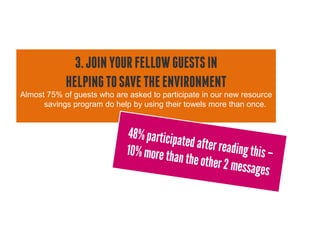
              3. JOIN YOUR FELLOW GUESTS IN
            HELPING TO SAVE THE ENVIRONMENT
Almost 75% of guests who are asked to participate in our new resource
      savings program do help by using their towels more than once.
Which message was   most   effective?
3. JOIN YOUR FELLOW GUESTS IN
            HELPING TO SAVE THE ENVIRONMENT
Almost 75% of guests who are asked to participate in our new resource
      savings program do help by using their towels more than once.
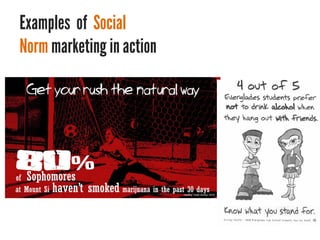
Examples of Social
Norm marketing in action
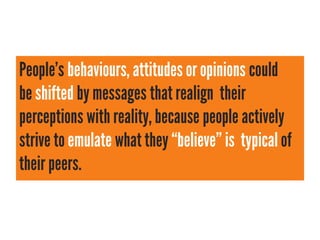
People’s behaviours, attitudes or opinions could
be shifted by messages that realign their
perceptions with reality, because people actively
strive to emulate what they “believe” is typical of
their peers.
No. 2 Priming
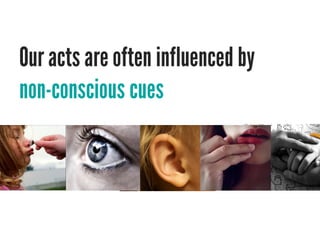
Our acts are often influenced by
non-conscious cues
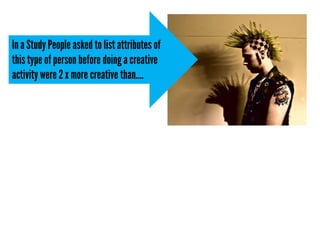
In a Study People asked to list attributes of
this type of person before doing a creative
activity were 2 x more creative than....
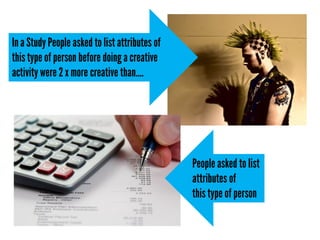
In a Study People asked to list attributes of
this type of person before doing a creative
activity were 2 x more creative than....


                                                People asked to list
                                                attributes of
                                                this type of person
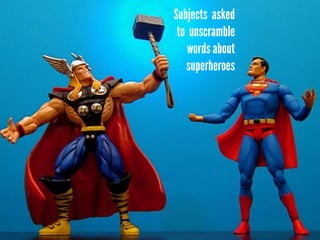
Subjects asked
 to unscramble
   words about
   superheroes
Volunteered TWICE as many hours as
     those who saw neutral words
And after 90 days, those primed with
    superhero words were 4x more
           likely to volunteer
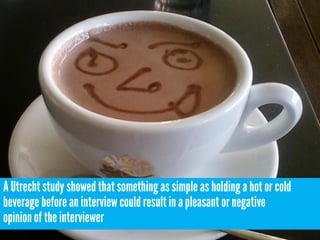
A Utrecht study showed that something as simple as holding a hot or cold
beverage before an interview could result in a pleasant or negative
opinion of the interviewer
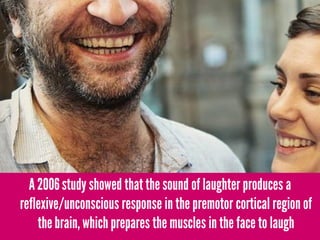
A 2006 study showed that the sound of laughter produces a
reflexive/unconscious response in the premotor cortical region of
    the brain, which prepares the muscles in the face to laugh
Priming can’t   make people do anything against their will.
But it can predispose people to be creative, collaborative,
altruistic, happy, perform better, achieve goals

...and elicit any other behaviour you can imagine ...both
negative and positive.
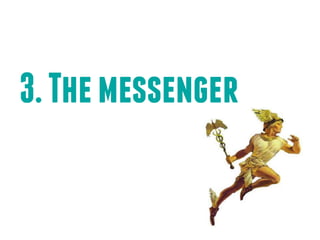
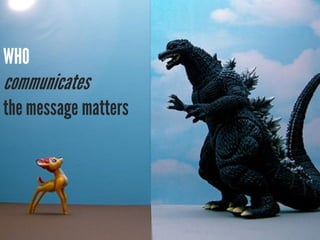
3. The messenger
WHO
communicates
the message matters
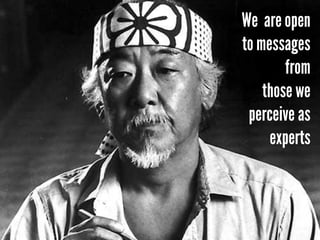
We are open
to messages
        from
    those we
 perceive as
     experts
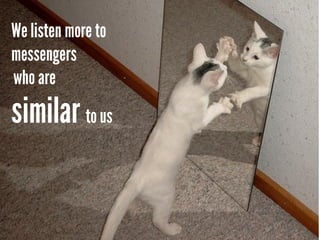
We listen more to
messengers
who are
similar to us
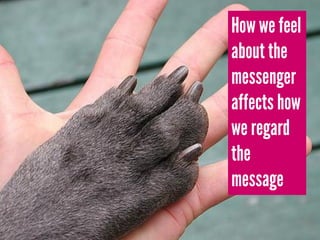
How we feel
about the
messenger
affects how
we regard
the
message
4. Sensory words
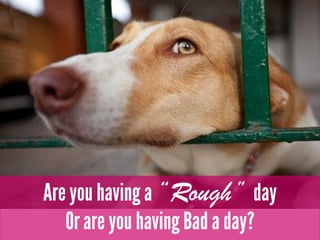
Are you having a “Rough” day
   Or are you having Bad a day?
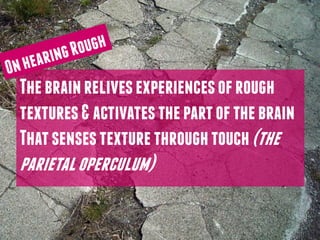
The brain relives experiences of rough
textures & activates the part of the brain
That senses texture through touch (the
parietal operculum)
Words that light
up these sensory
areas of the brain
are likely to be
more memorable
and impactful.
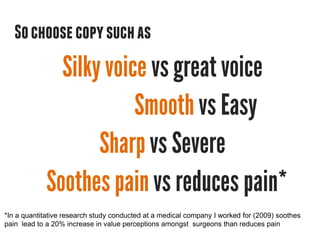
So choose copy such as
               Silky voice vs great voice
                         Smooth vs Easy
                    Sharp vs Severe
             Soothes pain vs reduces pain*
*In a quantitative research study conducted at a medical company I worked for (2009) soothes
pain lead to a 20% increase in value perceptions amongst surgeons than reduces pain
Need help to
move your
business
to the next
LEVEL?
We’re pros in marketing,
leadership and business
strategy.
We coach, train, prod, facilitate,
encourage, support, inspire & energise
to help you move from
Good to Awesome.
How to find us          info@provadisgroup.com
                                   @myprovadis
                 0161 980 1371 (Manchester, UK)
                        www.provadisgroup.com
                     www.provadisblogspot.com
References
•   Bypassing the Will: Toward Demystifying the Nonconscious Control of SociaI
    Behavior John A. Bargh
•   Mindspace: influencing behaviour through public policy. Institute for government.
•   The Automated Will: Nonconscious Activation and Pursuit of Behavioral Goals John
    A. Bargh
•   Don't Throw in the Towel: Use Social Influence Research – Association for
    psychological science. Robert B. Cialdini
•   IJerman, Hans; Semin, Gun R. (2009). "The Thermometer of Social Relations:
    Mapping Social Proximity on Temperature". Psychological Science 20 (10): 1214–
    1220.
•   Winkleman, Berridge, Wilbarger (2005) Unconscious affective reactions to masked
    happy versus angry faces influence consumption behavior and judgments of value.
    Personality and Social Psychology Bulletin 31(1):121-135.
•   Laugh and the whole world laughs with you -- Why the brain just can't help itself.
    Institute of Cognitive Neuroscience – Sophie Scott
Photos
Thanks to Compfight and the following photo sharers:

carbonNYC, davedudaley, edenlay, mdanys, moriza, satoru,
superfantastic, tambakothejaguar, jdhancock, jiimywee,
chrstphr, dierkschaefer, elbibliomata, faungg, ma1974,
kellbailey, kevindooley,larsploughmann, helgabj, helgaweber,
jesse.millan, liquene, TravisIsaacs, unhindered talent.

Why we do what we do

  • 1.
    Why we dowhat we do & why it matters for Business
  • 2.
    Leaders, governments, business owners& marketers all have the same basic desire
  • 4.
    …participate, follow, engage, buy,tell, stop doing, do more of…
  • 5.
    Ultimately we areseeking to Influence behaviour
  • 6.
    So how canwe do that?
  • 7.
    Often people think wemake decisions like this
  • 8.
    So they use thesekind of things to try to influence us
  • 9.
    But really we makedecisions with this
  • 11.
    Because If wehad to think through every decision
  • 12.
    We’d be exhaustedmost of the time
  • 13.
    . Our brains are pretty efficient and like to find patterns and routines to follow.
  • 14.
    Most of ourdecision making is automatic.
  • 15.
  • 16.
    Simple, routine decisions How our brains really make Stanford Centre for mind, brain decisions and computation
  • 17.
    Simple, routine decisions Pre -Frontal cortex responsible for Rational planning is active How our brains really make Stanford Centre for mind, brain decisions and computation
  • 18.
    Simple, routine decisions Pre -Frontal cortex responsible for Rational planning is active Exciting, interesting, shiny activities, such as buying an ipad or fabulous shoes How our brains really make Stanford Centre for mind, brain decisions and computation
  • 19.
    Simple, routine decisions Pre -Frontal cortex Mid-brain responsible for dopamine system Rational planning is active is active Exciting, interesting, shiny activities, such as buying an ipad or fabulous shoes How our brains really make Stanford Centre for mind, brain decisions and computation
  • 20.
    Emotions, Simple, feelings, moods routine gut reactions – decisions sometimes seen Pre -Frontal cortex as irrational! Mid-brain responsible for dopamine system Rational planning is active is active Exciting, interesting, shiny activities, such as buying an ipad or fabulous shoes How our brains really make Stanford Centre for mind, brain decisions and computation
  • 21.
    Images, colours, music,even social discussion activates the midbrain
  • 22.
    Images, colours, music,even social When the midbrain discussion activates emotional area is the midbrain active
  • 23.
    Images, colours, music, even social When the midbrain discussion activates emotional area is the midbrain active The rational part of the brain is tricked into supporting the emotional brain and searches for reasons why the emotional choice is a good one!
  • 24.
    If we acknowledgethese automatic responses in decision making we can better influence behaviour
  • 25.
    Here are someof the quirky things that make us do what we do
  • 26.
  • 27.
    We all like tothink we are individual
  • 28.
    But when itcomes to action we tend to do what those around us are already doing
  • 29.
    Social Norms are behavioursand rules implicit or explicit within a community of people.
  • 30.
  • 31.
    How do youget more hotel guests to re-use their towels to support the environment?
  • 32.
    In a study3 different room card messages were placed at random across 190 rooms and actual recycling behaviour was tracked Robert Cialdini – Arizona University
  • 33.
    1. HELP SAVETHE ENVIRONMENT You can show your respect for nature and help save the environment by reusing your towels during your stay 2. PARTNER WITH US TO HELP SAVE THE ENVIRONMENT In exchange for recycling your towel, the hotel will donate a percentage of the energy savings to a non-profit environmental organization. 3. JOIN YOUR FELLOW GUESTS IN HELPING TO SAVE THE ENVIRONMENT Almost 75% of guests who are asked to participate in our new resource savings program do help by using their towels more than once.
  • 34.
    Which message was most effective?
  • 35.
    3. JOIN YOURFELLOW GUESTS IN HELPING TO SAVE THE ENVIRONMENT Almost 75% of guests who are asked to participate in our new resource savings program do help by using their towels more than once.
  • 36.
    Examples of Social Normmarketing in action
  • 37.
    People’s behaviours, attitudesor opinions could be shifted by messages that realign their perceptions with reality, because people actively strive to emulate what they “believe” is typical of their peers.
  • 38.
  • 39.
    Our acts areoften influenced by non-conscious cues
  • 40.
    In a StudyPeople asked to list attributes of this type of person before doing a creative activity were 2 x more creative than....
  • 41.
    In a StudyPeople asked to list attributes of this type of person before doing a creative activity were 2 x more creative than.... People asked to list attributes of this type of person
  • 42.
    Subjects asked tounscramble words about superheroes
  • 43.
    Volunteered TWICE asmany hours as those who saw neutral words
  • 44.
    And after 90days, those primed with superhero words were 4x more likely to volunteer
  • 45.
    A Utrecht studyshowed that something as simple as holding a hot or cold beverage before an interview could result in a pleasant or negative opinion of the interviewer
  • 46.
    A 2006 studyshowed that the sound of laughter produces a reflexive/unconscious response in the premotor cortical region of the brain, which prepares the muscles in the face to laugh
  • 47.
    Priming can’t make people do anything against their will.
  • 48.
    But it canpredispose people to be creative, collaborative, altruistic, happy, perform better, achieve goals ...and elicit any other behaviour you can imagine ...both negative and positive.
  • 49.
  • 50.
  • 51.
    We are open tomessages from those we perceive as experts
  • 52.
    We listen moreto messengers who are similar to us
  • 53.
    How we feel aboutthe messenger affects how we regard the message
  • 54.
  • 55.
    Are you havinga “Rough” day Or are you having Bad a day?
  • 56.
    The brain relivesexperiences of rough textures & activates the part of the brain That senses texture through touch (the parietal operculum)
  • 57.
    Words that light upthese sensory areas of the brain are likely to be more memorable and impactful.
  • 58.
    So choose copysuch as Silky voice vs great voice Smooth vs Easy Sharp vs Severe Soothes pain vs reduces pain* *In a quantitative research study conducted at a medical company I worked for (2009) soothes pain lead to a 20% increase in value perceptions amongst surgeons than reduces pain
  • 59.
    Need help to moveyour business to the next LEVEL?
  • 60.
    We’re pros inmarketing, leadership and business strategy. We coach, train, prod, facilitate, encourage, support, inspire & energise to help you move from Good to Awesome.
  • 61.
    How to findus info@provadisgroup.com @myprovadis 0161 980 1371 (Manchester, UK) www.provadisgroup.com www.provadisblogspot.com
  • 62.
    References • Bypassing the Will: Toward Demystifying the Nonconscious Control of SociaI Behavior John A. Bargh • Mindspace: influencing behaviour through public policy. Institute for government. • The Automated Will: Nonconscious Activation and Pursuit of Behavioral Goals John A. Bargh • Don't Throw in the Towel: Use Social Influence Research – Association for psychological science. Robert B. Cialdini • IJerman, Hans; Semin, Gun R. (2009). "The Thermometer of Social Relations: Mapping Social Proximity on Temperature". Psychological Science 20 (10): 1214– 1220. • Winkleman, Berridge, Wilbarger (2005) Unconscious affective reactions to masked happy versus angry faces influence consumption behavior and judgments of value. Personality and Social Psychology Bulletin 31(1):121-135. • Laugh and the whole world laughs with you -- Why the brain just can't help itself. Institute of Cognitive Neuroscience – Sophie Scott
  • 63.
    Photos Thanks to Compfightand the following photo sharers: carbonNYC, davedudaley, edenlay, mdanys, moriza, satoru, superfantastic, tambakothejaguar, jdhancock, jiimywee, chrstphr, dierkschaefer, elbibliomata, faungg, ma1974, kellbailey, kevindooley,larsploughmann, helgabj, helgaweber, jesse.millan, liquene, TravisIsaacs, unhindered talent.