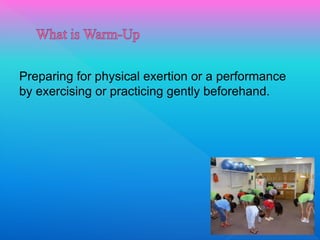
Preparing for physical exertion or a performance
by exercising or practicing gently beforehand.
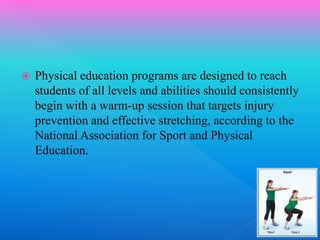
 Physical education programs are designed to reach
students of all levels and abilities should consistently
begin with a warm-up session that targets injury
prevention and effective stretching, according to the
National Association for Sport and Physical
Education.
The warm-up is a period of reintroduction to
physical activity that has significant implications for
performance and both short- and long-term
enjoyment of fitness regimens.
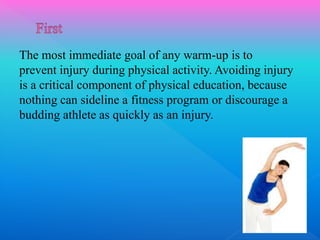
The most immediate goal of any warm-up is to
prevent injury during physical activity. Avoiding injury
is a critical component of physical education, because
nothing can sideline a fitness program or discourage a
budding athlete as quickly as an injury.
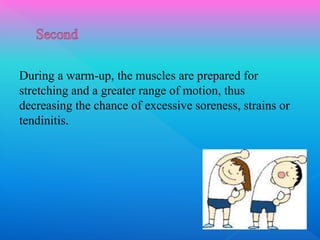
During a warm-up, the muscles are prepared for
stretching and a greater range of motion, thus
decreasing the chance of excessive soreness, strains or
tendinitis.
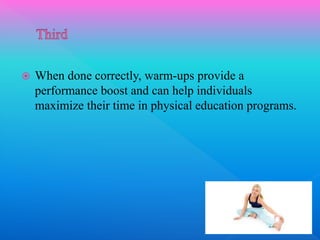
 When done correctly, warm-ups provide a
performance boost and can help individuals
maximize their time in physical education programs.
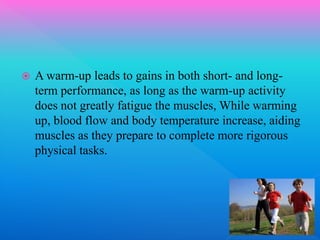
 A warm-up leads to gains in both short- and long-
term performance, as long as the warm-up activity
does not greatly fatigue the muscles, While warming
up, blood flow and body temperature increase, aiding
muscles as they prepare to complete more rigorous
physical tasks.
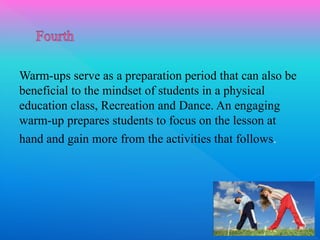
Warm-ups serve as a preparation period that can also be
beneficial to the mindset of students in a physical
education class, Recreation and Dance. An engaging
warm-up prepares students to focus on the lesson at
hand and gain more from the activities that follows.
 Over the long run, warming up allows for greater
enjoyment and faster progress toward fitness goals by
ensuring the body is in its best condition for sequential
sessions.
 https://www.google.com.jm/search?q=what+is+war
m+up&biw=1280&bih=929&source=lnms&sa=X&e
i=2Xj0VL6DI8_bsASFxYCIAg&ved=0CAUQ_AU
oAA&dpr=1
Why warm up

Why warm up

  • 2.
    Preparing for physicalexertion or a performance by exercising or practicing gently beforehand.
  • 3.
     Physical educationprograms are designed to reach students of all levels and abilities should consistently begin with a warm-up session that targets injury prevention and effective stretching, according to the National Association for Sport and Physical Education.
  • 4.
    The warm-up isa period of reintroduction to physical activity that has significant implications for performance and both short- and long-term enjoyment of fitness regimens.
  • 5.
    The most immediategoal of any warm-up is to prevent injury during physical activity. Avoiding injury is a critical component of physical education, because nothing can sideline a fitness program or discourage a budding athlete as quickly as an injury.
  • 6.
    During a warm-up,the muscles are prepared for stretching and a greater range of motion, thus decreasing the chance of excessive soreness, strains or tendinitis.
  • 7.
     When donecorrectly, warm-ups provide a performance boost and can help individuals maximize their time in physical education programs.
  • 8.
     A warm-upleads to gains in both short- and long- term performance, as long as the warm-up activity does not greatly fatigue the muscles, While warming up, blood flow and body temperature increase, aiding muscles as they prepare to complete more rigorous physical tasks.
  • 9.
    Warm-ups serve asa preparation period that can also be beneficial to the mindset of students in a physical education class, Recreation and Dance. An engaging warm-up prepares students to focus on the lesson at hand and gain more from the activities that follows.
  • 10.
     Over thelong run, warming up allows for greater enjoyment and faster progress toward fitness goals by ensuring the body is in its best condition for sequential sessions.
  • 11.