
THE GREAT GENERATIONAL SHIFT 
Why The Differences Between Generations Will 
Reshape Your Workplace
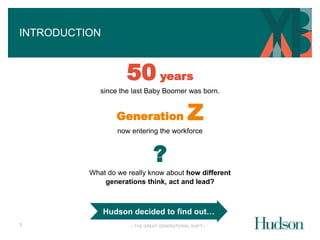
50 years 
Generation Z 
? 
—THE GREAT GENERATIONAL SHIFT— 
INTRODUCTION 
1 
since the last Baby Boomer was born. 
now entering the workforce 
What do we really know about how different 
generations think, act and lead? 
Hudson decided to find out…
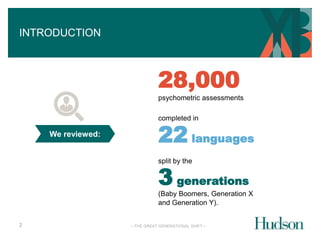
28,000 
—THE GREAT GENERATIONAL SHIFT— 
INTRODUCTION 
2 
We reviewed: 
psychometric assessments 
completed in 
22 languages 
split by the 
3 generations 
(Baby Boomers, Generation X 
and Generation Y).
—THE GREAT GENERATIONAL SHIFT— 
INTRODUCTION 
3 
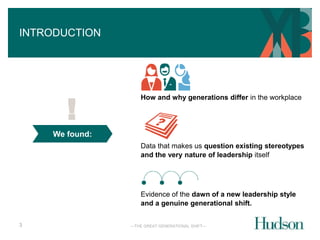
We found: 
How and why generations differ in the workplace 
! 
Data that makes us question existing stereotypes 
and the very nature of leadership itself 
Evidence of the dawn of a new leadership style 
and a genuine generational shift.
—THE GREAT GENERATIONAL SHIFT— 
INTRODUCTION 
4 
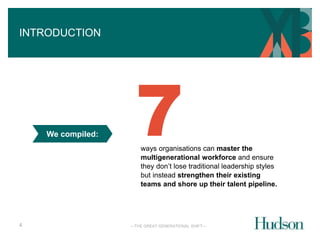
We compiled: 
7 
ways organisations can master the 
multigenerational workforce and ensure 
they don’t lose traditional leadership styles 
but instead strengthen their existing 
teams and shore up their talent pipeline.
UNDERSTANDING THE GENERATIONS
—THE GREAT GENERATIONAL SHIFT— 
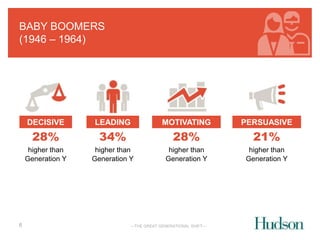
BABY BOOMERS 
(1946 – 1964) 
DECISIVE 
28% 
higher than 
Generation Y 
LEADING 
34% 
higher than 
Generation Y 
MOTIVATING 
28% 
higher than 
Generation Y 
PERSUASIVE 
21% 
higher than 
Generation Y 
6
—THE GREAT GENERATIONAL SHIFT— 
BABY BOOMERS 
(1946–1964) 
7 
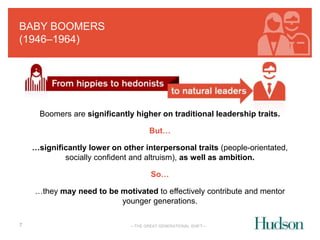
Boomers are significantly higher on traditional leadership traits. 
But… 
…significantly lower on other interpersonal traits (people-orientated, 
socially confident and altruism), as well as ambition. 
So… 
…they may need to be motivated to effectively contribute and mentor 
younger generations.
—THE GREAT GENERATIONAL SHIFT— 
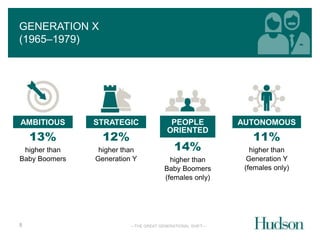
GENERATION X 
(1965–1979) 
AMBITIOUS 
8 
13% 
higher than 
Baby Boomers 
STRATEGIC 
12% 
higher than 
Generation Y 
PEOPLE 
ORIENTED 
14% 
higher than 
Baby Boomers 
(females only) 
AUTONOMOUS 
11% 
higher than 
Generation Y 
(females only)
—THE GREAT GENERATIONAL SHIFT— 
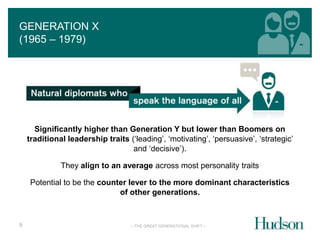
GENERATION X 
(1965 – 1979) 
9 
Significantly higher than Generation Y but lower than Boomers on 
traditional leadership traits (‘leading’, ‘motivating’, ‘persuasive’, ‘strategic’ 
and ‘decisive’). 
They align to an average across most personality traits 
Potential to be the counter lever to the more dominant characteristics 
of other generations.
—THE GREAT GENERATIONAL SHIFT— 
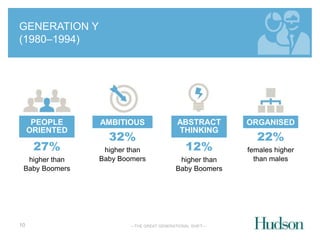
GENERATION Y 
(1980–1994) 
PEOPLE 
ORIENTED 
10 
27% 
higher than 
Baby Boomers 
AMBITIOUS 
32% 
higher than 
Baby Boomers 
ABSTRACT 
THINKING 
12% 
higher than 
Baby Boomers 
ORGANISED 
22% 
females higher 
than males
—THE GREAT GENERATIONAL SHIFT— 
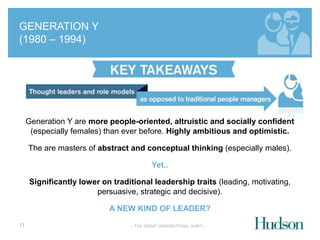
GENERATION Y 
(1980 – 1994) 
11 
Generation Y are more people-oriented, altruistic and socially confident 
(especially females) than ever before. Highly ambitious and optimistic. 
The are masters of abstract and conceptual thinking (especially males). 
Yet.. 
Significantly lower on traditional leadership traits (leading, motivating, 
persuasive, strategic and decisive). 
A NEW KIND OF LEADER?
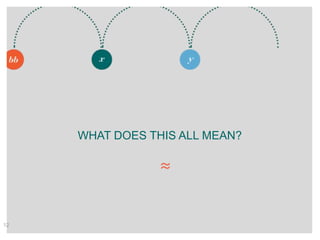
WHAT DOES THIS ALL MEAN? 
12
HOW TO THRIVE IN A 
MULTIGENERATIONAL WORKPLACE? 
7 
ways organisations can master the multigenerational 
workforce and ensure 
 they don’t lose traditional leadership styles, 
 but instead strengthen their existing teams 
and shore up their talent pipeline 
—THE GREAT GENERATIONAL SHIFT— 
13
WHAT’S AN ORGANISATION TO DO? 
1. RECRUIT RIGHT 
Recruit and select with diversity in mind 
We can help: 
 Our EVP framework, based on an evidence-based 8-factor model of satisfaction 
—THE GREAT GENERATIONAL SHIFT— 
 Competency-based interviews 
 Psychometric assessments 
 Assessment centers 
14
WHAT’S AN ORGANISATION TO DO? 
2. DESIGN ROLES 
Design roles to maximise engagement 
 Roles that are aligned with individuals preferences are more likely to be engaging 
and motivating, and therefore to result in high performance 
—THE GREAT GENERATIONAL SHIFT— 
We can help: 
 Job crafting 
 Job (re)design 
15
WHAT’S AN ORGANISATION TO DO? 
3. MENTOR PROGRAMS 
Develop mentoring programs 
 Build leadership capability by matching Baby Boomers with other generations 
We can help: 
 Facilitating mentor programs to develop leadership 
—THE GREAT GENERATIONAL SHIFT— 
 Mentor-mentee matching 
16 
̶ Provide Generation Y with exposure to stronger leadership traits 
̶ Provide Baby Boomers with exposure to a more people-orientated style and 
preference for abstract and conceptual thinking 
 Well rounded individuals are likely to be the most effective and adaptable
WHAT’S AN ORGANISATION TO DO? 
4. LEADERSHIP 
Promote inclusive leadership practices 
 The practice of leadership that carefully includes the contributions of all stakeholders/ 
generations 
 At the core is a relationally and culturally sensitive leader with a well articulated personal 
leadership philosophy who: 
We can help: 
 Leadership development programs 
—THE GREAT GENERATIONAL SHIFT— 
17 
̶ Actively creates a high-engagement culture by encouraging the input and initiative of 
all employees 
̶ Increases the transparency of team decision-making and processes
WHAT’S AN ORGANISATION TO DO? 
5. ANALYTICS 
Leverage talent analytics to inform HR strategies 
 Leverage assessments of individuals, teams and cohorts across your organisation to 
provide valuable data analytics about your talent profile 
We can help: 
 Identify performance attributes and develop success profiles 
 Provide interactive dashboards and cohort reports for specific generation/other 
workforce groups 
—THE GREAT GENERATIONAL SHIFT— 
 Job (re)design 
18
WHAT’S AN ORGANISATION TO DO? 
6. FUTURE PROOF 
Future proof your organisation 
 Ensure your leadership frameworks and pipelines are ‘up-to-date’ and aligned with new 
business strategies for today’s external environment 
 Ensure you assess and develop your leadership pipeline 
 Do you have people who can provide meaningful insights in a data-driven world? 
Can they lead through uncertainty and change? 
We can help: 
 Map competencies required across the organisation 
—THE GREAT GENERATIONAL SHIFT— 
 Develop high potential programs 
 Succession planning 
19
WHAT’S AN ORGANISATION TO DO? 
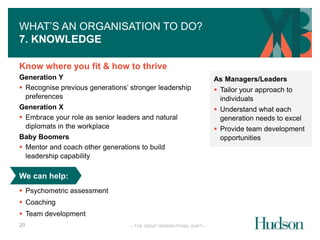
7. KNOWLEDGE 
Know where you fit & how to thrive 
Generation Y 
 Recognise previous generations’ stronger leadership 
preferences 
Generation X 
 Embrace your role as senior leaders and natural 
diplomats in the workplace 
Baby Boomers 
 Mentor and coach other generations to build 
leadership capability 
—THE GREAT GENERATIONAL SHIFT— 
We can help: 
 Psychometric assessment 
 Coaching 
 Team development 
20 
As Managers/Leaders 
 Tailor your approach to 
individuals 
 Understand what each 
generation needs to excel 
 Provide team development 
opportunities
ABOUT THIS RESEARCH 
21
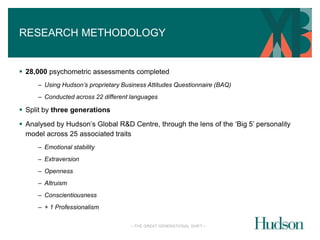
RESEARCH METHODOLOGY 
 28,000 psychometric assessments completed 
– Using Hudson’s proprietary Business Attitudes Questionnaire (BAQ) 
– Conducted across 22 different languages 
—THE GREAT GENERATIONAL SHIFT— 
 Split by three generations 
 Analysed by Hudson’s Global R&D Centre, through the lens of the ‘Big 5’ personality 
model across 25 associated traits 
– Emotional stability 
– Extraversion 
– Openness 
– Altruism 
– Conscientiousness 
– + 1 Professionalism
FURTHER INFORMATION 
The Great Generational Shift: 
Why The Differences Between Generations 
Will Reshape Your Workplace (2014) 
—THE GREAT GENERATIONAL SHIFT— 
23 
http://nl.hudson.com/nl-nl/drie-verschillende-generaties
24

Why three generations will reshape your workplace hudson netherlands

  • 1.
    THE GREAT GENERATIONALSHIFT Why The Differences Between Generations Will Reshape Your Workplace
  • 2.
    50 years GenerationZ ? —THE GREAT GENERATIONAL SHIFT— INTRODUCTION 1 since the last Baby Boomer was born. now entering the workforce What do we really know about how different generations think, act and lead? Hudson decided to find out…
  • 3.
    28,000 —THE GREATGENERATIONAL SHIFT— INTRODUCTION 2 We reviewed: psychometric assessments completed in 22 languages split by the 3 generations (Baby Boomers, Generation X and Generation Y).
  • 4.
    —THE GREAT GENERATIONALSHIFT— INTRODUCTION 3 We found: How and why generations differ in the workplace ! Data that makes us question existing stereotypes and the very nature of leadership itself Evidence of the dawn of a new leadership style and a genuine generational shift.
  • 5.
    —THE GREAT GENERATIONALSHIFT— INTRODUCTION 4 We compiled: 7 ways organisations can master the multigenerational workforce and ensure they don’t lose traditional leadership styles but instead strengthen their existing teams and shore up their talent pipeline.
  • 6.
  • 7.
    —THE GREAT GENERATIONALSHIFT— BABY BOOMERS (1946 – 1964) DECISIVE 28% higher than Generation Y LEADING 34% higher than Generation Y MOTIVATING 28% higher than Generation Y PERSUASIVE 21% higher than Generation Y 6
  • 8.
    —THE GREAT GENERATIONALSHIFT— BABY BOOMERS (1946–1964) 7 Boomers are significantly higher on traditional leadership traits. But… …significantly lower on other interpersonal traits (people-orientated, socially confident and altruism), as well as ambition. So… …they may need to be motivated to effectively contribute and mentor younger generations.
  • 9.
    —THE GREAT GENERATIONALSHIFT— GENERATION X (1965–1979) AMBITIOUS 8 13% higher than Baby Boomers STRATEGIC 12% higher than Generation Y PEOPLE ORIENTED 14% higher than Baby Boomers (females only) AUTONOMOUS 11% higher than Generation Y (females only)
  • 10.
    —THE GREAT GENERATIONALSHIFT— GENERATION X (1965 – 1979) 9 Significantly higher than Generation Y but lower than Boomers on traditional leadership traits (‘leading’, ‘motivating’, ‘persuasive’, ‘strategic’ and ‘decisive’). They align to an average across most personality traits Potential to be the counter lever to the more dominant characteristics of other generations.
  • 11.
    —THE GREAT GENERATIONALSHIFT— GENERATION Y (1980–1994) PEOPLE ORIENTED 10 27% higher than Baby Boomers AMBITIOUS 32% higher than Baby Boomers ABSTRACT THINKING 12% higher than Baby Boomers ORGANISED 22% females higher than males
  • 12.
    —THE GREAT GENERATIONALSHIFT— GENERATION Y (1980 – 1994) 11 Generation Y are more people-oriented, altruistic and socially confident (especially females) than ever before. Highly ambitious and optimistic. The are masters of abstract and conceptual thinking (especially males). Yet.. Significantly lower on traditional leadership traits (leading, motivating, persuasive, strategic and decisive). A NEW KIND OF LEADER?
  • 13.
    WHAT DOES THISALL MEAN? 12
  • 14.
    HOW TO THRIVEIN A MULTIGENERATIONAL WORKPLACE? 7 ways organisations can master the multigenerational workforce and ensure  they don’t lose traditional leadership styles,  but instead strengthen their existing teams and shore up their talent pipeline —THE GREAT GENERATIONAL SHIFT— 13
  • 15.
    WHAT’S AN ORGANISATIONTO DO? 1. RECRUIT RIGHT Recruit and select with diversity in mind We can help:  Our EVP framework, based on an evidence-based 8-factor model of satisfaction —THE GREAT GENERATIONAL SHIFT—  Competency-based interviews  Psychometric assessments  Assessment centers 14
  • 16.
    WHAT’S AN ORGANISATIONTO DO? 2. DESIGN ROLES Design roles to maximise engagement  Roles that are aligned with individuals preferences are more likely to be engaging and motivating, and therefore to result in high performance —THE GREAT GENERATIONAL SHIFT— We can help:  Job crafting  Job (re)design 15
  • 17.
    WHAT’S AN ORGANISATIONTO DO? 3. MENTOR PROGRAMS Develop mentoring programs  Build leadership capability by matching Baby Boomers with other generations We can help:  Facilitating mentor programs to develop leadership —THE GREAT GENERATIONAL SHIFT—  Mentor-mentee matching 16 ̶ Provide Generation Y with exposure to stronger leadership traits ̶ Provide Baby Boomers with exposure to a more people-orientated style and preference for abstract and conceptual thinking  Well rounded individuals are likely to be the most effective and adaptable
  • 18.
    WHAT’S AN ORGANISATIONTO DO? 4. LEADERSHIP Promote inclusive leadership practices  The practice of leadership that carefully includes the contributions of all stakeholders/ generations  At the core is a relationally and culturally sensitive leader with a well articulated personal leadership philosophy who: We can help:  Leadership development programs —THE GREAT GENERATIONAL SHIFT— 17 ̶ Actively creates a high-engagement culture by encouraging the input and initiative of all employees ̶ Increases the transparency of team decision-making and processes
  • 19.
    WHAT’S AN ORGANISATIONTO DO? 5. ANALYTICS Leverage talent analytics to inform HR strategies  Leverage assessments of individuals, teams and cohorts across your organisation to provide valuable data analytics about your talent profile We can help:  Identify performance attributes and develop success profiles  Provide interactive dashboards and cohort reports for specific generation/other workforce groups —THE GREAT GENERATIONAL SHIFT—  Job (re)design 18
  • 20.
    WHAT’S AN ORGANISATIONTO DO? 6. FUTURE PROOF Future proof your organisation  Ensure your leadership frameworks and pipelines are ‘up-to-date’ and aligned with new business strategies for today’s external environment  Ensure you assess and develop your leadership pipeline  Do you have people who can provide meaningful insights in a data-driven world? Can they lead through uncertainty and change? We can help:  Map competencies required across the organisation —THE GREAT GENERATIONAL SHIFT—  Develop high potential programs  Succession planning 19
  • 21.
    WHAT’S AN ORGANISATIONTO DO? 7. KNOWLEDGE Know where you fit & how to thrive Generation Y  Recognise previous generations’ stronger leadership preferences Generation X  Embrace your role as senior leaders and natural diplomats in the workplace Baby Boomers  Mentor and coach other generations to build leadership capability —THE GREAT GENERATIONAL SHIFT— We can help:  Psychometric assessment  Coaching  Team development 20 As Managers/Leaders  Tailor your approach to individuals  Understand what each generation needs to excel  Provide team development opportunities
  • 22.
  • 23.
    RESEARCH METHODOLOGY 28,000 psychometric assessments completed – Using Hudson’s proprietary Business Attitudes Questionnaire (BAQ) – Conducted across 22 different languages —THE GREAT GENERATIONAL SHIFT—  Split by three generations  Analysed by Hudson’s Global R&D Centre, through the lens of the ‘Big 5’ personality model across 25 associated traits – Emotional stability – Extraversion – Openness – Altruism – Conscientiousness – + 1 Professionalism
  • 24.
    FURTHER INFORMATION TheGreat Generational Shift: Why The Differences Between Generations Will Reshape Your Workplace (2014) —THE GREAT GENERATIONAL SHIFT— 23 http://nl.hudson.com/nl-nl/drie-verschillende-generaties
  • 25.

Editor's Notes

  • #16 Recruit and select with diversity in mind Understand the strengths that different generations and different people bring to your organisation Use more objective techniques such as psychometric assessments to help eliminate any biases due to stereotypes Review your Employee Value Proposition (EVP) to attract a diverse range of candidates across all generations
  • #17 Design roles to maximise engagement Roles that are aligned with individuals preferences are more likely to be engaging and motivating, and therefore to result in high performance Job crafting captures what employees can do to customise their own jobs in ways that foster engagement and job satisfaction (for example, finding ways to leverage Gen Y’s people-orientation and altruism within their existing role) Job design focuses on the top-down processes of managers designing jobs for their employees (for example, fundamentally redefining and designing a role to focus solely on people management tasks, in line with a traditional Boomer profile)
  • #18 Develop mentoring problems - Build leadership capability by matching Baby Boomers with other generations - Provide Generation Y with exposure to stronger leadership traits - Provide Baby Boomers with exposure to a more people-orientated style and preference for abstract and conceptual thinking - Well rounded individuals are likely to be the most effective and adaptable NB: Providing career development opportunities for Generation Y is critical to retention (given their higher scores on ambition), and will help manage ageing workforce challenges
  • #19 Promote inclusive leadership practices The practice of leadership that carefully includes the contributions of all stakeholders / generations At the core is a relationally and culturally sensitive leader with a well articulated personal leadership philosophy who: - Actively creates a high-engagement culture by encouraging the input and initiative of all employees - Increases the transparency of team decision-making and processes Leaders’ words and deeds must demonstrate an authentic appreciation for the diverse identities, backgrounds, talents and contributions of all team members. Leaders should first be aware of their stereotypes, biases, and mental models that impede valuing diverse others. They should allow and recognize diverse identity expression from their employees. They should hold others accountable for disrespectful behavior toward different others. Inclusive leaders should articulate the value of diversity for team effectiveness and show a commitment to diversity in hiring, advancement, compensation, and retention practices. And, inclusive leaders should demonstrate a willingness to learn from diverse perspectives. Leaders should monitor their own behaviors to ensure that they treat all opinions equally and respectfully. Leaders should create team conditions that encourage members to speak up about ideas, opportunities, problems, and errors, and to engage in vigorous debate about these if necessary; such conditions include a sense of psychological safety that allows the voicing of dissent or imagination, and a learning orientation. By their words and actions, leaders should promote team relations that are fair, democratic, supportive, and welcoming of questions and challenges, rather than team relations that are authoritarian, unsupportive, defensive, or based on favoritism. By undertaking these two sets of actions, leaders can engineer a shift from an exclusionary and stagnant culture that is de-motivating and de-energizing, to an inclusive and open culture that brings out the best of people, energizes them, encourages collaboration, and supports initiative and innovative contributions from all individuals. Such inclusive leadership leverages team member differences to tap into new opportunities and innovate new ways of doing business. By propagating a sense of inclusion and ownership, inclusive leadership is persuasive and inspiring, and people are motivated to invest themselves in achieving extraordinary results. By undertaking these two sets of actions, leaders can engineer a shift from an exclusionary and stagnant culture that is de-motivating and de-energizing, to an inclusive and open culture that brings out the best of people, energizes them, encourages collaboration, and supports initiative and innovative contributions from all individuals. Such inclusive leadership leverages team member differences to tap into new opportunities and innovate new ways of doing business. By propagating a sense of inclusion and ownership, inclusive leadership is persuasive and inspiring, and people are motivated to invest themselves in achieving extraordinary results. (Weatherhead School of Management, 2012)
  • #20 Leverage talent analytics to inform HR strategies Leverage assessments of individuals, teams and cohorts across your organisation to provide valuable data analytics about your talent profile Analytics can: - Identify which attributes are the strongest predictors of performance for specific roles in your organisation - Identify and target critical gaps (build or buy) - Develop people at the group-level (cost effectively targeting common areas for development) - Understand and manage your leadership pipeline Reports can help you eg. Do you need a master of abstract thinking – characteristic of Gen Y; or a strong people manager - like a traditional Boomer profile?
  • #21 6. Future proof your organisation Ensure your leadership frameworks and pipelines are ‘up-to-date’ and aligned with new business strategies for today’s external environment Ensure you assess and develop your leadership pipeline Do you have people who can provide meaningful insights in a data-driven world? Can they lead through uncertainty and change? ‘Connecting the dots’ and providing meaningful insights in a data-driven world Leading through uncertainty and change Balancing a short and longer term strategic focus Strong operational leadership / ‘leading from the front’
  • #22 ‘Connecting the dots’ and providing meaningful insights in a data-driven world Leading through uncertainty and change Balancing a short and longer term strategic focus Strong operational leadership / ‘leading from the front’