Why Teaching of
Bioethics Matters
HUBS Spring Meeting 2017
http://tinyurl.com/ethicsmaze1
Dr Chris Willmott
Dept of Molecular
and Cell Biology
University of Leicester
cjrw2@le.ac.uk
• Pace of discovery in bioscience
• Distance “entry-level” knowledge to science frontier
• All valuable content
• Surely not room for bioethics?
The Crowded Curriculum
http://tinyurl.com/n94dfgf
Broader Conversation re Curriculum
• A levels changing
• Tension: content v skills
• Guide own learning
• Bioethics needs to be a core part of the final mix
• Why?
Why we need to include bioethics
in our undergraduate programmes
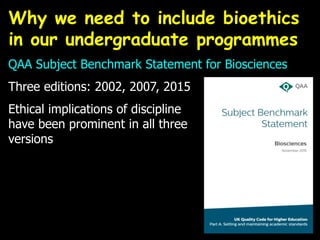
QAA Subject Benchmark Statement for Biosciences
Three editions: 2002, 2007, 2015
Ethical implications of discipline
have been prominent in all three
versions
• “Students should expect to be confronted by
some of the scientific, moral and ethical questions
raised by their study subject, to consider
viewpoints other than their own, and to engage in
critical assessment and intellectual argument.
Graduates should be comfortable with dealing
with uncertainty.”
• “Recognise the moral and ethical issues of
investigations and appreciate the need for ethical
standards and professional codes of conduct.”
QAA Benchmarking: Bioscience
All honours graduates MUST have
“an appreciation of ethical issues and how they
underpin professional integrity and standards”
A typical honours graduate WILL be able to
“construct reasoned arguments to support their
position on the ethical and social impact of advances
in the biosciences”
QAA Benchmarking: Bioscience
1. Explosion of new issues
“Modern Science has placed in our hands
capabilities that have aggravated long-standing
ethical problems as well as introducing new
quandaries.”
Stanley Grenz (moral philosopher)
Why do Benchmark statements
include Bioethics?
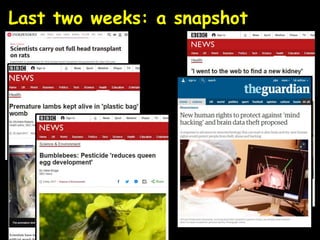
Last two weeks: a snapshot
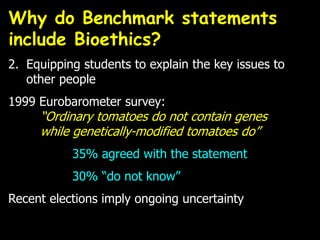
2. Equipping students to explain the key issues to
other people
1999 Eurobarometer survey:
“Ordinary tomatoes do not contain genes
while genetically-modified tomatoes do”
35% agreed with the statement
30% “do not know”
Recent elections imply ongoing uncertainty
Why do Benchmark statements
include Bioethics?
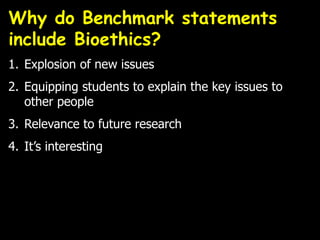
1. Explosion of new issues
2. Equipping students to explain the key issues to
other people
3. Relevance to future research
4. It’s interesting
Why do Benchmark statements
include Bioethics?
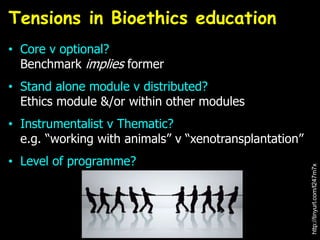
• Core v optional?
Benchmark implies former
• Stand alone module v distributed?
Ethics module &/or within other modules
• Instrumentalist v Thematic?
e.g. “working with animals” v “xenotransplantation”
• Level of programme?
Tensions in Bioethics education
http://tinyurl.com/l247m7x
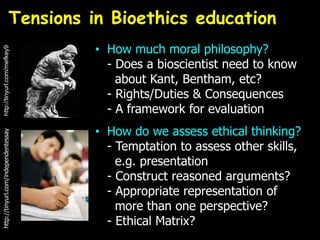
• How much moral philosophy?
- Does a bioscientist need to know
about Kant, Bentham, etc?
- Rights/Duties & Consequences
- A framework for evaluation
• How do we assess ethical thinking?
- Temptation to assess other skills,
e.g. presentation
- Construct reasoned arguments?
- Appropriate representation of
more than one perspective?
- Ethical Matrix?
Tensions in Bioethics education
http://tinyurl.com/mefkey9http://tinyurl.com/independentessay
• What?
Some aspects generic, others depend on cohort
• Who?
Bioscience staff or external?
• How?
Different approaches
- Case studies
Tensions in Bioethics education
Can consider issues in three categories:
1. Research integrity
2. Biomedical ethics
3. Environmental bioethics
Ethical issues for Bioscientists
e.g.
responsible use of humans & human material
responsible use of animals
responsible use of GMOs
appropriate use of funding
bias/suppression of results > “confirmation bias”
fabrication, falsification, plagiarism (FFP)
sabotage
dangerous research: “dual use dilemma”
Research integrity
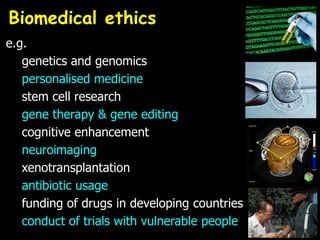
e.g.
genetics and genomics
personalised medicine
stem cell research
gene therapy & gene editing
cognitive enhancement
neuroimaging
xenotransplantation
antibiotic usage
funding of drugs in developing countries
conduct of trials with vulnerable people
Biomedical ethics
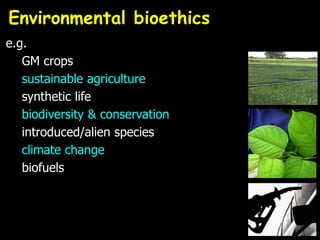
e.g.
GM crops
sustainable agriculture
synthetic life
biodiversity & conservation
introduced/alien species
climate change
biofuels
Environmental bioethics
• Real v Fictional?
Real: News clips, News websites
Fictional: Can “tidy up” &/or seed specific points
Work best when based on real cases
• Formats?
- longer scenarios?
- open ended v structured v standard tool?
Case studies
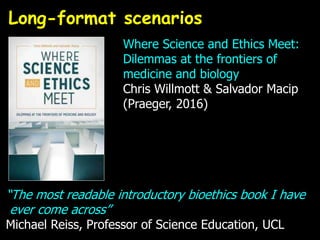
“The most readable introductory bioethics book I have
ever come across”
Michael Reiss, Professor of Science Education, UCL
Long-format scenarios
Where Science and Ethics Meet:
Dilemmas at the frontiers of
medicine and biology
Chris Willmott & Salvador Macip
(Praeger, 2016)
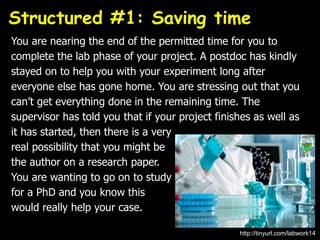
You are nearing the end of the permitted time for you to
complete the lab phase of your project. A postdoc has kindly
stayed on to help you with your experiment long after
everyone else has gone home. You are stressing out that you
can’t get everything done in the remaining time. The
supervisor has told you that if your project finishes as well as
it has started, then there is a very
real possibility that you might be
the author on a research paper.
You are wanting to go on to study
for a PhD and you know this
would really help your case.
Structured #1: Saving time
http://tinyurl.com/labwork14
Aware of your time constraints, the postdoc advises you to
make sure you get all the “real” experiments done; if
necessary you can fake the “controls”. He hasn’t told the
Principal Investigator (your supervisor) this, but he confides
in you that for the paper they recently had accepted for
publication in the prestigious journal Proceedings of the
National Academy of Science he made up the control data.
1. What do you do now?
- Do you accept the advice and fabricate your controls?
- Do you inform the supervisor?
- Do you contact the journal editor?
- Do you do something different?
Structured #1: Saving time
Working with a colleague in chemistry, you have developed
some interesting compounds that you think may be of
medicinal benefit. Specifically, you have conducted some in
vitro experiments in which human cells appear to survive for
longer when treated with the compounds than they would
normally. You would now like to escalate this study to see
whether the compounds have an anti-ageing effect on mice.
Although there are strains of mice engineered to be prone to
premature ageing, you intend to conduct the research using
a standard laboratory strain.
Structured #2: Anti-ageing drugs
1. What are the ethical issues associated with this study?
2. Why use a mouse model for this research?
3. Which ethics committee(s) would need to be approached to
grant approval for the research, and what paperwork would
you need to produce for them to consider your proposal?
Structured #2: Anti-ageing drugs
Carl is a twenty-one year old builder. He is engaged to Julie,
and she has recently discovered that she is expecting their
first child. In 2008, Carl’s maternal grandfather died from
Huntington’s disease (HD), a late-onset degenerative disease
of the nervous system. HD is inherited in a dominant fashion;
if you do have HD, you have a 50% chance of passing it on to
your children. Carl’s mum has decided not to take the test to
find out if she got the faulty copy from her father, but now
that he is expecting to be a father himself, Carl is keen to find
out if there is any risk that he has passed on the condition.
What are some of the issues at stake for Carl and Julie? What
are the consequences of taking the test, or deciding not to?
If you were Carl, what would you do?
Case study: Carl and Julie
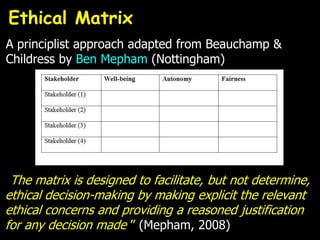
A principlist approach adapted from Beauchamp &
Childress by Ben Mepham (Nottingham)
Ethical Matrix
“The matrix is designed to facilitate, but not determine,
ethical decision-making by making explicit the relevant
ethical concerns and providing a reasoned justification
for any decision made ” (Mepham, 2008)
Any Questions?
E-mail: cjrw2@le.ac.uk
Twitter: cjrw
Slideshare: cjrw2
Delicious: chriswillmott
Blogs: www.bioethicsbytes.wordpress.com
www.biologyonthebox.wordpress.com
www.biosciencecareers.wordpress.com
www.lefthandedbiochemist.wordpress.com

Why Teaching of Bioethics Matters

  • 1.
    Why Teaching of BioethicsMatters HUBS Spring Meeting 2017 http://tinyurl.com/ethicsmaze1 Dr Chris Willmott Dept of Molecular and Cell Biology University of Leicester cjrw2@le.ac.uk
  • 2.
    • Pace ofdiscovery in bioscience • Distance “entry-level” knowledge to science frontier • All valuable content • Surely not room for bioethics? The Crowded Curriculum http://tinyurl.com/n94dfgf
  • 3.
    Broader Conversation reCurriculum • A levels changing • Tension: content v skills • Guide own learning • Bioethics needs to be a core part of the final mix • Why?
  • 4.
    Why we needto include bioethics in our undergraduate programmes QAA Subject Benchmark Statement for Biosciences Three editions: 2002, 2007, 2015 Ethical implications of discipline have been prominent in all three versions
  • 5.
    • “Students shouldexpect to be confronted by some of the scientific, moral and ethical questions raised by their study subject, to consider viewpoints other than their own, and to engage in critical assessment and intellectual argument. Graduates should be comfortable with dealing with uncertainty.” • “Recognise the moral and ethical issues of investigations and appreciate the need for ethical standards and professional codes of conduct.” QAA Benchmarking: Bioscience
  • 6.
    All honours graduatesMUST have “an appreciation of ethical issues and how they underpin professional integrity and standards” A typical honours graduate WILL be able to “construct reasoned arguments to support their position on the ethical and social impact of advances in the biosciences” QAA Benchmarking: Bioscience
  • 7.
    1. Explosion ofnew issues “Modern Science has placed in our hands capabilities that have aggravated long-standing ethical problems as well as introducing new quandaries.” Stanley Grenz (moral philosopher) Why do Benchmark statements include Bioethics?
  • 8.
    Last two weeks:a snapshot
  • 9.
    2. Equipping studentsto explain the key issues to other people 1999 Eurobarometer survey: “Ordinary tomatoes do not contain genes while genetically-modified tomatoes do” 35% agreed with the statement 30% “do not know” Recent elections imply ongoing uncertainty Why do Benchmark statements include Bioethics?
  • 10.
    1. Explosion ofnew issues 2. Equipping students to explain the key issues to other people 3. Relevance to future research 4. It’s interesting Why do Benchmark statements include Bioethics?
  • 11.
    • Core voptional? Benchmark implies former • Stand alone module v distributed? Ethics module &/or within other modules • Instrumentalist v Thematic? e.g. “working with animals” v “xenotransplantation” • Level of programme? Tensions in Bioethics education http://tinyurl.com/l247m7x
  • 12.
    • How muchmoral philosophy? - Does a bioscientist need to know about Kant, Bentham, etc? - Rights/Duties & Consequences - A framework for evaluation • How do we assess ethical thinking? - Temptation to assess other skills, e.g. presentation - Construct reasoned arguments? - Appropriate representation of more than one perspective? - Ethical Matrix? Tensions in Bioethics education http://tinyurl.com/mefkey9http://tinyurl.com/independentessay
  • 13.
    • What? Some aspectsgeneric, others depend on cohort • Who? Bioscience staff or external? • How? Different approaches - Case studies Tensions in Bioethics education
  • 14.
    Can consider issuesin three categories: 1. Research integrity 2. Biomedical ethics 3. Environmental bioethics Ethical issues for Bioscientists
  • 15.
    e.g. responsible use ofhumans & human material responsible use of animals responsible use of GMOs appropriate use of funding bias/suppression of results > “confirmation bias” fabrication, falsification, plagiarism (FFP) sabotage dangerous research: “dual use dilemma” Research integrity
  • 16.
    e.g. genetics and genomics personalisedmedicine stem cell research gene therapy & gene editing cognitive enhancement neuroimaging xenotransplantation antibiotic usage funding of drugs in developing countries conduct of trials with vulnerable people Biomedical ethics
  • 17.
    e.g. GM crops sustainable agriculture syntheticlife biodiversity & conservation introduced/alien species climate change biofuels Environmental bioethics
  • 18.
    • Real vFictional? Real: News clips, News websites Fictional: Can “tidy up” &/or seed specific points Work best when based on real cases • Formats? - longer scenarios? - open ended v structured v standard tool? Case studies
  • 19.
    “The most readableintroductory bioethics book I have ever come across” Michael Reiss, Professor of Science Education, UCL Long-format scenarios Where Science and Ethics Meet: Dilemmas at the frontiers of medicine and biology Chris Willmott & Salvador Macip (Praeger, 2016)
  • 20.
    You are nearingthe end of the permitted time for you to complete the lab phase of your project. A postdoc has kindly stayed on to help you with your experiment long after everyone else has gone home. You are stressing out that you can’t get everything done in the remaining time. The supervisor has told you that if your project finishes as well as it has started, then there is a very real possibility that you might be the author on a research paper. You are wanting to go on to study for a PhD and you know this would really help your case. Structured #1: Saving time http://tinyurl.com/labwork14
  • 21.
    Aware of yourtime constraints, the postdoc advises you to make sure you get all the “real” experiments done; if necessary you can fake the “controls”. He hasn’t told the Principal Investigator (your supervisor) this, but he confides in you that for the paper they recently had accepted for publication in the prestigious journal Proceedings of the National Academy of Science he made up the control data. 1. What do you do now? - Do you accept the advice and fabricate your controls? - Do you inform the supervisor? - Do you contact the journal editor? - Do you do something different? Structured #1: Saving time
  • 22.
    Working with acolleague in chemistry, you have developed some interesting compounds that you think may be of medicinal benefit. Specifically, you have conducted some in vitro experiments in which human cells appear to survive for longer when treated with the compounds than they would normally. You would now like to escalate this study to see whether the compounds have an anti-ageing effect on mice. Although there are strains of mice engineered to be prone to premature ageing, you intend to conduct the research using a standard laboratory strain. Structured #2: Anti-ageing drugs
  • 23.
    1. What arethe ethical issues associated with this study? 2. Why use a mouse model for this research? 3. Which ethics committee(s) would need to be approached to grant approval for the research, and what paperwork would you need to produce for them to consider your proposal? Structured #2: Anti-ageing drugs
  • 24.
    Carl is atwenty-one year old builder. He is engaged to Julie, and she has recently discovered that she is expecting their first child. In 2008, Carl’s maternal grandfather died from Huntington’s disease (HD), a late-onset degenerative disease of the nervous system. HD is inherited in a dominant fashion; if you do have HD, you have a 50% chance of passing it on to your children. Carl’s mum has decided not to take the test to find out if she got the faulty copy from her father, but now that he is expecting to be a father himself, Carl is keen to find out if there is any risk that he has passed on the condition. What are some of the issues at stake for Carl and Julie? What are the consequences of taking the test, or deciding not to? If you were Carl, what would you do? Case study: Carl and Julie
  • 25.
    A principlist approachadapted from Beauchamp & Childress by Ben Mepham (Nottingham) Ethical Matrix “The matrix is designed to facilitate, but not determine, ethical decision-making by making explicit the relevant ethical concerns and providing a reasoned justification for any decision made ” (Mepham, 2008)
  • 26.
    Any Questions? E-mail: cjrw2@le.ac.uk Twitter:cjrw Slideshare: cjrw2 Delicious: chriswillmott Blogs: www.bioethicsbytes.wordpress.com www.biologyonthebox.wordpress.com www.biosciencecareers.wordpress.com www.lefthandedbiochemist.wordpress.com