Why software
engineering ?
Presented by
Reduan Ahmad
Department of Software
Engineering
Id : 0242320005341016
Reg : 232-35-016
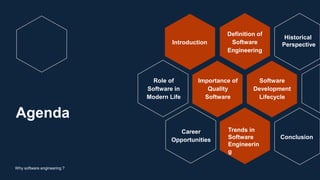
Agenda
Introduction
Definition of
Software
Engineering
Career
Opportunities
Why software engineering ?
Historical
Perspective
Software
Development
Lifecycle
Role of
Software in
Modern Life
Importance of
Quality
Software
Conclusion
Trends in
Software
Engineerin
g
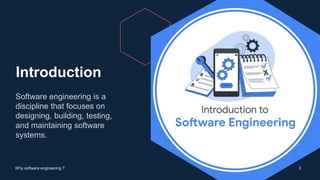
Introduction
Software engineering is a
discipline that focuses on
designing, building, testing,
and maintaining software
systems.
3
Why software engineering ?
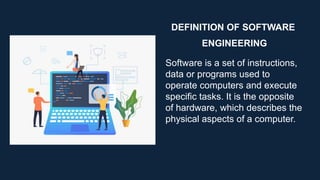
DEFINITION OF SOFTWARE
ENGINEERING
Software is a set of instructions,
data or programs used to
operate computers and execute
specific tasks. It is the opposite
of hardware, which describes the
physical aspects of a computer.
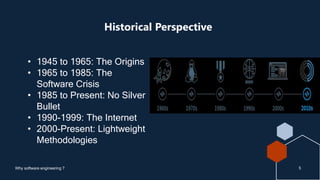
Historical Perspective
5
Why software engineering ?
• 1945 to 1965: The Origins
• 1965 to 1985: The
Software Crisis
• 1985 to Present: No Silver
Bullet
• 1990-1999: The Internet
• 2000-Present: Lightweight
Methodologies
Role of Software in Modern
Life
 Communication
 Information Access
 Entertainment
 Healthcare
 Finance
 Education
 E-commerce
 Agriculture
 Smart Homes
 Government Services
 Research and Development
 Environmental Monitoring
 Security 6
Why software engineering ?
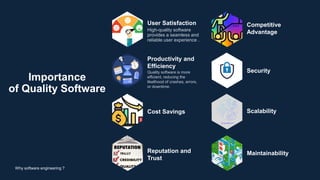
Importance
of Quality Software
User Satisfaction
High-quality software
provides a seamless and
reliable user experience .
Competitive
Advantage
Productivity and
Efficiency
Quality software is more
efficient, reducing the
likelihood of crashes, errors,
or downtime.
Security
Cost Savings Scalability
Reputation and
Trust
Maintainability
Why software engineering ?
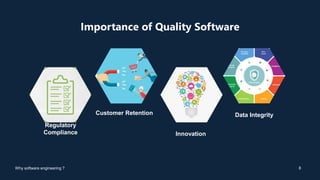
Importance of Quality Software
Regulatory
Compliance
Customer Retention
Innovation
Data Integrity
8
Why software engineering ?
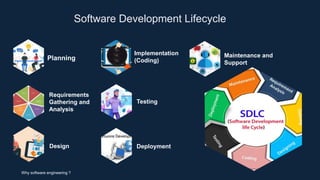
Planning
Requirements
Gathering and
Analysis
Design
Implementation
(Coding)
Testing
Deployment
Maintenance and
Support
Why software engineering ?
Software Development Lifecycle​
Career Opportunities
10
Software engineers have diverse career opportunities,
including roles like software developer, front-end/back-
end developer, full-stack developer, DevOps engineer,
data scientist, machine learning engineer, cybersecurity
analyst, cloud solutions architect, database administrator,
QA engineer, product manager, UI/UX designer, data
engineer, and software architect.
Trends in
Software
Engineering
11
Artificial Intelligence (AI) and Machine Learning (ML): Integrating AI/ML into software
for automation and data-driven insights.
Cloud-Native Development: Building and deploying applications optimized for cloud
environments.
DevOps and DevSecOps: Emphasizing collaboration, automation, and security in
software development and operations.
Microservices and Containerization: Breaking applications into smaller, scalable
services using containers like Docker and orchestration tools like Kubernetes.
Low-Code/No-Code: Platforms that simplify application development for non-
developers.
Edge Computing: Processing data closer to its source for real-time applications.
Quantum Computing: Exploring the potential of quantum computing for complex
problem-solving.
Cybersecurity: Increasing focus on security in software design and development.
Remote Collaboration Tools: Facilitating remote work and collaboration among
software teams.
Ethical AI: Addressing ethical concerns in AI and machine learning algorithms
Conclusion
Software engineering is the disciplined and
systematic approach to designing, developing, and
maintaining software systems. It involves a range of
activities, from requirements gathering to testing
and deployment, with the goal of producing high-
quality, reliable, and maintainable software.
In conclusion, software engineering is essential for
ensuring that software projects are successful in
meeting their objectives and delivering value to
users and stakeholders. It emphasizes best
practices, collaboration, and adherence to well-
defined processes to create software that is both
functional and sustainable over time.
12
Why software engineering ?
Thank you
Reduan Ahmad
Ahmad2305341016@diu.edu.bd
https://sites.google.com/view/redua
nahmadrasal/home

Why Software engineering presentation.pptx

  • 1.
    Why software engineering ? Presentedby Reduan Ahmad Department of Software Engineering Id : 0242320005341016 Reg : 232-35-016
  • 2.
    Agenda Introduction Definition of Software Engineering Career Opportunities Why softwareengineering ? Historical Perspective Software Development Lifecycle Role of Software in Modern Life Importance of Quality Software Conclusion Trends in Software Engineerin g
  • 3.
    Introduction Software engineering isa discipline that focuses on designing, building, testing, and maintaining software systems. 3 Why software engineering ?
  • 4.
    DEFINITION OF SOFTWARE ENGINEERING Softwareis a set of instructions, data or programs used to operate computers and execute specific tasks. It is the opposite of hardware, which describes the physical aspects of a computer.
  • 5.
    Historical Perspective 5 Why softwareengineering ? • 1945 to 1965: The Origins • 1965 to 1985: The Software Crisis • 1985 to Present: No Silver Bullet • 1990-1999: The Internet • 2000-Present: Lightweight Methodologies
  • 6.
    Role of Softwarein Modern Life  Communication  Information Access  Entertainment  Healthcare  Finance  Education  E-commerce  Agriculture  Smart Homes  Government Services  Research and Development  Environmental Monitoring  Security 6 Why software engineering ?
  • 7.
    Importance of Quality Software UserSatisfaction High-quality software provides a seamless and reliable user experience . Competitive Advantage Productivity and Efficiency Quality software is more efficient, reducing the likelihood of crashes, errors, or downtime. Security Cost Savings Scalability Reputation and Trust Maintainability Why software engineering ?
  • 8.
    Importance of QualitySoftware Regulatory Compliance Customer Retention Innovation Data Integrity 8 Why software engineering ?
  • 9.
  • 10.
    Career Opportunities 10 Software engineershave diverse career opportunities, including roles like software developer, front-end/back- end developer, full-stack developer, DevOps engineer, data scientist, machine learning engineer, cybersecurity analyst, cloud solutions architect, database administrator, QA engineer, product manager, UI/UX designer, data engineer, and software architect.
  • 11.
    Trends in Software Engineering 11 Artificial Intelligence(AI) and Machine Learning (ML): Integrating AI/ML into software for automation and data-driven insights. Cloud-Native Development: Building and deploying applications optimized for cloud environments. DevOps and DevSecOps: Emphasizing collaboration, automation, and security in software development and operations. Microservices and Containerization: Breaking applications into smaller, scalable services using containers like Docker and orchestration tools like Kubernetes. Low-Code/No-Code: Platforms that simplify application development for non- developers. Edge Computing: Processing data closer to its source for real-time applications. Quantum Computing: Exploring the potential of quantum computing for complex problem-solving. Cybersecurity: Increasing focus on security in software design and development. Remote Collaboration Tools: Facilitating remote work and collaboration among software teams. Ethical AI: Addressing ethical concerns in AI and machine learning algorithms
  • 12.
    Conclusion Software engineering isthe disciplined and systematic approach to designing, developing, and maintaining software systems. It involves a range of activities, from requirements gathering to testing and deployment, with the goal of producing high- quality, reliable, and maintainable software. In conclusion, software engineering is essential for ensuring that software projects are successful in meeting their objectives and delivering value to users and stakeholders. It emphasizes best practices, collaboration, and adherence to well- defined processes to create software that is both functional and sustainable over time. 12 Why software engineering ?
  • 13.