Fiona Murphy1, The Resource Identification Initiative Consortium,
Maryann Martone2
1Wiley Publishing, Chichester, United Kingdom, 2Center for Research in Biological Systems, University of
California, San Diego, CA
The Resource Identification Initiative is
designed to help researchers sufficiently
cite the key resources used to produce
the scientific findings reported in the
biomedical literature. A diverse group of
collaborators are leading the project,
including the Neuroscience Information
Framework and the Oregon Health &
Science University Library, with the
support of the National Institutes of
H e a l t h a n d t h e I n t e r n a t i o n a l
Neuroinformatics Coordinating Facility.
Introduction
The Problem:
Research Resources are
Unidentifiable in the
Published Literature
Sponsored	
  by:	
  
The Resource Identification Initiative:
Making science more reproducible
#RII	
  
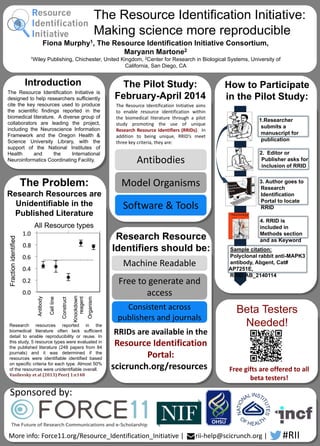
Research resources reported in the
biomedical literature often lack sufficient
detail to enable reproducibility or reuse. In
this study, 5 resource types were evaluated in
the published literature (248 papers from 84
journals) and it was determined if the
resources were identifiable identified based
on specific criteria for each type. Almost 50%
of the resources were unidentifiable overall.
Vasilevsky	
  et	
  al	
  (2013)	
  PeerJ	
  1:e148
The	
  Resource	
  Iden4fica4on	
  Ini4a4ve	
  aims	
  
to	
   enable	
   resource	
   iden4fica4on	
   within	
  
the	
   biomedical	
   literature	
   through	
   a	
   pilot	
  
study	
   promo4ng	
   the	
   use	
   of	
   unique	
  
Research	
  Resource	
  Iden.fiers	
  (RRIDs).	
   	
  In	
  
addi4on	
   to	
   being	
   unique,	
   RRID’s	
   meet	
  
three	
  key	
  criteria,	
  they	
  are:	
  
The Pilot Study:
February-April 2014
An4bodies	
  
SoFware	
  &	
  Tools	
  
Model	
  Organisms	
  
Research Resource
Identifiers should be:
Machine	
  Readable	
  
Consistent	
  across	
  
publishers	
  and	
  journals	
  
Free	
  to	
  generate	
  and	
  
access	
  
RRIDs	
  are	
  available	
  in	
  the	
  	
  
Resource	
  Iden.fica.on	
  
Portal:	
  
scicrunch.org/resources	
  
ç
How to Participate
in the Pilot Study:
More	
  info:	
  Force11.org/Resource_Iden4fica4on_Ini4a4ve	
  |	


  rii-­‐help@scicrunch.org	
  |	
  
Beta Testers
Needed!


Free	
  gi>s	
  are	
  offered	
  to	
  all	
  
beta	
  testers!	
  
3.Author goes to
Research
Identification Portal
to locate RRID	

2. Editor or Publisher
asks for inclusion of
RRID	

1. Researcher submits a
manuscript for
publication	

Sample citation:	

Polyclonal rabbit anti-MAPK3 	

antibody,Abgent, Cat# AP7251E, 	

RRID:AB_2140114	

4. RRID is included in
Methods section and
as Keyword 	

Resource	
  
Iden4fica4on	
  
Portal	
  

Resource Identification Initiative_RDA_March2014

  • 1.
    Fiona Murphy1, TheResource Identification Initiative Consortium, Maryann Martone2 1Wiley Publishing, Chichester, United Kingdom, 2Center for Research in Biological Systems, University of California, San Diego, CA The Resource Identification Initiative is designed to help researchers sufficiently cite the key resources used to produce the scientific findings reported in the biomedical literature. A diverse group of collaborators are leading the project, including the Neuroscience Information Framework and the Oregon Health & Science University Library, with the support of the National Institutes of H e a l t h a n d t h e I n t e r n a t i o n a l Neuroinformatics Coordinating Facility. Introduction The Problem: Research Resources are Unidentifiable in the Published Literature Sponsored  by:   The Resource Identification Initiative: Making science more reproducible #RII   Research resources reported in the biomedical literature often lack sufficient detail to enable reproducibility or reuse. In this study, 5 resource types were evaluated in the published literature (248 papers from 84 journals) and it was determined if the resources were identifiable identified based on specific criteria for each type. Almost 50% of the resources were unidentifiable overall. Vasilevsky  et  al  (2013)  PeerJ  1:e148 The  Resource  Iden4fica4on  Ini4a4ve  aims   to   enable   resource   iden4fica4on   within   the   biomedical   literature   through   a   pilot   study   promo4ng   the   use   of   unique   Research  Resource  Iden.fiers  (RRIDs).    In   addi4on   to   being   unique,   RRID’s   meet   three  key  criteria,  they  are:   The Pilot Study: February-April 2014 An4bodies   SoFware  &  Tools   Model  Organisms   Research Resource Identifiers should be: Machine  Readable   Consistent  across   publishers  and  journals   Free  to  generate  and   access   RRIDs  are  available  in  the     Resource  Iden.fica.on   Portal:   scicrunch.org/resources   ç How to Participate in the Pilot Study: More  info:  Force11.org/Resource_Iden4fica4on_Ini4a4ve  |              rii-­‐help@scicrunch.org  |   Beta Testers Needed!       Free  gi>s  are  offered  to  all   beta  testers!   3.Author goes to Research Identification Portal to locate RRID 2. Editor or Publisher asks for inclusion of RRID 1. Researcher submits a manuscript for publication Sample citation: Polyclonal rabbit anti-MAPK3 antibody,Abgent, Cat# AP7251E, RRID:AB_2140114 4. RRID is included in Methods section and as Keyword Resource   Iden4fica4on   Portal