Business leaders and experts have proclaimed that project management is critical to
sustainable economic growth.
New jobs and competitive advantage are achieved by constant innovation, developing
new products and services, and improving both productivity and quality of work.
This is the world of project management.
Today project teams carry out everything:
1. From port expansions to hospital restructuring to upgrading information systems.
2. They are creating next-generation fuel-efficient vehicles, developing sustainable
sources of energy, and exploring the farthest reaches of outer space.
3. The electronics industry, where the new folk heroes are young professionals whose
Herculean efforts lead to the constant flow of new hardware and software products.
Project management provides people with a powerful set of tools that improves their
ability to plan, implement, and manage activities to accomplish specific objectives.
But project management is more than just a set of tools; it is a results-oriented
management style that places a premium on building collaborative relationships among
a diverse cast of characters.
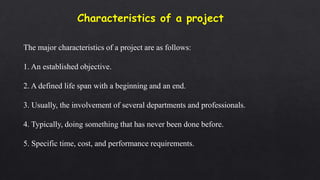
The major characteristics of a project are as follows:
1. An established objective.
2. A defined life span with a beginning and an end.
3. Usually, the involvement of several departments and professionals.
4. Typically, doing something that has never been done before.
5. Specific time, cost, and performance requirements.
 Projects should not be confused with everyday work.
 A project is not routine, repetitive work!
 Ordinary daily work typically requires doing the same or similar work over
 And over, while a project is done only once; a new product or service exists when the project is
completed.
 Program management is the process of managing a group of ongoing, interdependent, related
projects in a coordinated way to achieve strategic objectives.
 Each project within a program has a project manager.
 The major differences lie in scale and time span.
 At some of these phases, projects could intersect with operations. Some of those are:
 Work towards giving the business the competitive advantage
 At the phase of developing a new product, expanding outputs, or upgrading a product
 At the product development process or while improving operations
 Until the end of the product lifecycle
 At closeout phase
Operations Management Project Management
Objectives Present oriented Future oriented
Budget Concerns those activities that are necessary
to maintain a specific profit margin.
Deals with completion of certain projects
within the specified budget constraints
Processes that
drive
Client demand deal with business units within an
organization
Schedule or Time
Constraints
Day-to-day management (repetitive and
ongoing.)
projects are characterized by a definite
beginning and ending
Type of business unique to a particular project. business as usual
Staff Management wider in terms of managing staff. His
responsibilities include recruiting people
project manager is not responsible for any
HR related issue like hiring or firing.
Types of Projects…
Construction Projects
Types of Projects…
Manufacturing Projects
Types of Projects…
Agricultural Projects
Types of Projects…
Energy Projects
Types of Projects…
Management Projects: These are the projects
that arise when companies
 develop and introduce a new computer
system,
 launch a marketing campaign,
 prepare for a trade exhibition,
 produce feasibility or other study report,
 restructure the organization,
Types of Projects…
Research Projects:
Research project is a particular type of project.
A characteristic feature of the research project is the lack of clear definition of
the final outcome of the project.
The results of the research may lead to useful results (new products, services,
improvements of production).
For example results of the research project may indicate that particular
management's plans are unreasonable or impracticable.
• Wanna to have a good travel
–Objective
–Begin and End
–Who should be included
–Time
–Cost
–…..
There are four interrelated and interdependent components of any project:
• scope
• schedule
• resources
• leadership
Components of a Project
Scope
• The project scope summarizes everything members of the project team
need to know to fully understand the project.
• A project’s scope includes a project overview, deliverables, features and
functions, acceptance criteria, restrictions/constraints, and uncertainties.
Components of a Project…
Why project.pptx
Why project.pptx
Why project.pptx
Why project.pptx
Why project.pptx
Why project.pptx
Why project.pptx
Why project.pptx
Why project.pptx
Why project.pptx

Why project.pptx

  • 2.
    Business leaders andexperts have proclaimed that project management is critical to sustainable economic growth. New jobs and competitive advantage are achieved by constant innovation, developing new products and services, and improving both productivity and quality of work. This is the world of project management.
  • 3.
    Today project teamscarry out everything: 1. From port expansions to hospital restructuring to upgrading information systems. 2. They are creating next-generation fuel-efficient vehicles, developing sustainable sources of energy, and exploring the farthest reaches of outer space. 3. The electronics industry, where the new folk heroes are young professionals whose Herculean efforts lead to the constant flow of new hardware and software products.
  • 4.
    Project management providespeople with a powerful set of tools that improves their ability to plan, implement, and manage activities to accomplish specific objectives. But project management is more than just a set of tools; it is a results-oriented management style that places a premium on building collaborative relationships among a diverse cast of characters.
  • 7.
    The major characteristicsof a project are as follows: 1. An established objective. 2. A defined life span with a beginning and an end. 3. Usually, the involvement of several departments and professionals. 4. Typically, doing something that has never been done before. 5. Specific time, cost, and performance requirements.
  • 8.
     Projects shouldnot be confused with everyday work.  A project is not routine, repetitive work!  Ordinary daily work typically requires doing the same or similar work over  And over, while a project is done only once; a new product or service exists when the project is completed.
  • 10.
     Program managementis the process of managing a group of ongoing, interdependent, related projects in a coordinated way to achieve strategic objectives.  Each project within a program has a project manager.  The major differences lie in scale and time span.
  • 12.
     At someof these phases, projects could intersect with operations. Some of those are:  Work towards giving the business the competitive advantage  At the phase of developing a new product, expanding outputs, or upgrading a product  At the product development process or while improving operations  Until the end of the product lifecycle  At closeout phase
  • 13.
    Operations Management ProjectManagement Objectives Present oriented Future oriented Budget Concerns those activities that are necessary to maintain a specific profit margin. Deals with completion of certain projects within the specified budget constraints Processes that drive Client demand deal with business units within an organization Schedule or Time Constraints Day-to-day management (repetitive and ongoing.) projects are characterized by a definite beginning and ending Type of business unique to a particular project. business as usual Staff Management wider in terms of managing staff. His responsibilities include recruiting people project manager is not responsible for any HR related issue like hiring or firing.
  • 15.
  • 16.
  • 17.
  • 18.
  • 19.
    Types of Projects… ManagementProjects: These are the projects that arise when companies  develop and introduce a new computer system,  launch a marketing campaign,  prepare for a trade exhibition,  produce feasibility or other study report,  restructure the organization,
  • 20.
    Types of Projects… ResearchProjects: Research project is a particular type of project. A characteristic feature of the research project is the lack of clear definition of the final outcome of the project. The results of the research may lead to useful results (new products, services, improvements of production). For example results of the research project may indicate that particular management's plans are unreasonable or impracticable.
  • 21.
    • Wanna tohave a good travel –Objective –Begin and End –Who should be included –Time –Cost –…..
  • 22.
    There are fourinterrelated and interdependent components of any project: • scope • schedule • resources • leadership Components of a Project
  • 23.
    Scope • The projectscope summarizes everything members of the project team need to know to fully understand the project. • A project’s scope includes a project overview, deliverables, features and functions, acceptance criteria, restrictions/constraints, and uncertainties. Components of a Project…
  • 24.
    Components of aProject…
  • 25.
    Components of aProject…