@dragoninnovate /dragoninnovationwww.dragoninnovation.com
WHY IS MANUFACTURING DIFFICULT?
DR. ANNA C. THORNTON
MIT February 17, 2016
LEARNING OBJECTIVES
Understand the process of going from a works like/looks
like prototype to a saleable unit.
Cost, quality, and schedule challenges.
Why this isn’t easy.
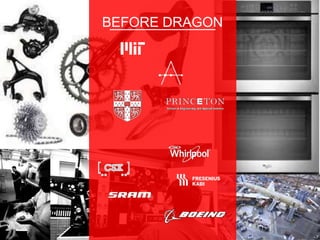
BEFORE DRAGON
We are going to make
something as insanely complex
as manufacturing consumer
electronics feel easy.
DRAGON’S VISION
WHO WE’VE HELPED
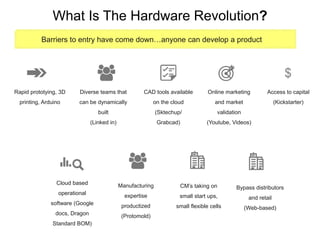
What Is The Hardware Revolution?
Access to capital
(Kickstarter)
Barriers to entry have come down…anyone can develop a product
CM’s taking on
small start ups,
small flexible cells
Diverse teams that
can be dynamically
built
(Linked in)
CAD tools available
on the cloud
(Sktechup/
Grabcad)
Manufacturing
expertise
productized
(Protomold)
Rapid prototying, 3D
printing, Arduino
Online marketing
and market
validation
(Youtube, Videos)
Bypass distributors
and retail
(Web-based)
Cloud based
operational
software (Google
docs, Dragon
Standard BOM)
$
7
Why is the HW revolution relevant to all companies?
The hardware revolution is a collection of
disruptive technologies that enable small
companies to behave like big ones.
Thousands of appropriately sized and
capable factories worldwide
Thousands of hardware products
will launch this year
Operational Changes
Quality requirements
Regulatory oversight
Customization
Globalization
Speed of product
introductions
Supply chain complexity
Product variants
Supply chain depth
Technology partners
More Complex Products with Fewer Resources
Technology Changes
Hydraulics
Disc brakes
Electronic shifters
Composite frame
Aerodynamic modeling
Built in power meters with wireless
Advanced manufacturing
Tighter tolerances
Bikes as Fashion
Ti, Al, composite
components
Weight reduction
Optimistic but inexperienced teams risk getting ahead of themselves
PERCEIVED VS ACTUAL TIMELINES
IDEA DELIVERCROWDFUND MANUFACTUREPROTO
X Y ZK L M N O P Q R S T U V WG H I JC D E FA B
IDEA DELIVERCROWDFUNDPROTO
W X YR S T U VC D E F G H I J K L M N O P QA B Z
MANUFACTURE
Test and refine and mfg. ramp are complex multi-disciplinary
activities that can make or break your product
PRODUCT DEVELOPMENT PROCESS
Concep
t
System
level
design
Detail
design
Test
and
refine
Mfg.
Ramp
up
Mfg.
Works-Like Looks-Like
What does it take to get to a saleable unit?
What else has to be engineered?
What tasks need to be done? How long does it take?
How much cash will it take?
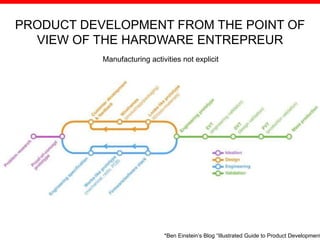
Manufacturing activities not explicit
PRODUCT DEVELOPMENT FROM THE POINT OF
VIEW OF THE HARDWARE ENTREPREUR
*Ben Einstein’s Blog “Illustrated Guide to Product Development
Three phases of production
Pre-manufacturing Production ramp Ongoing
Production
The iterations and interactions are too complicated to draw…
Multiple critical activities in each phase
Pre-mfg Mfg ramp Ongoing Production
*Ben Einstein’s Blog “Illustrated Guide to Product Development
DFX
Your beautifully designed product
probably can’t be built.
MANUFACTURING IS A
COMPLEX BUSINESS
Exactingly detailed process fraught with decisions that cast a long shadow once set
• Design for assembly
• Design for IM
• Design for testing
• Design for cost
• Design for variability
Supplier selection:
Choosing a CM is
only the first step.
• Cost drivers
• Trust and capability
• MOQ, terms
• Tooling cost
• Tooling schedule
• Quality capability
• COTS vs. custom
Quality Systems:
It won’t work right
the first time
• Functional testing
• Life testing
• Certification
• Durability testing
• Transportation
• Safety
• Board level tests
• Shipment audits
Forecasting and planning:
You need to order long before you need
the product
• How to plan a forecast for a product
before you understand the market
• Tradeoff of MOQ and capital costs
• Terms will influence ordering
• Risk buys
• Long lead items
• Spares and replacements
• Cash flow (huge amount before you
get a check!)
Serious HW chops
Best customers
Big vision
About to stomp on gas
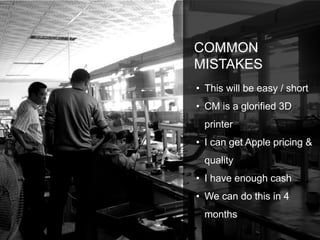
COMMON
MISTAKES
• This will be easy / short
• CM is a glorified 3D
printer
• I can get Apple pricing &
quality
• I have enough cash
• We can do this in 4
months
What variables matter? Keys to a good RFQ
Selecting a CM Partner
You are going to have to live with them a long time….
Cost of goods
Terms
Quality
Experience
Size (small fish big pond vs. bfsp)
Equipment
Investments
NRE terms
On-site capability
Key suppliers/partners
Need to sell yourself
The more you detail the RFQ, the better
Require an OPEN BOOK RFQ
Clear about RASI
Define quality requirements
Clear warranty targets and AQL
CM not signed until all negotiations are
finished
There is no “best” CM,
it is a process of matching their skills to your needs
• Design for X
• Manufacture. Produced reliably with a high
yield
• Assembly. Assembled efficiently with high
yield?
• Cost. Remove extra parts, combine parts,
tooling?
• Durability and reliability
• Is your PCBA designed for reliability
• Is your software reliable? Do you have the right
test suites?
• Have you thought about mechanical durability
and life time performance?
• Sourcing
• Can you get OTS parts or do you need
custom?
• Packaging?
• What else is included (spares, batteries, install
hardware, cables, inserts, etc)?
GETTING YOUR
PRODUCT
READY FOR
PRODUCTION
MANUFACTURING TRIANGLE
SCHEDULE
QUALITYCOST
8
Kickoffproject
SelectCMandaward
MSA
Projectkick-off
4
RFQreleased
Clientvisit
RFQnegotiations
Toolmodscomplete
Toolingrelease
Toolingstart
Firstshots
7 45
EP1/EVTcomplete
EP2/DVT1complete
FEP/DVT2complete
PPcomplete
5 3 2
Productionstart
Shipmentaudit/Exfactory
ShipmentarrivesUS
Inthehandsofcustomer
4
TYPICAL CRITICAL PATH
46 weeks
Pre-prod.eng.finished
4
DFMactivities
Long MSA negotiations
Late design release
Custom designed
components
Certification, MA, Late design changes, Life
testing, Packaging
Material shortages
PILOT / VALIDATION CYCLES
EP/EVT - Engineering pilot / Engineering Validation Test:
Build and test several units that function as expected. Learn
about new requirements from users.
EP/DVT - Design Validation Test:
Build and test more units that function as expected and have
close to the final aesthetic. Learn what need to be tweaked in
the the design.
FEP/ PVT - Production Validation Test:
Build and test a lot of units that that function as expected, final
ID , and can be assembled and tested. Learn what need to be
fixed in production system.
What Numbers Matter?
PER UNIT COST
Cost of ex-factory product
Sale price
Mark up/profit
Consigned/assigned/CM
Shipment
INVESTMENT
NRE
Time
Capital costs
ON GOING
Cost down rate
Warranty rates
CASH FLOW
MA – Long lead items
Consigned parts
Payment terms (CM)
Payment terms (retail)
PO timing
Inventory
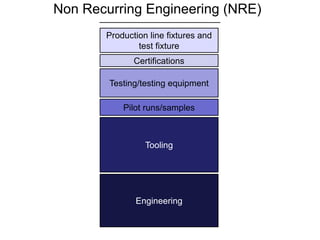
Engineering
Pilot runs/samples
Tooling
Testing/testing equipment
Production line fixtures and
test fixture
Certifications
Non Recurring Engineering (NRE)
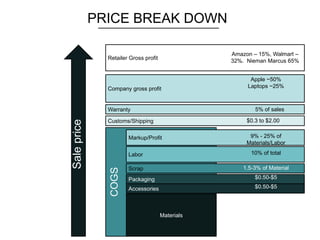
COGS
Company gross profit
Retailer Gross profit
Materials
Labor
Markup/Profit
Scrap
Packaging
Warranty
Customs/Shipping
PRICE BREAK DOWN
Amazon – 15%, Walmart –
32%. Nieman Marcus 65%
Apple ~50%
Laptops ~25%
5% of sales
$0.3 to $2.00
1.5-3% of Material
9% - 25% of
Materials/Labor
$0.50-$5
Accessories $0.50-$5
Saleprice
10% of total
SUPPLY CHAIN PLANNING
• Consigned vs. non-consigned
• You don’t pay the overhead but you need to
pay ahead
• Material planning overhead
• Purchase orders
• Inventory vs. lost sales. You need to
determine your orders ahead
• Terms
• Is 15% vs. 20% better or is a $1 better
• Impact of long lead parts
• Cost down impact
How to tradeoff
MSA terms
• 12% Markup & 50% at PO
50% at ship
• 20% Markup & 20% at PO
30% at production and 50% at
ship.
Consigned vs. Assigned
• $3 part.
• Consigned
• 3% consigned MVA
• 100% due on PO for part if
consigned
• Normal non-consigned
• 15% assigned MVA
• 50% / 50%
TYPICAL PRC CM MARGINS
(Profit, Scrap, Overhead)
PCBA
6-8%
TOYS
12%
CONSUMER
15%
MEDICAL
>40%
Dragon provides the fastest, simplest, and safest way to
manufacture electronics at scale.
From Dragon Certified pre-launch to our Manufacturing
Solutions when you move into production, we can help every
step of the way as you bring your product to life.
We've refined our process by working with hundreds of
customers to produce millions of complex, innovative
products and provide you with the tools and knowledge to go
from prototype to production.
THE DRAGON STANDARD BOM
Google Sheets Add-on | Easy to Follow Format | Data Validation
Utility Flat BOM Function | Pre-Formatted Reports
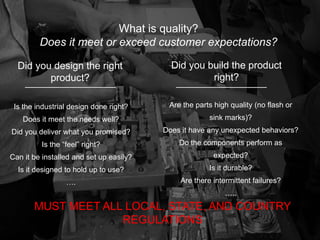
Did you design the right
product?
Did you build the product
right?
What is quality?
Does it meet or exceed customer expectations?
Is the industrial design done right?
Does it meet the needs well?
Did you deliver what you promised?
Is the “feel” right?
Can it be installed and set up easily?
Is it designed to hold up to use?
….
Are the parts high quality (no flash or
sink marks)?
Does it have any unexpected behaviors?
Do the components perform as
expected?
Is it durable?
Are there intermittent failures?
…..
MUST MEET ALL LOCAL, STATE, AND COUNTRY
REGULATIONS
• Test early and often. Better you find it
than your customers
• Planning for quality early will highlight:
• What you should be designing for
• How long life testing will take
• How many samples you need
• Testing fixtures can take a long time to
design and debug
• If quality planning to CM, you limit your
control of quality later.
• Life testing takes a lot longer than you
think
• You need to test to a much more
rigorous level than you think to ensure
low returns (10 units for 4 warranty
periods to ensure a low return rate)
Quality
planning:
The earlier the
better
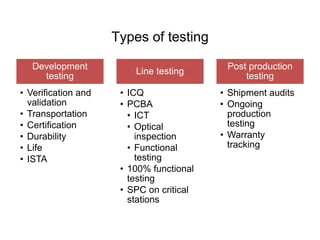
Types of testing
Development
testing
• Verification and
validation
• Transportation
• Certification
• Durability
• Life
• ISTA
Line testing
• ICQ
• PCBA
• ICT
• Optical
inspection
• Functional
testing
• 100% functional
testing
• SPC on critical
stations
Post production
testing
• Shipment audits
• Ongoing
production
testing
• Warranty
tracking
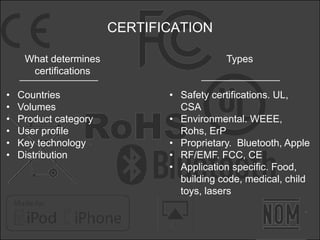
CERTIFICATION
What determines
certifications
• Countries
• Volumes
• Product category
• User profile
• Key technology
• Distribution
Types
• Safety certifications. UL,
CSA
• Environmental. WEEE,
Rohs, ErP
• Proprietary. Bluetooth, Apple
• RF/EMF. FCC, CE
• Application specific. Food,
building code, medical, child
toys, lasers
WHAT IS IN A QUALITY PLAN?
• AQL
• Functional testing
• Durability
• Life testing
• Verification/Validation
• Inspection criteria
• Certification
• PCB Testing
• SPC
• Shipment audits
• Process control and set up
Life testing
Target Rate
6%
Non-defective
Runs 60% of total
return rate (3.6%)
Defective runs
40% of Target
(2.4%)
Unanticipated
(1/3 of all returns
(0.8%)
Factory AQL
(0.65%)
TARGET (0.95%)
Set the sample sizes and warranty periods to
get certainty that you haven’t found a problem
Example: 10 units for 4 warranty periods to
get sufficient confidence
Exercise
• Disassemble the packaging.
• What are the decisions that need to be
made?
• Cost, quality, schedule, etc.
• Who is involved?
• What decisions need to be made about
cost?
• What are the schedule issues, what are
long lead items/critical path?
35
Find us at
DragonInnovation.com
@dragoninnovate /dragoninnovation
Why Is Manufacturing Difficult?

Why Is Manufacturing Difficult?

  • 1.
    @dragoninnovate /dragoninnovationwww.dragoninnovation.com WHY ISMANUFACTURING DIFFICULT? DR. ANNA C. THORNTON MIT February 17, 2016
  • 2.
    LEARNING OBJECTIVES Understand theprocess of going from a works like/looks like prototype to a saleable unit. Cost, quality, and schedule challenges. Why this isn’t easy.
  • 3.
  • 4.
    We are goingto make something as insanely complex as manufacturing consumer electronics feel easy. DRAGON’S VISION
  • 5.
  • 6.
    What Is TheHardware Revolution? Access to capital (Kickstarter) Barriers to entry have come down…anyone can develop a product CM’s taking on small start ups, small flexible cells Diverse teams that can be dynamically built (Linked in) CAD tools available on the cloud (Sktechup/ Grabcad) Manufacturing expertise productized (Protomold) Rapid prototying, 3D printing, Arduino Online marketing and market validation (Youtube, Videos) Bypass distributors and retail (Web-based) Cloud based operational software (Google docs, Dragon Standard BOM) $
  • 7.
    7 Why is theHW revolution relevant to all companies? The hardware revolution is a collection of disruptive technologies that enable small companies to behave like big ones. Thousands of appropriately sized and capable factories worldwide Thousands of hardware products will launch this year
  • 8.
    Operational Changes Quality requirements Regulatoryoversight Customization Globalization Speed of product introductions Supply chain complexity Product variants Supply chain depth Technology partners More Complex Products with Fewer Resources Technology Changes Hydraulics Disc brakes Electronic shifters Composite frame Aerodynamic modeling Built in power meters with wireless Advanced manufacturing Tighter tolerances Bikes as Fashion Ti, Al, composite components Weight reduction
  • 9.
    Optimistic but inexperiencedteams risk getting ahead of themselves PERCEIVED VS ACTUAL TIMELINES IDEA DELIVERCROWDFUND MANUFACTUREPROTO X Y ZK L M N O P Q R S T U V WG H I JC D E FA B IDEA DELIVERCROWDFUNDPROTO W X YR S T U VC D E F G H I J K L M N O P QA B Z MANUFACTURE
  • 10.
    Test and refineand mfg. ramp are complex multi-disciplinary activities that can make or break your product PRODUCT DEVELOPMENT PROCESS Concep t System level design Detail design Test and refine Mfg. Ramp up Mfg.
  • 11.
    Works-Like Looks-Like What doesit take to get to a saleable unit? What else has to be engineered? What tasks need to be done? How long does it take? How much cash will it take?
  • 12.
    Manufacturing activities notexplicit PRODUCT DEVELOPMENT FROM THE POINT OF VIEW OF THE HARDWARE ENTREPREUR *Ben Einstein’s Blog “Illustrated Guide to Product Development
  • 13.
    *Ben Einstein’s Blog“Illustrated Guide to Product Development Three phases of production Pre-manufacturing Production ramp Ongoing Production
  • 14.
    The iterations andinteractions are too complicated to draw… Multiple critical activities in each phase Pre-mfg Mfg ramp Ongoing Production *Ben Einstein’s Blog “Illustrated Guide to Product Development
  • 15.
    DFX Your beautifully designedproduct probably can’t be built. MANUFACTURING IS A COMPLEX BUSINESS Exactingly detailed process fraught with decisions that cast a long shadow once set • Design for assembly • Design for IM • Design for testing • Design for cost • Design for variability Supplier selection: Choosing a CM is only the first step. • Cost drivers • Trust and capability • MOQ, terms • Tooling cost • Tooling schedule • Quality capability • COTS vs. custom Quality Systems: It won’t work right the first time • Functional testing • Life testing • Certification • Durability testing • Transportation • Safety • Board level tests • Shipment audits Forecasting and planning: You need to order long before you need the product • How to plan a forecast for a product before you understand the market • Tradeoff of MOQ and capital costs • Terms will influence ordering • Risk buys • Long lead items • Spares and replacements • Cash flow (huge amount before you get a check!)
  • 16.
    Serious HW chops Bestcustomers Big vision About to stomp on gas COMMON MISTAKES • This will be easy / short • CM is a glorified 3D printer • I can get Apple pricing & quality • I have enough cash • We can do this in 4 months
  • 17.
    What variables matter?Keys to a good RFQ Selecting a CM Partner You are going to have to live with them a long time…. Cost of goods Terms Quality Experience Size (small fish big pond vs. bfsp) Equipment Investments NRE terms On-site capability Key suppliers/partners Need to sell yourself The more you detail the RFQ, the better Require an OPEN BOOK RFQ Clear about RASI Define quality requirements Clear warranty targets and AQL CM not signed until all negotiations are finished There is no “best” CM, it is a process of matching their skills to your needs
  • 18.
    • Design forX • Manufacture. Produced reliably with a high yield • Assembly. Assembled efficiently with high yield? • Cost. Remove extra parts, combine parts, tooling? • Durability and reliability • Is your PCBA designed for reliability • Is your software reliable? Do you have the right test suites? • Have you thought about mechanical durability and life time performance? • Sourcing • Can you get OTS parts or do you need custom? • Packaging? • What else is included (spares, batteries, install hardware, cables, inserts, etc)? GETTING YOUR PRODUCT READY FOR PRODUCTION
  • 19.
  • 20.
    8 Kickoffproject SelectCMandaward MSA Projectkick-off 4 RFQreleased Clientvisit RFQnegotiations Toolmodscomplete Toolingrelease Toolingstart Firstshots 7 45 EP1/EVTcomplete EP2/DVT1complete FEP/DVT2complete PPcomplete 5 32 Productionstart Shipmentaudit/Exfactory ShipmentarrivesUS Inthehandsofcustomer 4 TYPICAL CRITICAL PATH 46 weeks Pre-prod.eng.finished 4 DFMactivities Long MSA negotiations Late design release Custom designed components Certification, MA, Late design changes, Life testing, Packaging Material shortages
  • 21.
    PILOT / VALIDATIONCYCLES EP/EVT - Engineering pilot / Engineering Validation Test: Build and test several units that function as expected. Learn about new requirements from users. EP/DVT - Design Validation Test: Build and test more units that function as expected and have close to the final aesthetic. Learn what need to be tweaked in the the design. FEP/ PVT - Production Validation Test: Build and test a lot of units that that function as expected, final ID , and can be assembled and tested. Learn what need to be fixed in production system.
  • 22.
    What Numbers Matter? PERUNIT COST Cost of ex-factory product Sale price Mark up/profit Consigned/assigned/CM Shipment INVESTMENT NRE Time Capital costs ON GOING Cost down rate Warranty rates CASH FLOW MA – Long lead items Consigned parts Payment terms (CM) Payment terms (retail) PO timing Inventory
  • 23.
    Engineering Pilot runs/samples Tooling Testing/testing equipment Productionline fixtures and test fixture Certifications Non Recurring Engineering (NRE)
  • 24.
    COGS Company gross profit RetailerGross profit Materials Labor Markup/Profit Scrap Packaging Warranty Customs/Shipping PRICE BREAK DOWN Amazon – 15%, Walmart – 32%. Nieman Marcus 65% Apple ~50% Laptops ~25% 5% of sales $0.3 to $2.00 1.5-3% of Material 9% - 25% of Materials/Labor $0.50-$5 Accessories $0.50-$5 Saleprice 10% of total
  • 25.
    SUPPLY CHAIN PLANNING •Consigned vs. non-consigned • You don’t pay the overhead but you need to pay ahead • Material planning overhead • Purchase orders • Inventory vs. lost sales. You need to determine your orders ahead • Terms • Is 15% vs. 20% better or is a $1 better • Impact of long lead parts • Cost down impact
  • 26.
    How to tradeoff MSAterms • 12% Markup & 50% at PO 50% at ship • 20% Markup & 20% at PO 30% at production and 50% at ship. Consigned vs. Assigned • $3 part. • Consigned • 3% consigned MVA • 100% due on PO for part if consigned • Normal non-consigned • 15% assigned MVA • 50% / 50%
  • 27.
    TYPICAL PRC CMMARGINS (Profit, Scrap, Overhead) PCBA 6-8% TOYS 12% CONSUMER 15% MEDICAL >40%
  • 28.
    Dragon provides thefastest, simplest, and safest way to manufacture electronics at scale. From Dragon Certified pre-launch to our Manufacturing Solutions when you move into production, we can help every step of the way as you bring your product to life. We've refined our process by working with hundreds of customers to produce millions of complex, innovative products and provide you with the tools and knowledge to go from prototype to production. THE DRAGON STANDARD BOM Google Sheets Add-on | Easy to Follow Format | Data Validation Utility Flat BOM Function | Pre-Formatted Reports
  • 29.
    Did you designthe right product? Did you build the product right? What is quality? Does it meet or exceed customer expectations? Is the industrial design done right? Does it meet the needs well? Did you deliver what you promised? Is the “feel” right? Can it be installed and set up easily? Is it designed to hold up to use? …. Are the parts high quality (no flash or sink marks)? Does it have any unexpected behaviors? Do the components perform as expected? Is it durable? Are there intermittent failures? ….. MUST MEET ALL LOCAL, STATE, AND COUNTRY REGULATIONS
  • 30.
    • Test earlyand often. Better you find it than your customers • Planning for quality early will highlight: • What you should be designing for • How long life testing will take • How many samples you need • Testing fixtures can take a long time to design and debug • If quality planning to CM, you limit your control of quality later. • Life testing takes a lot longer than you think • You need to test to a much more rigorous level than you think to ensure low returns (10 units for 4 warranty periods to ensure a low return rate) Quality planning: The earlier the better
  • 31.
    Types of testing Development testing •Verification and validation • Transportation • Certification • Durability • Life • ISTA Line testing • ICQ • PCBA • ICT • Optical inspection • Functional testing • 100% functional testing • SPC on critical stations Post production testing • Shipment audits • Ongoing production testing • Warranty tracking
  • 32.
    CERTIFICATION What determines certifications • Countries •Volumes • Product category • User profile • Key technology • Distribution Types • Safety certifications. UL, CSA • Environmental. WEEE, Rohs, ErP • Proprietary. Bluetooth, Apple • RF/EMF. FCC, CE • Application specific. Food, building code, medical, child toys, lasers
  • 33.
    WHAT IS INA QUALITY PLAN? • AQL • Functional testing • Durability • Life testing • Verification/Validation • Inspection criteria • Certification • PCB Testing • SPC • Shipment audits • Process control and set up
  • 34.
    Life testing Target Rate 6% Non-defective Runs60% of total return rate (3.6%) Defective runs 40% of Target (2.4%) Unanticipated (1/3 of all returns (0.8%) Factory AQL (0.65%) TARGET (0.95%) Set the sample sizes and warranty periods to get certainty that you haven’t found a problem Example: 10 units for 4 warranty periods to get sufficient confidence
  • 35.
    Exercise • Disassemble thepackaging. • What are the decisions that need to be made? • Cost, quality, schedule, etc. • Who is involved? • What decisions need to be made about cost? • What are the schedule issues, what are long lead items/critical path? 35
  • 36.

Editor's Notes

  • #6 Fortunate to have worked with some of the most exciting brands in the hardware revolution. Do people even talk about the revolution any more? Seems like it’s already over and companies who were the “little guy” in 2013 like Go Pro and Nest are dominating.
  • #10 Fallacy in the market that getting something manufactured is like printing copies. There’s a ton of hard work (and ways to get off the rails) between a brilliant idea and products in a customers hand.
  • #11 Fallacy in the market that getting something manufactured is like printing copies. There’s a ton of hard work (and ways to get off the rails) between a brilliant idea and products in a customers hand.
  • #16 This is a scary list of things you don’t understand but we do because we’ve lived through it all and learned the hard way.