Slide | 1
Slide | 2
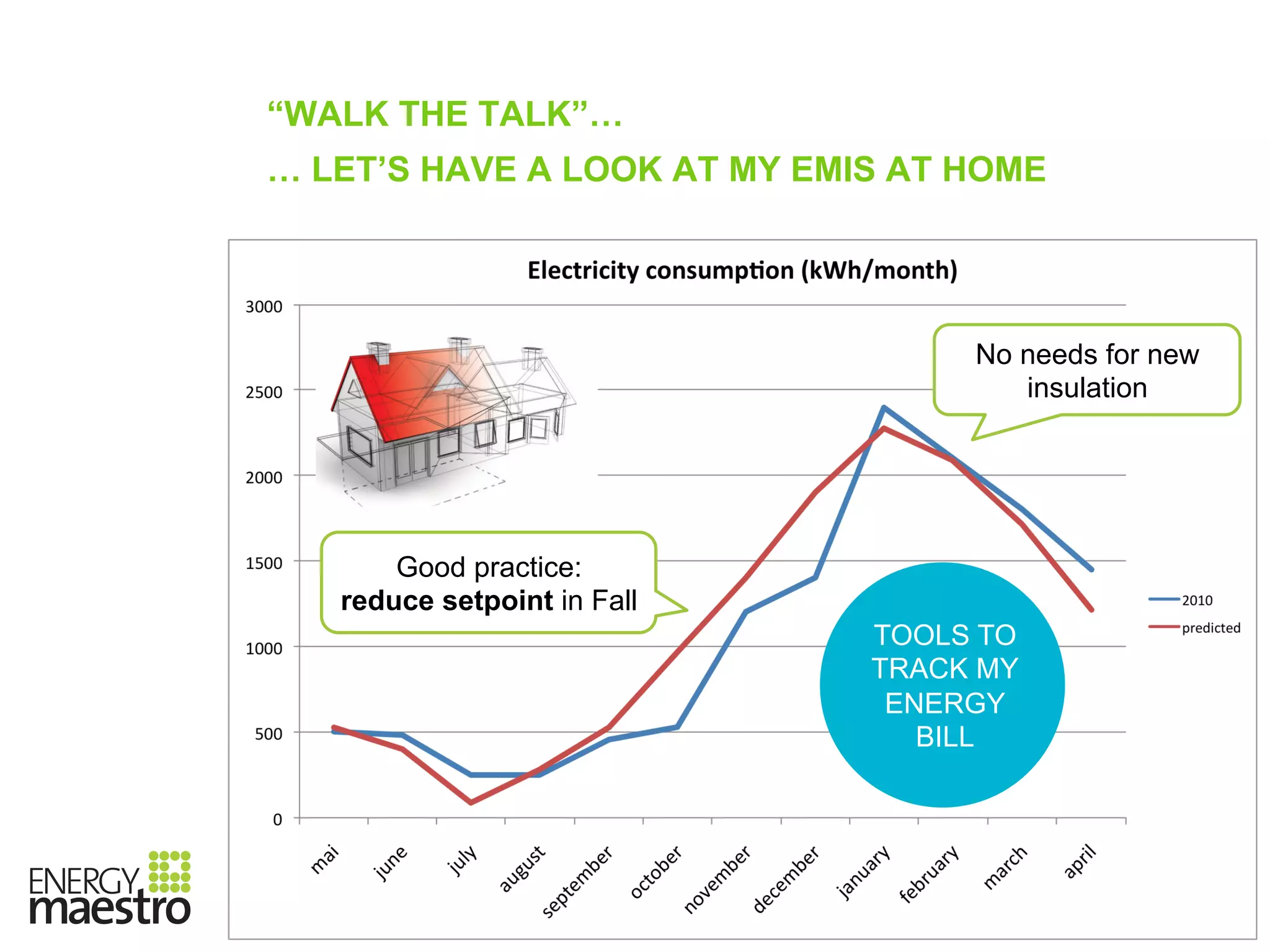
“WALK THE TALK”…
… LET’S HAVE A LOOK AT MY EMIS AT HOME
No needs for new
insulation
Good practice:
reduce setpoint in Fall
TOOLS TO
TRACK MY
ENERGY
BILL
Slide | 3
SUCCESS FACTORS
①  You’re richer than you think
Meters, historian, display, analysis software…
②  Top-down approach, bottom-up
implementation
No accountability without actionable parameters
③  Start implementation with an energy
optimization project
Pilot: people readiness, potential, data available
Slide | 4
WHY DON’T YOU HAVE
AN ENERGY MANAGEMENT
SYSTEM YET?
and should you?
Sebastien Lafourcade, Pepite Technologies
Slide | 5
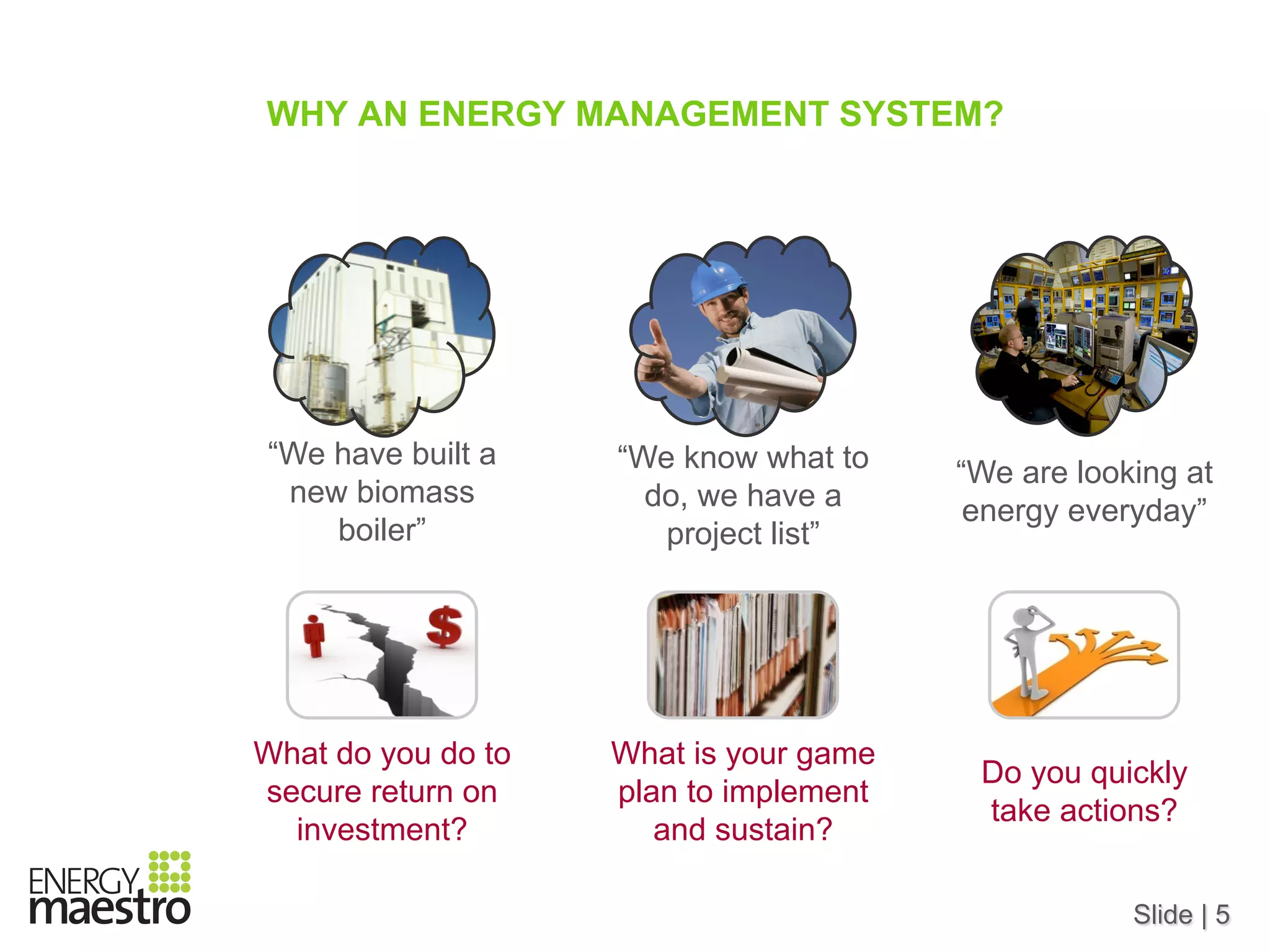
WHY AN ENERGY MANAGEMENT SYSTEM?
“We have built a
new biomass
boiler”
“We know what to
do, we have a
project list”
“We are looking at
energy everyday”
What do you do to
secure return on
investment?
What is your game
plan to implement
and sustain?
Do you quickly
take actions?
Slide | 6
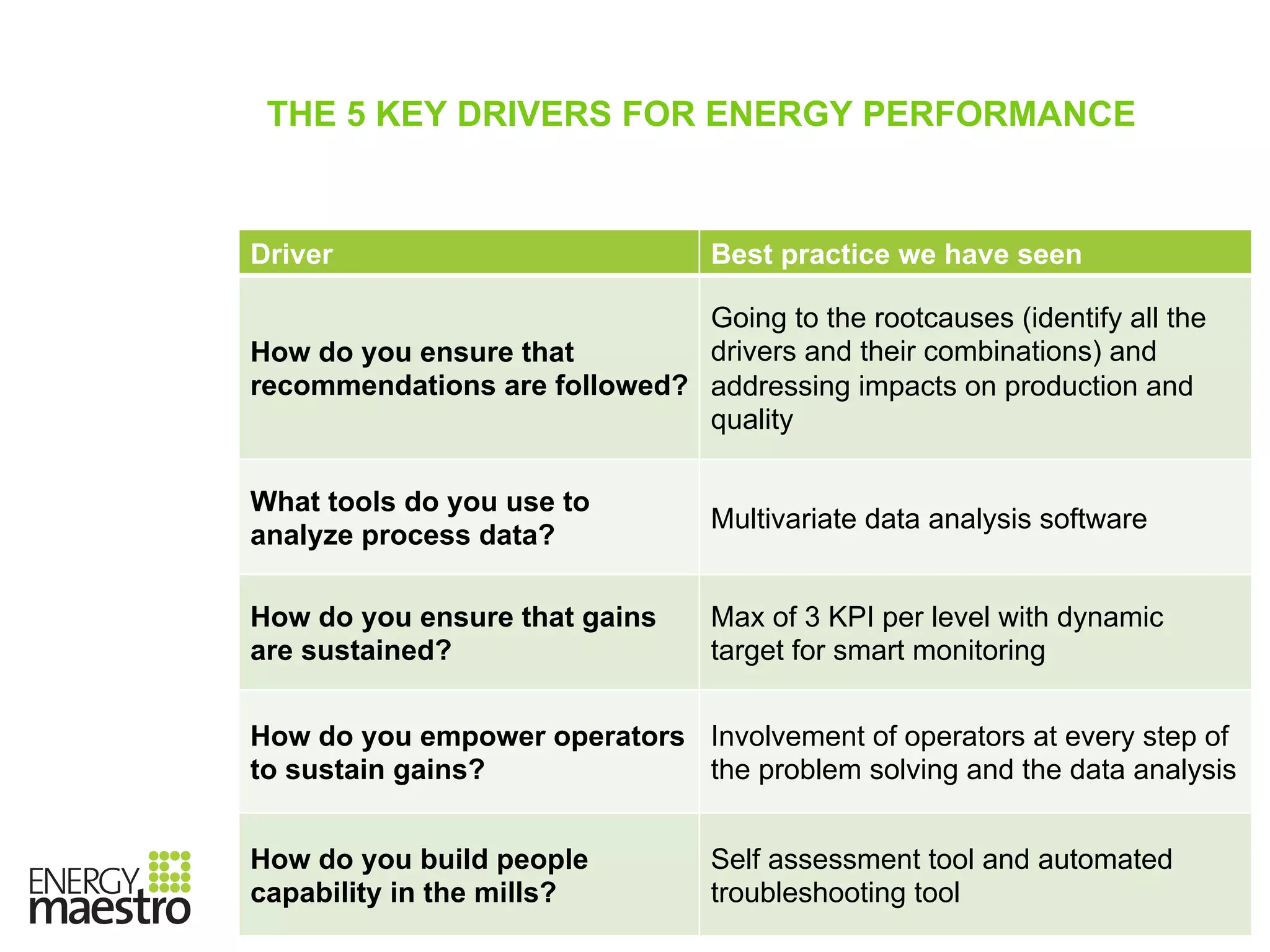
THE 5 KEY DRIVERS FOR ENERGY PERFORMANCE
Driver Best practice we have seen
How do you ensure that
recommendations are followed?
Going to the rootcauses (identify all the
drivers and their combinations) and
addressing impacts on production and
quality
What tools do you use to
analyze process data?
Multivariate data analysis software
How do you ensure that gains
are sustained?
Max of 3 KPI per level with dynamic
target for smart monitoring
How do you empower operators
to sustain gains?
Involvement of operators at every step of
the problem solving and the data analysis
How do you build people
capability in the mills?
Self assessment tool and automated
troubleshooting tool
Slide | 7
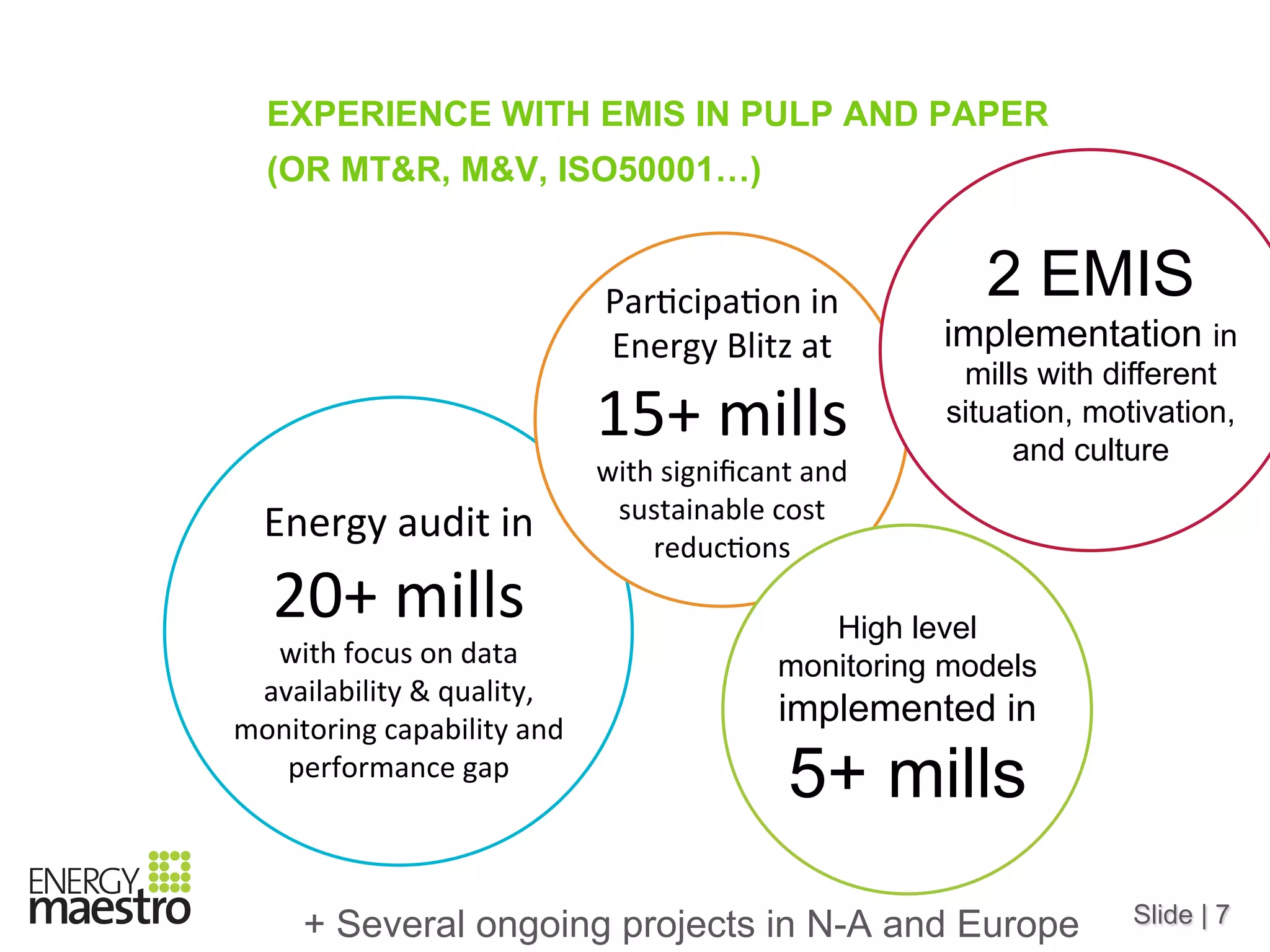
EXPERIENCE WITH EMIS IN PULP AND PAPER
(OR MT&R, M&V, ISO50001…)
+ Several ongoing projects in N-A and Europe
Energy	
  audit	
  in	
  
20+	
  mills	
  
with	
  focus	
  on	
  data	
  
availability	
  &	
  quality,	
  
monitoring	
  capability	
  and	
  
performance	
  gap	
  	
  
Par?cipa?on	
  in	
  
Energy	
  Blitz	
  at	
  
15+	
  mills	
  
with	
  significant	
  and	
  
sustainable	
  cost	
  
reduc?ons	
  
2 EMIS
implementation in
mills with different
situation, motivation,
and culture
High level
monitoring models
implemented in
5+ mills 	
  
Slide | 8
WHY SO LITTLE IMPLEMENTATION IN P&P?
Strengths Challenges
?	
  
Slide | 9
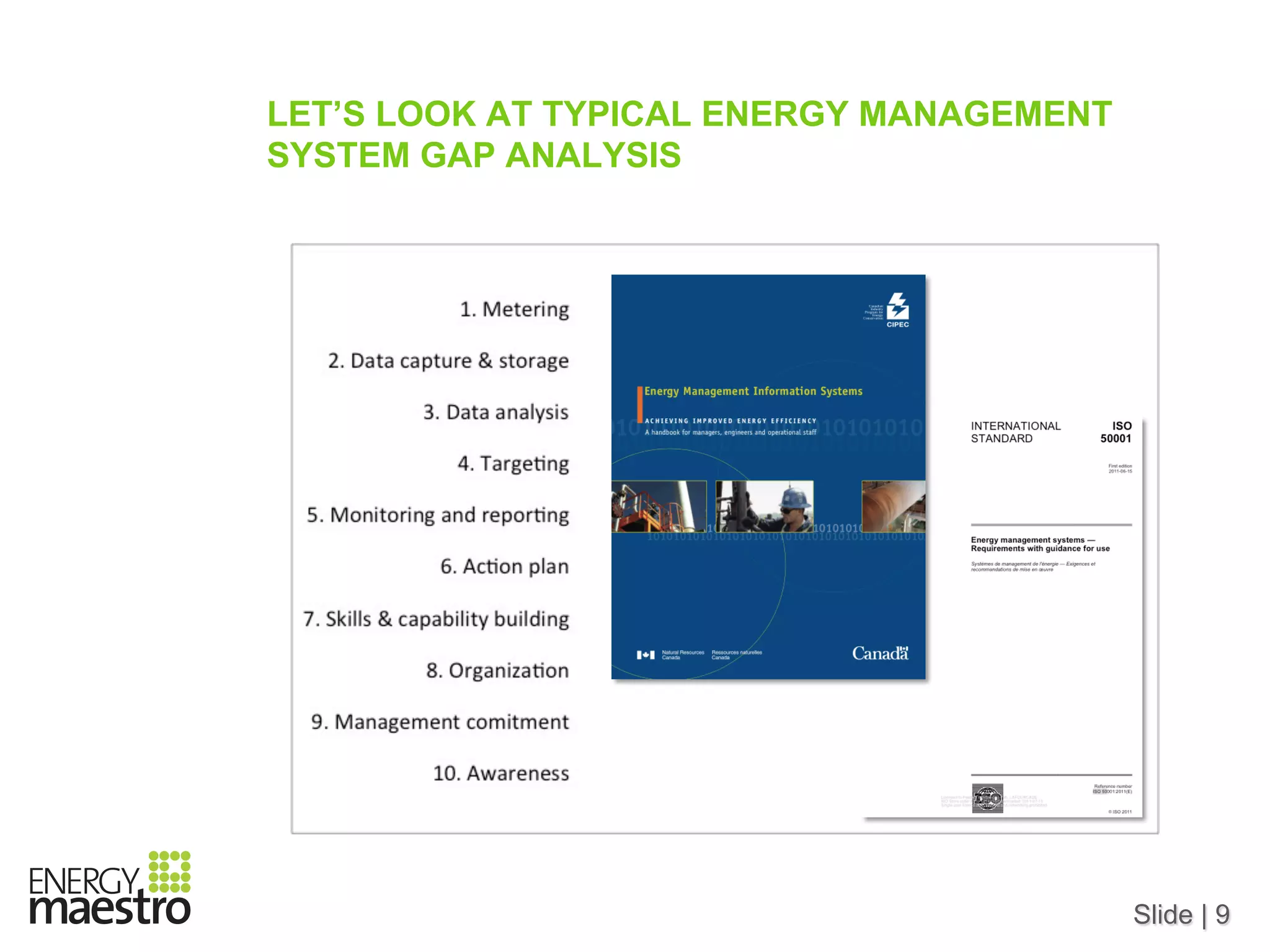
LET’S LOOK AT TYPICAL ENERGY MANAGEMENT
SYSTEM GAP ANALYSIS
Slide | 10
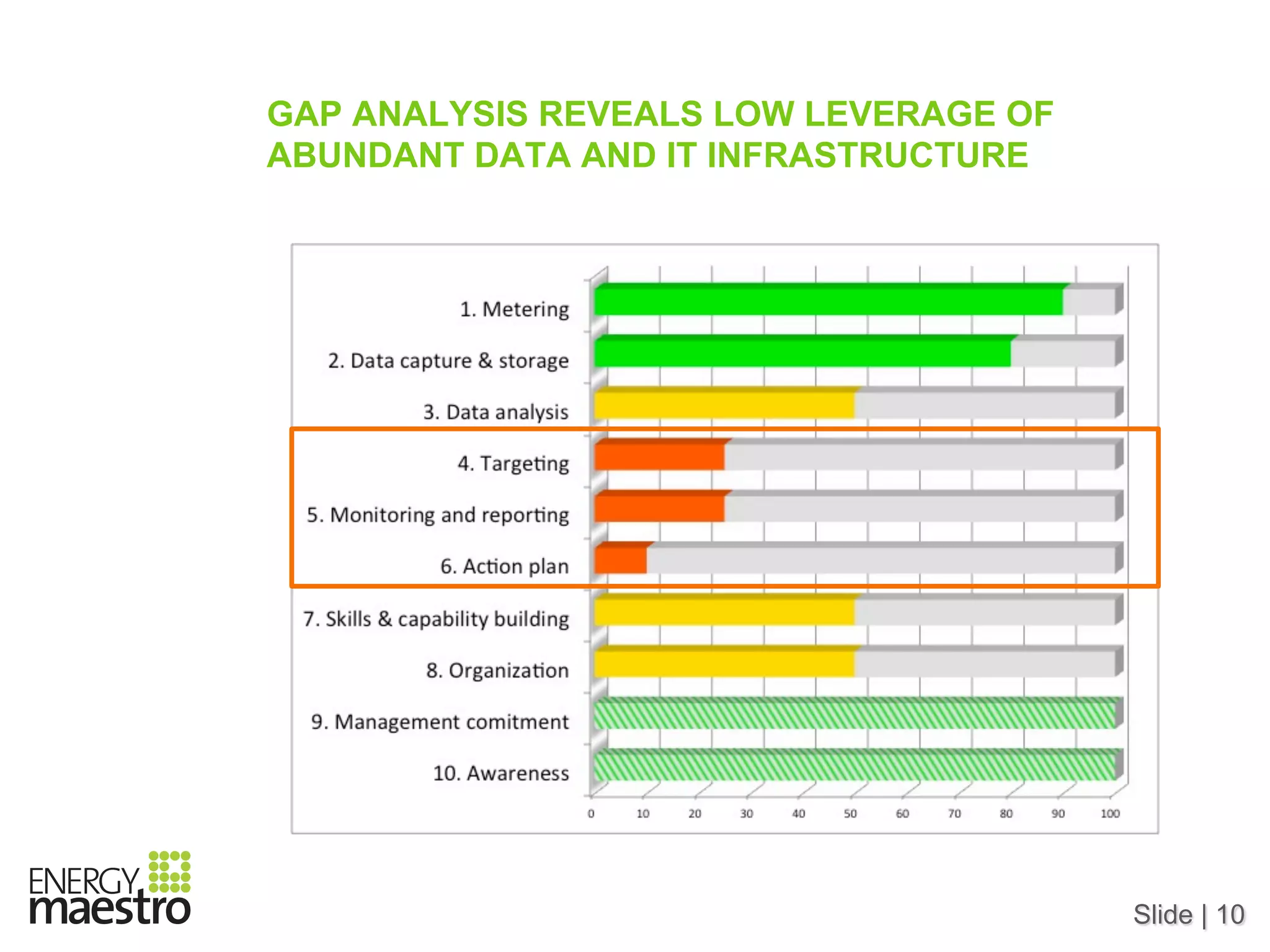
GAP ANALYSIS REVEALS LOW LEVERAGE OF
ABUNDANT DATA AND IT INFRASTRUCTURE
Slide | 11
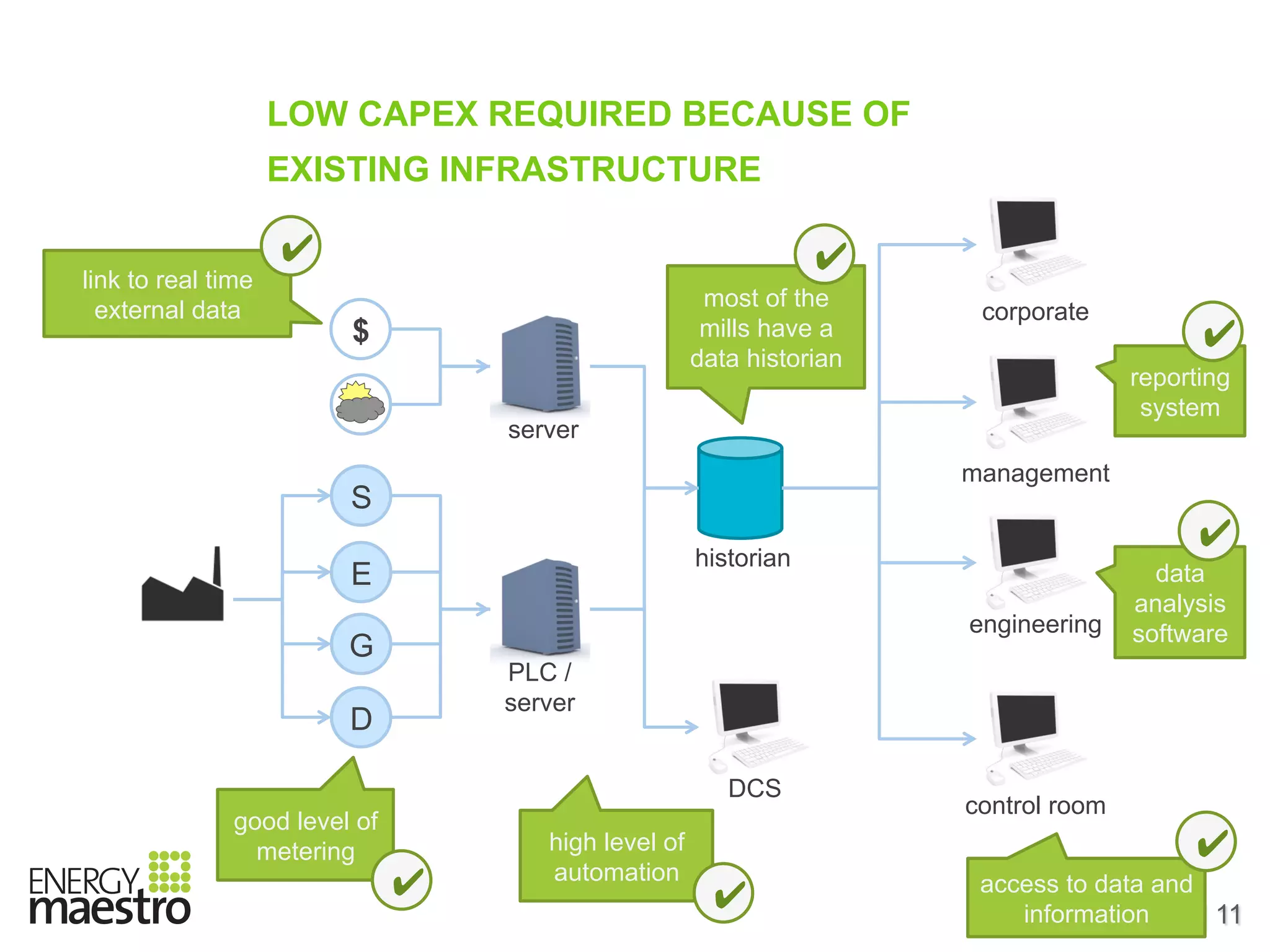
LOW CAPEX REQUIRED BECAUSE OF
EXISTING INFRASTRUCTURE
good level of
metering
$
S
E
G
D
historian
DCS
control room
engineering
management
corporate
PLC /
server
server
link to real time
external data
high level of
automation
most of the
mills have a
data historian
access to data and
information
data
analysis
software
reporting
system
✔ ✔
✔
✔
✔
✔✔
Slide | 12
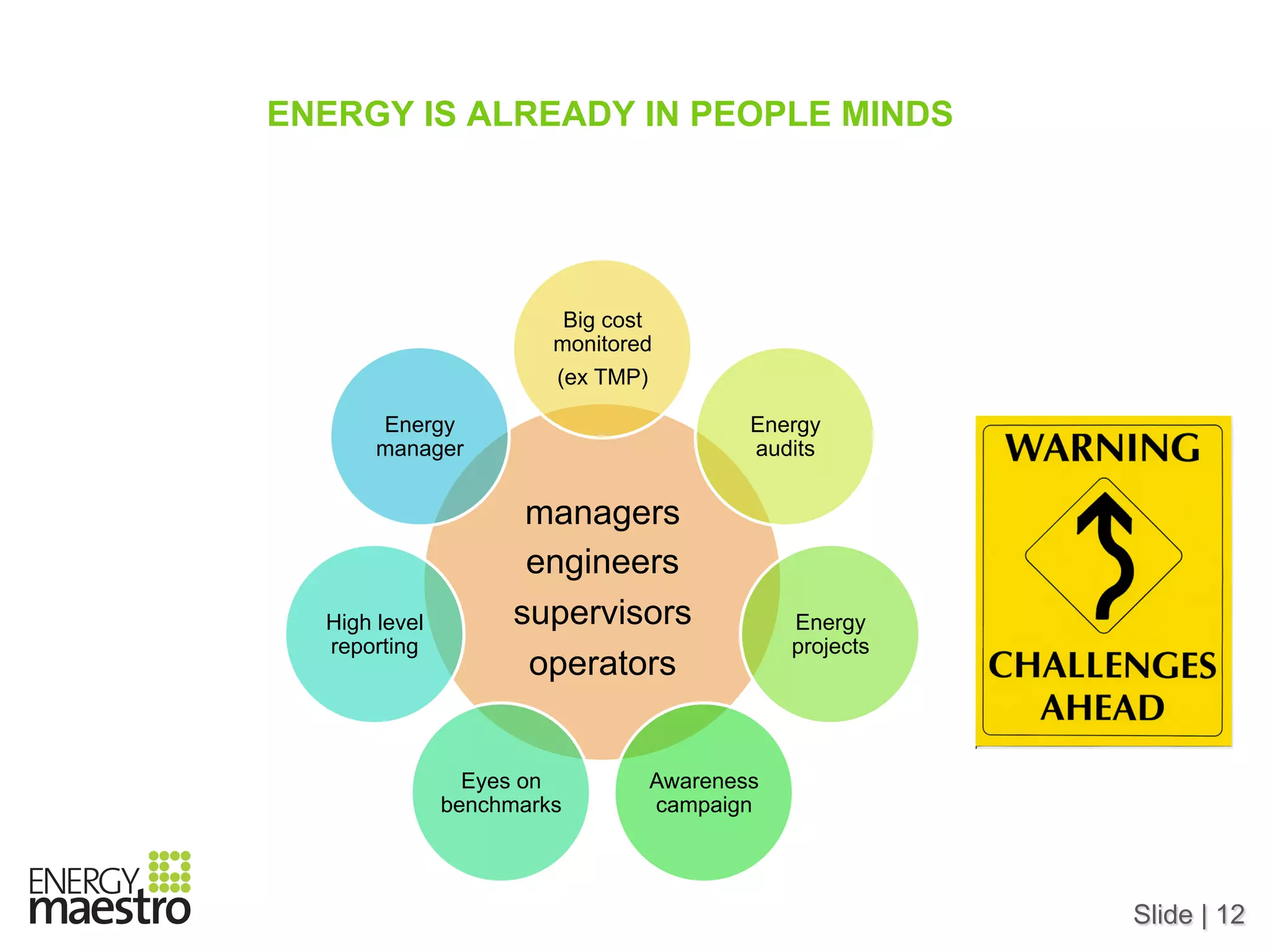
ENERGY IS ALREADY IN PEOPLE MINDS
managers
engineers
supervisors
operators
Big cost
monitored
(ex TMP)
Energy
audits
Energy
projects
Awareness
campaign
Eyes on
benchmarks
High level
reporting
Energy
manager
Slide | 13
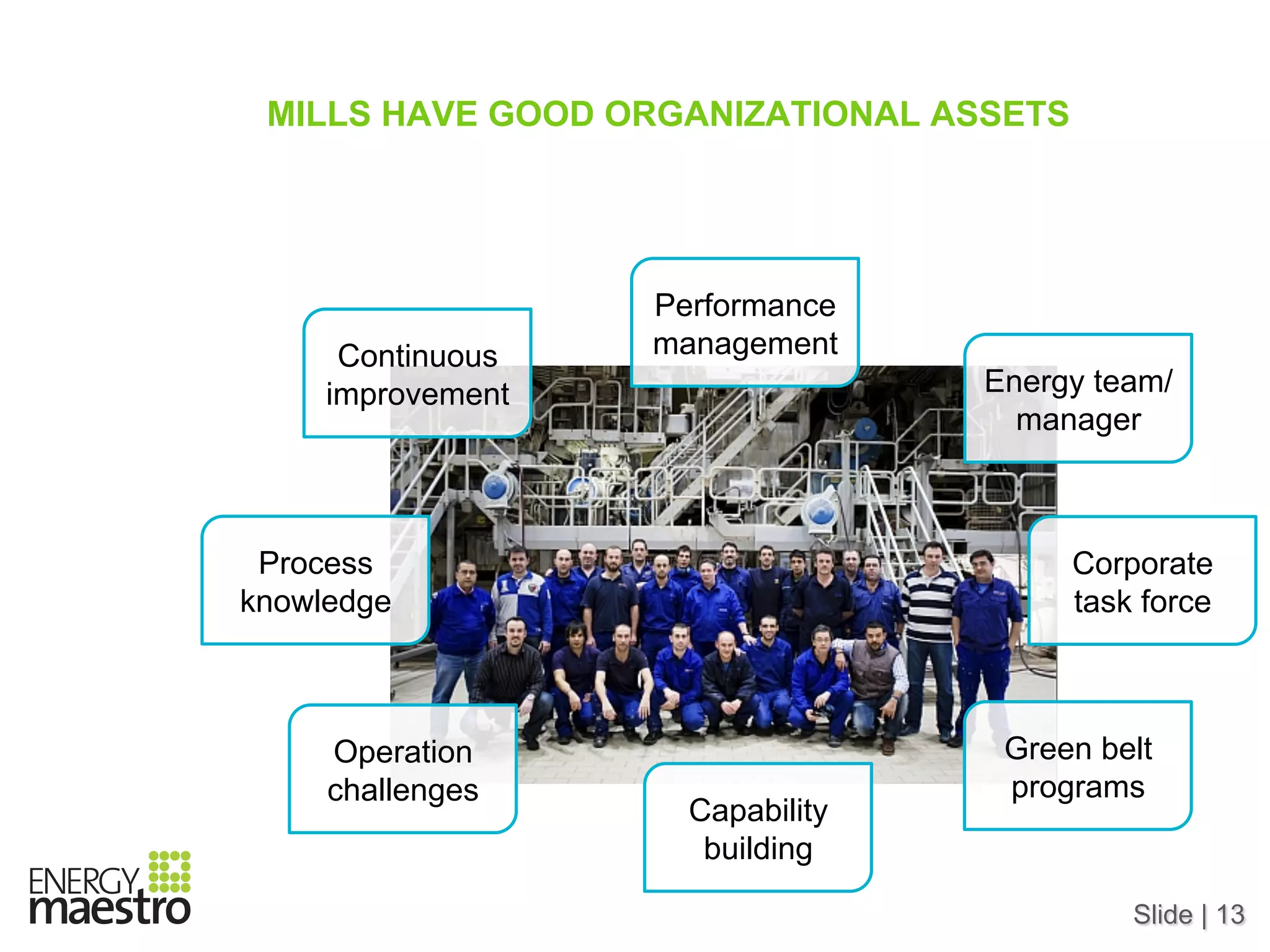
MILLS HAVE GOOD ORGANIZATIONAL ASSETS
Corporate
task force
Energy team/
manager
Green belt
programs
Process
knowledge
Continuous
improvement
Operation
challenges
Capability
building
Performance
management
Slide | 14
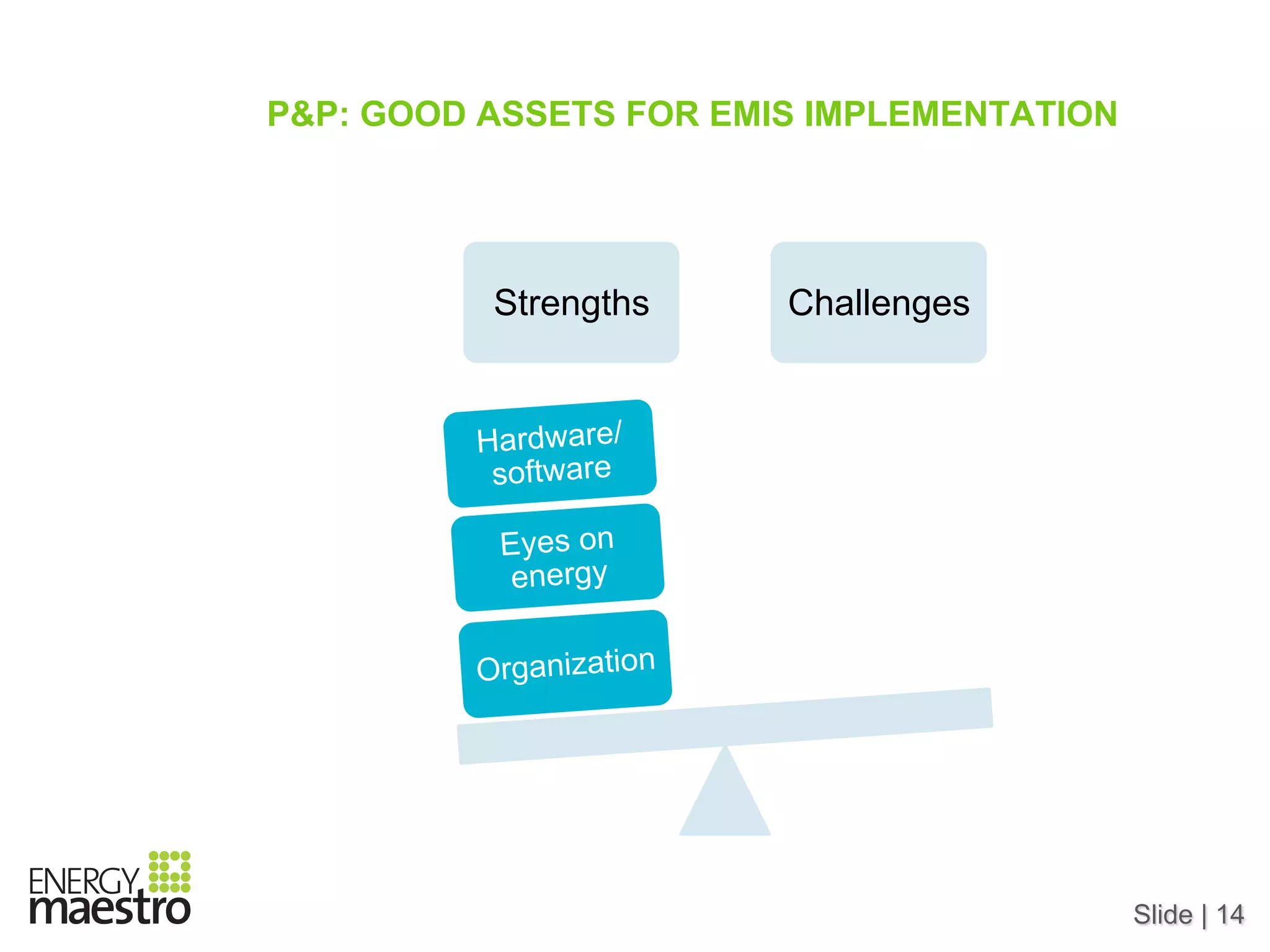
P&P: GOOD ASSETS FOR EMIS IMPLEMENTATION
Strengths Challenges
Organization
Eyes on
energy
Hardware/
software
Slide | 15
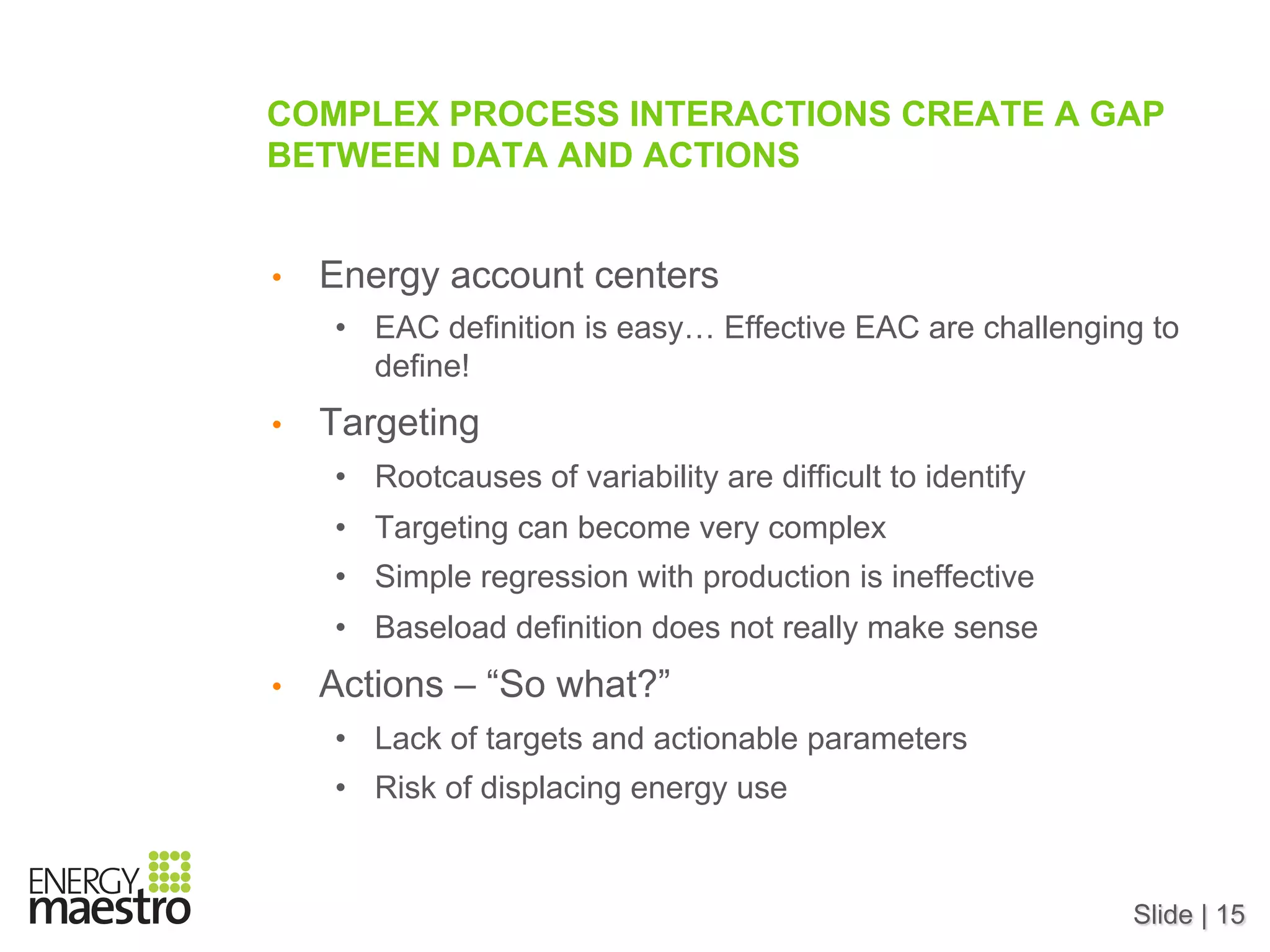
COMPLEX PROCESS INTERACTIONS CREATE A GAP
BETWEEN DATA AND ACTIONS
•  Energy account centers
•  EAC definition is easy… Effective EAC are challenging to
define!
•  Targeting
•  Rootcauses of variability are difficult to identify
•  Targeting can become very complex
•  Simple regression with production is ineffective
•  Baseload definition does not really make sense
•  Actions – “So what?”
•  Lack of targets and actionable parameters
•  Risk of displacing energy use
Slide | 16
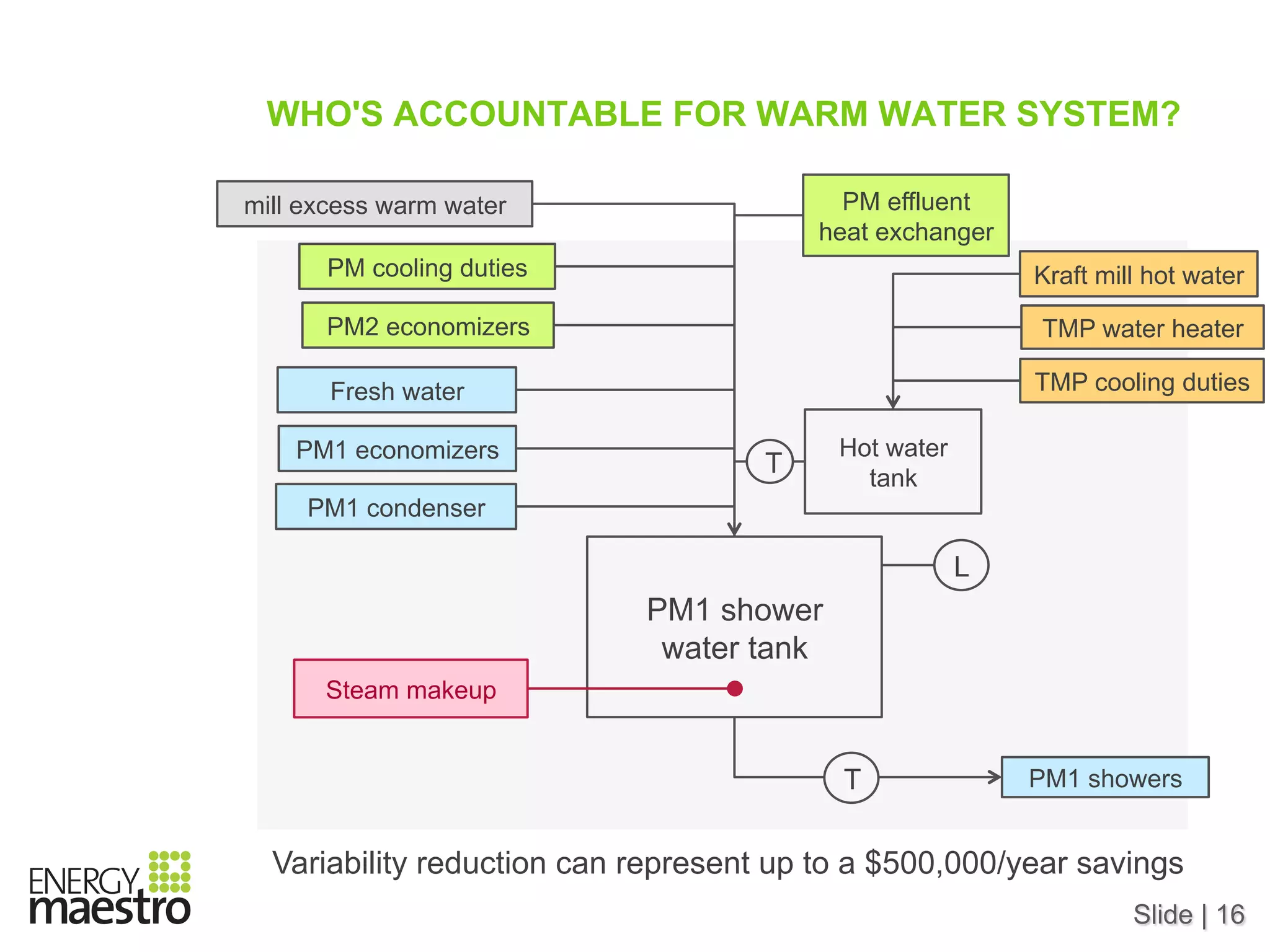
WHO'S ACCOUNTABLE FOR WARM WATER SYSTEM?
PM1 shower
water tank
PM1 showersT
Steam makeup
Variability reduction can represent up to a $500,000/year savings
L
Fresh water
PM1 condenser
PM1 economizers Hot water
tank
Kraft mill hot water
TMP water heater
TMP cooling duties
mill excess warm water
PM2 economizers
PM cooling duties
PM effluent
heat exchanger
T
Slide | 17
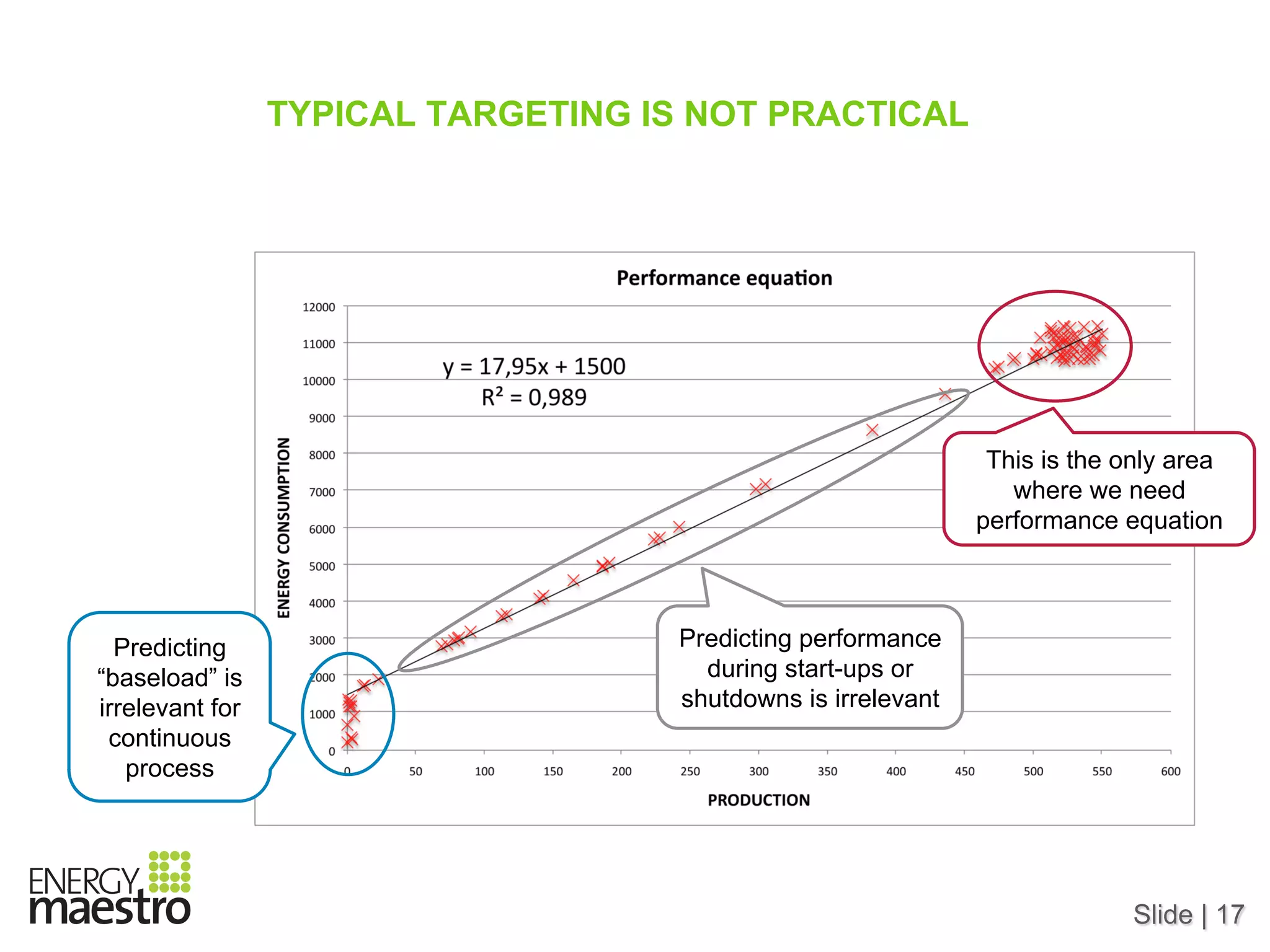
TYPICAL TARGETING IS NOT PRACTICAL
Predicting performance
during start-ups or
shutdowns is irrelevant
Predicting
“baseload” is
irrelevant for
continuous
process
This is the only area
where we need
performance equation
Slide | 18
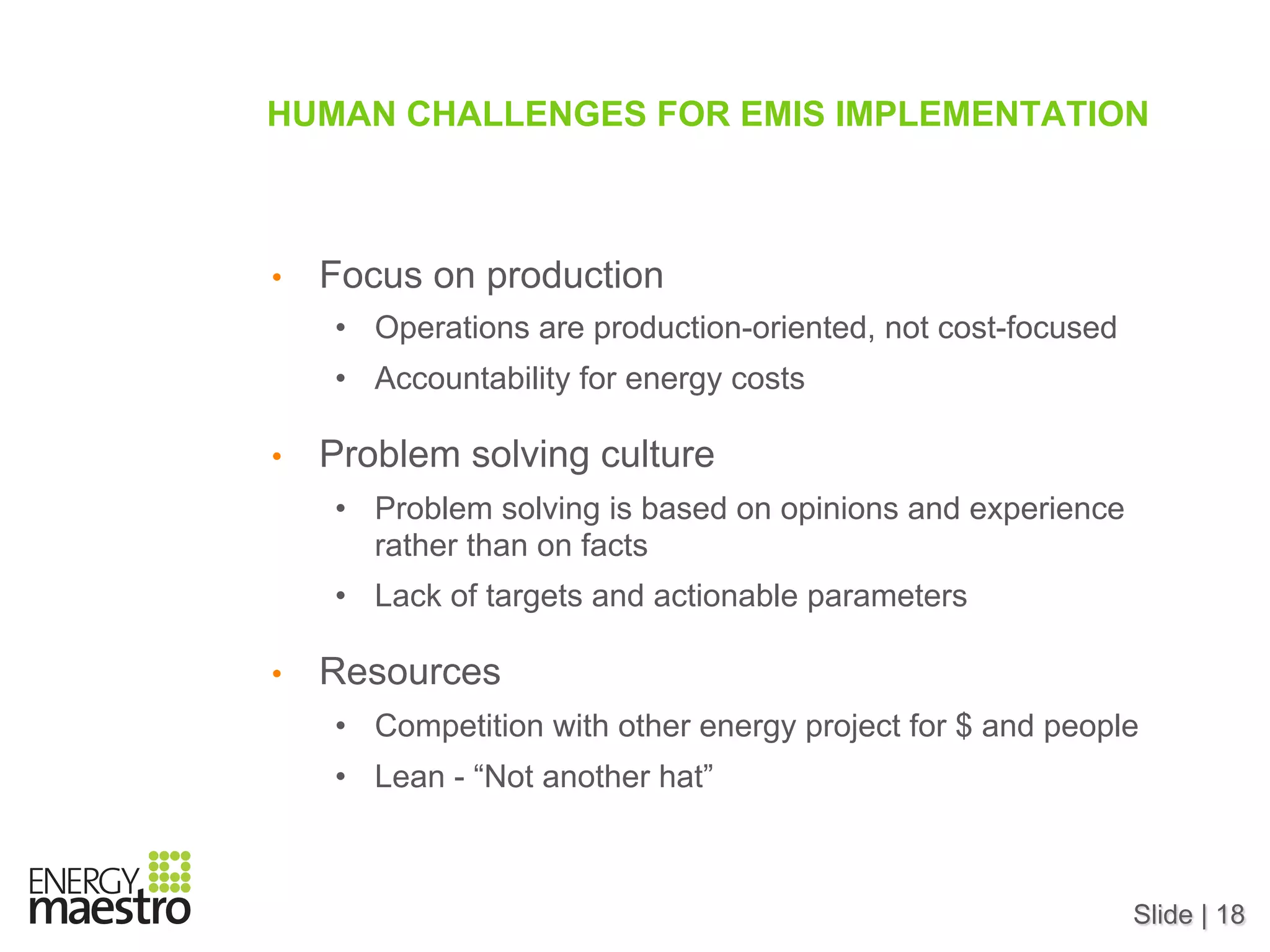
HUMAN CHALLENGES FOR EMIS IMPLEMENTATION
•  Focus on production
•  Operations are production-oriented, not cost-focused
•  Accountability for energy costs
•  Problem solving culture
•  Problem solving is based on opinions and experience
rather than on facts
•  Lack of targets and actionable parameters
•  Resources
•  Competition with other energy project for $ and people
•  Lean - “Not another hat”
Slide | 19
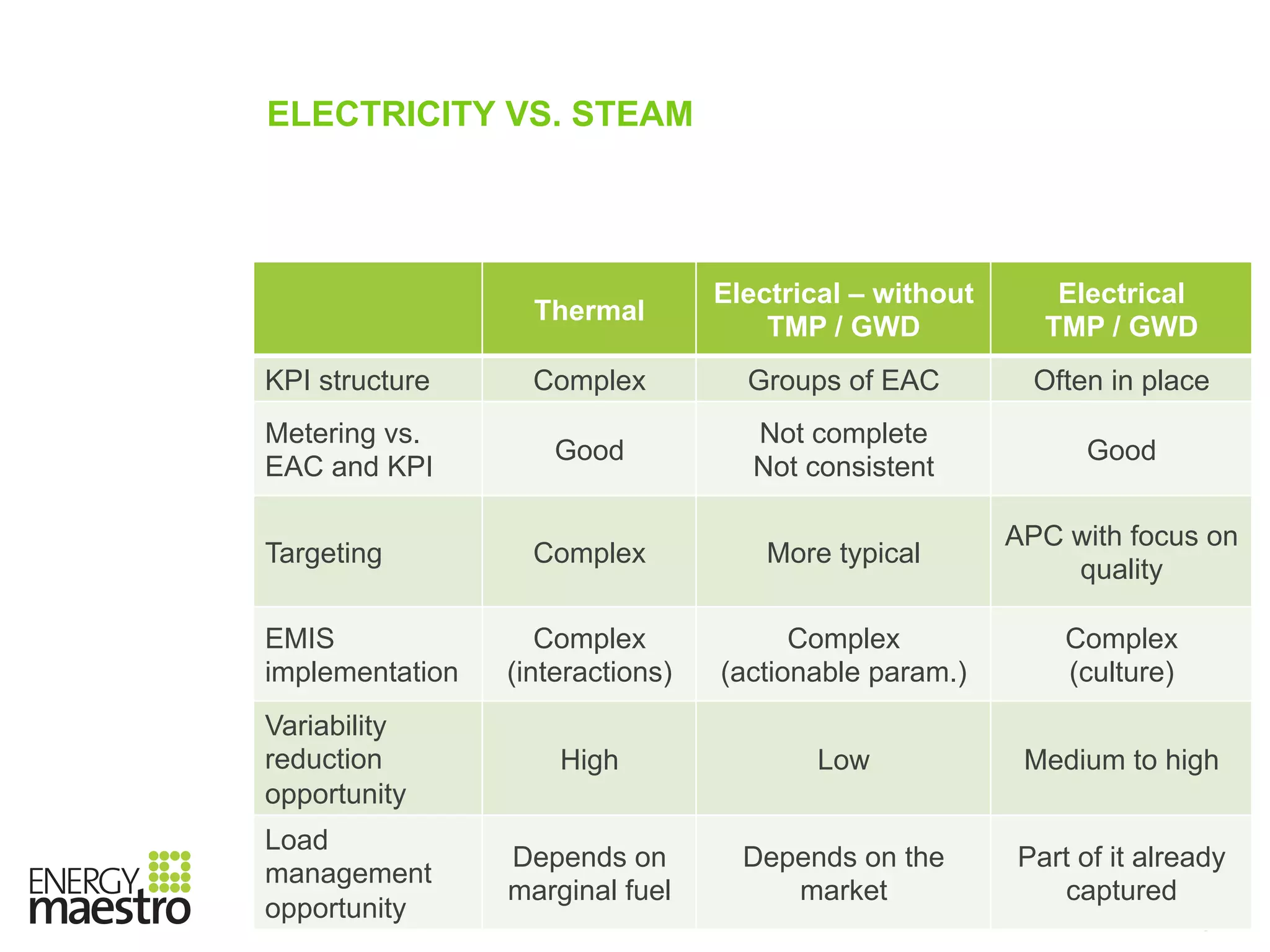
ELECTRICITY VS. STEAM
Thermal
Electrical – without
TMP / GWD
Electrical
TMP / GWD
KPI structure Complex Groups of EAC Often in place
Metering vs.
EAC and KPI
Good
Not complete
Not consistent
Good
Targeting Complex More typical
APC with focus on
quality
EMIS
implementation
Complex
(interactions)
Complex
(actionable param.)
Complex
(culture)
Variability
reduction
opportunity
High Low Medium to high
Load
management
opportunity
Depends on
marginal fuel
Depends on the
market
Part of it already
captured
Slide | 20
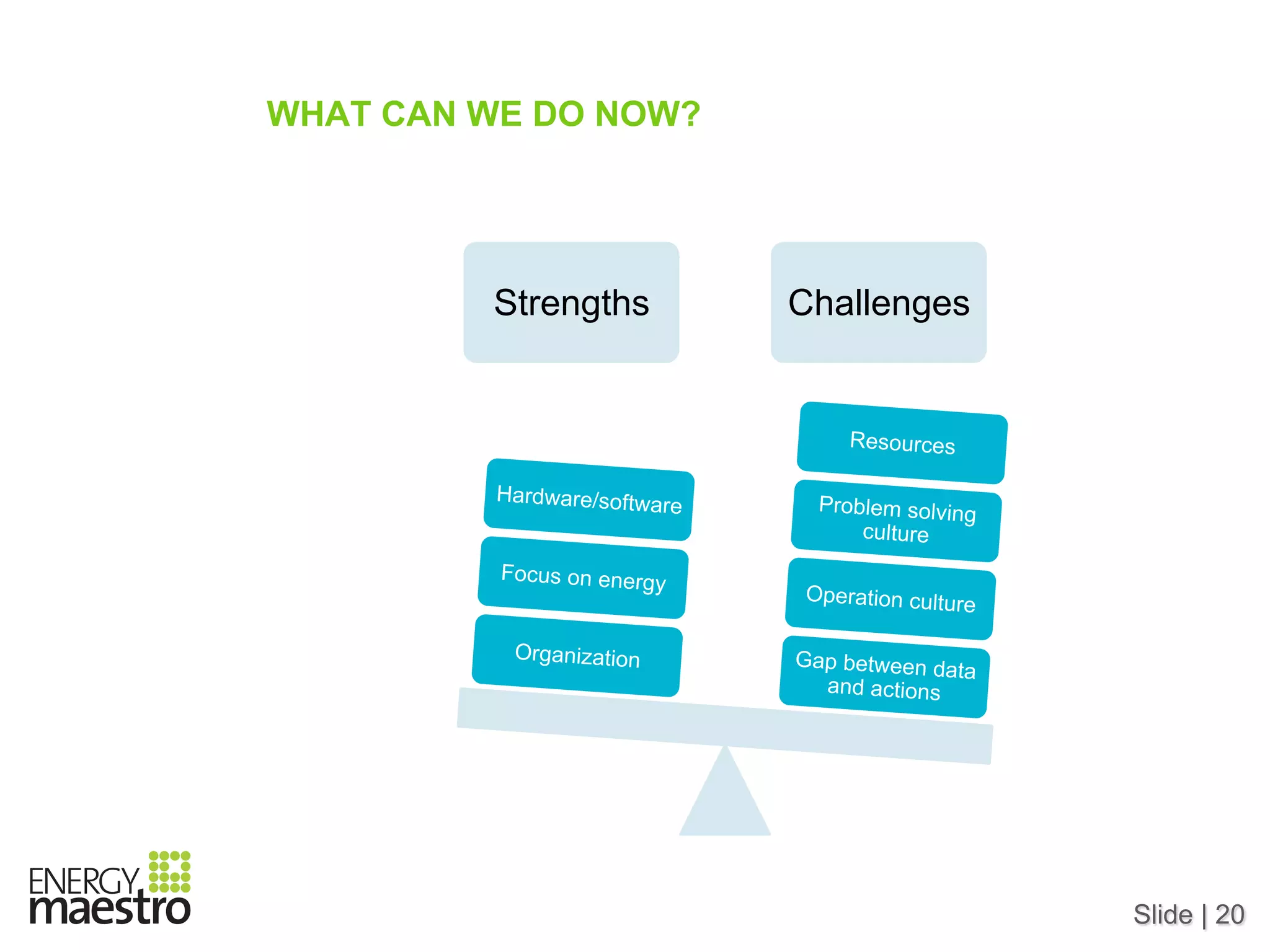
WHAT CAN WE DO NOW?
Strengths Challenges
Gap between data
and actions
Operation culture
Problem solving
culture
Resources
Organization
Focus on energy
Hardware/software
Slide | 21
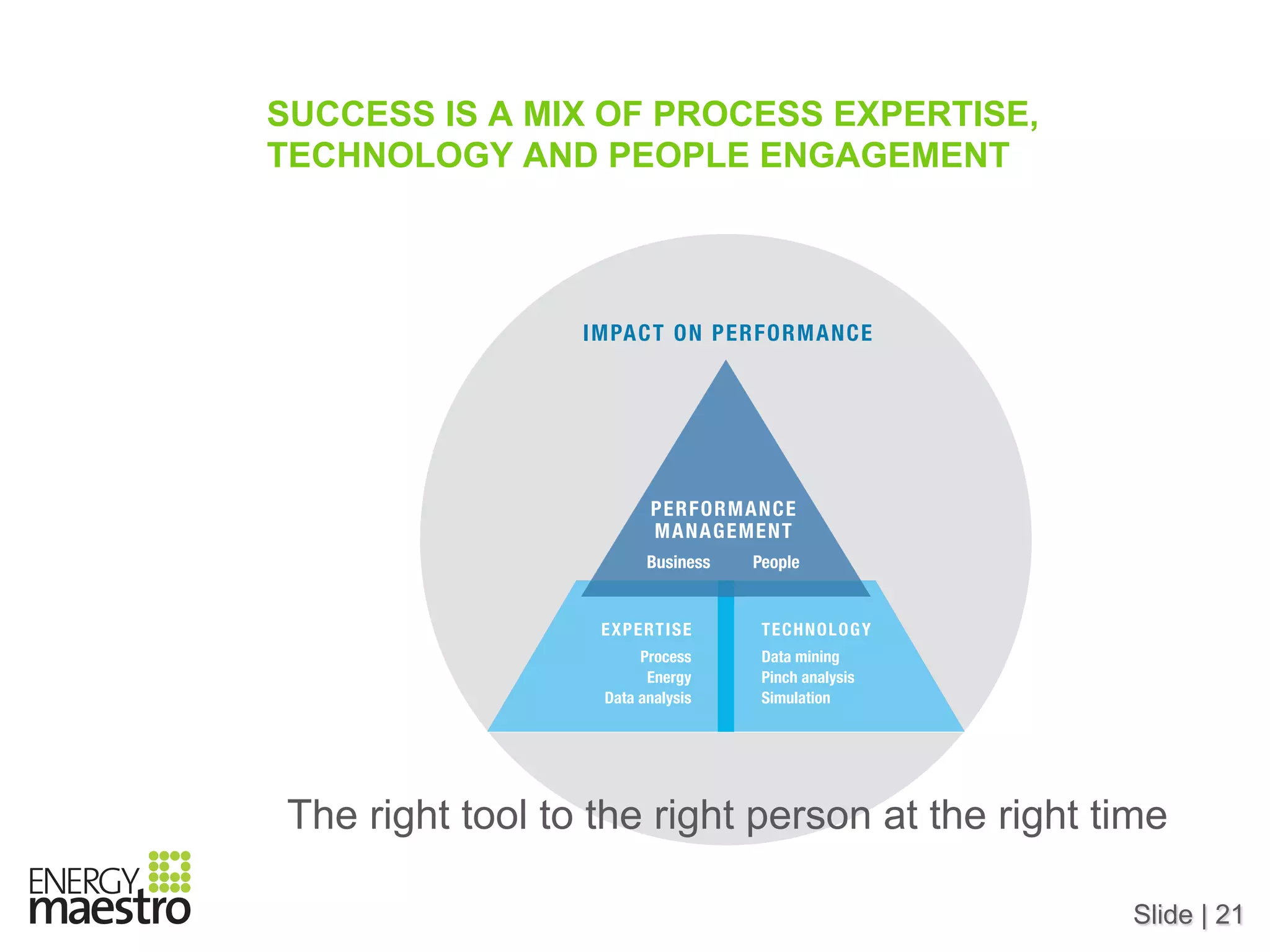
SUCCESS IS A MIX OF PROCESS EXPERTISE,
TECHNOLOGY AND PEOPLE ENGAGEMENT
The right tool to the right person at the right time
Slide | 22
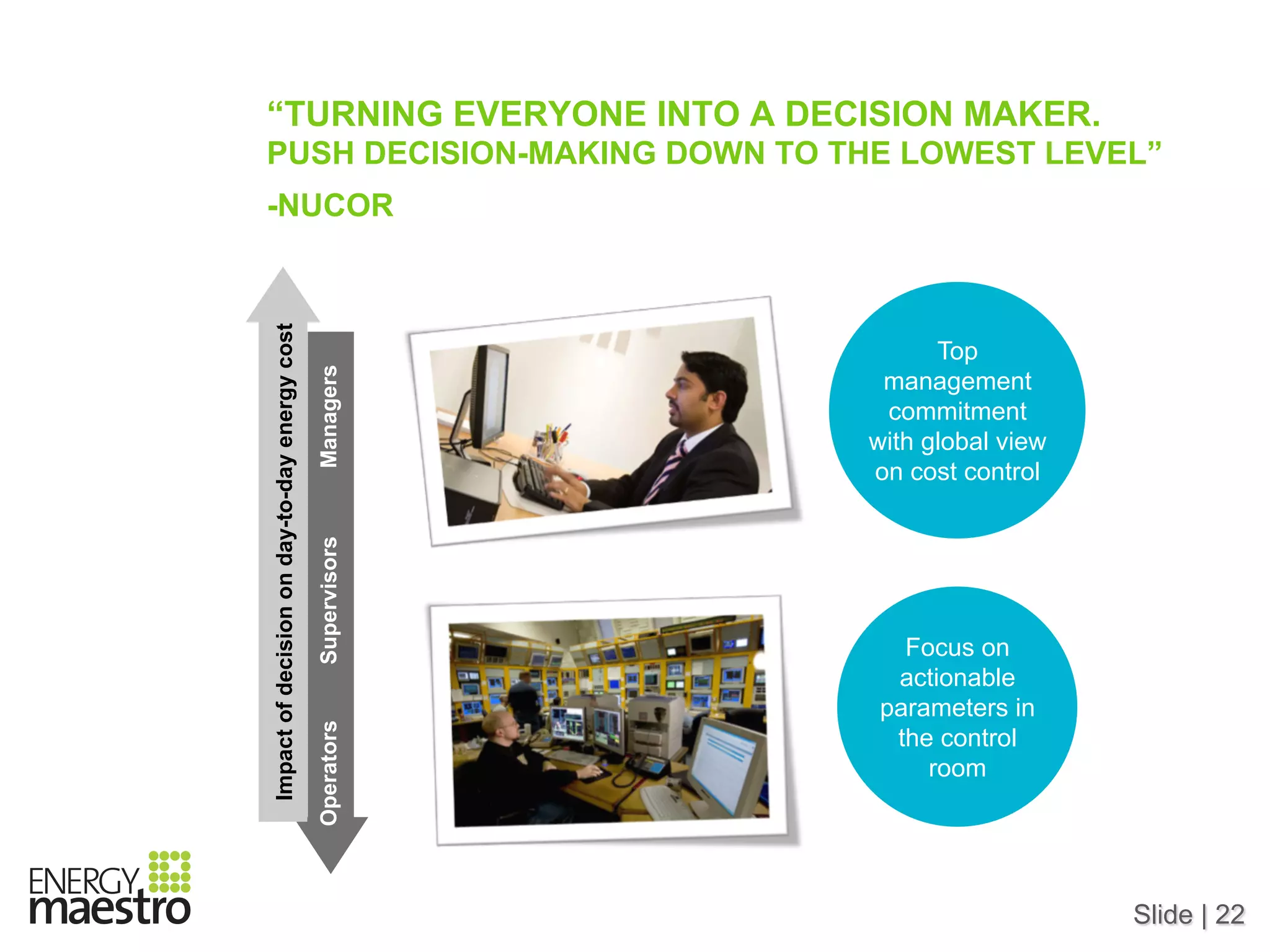
“TURNING EVERYONE INTO A DECISION MAKER.
PUSH DECISION-MAKING DOWN TO THE LOWEST LEVEL”
-NUCOR
OperatorsSupervisorsManagers
Impactofdecisiononday-to-dayenergycost
Top
management
commitment
with global view
on cost control
Focus on
actionable
parameters in
the control
room
Slide | 23
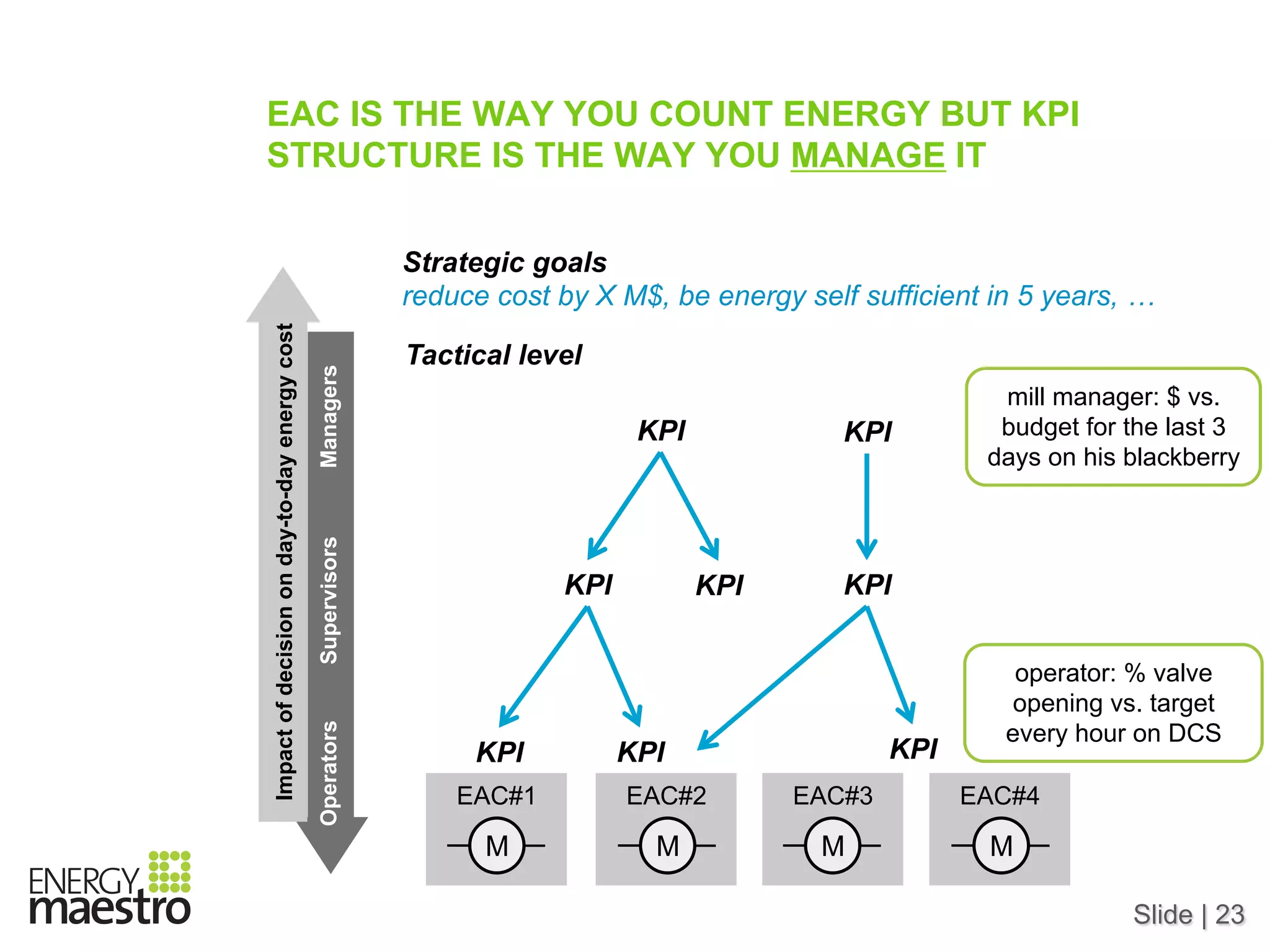
EAC IS THE WAY YOU COUNT ENERGY BUT KPI
STRUCTURE IS THE WAY YOU MANAGE IT
Strategic goals
reduce cost by X M$, be energy self sufficient in 5 years, …
EAC#2 EAC#3 EAC#4EAC#1
M M M M
KPI KPI
KPI KPI KPI
KPI
KPI KPI
Tactical level
OperatorsSupervisorsManagers
Impactofdecisiononday-to-dayenergycost
mill manager: $ vs.
budget for the last 3
days on his blackberry
operator: % valve
opening vs. target
every hour on DCS
Slide | 24
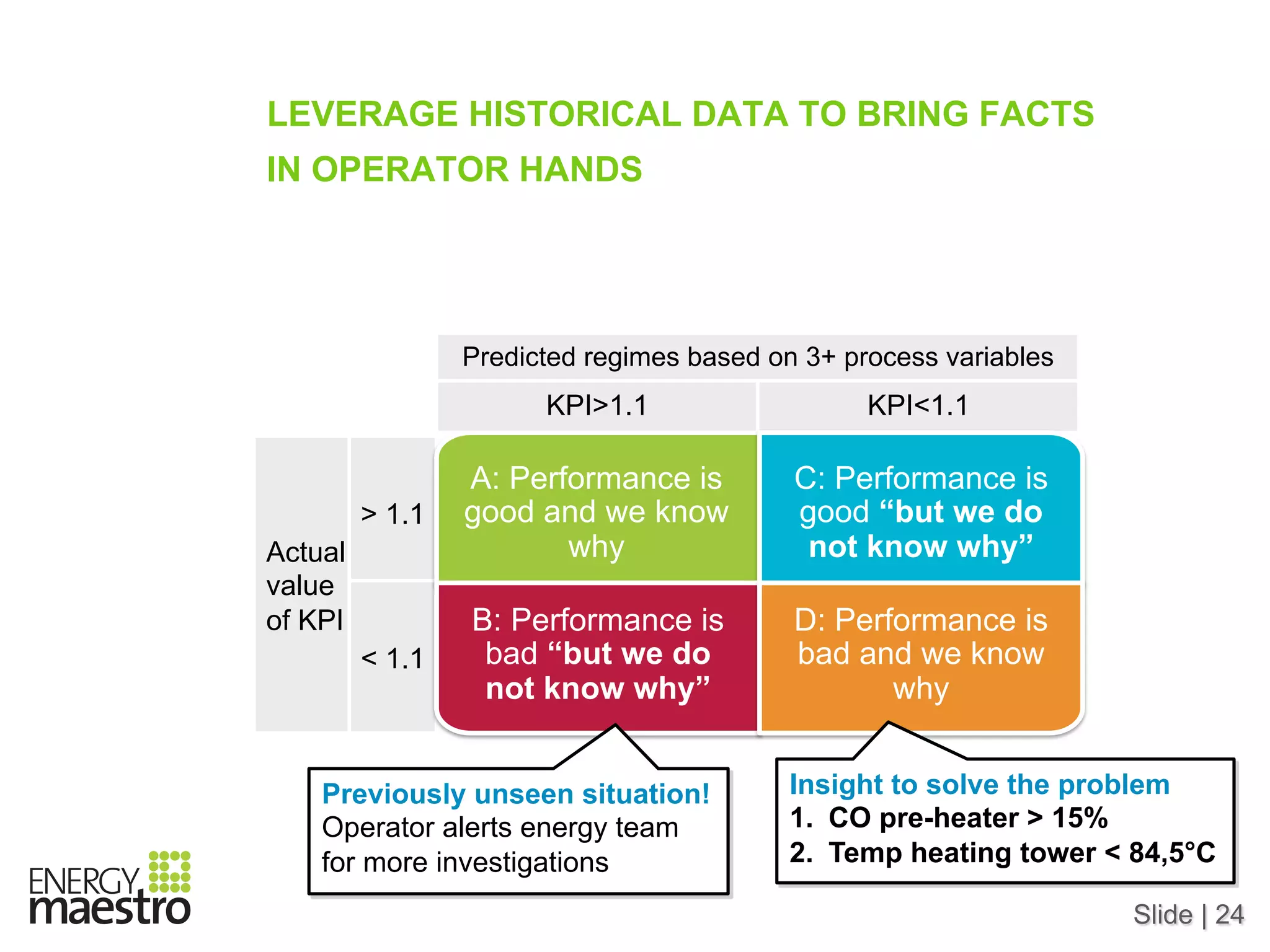
LEVERAGE HISTORICAL DATA TO BRING FACTS
IN OPERATOR HANDS
Actual
value
of KPI
Predicted regimes based on 3+ process variables
> 1.1
< 1.1
KPI>1.1 KPI<1.1
A: Performance is
good and we know
why
C: Performance is
good “but we do
not know why”
B: Performance is
bad “but we do
not know why”
D: Performance is
bad and we know
why
Insight to solve the problem
1.  CO pre-heater > 15%
2.  Temp heating tower < 84,5°C
Previously unseen situation!
Operator alerts energy team
for more investigations
Slide | 25
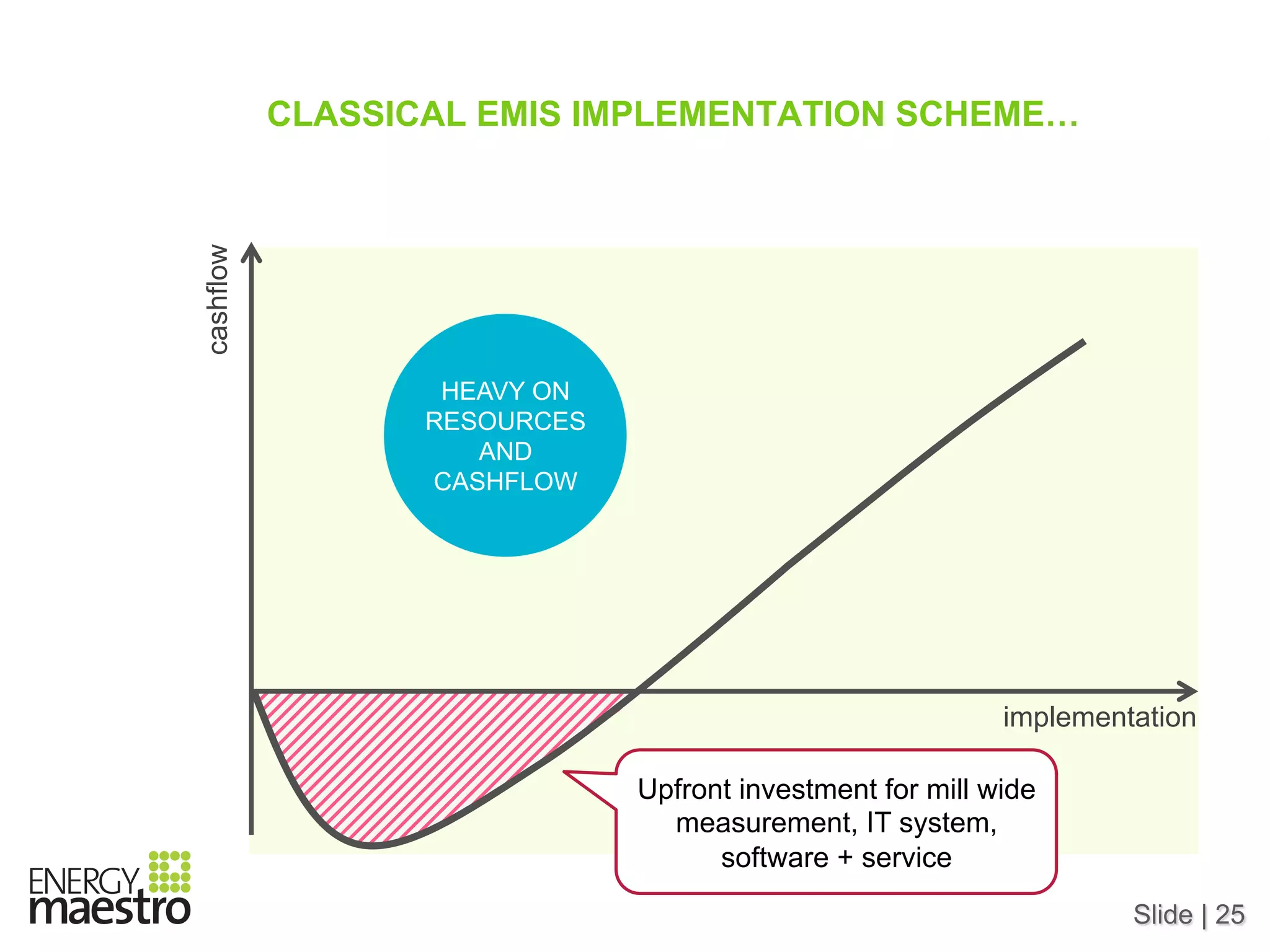
CLASSICAL EMIS IMPLEMENTATION SCHEME…
Upfront investment for mill wide
measurement, IT system,
software + service
cashflow
implementation
HEAVY ON
RESOURCES
AND
CASHFLOW
Slide | 26
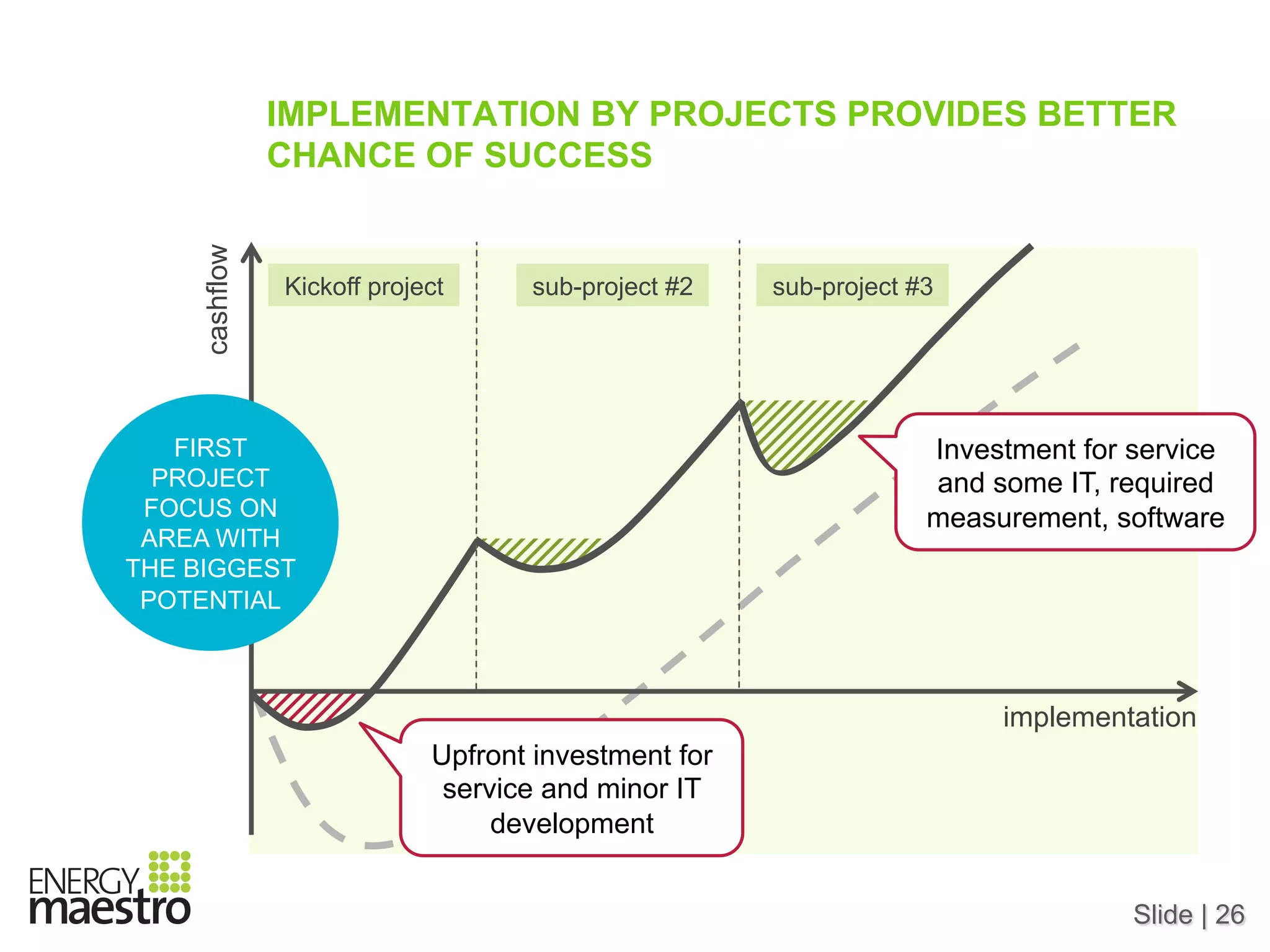
IMPLEMENTATION BY PROJECTS PROVIDES BETTER
CHANCE OF SUCCESS
cashflow
implementation
Upfront investment for
service and minor IT
development
FIRST
PROJECT
FOCUS ON
AREA WITH
THE BIGGEST
POTENTIAL
Investment for service
and some IT, required
measurement, software
Kickoff project sub-project #2 sub-project #3
Slide | 27
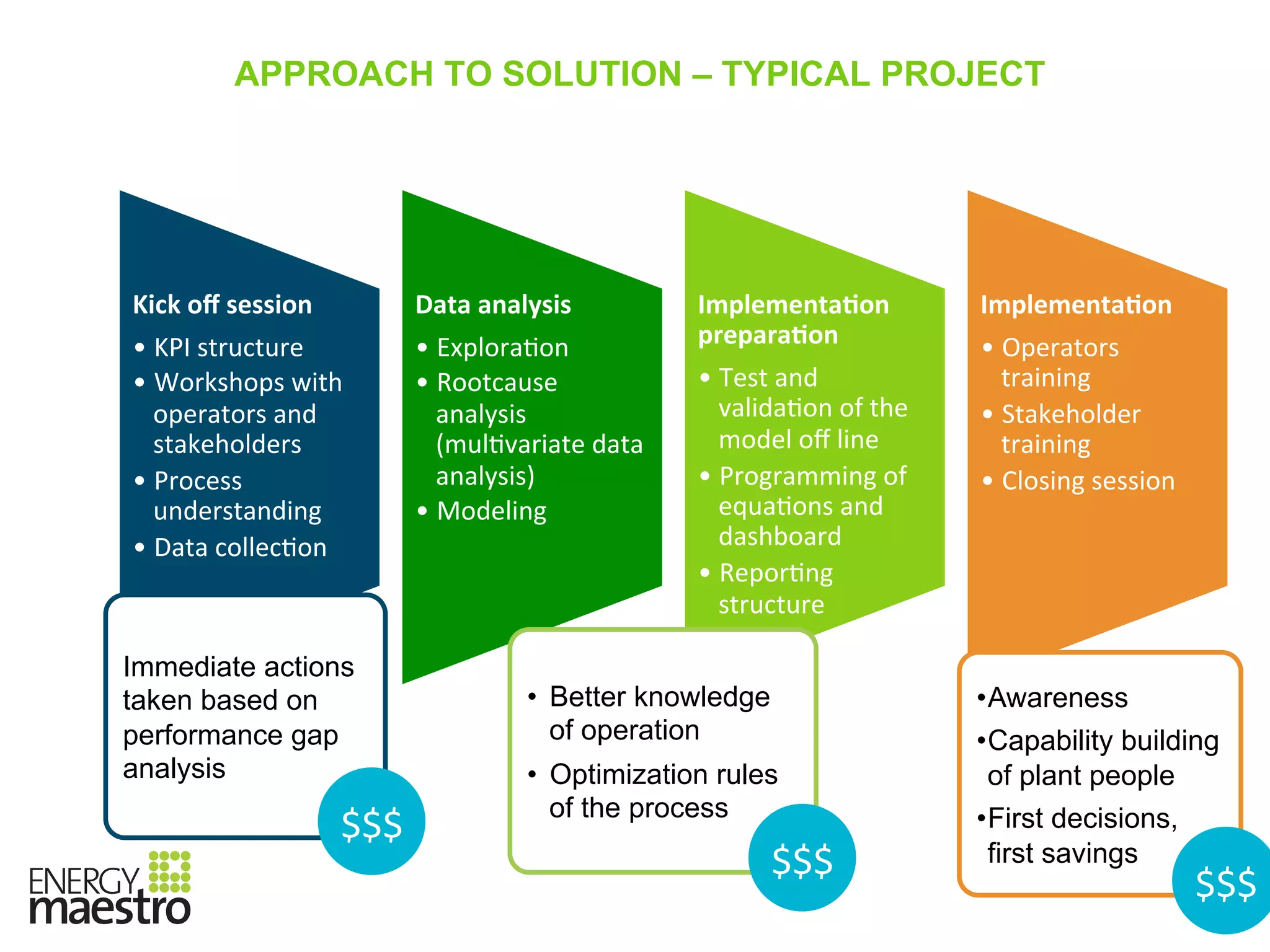
APPROACH TO SOLUTION – TYPICAL PROJECT
Kick	
  off	
  session	
  
• KPI	
  structure	
  
• Workshops	
  with	
  
operators	
  and	
  
stakeholders	
  
• Process	
  
understanding	
  
• Data	
  collec?on	
  
Data	
  analysis	
  
• Explora?on	
  
• Rootcause	
  
analysis	
  
(mul?variate	
  data	
  
analysis)	
  
• Modeling	
  
Implementa3on	
  
prepara3on	
  
• Test	
  and	
  
valida?on	
  of	
  the	
  
model	
  off	
  line	
  
• Programming	
  of	
  
equa?ons	
  and	
  
dashboard	
  
• Repor?ng	
  
structure	
  
Implementa3on	
  
• Operators	
  
training	
  
• Stakeholder	
  
training	
  
• Closing	
  session	
  
Immediate actions
taken based on
performance gap
analysis
• Awareness
• Capability building
of plant people
• First decisions,
first savings
•  Better knowledge
of operation
•  Optimization rules
of the process
$$$	
  
$$$	
  
$$$	
  
Slide | 28
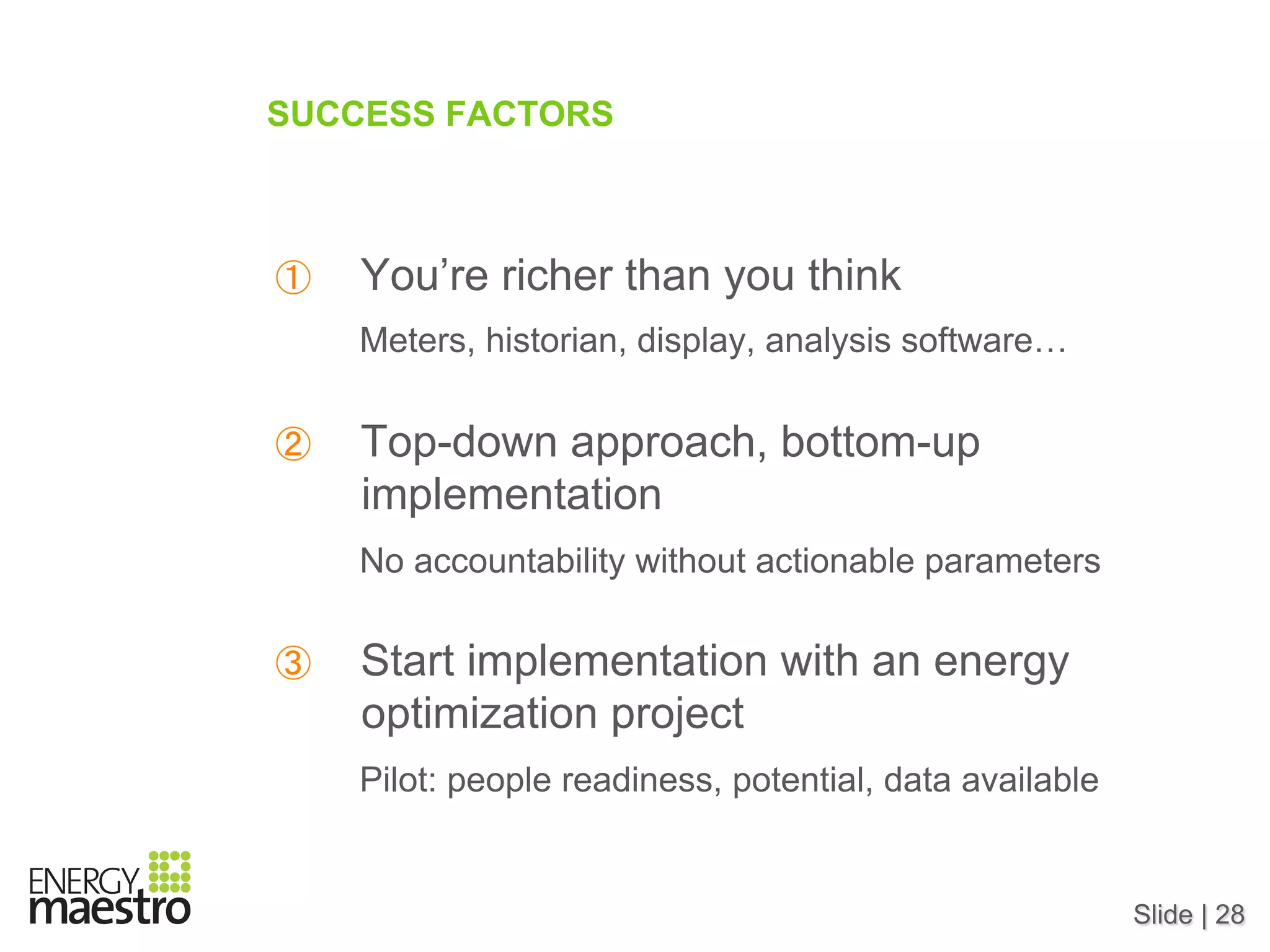
SUCCESS FACTORS
①  You’re richer than you think
Meters, historian, display, analysis software…
②  Top-down approach, bottom-up
implementation
No accountability without actionable parameters
③  Start implementation with an energy
optimization project
Pilot: people readiness, potential, data available
Slide | 29
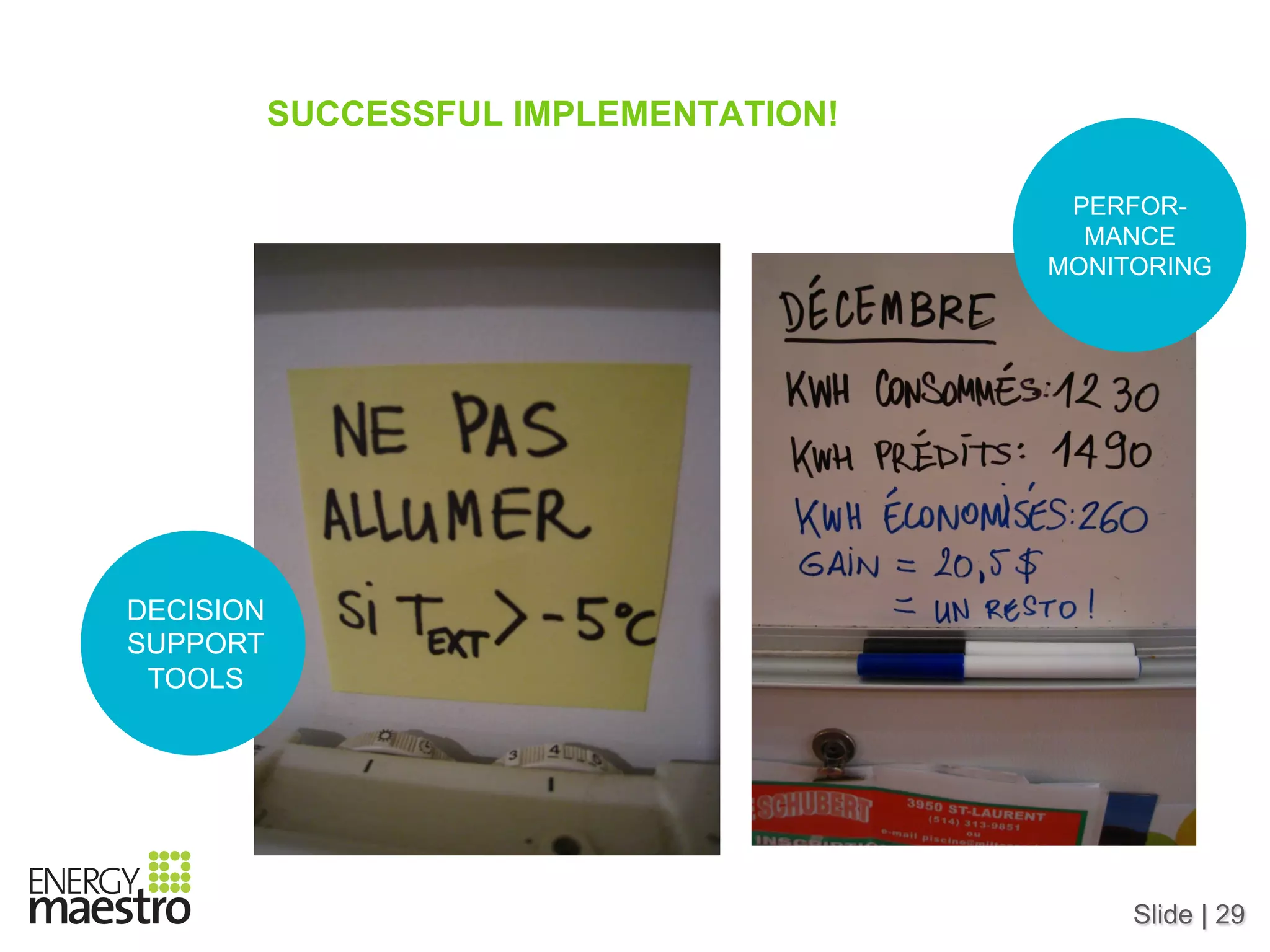
SUCCESSFUL IMPLEMENTATION!
DECISION
SUPPORT
TOOLS
PERFOR-
MANCE
MONITORING
Slide | 30
THANK YOU!
Visit: www.myenergymaestro.com
Sebastien Lafourcade – slafourcade@pepite.ca +1-5124-571-9118

Why don't you have an energy management system yet

  • 1.
  • 2.
    Slide | 2 “WALKTHE TALK”… … LET’S HAVE A LOOK AT MY EMIS AT HOME No needs for new insulation Good practice: reduce setpoint in Fall TOOLS TO TRACK MY ENERGY BILL
  • 3.
    Slide | 3 SUCCESSFACTORS ①  You’re richer than you think Meters, historian, display, analysis software… ②  Top-down approach, bottom-up implementation No accountability without actionable parameters ③  Start implementation with an energy optimization project Pilot: people readiness, potential, data available
  • 4.
    Slide | 4 WHYDON’T YOU HAVE AN ENERGY MANAGEMENT SYSTEM YET? and should you? Sebastien Lafourcade, Pepite Technologies
  • 5.
    Slide | 5 WHYAN ENERGY MANAGEMENT SYSTEM? “We have built a new biomass boiler” “We know what to do, we have a project list” “We are looking at energy everyday” What do you do to secure return on investment? What is your game plan to implement and sustain? Do you quickly take actions?
  • 6.
    Slide | 6 THE5 KEY DRIVERS FOR ENERGY PERFORMANCE Driver Best practice we have seen How do you ensure that recommendations are followed? Going to the rootcauses (identify all the drivers and their combinations) and addressing impacts on production and quality What tools do you use to analyze process data? Multivariate data analysis software How do you ensure that gains are sustained? Max of 3 KPI per level with dynamic target for smart monitoring How do you empower operators to sustain gains? Involvement of operators at every step of the problem solving and the data analysis How do you build people capability in the mills? Self assessment tool and automated troubleshooting tool
  • 7.
    Slide | 7 EXPERIENCEWITH EMIS IN PULP AND PAPER (OR MT&R, M&V, ISO50001…) + Several ongoing projects in N-A and Europe Energy  audit  in   20+  mills   with  focus  on  data   availability  &  quality,   monitoring  capability  and   performance  gap     Par?cipa?on  in   Energy  Blitz  at   15+  mills   with  significant  and   sustainable  cost   reduc?ons   2 EMIS implementation in mills with different situation, motivation, and culture High level monitoring models implemented in 5+ mills  
  • 8.
    Slide | 8 WHYSO LITTLE IMPLEMENTATION IN P&P? Strengths Challenges ?  
  • 9.
    Slide | 9 LET’SLOOK AT TYPICAL ENERGY MANAGEMENT SYSTEM GAP ANALYSIS
  • 10.
    Slide | 10 GAPANALYSIS REVEALS LOW LEVERAGE OF ABUNDANT DATA AND IT INFRASTRUCTURE
  • 11.
    Slide | 11 LOWCAPEX REQUIRED BECAUSE OF EXISTING INFRASTRUCTURE good level of metering $ S E G D historian DCS control room engineering management corporate PLC / server server link to real time external data high level of automation most of the mills have a data historian access to data and information data analysis software reporting system ✔ ✔ ✔ ✔ ✔ ✔✔
  • 12.
    Slide | 12 ENERGYIS ALREADY IN PEOPLE MINDS managers engineers supervisors operators Big cost monitored (ex TMP) Energy audits Energy projects Awareness campaign Eyes on benchmarks High level reporting Energy manager
  • 13.
    Slide | 13 MILLSHAVE GOOD ORGANIZATIONAL ASSETS Corporate task force Energy team/ manager Green belt programs Process knowledge Continuous improvement Operation challenges Capability building Performance management
  • 14.
    Slide | 14 P&P:GOOD ASSETS FOR EMIS IMPLEMENTATION Strengths Challenges Organization Eyes on energy Hardware/ software
  • 15.
    Slide | 15 COMPLEXPROCESS INTERACTIONS CREATE A GAP BETWEEN DATA AND ACTIONS •  Energy account centers •  EAC definition is easy… Effective EAC are challenging to define! •  Targeting •  Rootcauses of variability are difficult to identify •  Targeting can become very complex •  Simple regression with production is ineffective •  Baseload definition does not really make sense •  Actions – “So what?” •  Lack of targets and actionable parameters •  Risk of displacing energy use
  • 16.
    Slide | 16 WHO'SACCOUNTABLE FOR WARM WATER SYSTEM? PM1 shower water tank PM1 showersT Steam makeup Variability reduction can represent up to a $500,000/year savings L Fresh water PM1 condenser PM1 economizers Hot water tank Kraft mill hot water TMP water heater TMP cooling duties mill excess warm water PM2 economizers PM cooling duties PM effluent heat exchanger T
  • 17.
    Slide | 17 TYPICALTARGETING IS NOT PRACTICAL Predicting performance during start-ups or shutdowns is irrelevant Predicting “baseload” is irrelevant for continuous process This is the only area where we need performance equation
  • 18.
    Slide | 18 HUMANCHALLENGES FOR EMIS IMPLEMENTATION •  Focus on production •  Operations are production-oriented, not cost-focused •  Accountability for energy costs •  Problem solving culture •  Problem solving is based on opinions and experience rather than on facts •  Lack of targets and actionable parameters •  Resources •  Competition with other energy project for $ and people •  Lean - “Not another hat”
  • 19.
    Slide | 19 ELECTRICITYVS. STEAM Thermal Electrical – without TMP / GWD Electrical TMP / GWD KPI structure Complex Groups of EAC Often in place Metering vs. EAC and KPI Good Not complete Not consistent Good Targeting Complex More typical APC with focus on quality EMIS implementation Complex (interactions) Complex (actionable param.) Complex (culture) Variability reduction opportunity High Low Medium to high Load management opportunity Depends on marginal fuel Depends on the market Part of it already captured
  • 20.
    Slide | 20 WHATCAN WE DO NOW? Strengths Challenges Gap between data and actions Operation culture Problem solving culture Resources Organization Focus on energy Hardware/software
  • 21.
    Slide | 21 SUCCESSIS A MIX OF PROCESS EXPERTISE, TECHNOLOGY AND PEOPLE ENGAGEMENT The right tool to the right person at the right time
  • 22.
    Slide | 22 “TURNINGEVERYONE INTO A DECISION MAKER. PUSH DECISION-MAKING DOWN TO THE LOWEST LEVEL” -NUCOR OperatorsSupervisorsManagers Impactofdecisiononday-to-dayenergycost Top management commitment with global view on cost control Focus on actionable parameters in the control room
  • 23.
    Slide | 23 EACIS THE WAY YOU COUNT ENERGY BUT KPI STRUCTURE IS THE WAY YOU MANAGE IT Strategic goals reduce cost by X M$, be energy self sufficient in 5 years, … EAC#2 EAC#3 EAC#4EAC#1 M M M M KPI KPI KPI KPI KPI KPI KPI KPI Tactical level OperatorsSupervisorsManagers Impactofdecisiononday-to-dayenergycost mill manager: $ vs. budget for the last 3 days on his blackberry operator: % valve opening vs. target every hour on DCS
  • 24.
    Slide | 24 LEVERAGEHISTORICAL DATA TO BRING FACTS IN OPERATOR HANDS Actual value of KPI Predicted regimes based on 3+ process variables > 1.1 < 1.1 KPI>1.1 KPI<1.1 A: Performance is good and we know why C: Performance is good “but we do not know why” B: Performance is bad “but we do not know why” D: Performance is bad and we know why Insight to solve the problem 1.  CO pre-heater > 15% 2.  Temp heating tower < 84,5°C Previously unseen situation! Operator alerts energy team for more investigations
  • 25.
    Slide | 25 CLASSICALEMIS IMPLEMENTATION SCHEME… Upfront investment for mill wide measurement, IT system, software + service cashflow implementation HEAVY ON RESOURCES AND CASHFLOW
  • 26.
    Slide | 26 IMPLEMENTATIONBY PROJECTS PROVIDES BETTER CHANCE OF SUCCESS cashflow implementation Upfront investment for service and minor IT development FIRST PROJECT FOCUS ON AREA WITH THE BIGGEST POTENTIAL Investment for service and some IT, required measurement, software Kickoff project sub-project #2 sub-project #3
  • 27.
    Slide | 27 APPROACHTO SOLUTION – TYPICAL PROJECT Kick  off  session   • KPI  structure   • Workshops  with   operators  and   stakeholders   • Process   understanding   • Data  collec?on   Data  analysis   • Explora?on   • Rootcause   analysis   (mul?variate  data   analysis)   • Modeling   Implementa3on   prepara3on   • Test  and   valida?on  of  the   model  off  line   • Programming  of   equa?ons  and   dashboard   • Repor?ng   structure   Implementa3on   • Operators   training   • Stakeholder   training   • Closing  session   Immediate actions taken based on performance gap analysis • Awareness • Capability building of plant people • First decisions, first savings •  Better knowledge of operation •  Optimization rules of the process $$$   $$$   $$$  
  • 28.
    Slide | 28 SUCCESSFACTORS ①  You’re richer than you think Meters, historian, display, analysis software… ②  Top-down approach, bottom-up implementation No accountability without actionable parameters ③  Start implementation with an energy optimization project Pilot: people readiness, potential, data available
  • 29.
    Slide | 29 SUCCESSFULIMPLEMENTATION! DECISION SUPPORT TOOLS PERFOR- MANCE MONITORING
  • 30.
    Slide | 30 THANKYOU! Visit: www.myenergymaestro.com Sebastien Lafourcade – slafourcade@pepite.ca +1-5124-571-9118