WHY
COATINGS
FAIL
WHY COATINGS FAIL
73%
16%
5%
4% 2%
Poor Surface Preparation /
Insufficient Bond Profile -
73%
Excessive Moisture /
Containment
Transmission - 16%
Poor Installation
Contractor Error - 5%
Job Site Conditions - 4%
Unexplained or Untestable
Failures - 2%
Surface Prep is the most critical component of any
coating project, and when done properly, will increase
the probability of long-term bond and system integrity.
Things to consider when deciding prep method:
• Substrate condition
• How stable is the concrete?
• How clean in the concrete?
• Job Owner Requirements and Limitations
• i.e. noise, vibration, electrical needs, etc
• System or Products to be Installed
SURFACE PREPARATION
METHODS OF PREPARATION
METHOD DESCRIPTION PROs CONs
Shot-
Blasting
Roughens horizontal surfaces for the
application of sealers, coatings and
polymer overlays; also used to
remove some existing coatings and
adhesives
-Uniform profile
-Large projects complete quickly
-Virtually dustless
-Removes sealers and profiles
-Costly equipment
-Larger electrical need
-Can leave "corn rows"
Grinding
Using various types of stones and
composites, applied under pressure
to achieve the desired profile
-Equipment advances allows
options
-Equipment less costly
-Can usually run off limited power
-Can be very dusty
-Can produce uneven profile
-Less output than shot-
blaster
Scarifying
Used mostly for removal of existing
coatings and/or contaminated
substrates, rotary action of toothed
cutters leave a deep profile
-Deep profiling
-Flattens high spots
-Removes contamination
-Very aggressive profile
-Can cause micro-cracking
-Not easy to locate equipment
Less Common Methods…
1) Acid Etching
2) Hydro-blasting
3) Flame-blasting
4) Scabbling-Milling
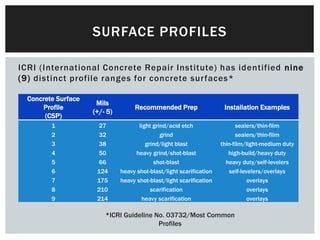
ICRI (International Concrete Repair Institute) has identified nine
(9) distinct profile ranges for concrete surfaces*
SURFACE PROFILES
Concrete Surface
Profile
(CSP)
Mils
(+/- 5)
Recommended Prep Installation Examples
1 27 light grind/acid etch sealers/thin-film
2 32 grind sealers/thin-film
3 38 grind/light blast thin-film/light-medium duty
4 50 heavy grind/shot-blast high-build/heavy duty
5 66 shot-blast heavy duty/self-levelers
6 124 heavy shot-blast/light scarification self-levelers/overlays
7 175 heavy shot-blast/light scarification overlays
8 210 scarification overlays
9 214 heavy scarification overlays
*ICRI Guideline No. 03732/Most Common
Profiles
WHY COATINGS FAIL
73%
16%
5% 4% 2%
Poor Surface Preparation /
Insufficient Bond Profile - 73%
Excessive Moisture /
Containment Transmission -
16%
Poor Installation Contractor
Error - 5%
Job Site Conditions - 4%
Unexplained or Untestable
Failures - 2%
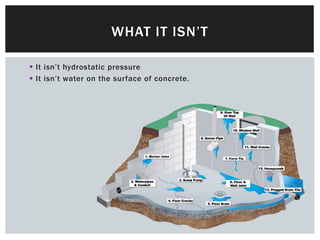
 It isn’t hydrostatic pressure
 It isn’t water on the surface of concrete.
WHAT IT ISN’T
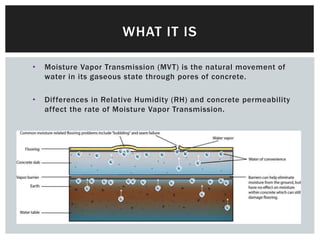
• Moisture Vapor Transmission (MVT) is the natural movement of
water in its gaseous state through pores of concrete.
• Differences in Relative Humidity (RH) and concrete permeability
affect the rate of Moisture Vapor Transmission.
WHAT IT IS
 Lack of a functioning subslab vapor barrier (greater than six-mil poly
and puncture resistant).
 Often concrete finishers use rebar to punch whole in the vapor retarder so
concrete will drain and can be finished faster.
 Use of high water to cement ratios in the concrete mix. Concrete
cures quickly but dries slowly.
 Sub-slab Soil moisture effected by High water tables, drainage,
irrigation, plumbing, trenching
 Moisture in blotter course placed in sand/rock by rain or for
compaction.
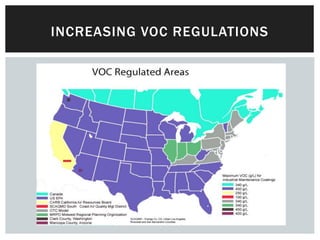
 Increasingly stringent VOC laws
WHAT CAUSES IT
INCREASING VOC REGULATIONS
 Highly Alkaline Moisture pools under non-breathable topcoats cause
bond failures.
WHAT ARE THE EFFECTS OF MVT?
MVT IN ACTION
How To Test For It
 Three ASTM Approved Tests
 Plastic Sheet Test (Qualitative)
 Calcium Chloride (Quantitative)
 RH Tester (moisture meter). (Quantitative)
HOW TO TEST FOR IT
HOW TO USE A WAGNER RH TEST
 When we talked to Donnelly the leading expert on MVT he listed three
things:
 As an industry professional it is your responsibility to inform and educate
customers on the possibility of MVT and its effects.
 Offer to test for MVT
 If you test do the test correctly!
WHAT IS MY RESPONSIBILITY
 Epoxies?
 Proper Prep
 Permaflex
HOW TO FIX IT
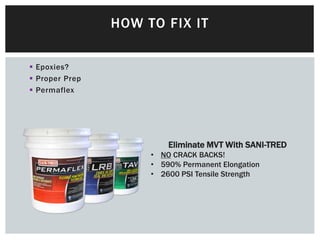
Eliminate MVT With SANI-TRED
• NO CRACK BACKS!
• 590% Permanent Elongation
• 2600 PSI Tensile Strength
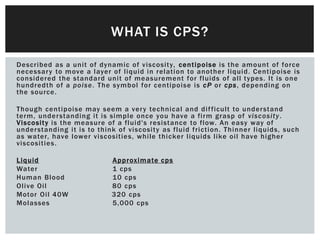
Described as a unit of dynamic of viscosity, centipoise is the amount of force
necessary to move a layer of liquid in relation to another liquid. Centipoise is
considered the standard unit of measurement for fluids of all types. It is one
hundredth of a poise. The symbol for centipoise is cP or cps, depending on
the source.
Though centipoise may seem a very technical and difficult to understand
term, understanding it is simple once you have a firm grasp of viscosity.
Viscosity is the measure of a fluid's resistance to flow. An easy way of
understanding it is to think of viscosity as fluid friction. Thinner liquids, such
as water, have lower viscosities, while thicker liquids like oil have higher
viscosities.
Liquid Approximate cps
Water 1 cps
Human Blood 10 cps
Olive Oil 80 cps
Motor Oil 40W 320 cps
Molasses 5,000 cps
WHAT IS CPS?

Why Concrete Coatings Fail

  • 1.
  • 2.
    WHY COATINGS FAIL 73% 16% 5% 4%2% Poor Surface Preparation / Insufficient Bond Profile - 73% Excessive Moisture / Containment Transmission - 16% Poor Installation Contractor Error - 5% Job Site Conditions - 4% Unexplained or Untestable Failures - 2%
  • 3.
    Surface Prep isthe most critical component of any coating project, and when done properly, will increase the probability of long-term bond and system integrity. Things to consider when deciding prep method: • Substrate condition • How stable is the concrete? • How clean in the concrete? • Job Owner Requirements and Limitations • i.e. noise, vibration, electrical needs, etc • System or Products to be Installed SURFACE PREPARATION
  • 4.
    METHODS OF PREPARATION METHODDESCRIPTION PROs CONs Shot- Blasting Roughens horizontal surfaces for the application of sealers, coatings and polymer overlays; also used to remove some existing coatings and adhesives -Uniform profile -Large projects complete quickly -Virtually dustless -Removes sealers and profiles -Costly equipment -Larger electrical need -Can leave "corn rows" Grinding Using various types of stones and composites, applied under pressure to achieve the desired profile -Equipment advances allows options -Equipment less costly -Can usually run off limited power -Can be very dusty -Can produce uneven profile -Less output than shot- blaster Scarifying Used mostly for removal of existing coatings and/or contaminated substrates, rotary action of toothed cutters leave a deep profile -Deep profiling -Flattens high spots -Removes contamination -Very aggressive profile -Can cause micro-cracking -Not easy to locate equipment Less Common Methods… 1) Acid Etching 2) Hydro-blasting 3) Flame-blasting 4) Scabbling-Milling
  • 5.
    ICRI (International ConcreteRepair Institute) has identified nine (9) distinct profile ranges for concrete surfaces* SURFACE PROFILES Concrete Surface Profile (CSP) Mils (+/- 5) Recommended Prep Installation Examples 1 27 light grind/acid etch sealers/thin-film 2 32 grind sealers/thin-film 3 38 grind/light blast thin-film/light-medium duty 4 50 heavy grind/shot-blast high-build/heavy duty 5 66 shot-blast heavy duty/self-levelers 6 124 heavy shot-blast/light scarification self-levelers/overlays 7 175 heavy shot-blast/light scarification overlays 8 210 scarification overlays 9 214 heavy scarification overlays *ICRI Guideline No. 03732/Most Common Profiles
  • 6.
    WHY COATINGS FAIL 73% 16% 5%4% 2% Poor Surface Preparation / Insufficient Bond Profile - 73% Excessive Moisture / Containment Transmission - 16% Poor Installation Contractor Error - 5% Job Site Conditions - 4% Unexplained or Untestable Failures - 2%
  • 7.
     It isn’thydrostatic pressure  It isn’t water on the surface of concrete. WHAT IT ISN’T
  • 8.
    • Moisture VaporTransmission (MVT) is the natural movement of water in its gaseous state through pores of concrete. • Differences in Relative Humidity (RH) and concrete permeability affect the rate of Moisture Vapor Transmission. WHAT IT IS
  • 9.
     Lack ofa functioning subslab vapor barrier (greater than six-mil poly and puncture resistant).  Often concrete finishers use rebar to punch whole in the vapor retarder so concrete will drain and can be finished faster.  Use of high water to cement ratios in the concrete mix. Concrete cures quickly but dries slowly.  Sub-slab Soil moisture effected by High water tables, drainage, irrigation, plumbing, trenching  Moisture in blotter course placed in sand/rock by rain or for compaction.  Increasingly stringent VOC laws WHAT CAUSES IT
  • 10.
  • 11.
     Highly AlkalineMoisture pools under non-breathable topcoats cause bond failures. WHAT ARE THE EFFECTS OF MVT?
  • 12.
  • 13.
    How To TestFor It  Three ASTM Approved Tests  Plastic Sheet Test (Qualitative)  Calcium Chloride (Quantitative)  RH Tester (moisture meter). (Quantitative) HOW TO TEST FOR IT
  • 14.
    HOW TO USEA WAGNER RH TEST
  • 15.
     When wetalked to Donnelly the leading expert on MVT he listed three things:  As an industry professional it is your responsibility to inform and educate customers on the possibility of MVT and its effects.  Offer to test for MVT  If you test do the test correctly! WHAT IS MY RESPONSIBILITY
  • 16.
     Epoxies?  ProperPrep  Permaflex HOW TO FIX IT Eliminate MVT With SANI-TRED • NO CRACK BACKS! • 590% Permanent Elongation • 2600 PSI Tensile Strength
  • 17.
    Described as aunit of dynamic of viscosity, centipoise is the amount of force necessary to move a layer of liquid in relation to another liquid. Centipoise is considered the standard unit of measurement for fluids of all types. It is one hundredth of a poise. The symbol for centipoise is cP or cps, depending on the source. Though centipoise may seem a very technical and difficult to understand term, understanding it is simple once you have a firm grasp of viscosity. Viscosity is the measure of a fluid's resistance to flow. An easy way of understanding it is to think of viscosity as fluid friction. Thinner liquids, such as water, have lower viscosities, while thicker liquids like oil have higher viscosities. Liquid Approximate cps Water 1 cps Human Blood 10 cps Olive Oil 80 cps Motor Oil 40W 320 cps Molasses 5,000 cps WHAT IS CPS?