Wenceslao Alfageme
WHY AGILE?
WHAT TO CONSIDER: OVERVIEW, BENEFITS, DISADVANTAGES
Wenceslao Alfageme
FOREWORD
The intention of this presentation is to give a very quick overview of what the agile
methodologies entail and what the impact of a transformation to agile could have on
an organisation.


It does not:


A. Intend to train the reader in any of the agile methodologies


B. Teach agile methodologies


C. Impose a view of which approach (waterfall or agile) is better suited
2
Wenceslao Alfageme
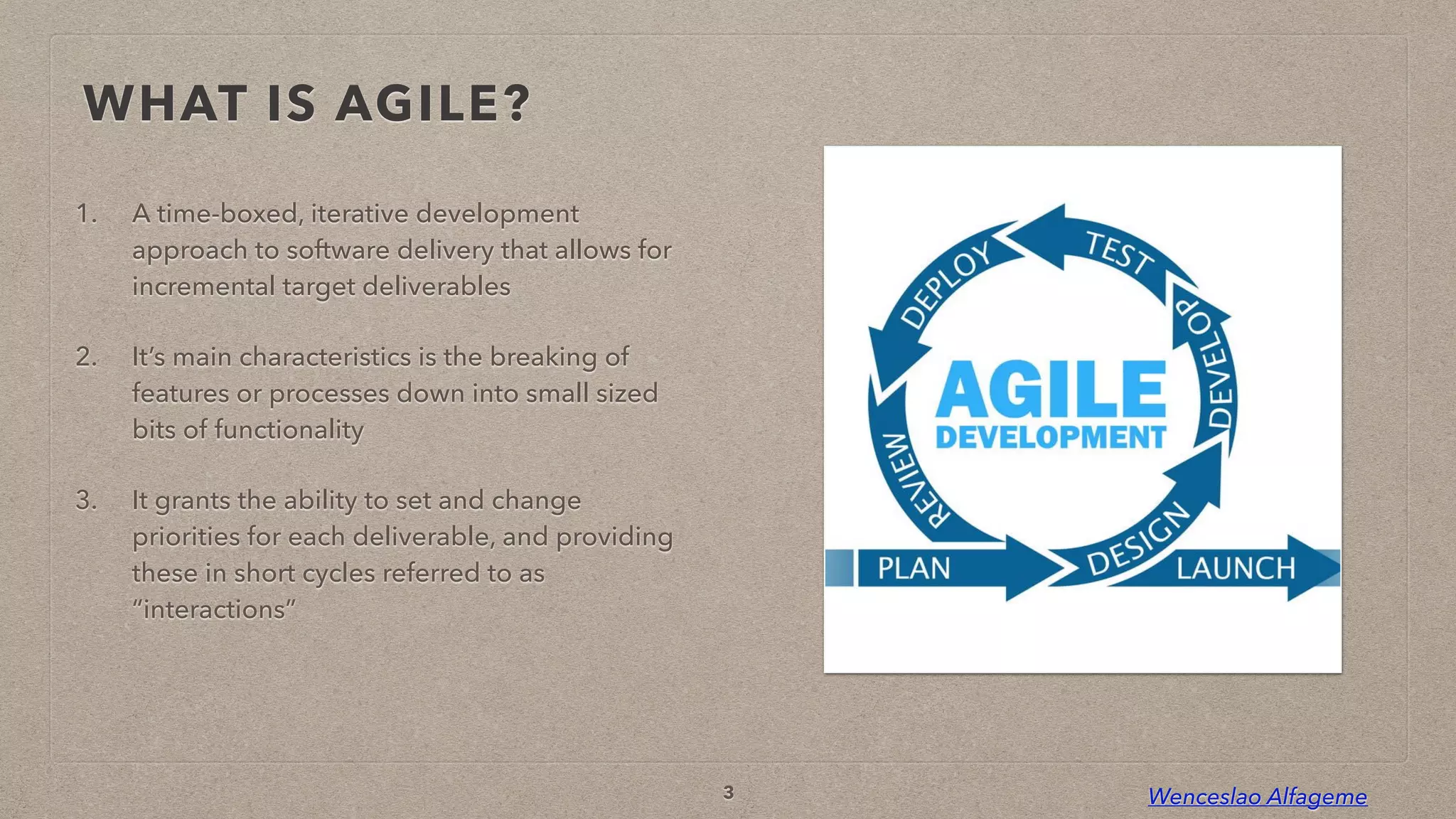
WHAT IS AGILE?
1. A time-boxed, iterative development
approach to software delivery that allows for
incremental target deliverables


2. It’s main characteristics is the breaking of
features or processes down into small sized
bits of functionality


3. It grants the ability to set and change
priorities for each deliverable, and providing
these in short cycles referred to as
“interactions”
3
Wenceslao Alfageme
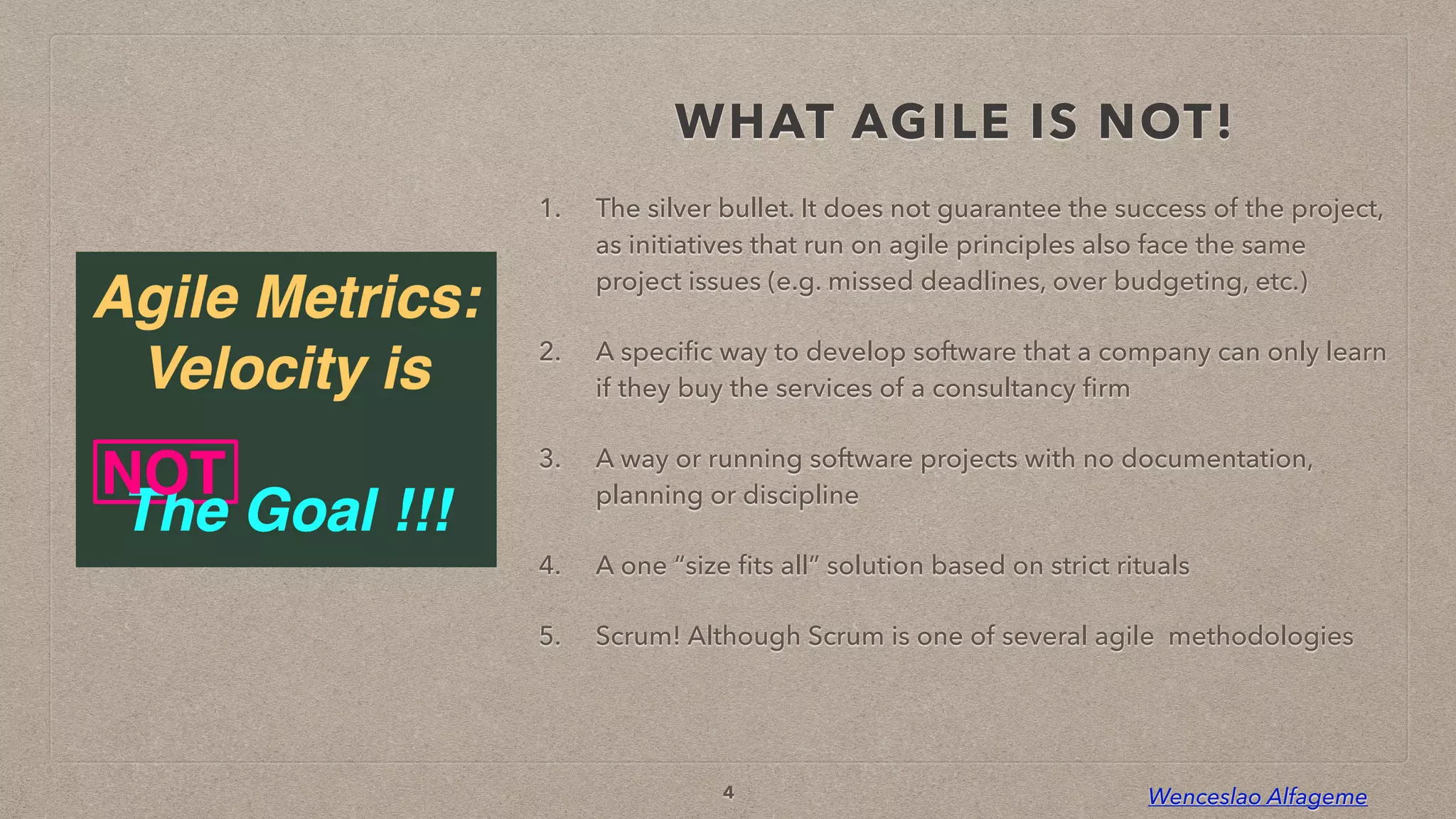
WHAT AGILE IS NOT!
1. The silver bullet. It does not guarantee the success of the project,
as initiatives that run on agile principles also face the same
project issues (e.g. missed deadlines, over budgeting, etc.)


2. A speci
fi
c way to develop software that a company can only learn
if they buy the services of a consultancy
fi
rm


3. A way or running software projects with no documentation,
planning or discipline


4. A one “size
fi
ts all” solution based on strict rituals


5. Scrum! Although Scrum is one of several agile methodologies
4
Wenceslao Alfageme
AGILE & WATERFALL PROJECT ENVIRONMENT
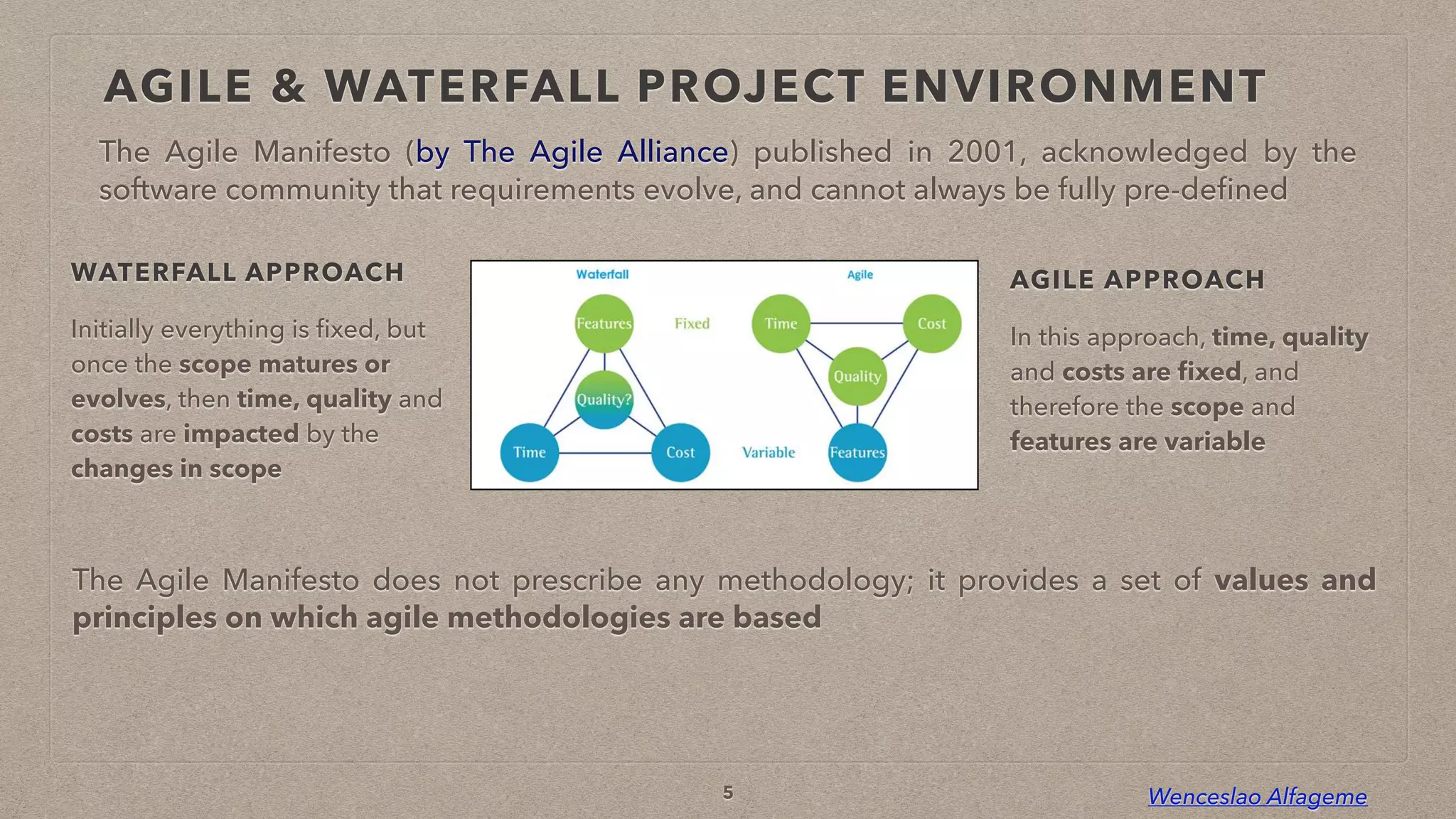
The Agile Manifesto (by The Agile Alliance) published in 2001, acknowledged by the
software community that requirements evolve, and cannot always be fully pre-de
fi
ned
WATERFALL APPROACH


Initially everything is
fi
xed, but
once the scope matures or
evolves, then time, quality and
costs are impacted by the
changes in scope
AGILE APPROACH


In this approach, time, quality
and costs are
fi
xed, and
therefore the scope and
features are variable
The Agile Manifesto does not prescribe any methodology; it provides a set of values and
principles on which agile methodologies are based


5
Wenceslao Alfageme
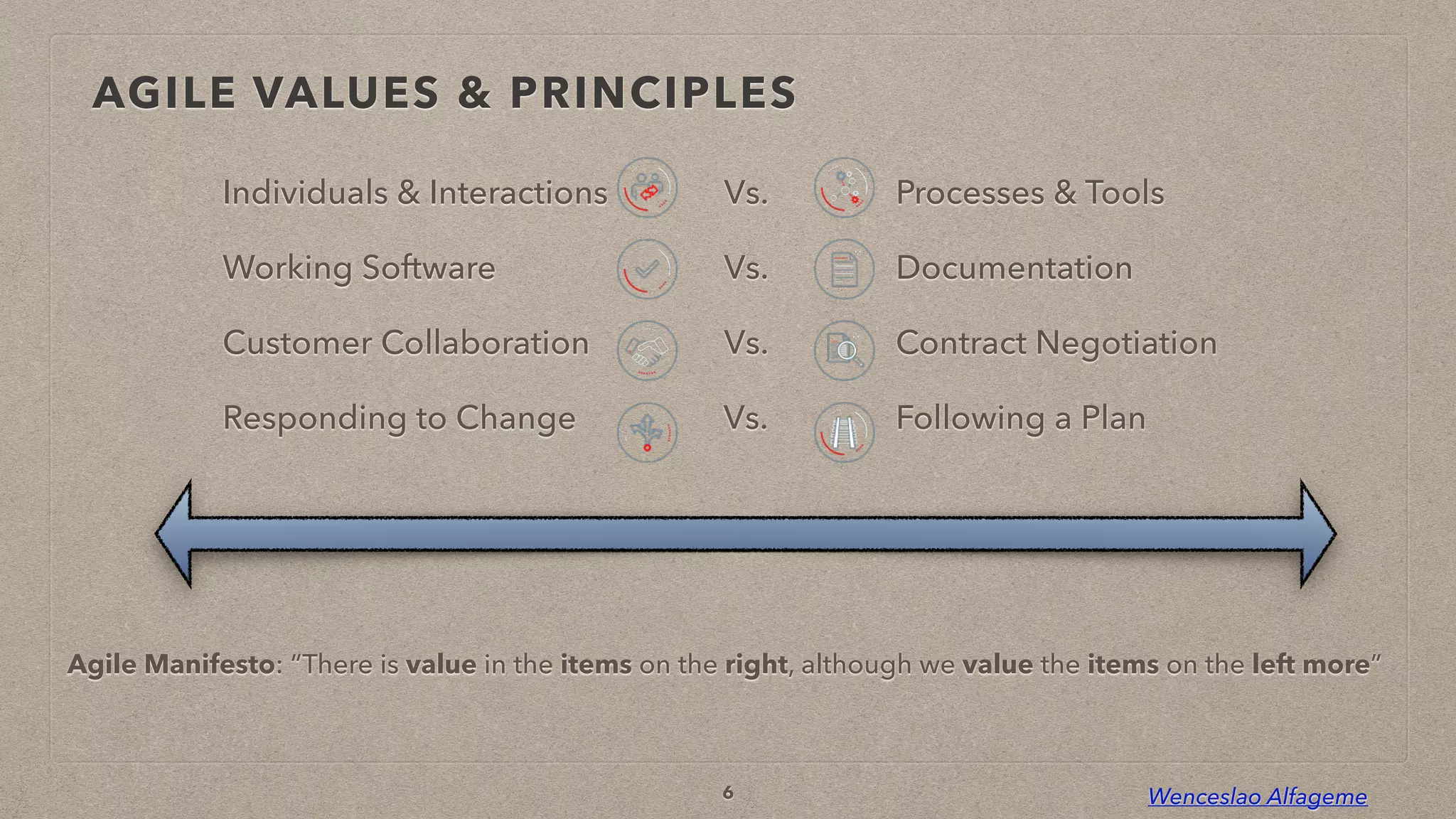
AGILE VALUES & PRINCIPLES
Individuals & Interactions


Working Software


Customer Collaboration


Responding to Change
Processes & Tools


Documentation


Contract Negotiation


Following a Plan
Vs.


Vs.


Vs.


Vs.
Agile Manifesto: “There is value in the items on the right, although we value the items on the left more”
6
Wenceslao Alfageme
THE ECONOMIC CASE FOR AGILE SOFTWARE DEVELOPMENT
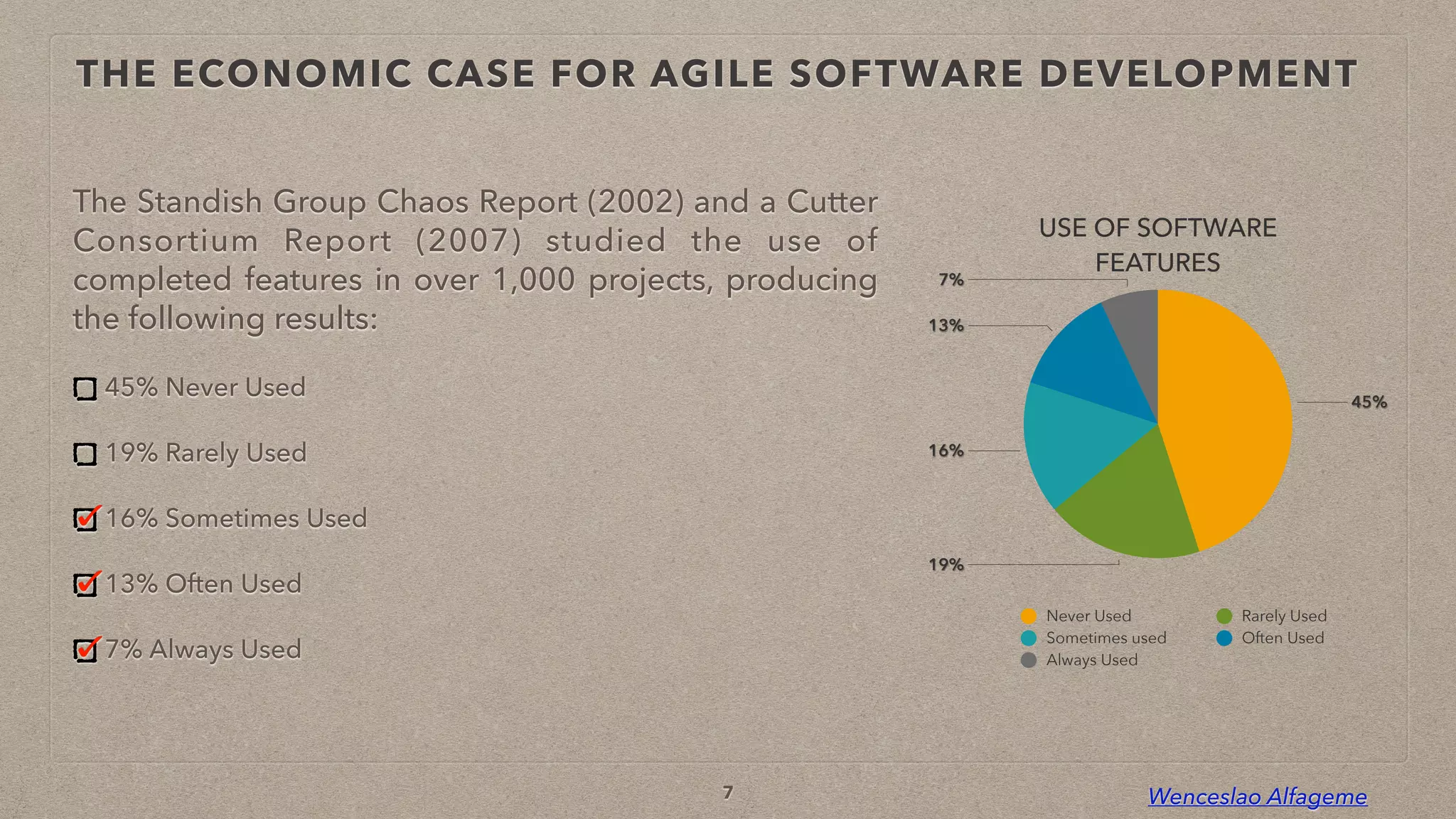
The Standish Group Chaos Report (2002) and a Cutter
Consortium Report (2007) studied the use of
completed features in over 1,000 projects, producing
the following results:


45% Never Used


19% Rarely Used


16% Sometimes Used


13% Often Used


7% Always Used
USE OF SOFTWARE
FEATURES
7%
13%
16%
19%
45%
Never Used Rarely Used
Sometimes used Often Used
Always Used
7
Wenceslao Alfageme
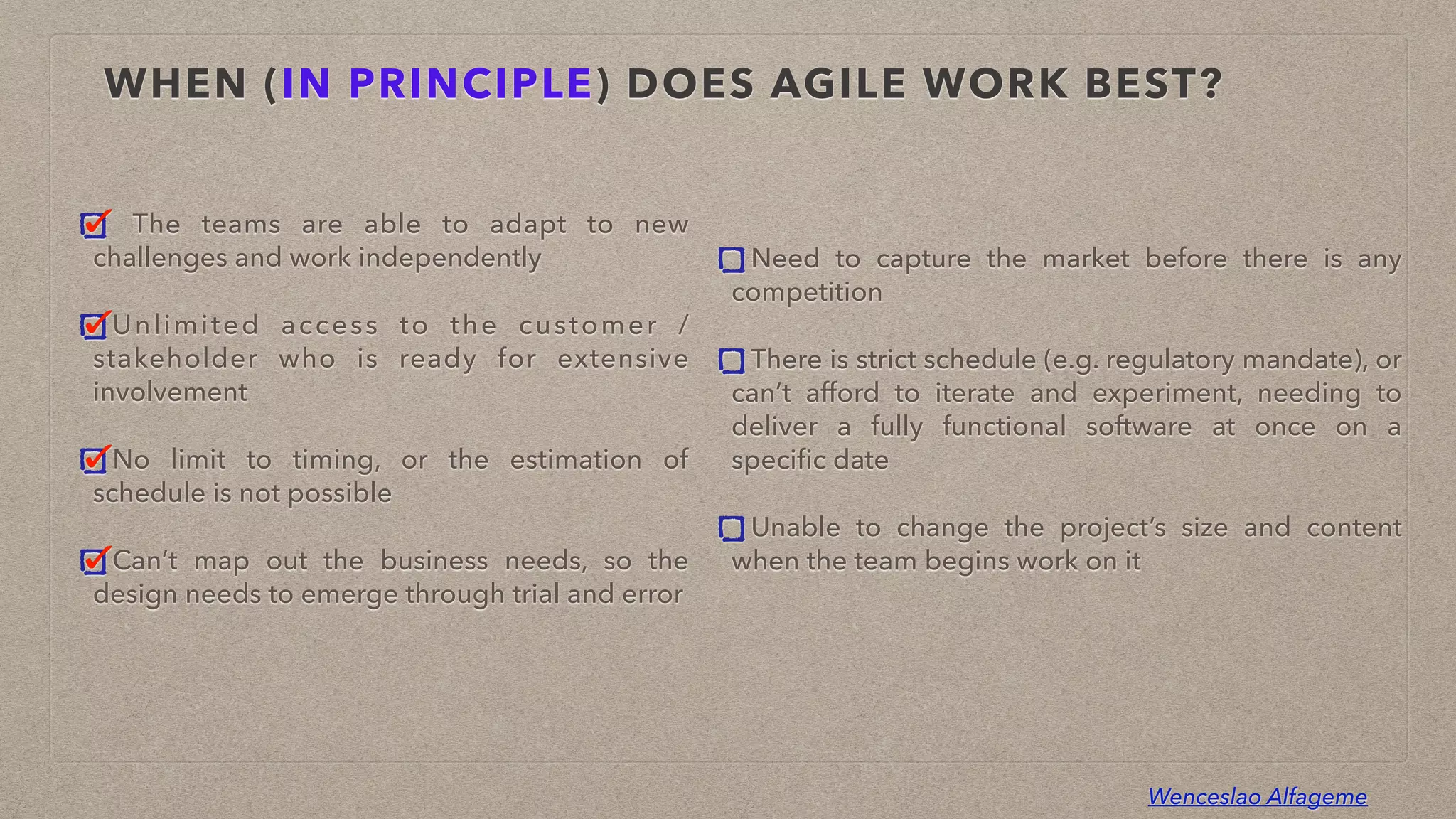
WHEN (IN PRINCIPLE) DOES AGILE WORK BEST?
The teams are able to adapt to new
challenges and work independently


Unlimited access to the customer /
stakeholder who is ready for extensive
involvement


No limit to timing, or the estimation of
schedule is not possible


Can’t map out the business needs, so the
design needs to emerge through trial and error
Need to capture the market before there is any
competition


There is strict schedule (e.g. regulatory mandate), or
can’t afford to iterate and experiment, needing to
deliver a fully functional software at once on a
speci
fi
c date


Unable to change the project’s size and content
when the team begins work on it
Wenceslao Alfageme
AGILE DEVELOPMENT: BENEFITS & DISADVANTAGES
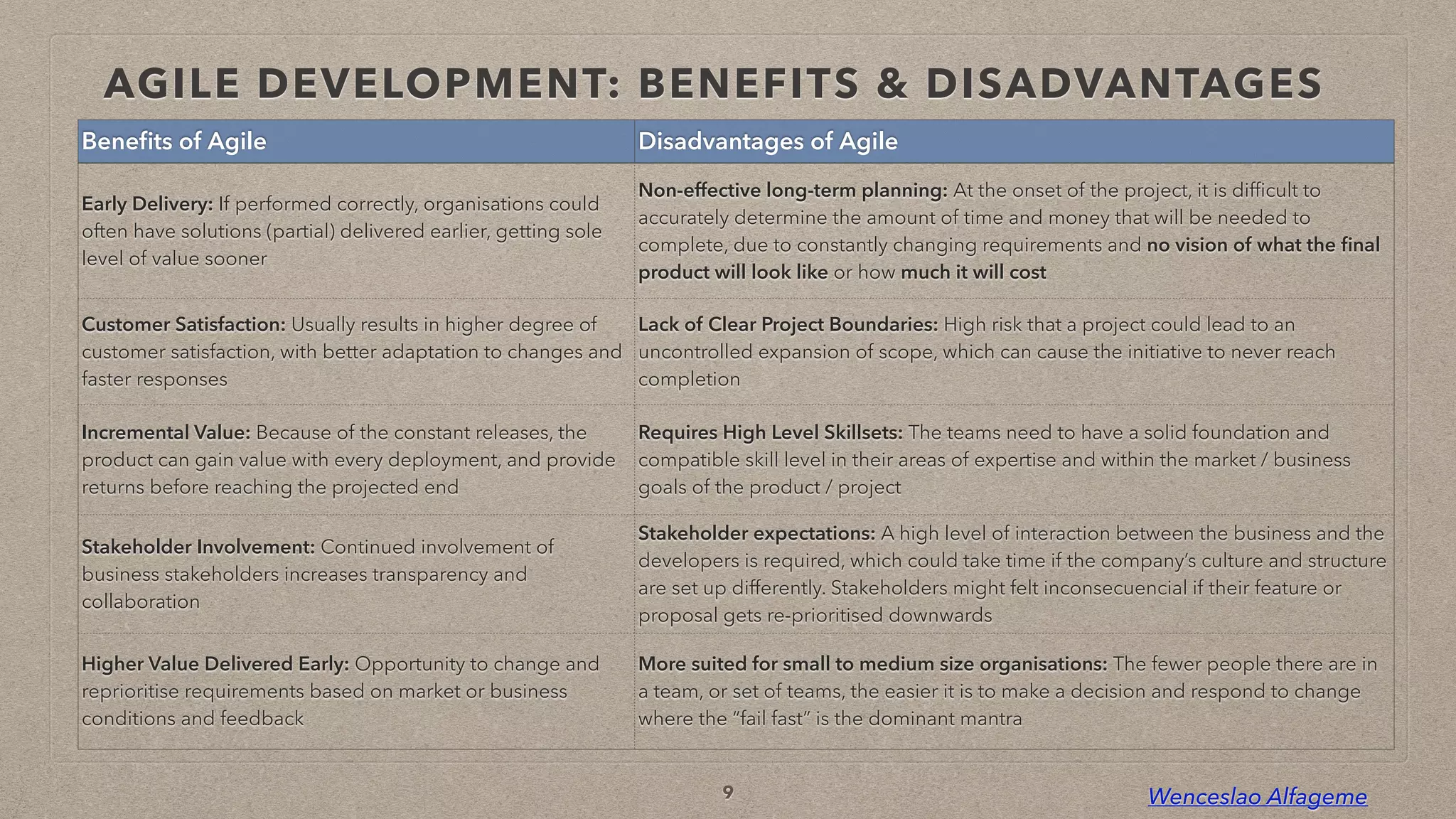
Bene
fi
ts of Agile Disadvantages of Agile
Early Delivery: If performed correctly, organisations could
often have solutions (partial) delivered earlier, getting sole
level of value sooner
Non-effective long-term planning: At the onset of the project, it is dif
fi
cult to
accurately determine the amount of time and money that will be needed to
complete, due to constantly changing requirements and no vision of what the
fi
nal
product will look like or how much it will cost
Customer Satisfaction: Usually results in higher degree of
customer satisfaction, with better adaptation to changes and
faster responses
Lack of Clear Project Boundaries: High risk that a project could lead to an
uncontrolled expansion of scope, which can cause the initiative to never reach
completion
Incremental Value: Because of the constant releases, the
product can gain value with every deployment, and provide
returns before reaching the projected end
Requires High Level Skillsets: The teams need to have a solid foundation and
compatible skill level in their areas of expertise and within the market / business
goals of the product / project
Stakeholder Involvement: Continued involvement of
business stakeholders increases transparency and
collaboration
Stakeholder expectations: A high level of interaction between the business and the
developers is required, which could take time if the company’s culture and structure
are set up differently. Stakeholders might felt inconsecuencial if their feature or
proposal gets re-prioritised downwards
Higher Value Delivered Early: Opportunity to change and
reprioritise requirements based on market or business
conditions and feedback
More suited for small to medium size organisations: The fewer people there are in
a team, or set of teams, the easier it is to make a decision and respond to change
where the “fail fast” is the dominant mantra
9
Wenceslao Alfageme
ADOPTION / TRANSFORMATION TO AGILE
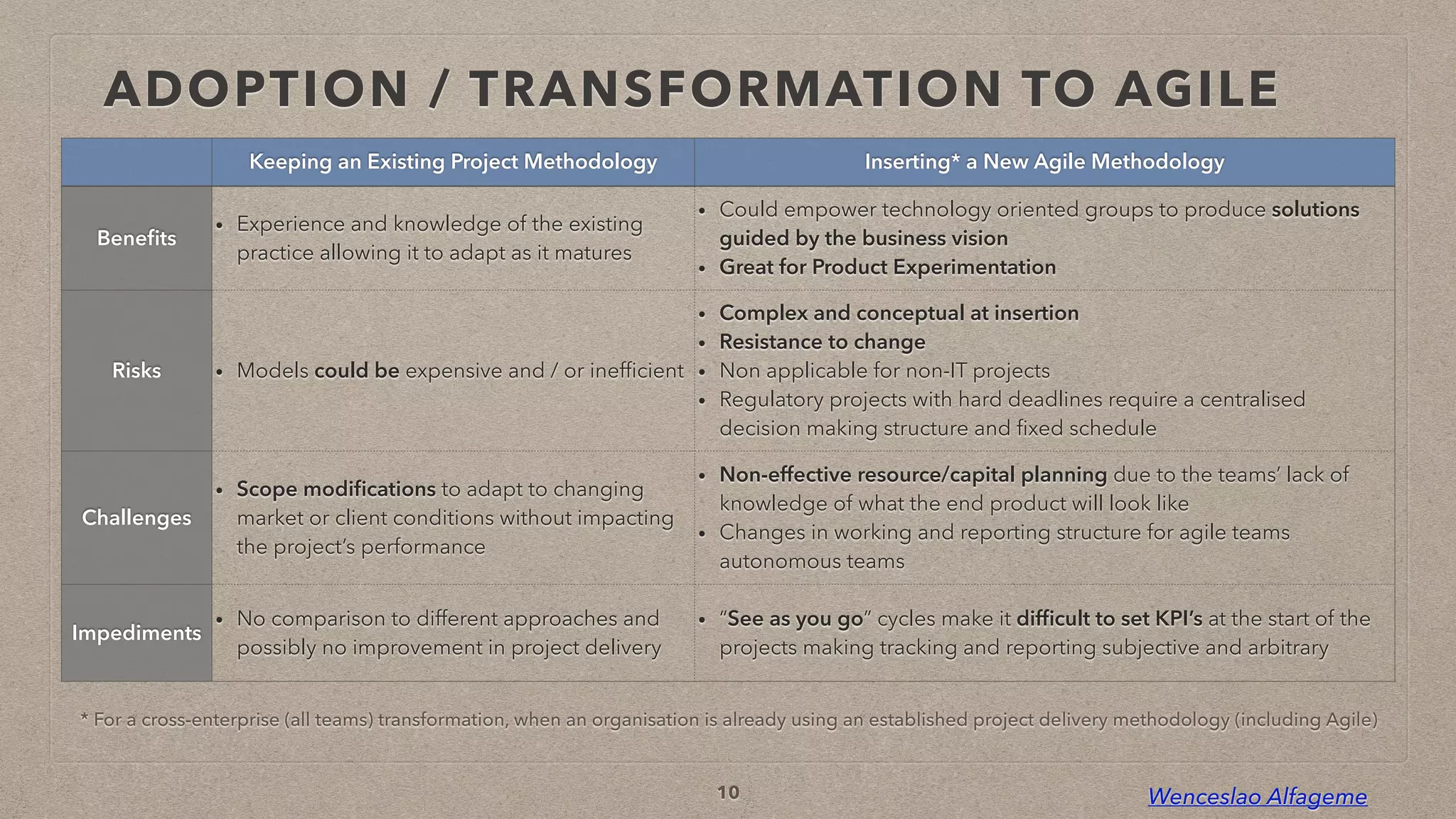
Keeping an Existing Project Methodology Inserting* a New Agile Methodology
Bene
fi
ts
• Experience and knowledge of the existing
practice allowing it to adapt as it matures
• Could empower technology oriented groups to produce solutions
guided by the business vision


• Great for Product Experimentation
Risks • Models could be expensive and / or inef
fi
cient
• Complex and conceptual at insertion


• Resistance to change


• Non applicable for non-IT projects


• Regulatory projects with hard deadlines require a centralised
decision making structure and
fi
xed schedule
Challenges
• Scope modi
fi
cations to adapt to changing
market or client conditions without impacting
the project’s performance
• Non-effective resource/capital planning due to the teams’ lack of
knowledge of what the end product will look like


• Changes in working and reporting structure for agile teams
autonomous teams
Impediments
• No comparison to different approaches and
possibly no improvement in project delivery
• “See as you go” cycles make it dif
fi
cult to set KPI’s at the start of the
projects making tracking and reporting subjective and arbitrary
10
* For a cross-enterprise (all teams) transformation, when an organisation is already using an established project delivery methodology (including Agile)
Wenceslao Alfageme
EPILOGUE
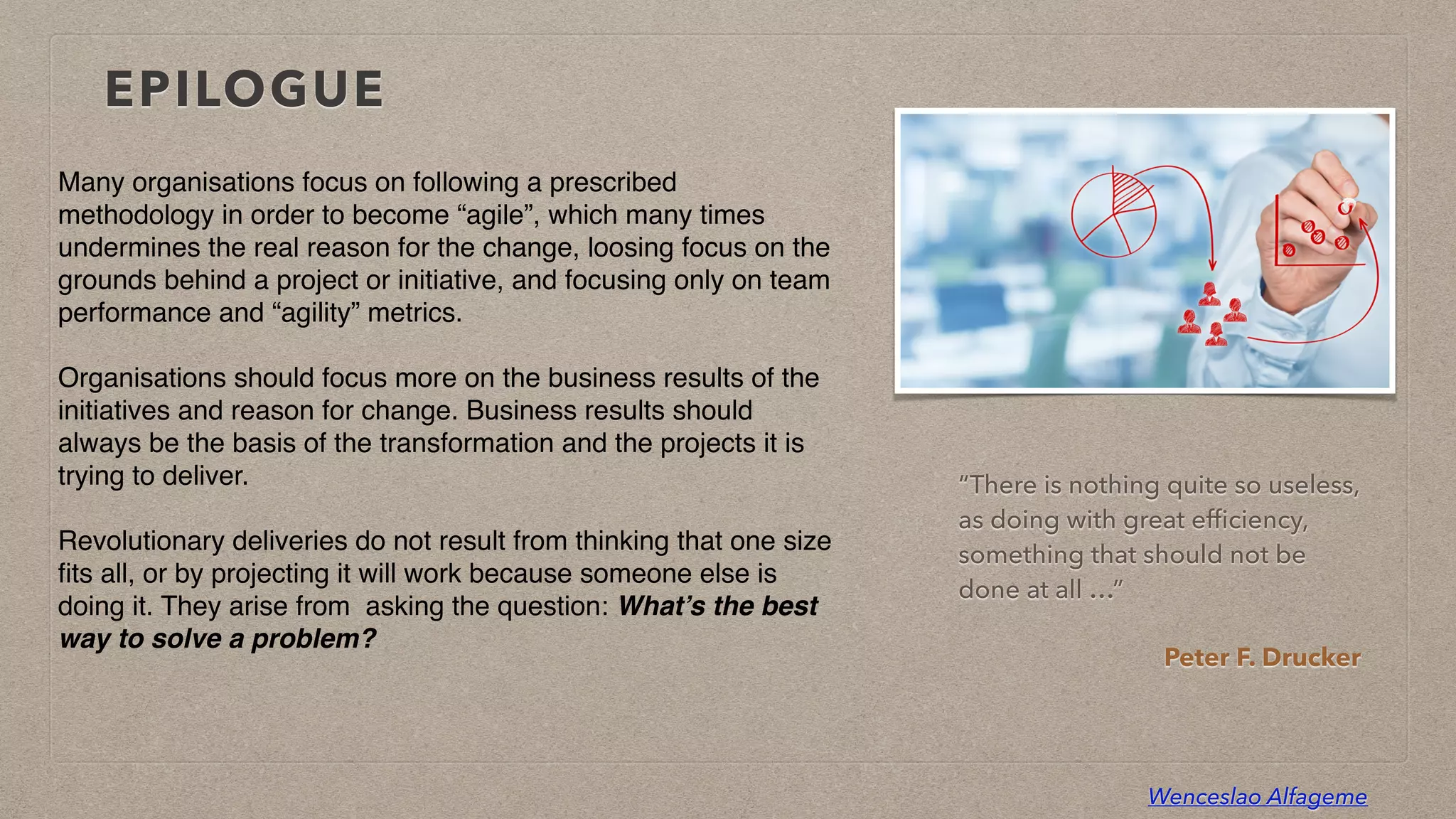
Many organisations focus on following a prescribed
methodology in order to become “agile”, which many times
undermines the real reason for the change, loosing focus on the
grounds behind a project or initiative, and focusing only on team
performance and “agility” metrics.
 

Organisations should focus more on the business results of the
initiatives and reason for change. Business results should
always be the basis of the transformation and the projects it is
trying to deliver
.

Revolutionary deliveries do not result from thinking that one size
fi
ts all, or by projecting it will work because someone else is
doing it. They arise from  asking the question: What’s the best
way to solve a problem?
“There is nothing quite so useless,
as doing with great ef
fi
ciency,
something that should not be
done at all …”


Peter F. Drucker

Why agile?

  • 1.
    Wenceslao Alfageme WHY AGILE? WHATTO CONSIDER: OVERVIEW, BENEFITS, DISADVANTAGES
  • 2.
    Wenceslao Alfageme FOREWORD The intentionof this presentation is to give a very quick overview of what the agile methodologies entail and what the impact of a transformation to agile could have on an organisation. It does not: A. Intend to train the reader in any of the agile methodologies B. Teach agile methodologies C. Impose a view of which approach (waterfall or agile) is better suited 2
  • 3.
    Wenceslao Alfageme WHAT ISAGILE? 1. A time-boxed, iterative development approach to software delivery that allows for incremental target deliverables 2. It’s main characteristics is the breaking of features or processes down into small sized bits of functionality 3. It grants the ability to set and change priorities for each deliverable, and providing these in short cycles referred to as “interactions” 3
  • 4.
    Wenceslao Alfageme WHAT AGILEIS NOT! 1. The silver bullet. It does not guarantee the success of the project, as initiatives that run on agile principles also face the same project issues (e.g. missed deadlines, over budgeting, etc.) 2. A speci fi c way to develop software that a company can only learn if they buy the services of a consultancy fi rm 3. A way or running software projects with no documentation, planning or discipline 4. A one “size fi ts all” solution based on strict rituals 5. Scrum! Although Scrum is one of several agile methodologies 4
  • 5.
    Wenceslao Alfageme AGILE &WATERFALL PROJECT ENVIRONMENT The Agile Manifesto (by The Agile Alliance) published in 2001, acknowledged by the software community that requirements evolve, and cannot always be fully pre-de fi ned WATERFALL APPROACH Initially everything is fi xed, but once the scope matures or evolves, then time, quality and costs are impacted by the changes in scope AGILE APPROACH In this approach, time, quality and costs are fi xed, and therefore the scope and features are variable The Agile Manifesto does not prescribe any methodology; it provides a set of values and principles on which agile methodologies are based 5
  • 6.
    Wenceslao Alfageme AGILE VALUES& PRINCIPLES Individuals & Interactions Working Software Customer Collaboration Responding to Change Processes & Tools Documentation Contract Negotiation Following a Plan Vs. Vs. Vs. Vs. Agile Manifesto: “There is value in the items on the right, although we value the items on the left more” 6
  • 7.
    Wenceslao Alfageme THE ECONOMICCASE FOR AGILE SOFTWARE DEVELOPMENT The Standish Group Chaos Report (2002) and a Cutter Consortium Report (2007) studied the use of completed features in over 1,000 projects, producing the following results: 45% Never Used 19% Rarely Used 16% Sometimes Used 13% Often Used 7% Always Used USE OF SOFTWARE FEATURES 7% 13% 16% 19% 45% Never Used Rarely Used Sometimes used Often Used Always Used 7
  • 8.
    Wenceslao Alfageme WHEN (INPRINCIPLE) DOES AGILE WORK BEST? The teams are able to adapt to new challenges and work independently Unlimited access to the customer / stakeholder who is ready for extensive involvement No limit to timing, or the estimation of schedule is not possible Can’t map out the business needs, so the design needs to emerge through trial and error Need to capture the market before there is any competition There is strict schedule (e.g. regulatory mandate), or can’t afford to iterate and experiment, needing to deliver a fully functional software at once on a speci fi c date Unable to change the project’s size and content when the team begins work on it
  • 9.
    Wenceslao Alfageme AGILE DEVELOPMENT:BENEFITS & DISADVANTAGES Bene fi ts of Agile Disadvantages of Agile Early Delivery: If performed correctly, organisations could often have solutions (partial) delivered earlier, getting sole level of value sooner Non-effective long-term planning: At the onset of the project, it is dif fi cult to accurately determine the amount of time and money that will be needed to complete, due to constantly changing requirements and no vision of what the fi nal product will look like or how much it will cost Customer Satisfaction: Usually results in higher degree of customer satisfaction, with better adaptation to changes and faster responses Lack of Clear Project Boundaries: High risk that a project could lead to an uncontrolled expansion of scope, which can cause the initiative to never reach completion Incremental Value: Because of the constant releases, the product can gain value with every deployment, and provide returns before reaching the projected end Requires High Level Skillsets: The teams need to have a solid foundation and compatible skill level in their areas of expertise and within the market / business goals of the product / project Stakeholder Involvement: Continued involvement of business stakeholders increases transparency and collaboration Stakeholder expectations: A high level of interaction between the business and the developers is required, which could take time if the company’s culture and structure are set up differently. Stakeholders might felt inconsecuencial if their feature or proposal gets re-prioritised downwards Higher Value Delivered Early: Opportunity to change and reprioritise requirements based on market or business conditions and feedback More suited for small to medium size organisations: The fewer people there are in a team, or set of teams, the easier it is to make a decision and respond to change where the “fail fast” is the dominant mantra 9
  • 10.
    Wenceslao Alfageme ADOPTION /TRANSFORMATION TO AGILE Keeping an Existing Project Methodology Inserting* a New Agile Methodology Bene fi ts • Experience and knowledge of the existing practice allowing it to adapt as it matures • Could empower technology oriented groups to produce solutions guided by the business vision • Great for Product Experimentation Risks • Models could be expensive and / or inef fi cient • Complex and conceptual at insertion • Resistance to change • Non applicable for non-IT projects • Regulatory projects with hard deadlines require a centralised decision making structure and fi xed schedule Challenges • Scope modi fi cations to adapt to changing market or client conditions without impacting the project’s performance • Non-effective resource/capital planning due to the teams’ lack of knowledge of what the end product will look like • Changes in working and reporting structure for agile teams autonomous teams Impediments • No comparison to different approaches and possibly no improvement in project delivery • “See as you go” cycles make it dif fi cult to set KPI’s at the start of the projects making tracking and reporting subjective and arbitrary 10 * For a cross-enterprise (all teams) transformation, when an organisation is already using an established project delivery methodology (including Agile)
  • 11.
    Wenceslao Alfageme EPILOGUE Many organisationsfocus on following a prescribed methodology in order to become “agile”, which many times undermines the real reason for the change, loosing focus on the grounds behind a project or initiative, and focusing only on team performance and “agility” metrics. Organisations should focus more on the business results of the initiatives and reason for change. Business results should always be the basis of the transformation and the projects it is trying to deliver . Revolutionary deliveries do not result from thinking that one size fi ts all, or by projecting it will work because someone else is doing it. They arise from  asking the question: What’s the best way to solve a problem? “There is nothing quite so useless, as doing with great ef fi ciency, something that should not be done at all …” Peter F. Drucker