Why Agile?


             Srijan Technologies Pvt. Ltd.
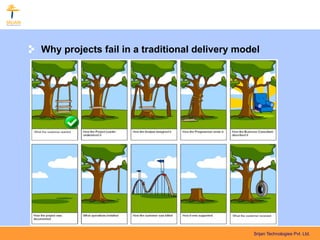
Why projects fail in a traditional delivery model


                                               Srijan Technologies Pvt. Ltd.
Why projects fail in a traditional delivery model
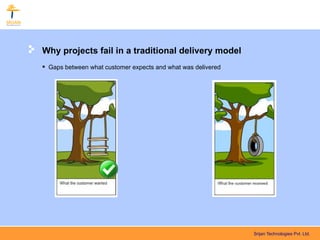
 Gaps between what customer expects and what was delivered


                                                              Srijan Technologies Pvt. Ltd.
Why projects fail in a traditional delivery model
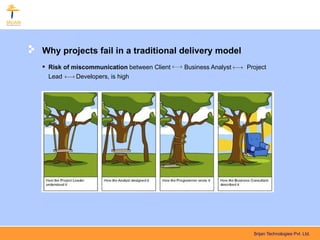
 Risk of miscommunication between Client   Business Analyst   Project
  Lead     Developers, is high


                                                                 Srijan Technologies Pvt. Ltd.
Other problems with such a delivery model
 It is nearly impossible to capture and document ALL features at the concept
  stage of a project [it also not an advisable project/product development strategy]

 Lack of clarity in feature specification leads to poor estimates – either they
  are over-estimated or under-estimated --> and both these situations are bad for
  the project

 Project failure rate in terms of delivery-on-time is high

 Cost over-runs

 Vendors cut-corners (when they are cornered!)

 During development, business/client teams request changes in features with
  evolving project/business goals; adapting these is really difficult


                                                                              Srijan Technologies Pvt. Ltd.
Enter Agile
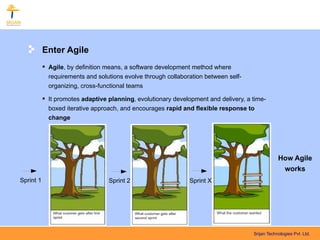
            Agile, by definition means, a software development method where
             requirements and solutions evolve through collaboration between self-
             organizing, cross-functional teams

            It promotes adaptive planning, evolutionary development and delivery, a time-
             boxed iterative approach, and encourages rapid and flexible response to
             change


                                                                                                 How Agile
                                                                                                  works
Sprint 1                          Sprint 2                     Sprint X


                                                                                     Srijan Technologies Pvt. Ltd.
Enter Agile : what this means
 Breaks down the project into an induction, development and transition phase

 Contracts can be defined for such stages of project evolution/development

 Incorporating “new ideas” or “yet better options” into project development
  lifecycle is manageable


                                                                               Srijan Technologies Pvt. Ltd.
Srijan's adaptation of Agile : Induction phase
 A typical Scrum team structure for the induction phase constitutes:

     –   Technical Architect Scrum Master, Developer(s) – from Srijan

     –   Product Owner – from the client side

 Requirements gathering is done with active involvement of the entire Scrum
  Team, and additional stakeholders from the client side, as needed

 A product backlog alongwith other supporting documentation such as
  wireframes, or even prototypes are prepared during this phase

 The development phase scope, time and contract is defined based on the
  estimates for features identified during the induction period

 Estimates for transition phase can be agreed upon.


                                                                         Srijan Technologies Pvt. Ltd.
Srijan's adaptation of Agile : Induction phase
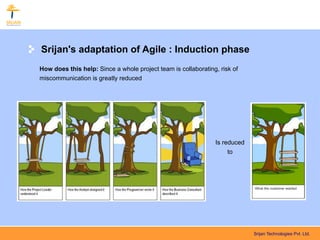
How does this help: Since a whole project team is collaborating, risk of
miscommunication is greatly reduced


                                                               Is reduced
                                                                    to


                                                                            Srijan Technologies Pvt. Ltd.
Srijan's adaptation of Agile : Development phase
 Development of the product is done in several Sprints. Each Sprint spans upto
  2 weeks

 Daily Stand-ups – ideally, a Product Owner is an part such daily meetings with
  the rest of the Scrum Team. Agenda:

     –   What was done yesterday

     –   What will be done today

     –   What are the hurdles faced

 A demo is given to Product Owner at each sprint-end.

 This enables early feedback, course correction (changes, misunderstandings in
  scope), measure speed of development (velocity)

 The Scrum Team is enhanced by adding more developers, front-end engineers
  and QA engineers, as estimated in induction phase


                                                                            Srijan Technologies Pvt. Ltd.
Srijan's adaptation of Agile : Development phase
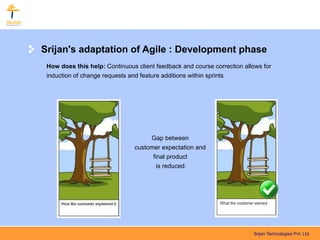
 How does this help: Continuous client feedback and course correction allows for
 induction of change requests and feature additions within sprints


                                    Gap between
                               customer expectation and
                                     final product
                                       is reduced.


                                                                         Srijan Technologies Pvt. Ltd.
Srijan's adaptation of Agile : Transition phase
 Transition period usually involves

     –   installation of the product to the live site for beta release

     –   User Acceptance Testing [UAT]

     –   Bug Fixing / Change Requests

     –   Training

     –   Final Sign-off

 Intense client [Product Owner] engagement through UAT, QA and training.

 During the transition phase we keep only one developer full-time to fix bugs
  and carry out operations.

 The SCRUM Master and QA Engineer coordinate with the Server
  administration team are used part-time to help in testing and training.

 Stake Holders [may] test the site as part of beta release


                                                                            Srijan Technologies Pvt. Ltd.
Srijan's adaptation of Agile : Transition phase
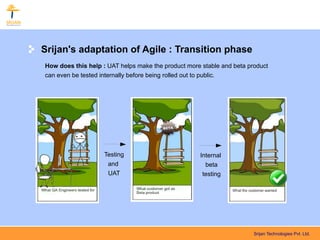
How does this help : UAT helps make the product more stable and beta product
can even be tested internally before being rolled out to public.


                    Testing                         Internal
                     and                              beta
                     UAT                             testing


                                                                       Srijan Technologies Pvt. Ltd.
How is Srijan's model different from others
 Agile by the book asks for the team to be staffed for the whole duration of the
  project starting from induction

 However, at Srijan, we understand that not all clients like this idea of staffing a
  fat team during induction itself , where only a couple of roles may suffice

 Similarly, a Technical Architect is not required in most cases during the transition
  phase!

 Contracts for induction, development and transition phases are separated

 The client gets what they pay for!!


                                                                                 Srijan Technologies Pvt. Ltd.
How does all this help the client?
 Greater project control

 Regular done-done deliverables; small wins, continuously

 You-get-what-you-pay-for

 Staffing team optimally for each phase

 Better tested and quality product

 Training and management/stakeholder acceptance happens continually

 Remote Management

 Greater client satisfaction as the product meets desired goals/objectives


                                                                              Srijan Technologies Pvt. Ltd.
Why Agile?
Thank you!

Get in touch
Interested in setting up an Agile Team with
Srijan? Write to us: business@srijan.in


                                       Srijan Technologies Pvt. Ltd.

Why Agile

  • 1.
    Why Agile? Srijan Technologies Pvt. Ltd.
  • 2.
    Why projects failin a traditional delivery model Srijan Technologies Pvt. Ltd.
  • 3.
    Why projects failin a traditional delivery model  Gaps between what customer expects and what was delivered Srijan Technologies Pvt. Ltd.
  • 4.
    Why projects failin a traditional delivery model  Risk of miscommunication between Client Business Analyst Project Lead Developers, is high Srijan Technologies Pvt. Ltd.
  • 5.
    Other problems withsuch a delivery model  It is nearly impossible to capture and document ALL features at the concept stage of a project [it also not an advisable project/product development strategy]  Lack of clarity in feature specification leads to poor estimates – either they are over-estimated or under-estimated --> and both these situations are bad for the project  Project failure rate in terms of delivery-on-time is high  Cost over-runs  Vendors cut-corners (when they are cornered!)  During development, business/client teams request changes in features with evolving project/business goals; adapting these is really difficult Srijan Technologies Pvt. Ltd.
  • 6.
    Enter Agile  Agile, by definition means, a software development method where requirements and solutions evolve through collaboration between self- organizing, cross-functional teams  It promotes adaptive planning, evolutionary development and delivery, a time- boxed iterative approach, and encourages rapid and flexible response to change How Agile works Sprint 1 Sprint 2 Sprint X Srijan Technologies Pvt. Ltd.
  • 7.
    Enter Agile :what this means  Breaks down the project into an induction, development and transition phase  Contracts can be defined for such stages of project evolution/development  Incorporating “new ideas” or “yet better options” into project development lifecycle is manageable Srijan Technologies Pvt. Ltd.
  • 8.
    Srijan's adaptation ofAgile : Induction phase  A typical Scrum team structure for the induction phase constitutes: – Technical Architect Scrum Master, Developer(s) – from Srijan – Product Owner – from the client side  Requirements gathering is done with active involvement of the entire Scrum Team, and additional stakeholders from the client side, as needed  A product backlog alongwith other supporting documentation such as wireframes, or even prototypes are prepared during this phase  The development phase scope, time and contract is defined based on the estimates for features identified during the induction period  Estimates for transition phase can be agreed upon. Srijan Technologies Pvt. Ltd.
  • 9.
    Srijan's adaptation ofAgile : Induction phase How does this help: Since a whole project team is collaborating, risk of miscommunication is greatly reduced Is reduced to Srijan Technologies Pvt. Ltd.
  • 10.
    Srijan's adaptation ofAgile : Development phase  Development of the product is done in several Sprints. Each Sprint spans upto 2 weeks  Daily Stand-ups – ideally, a Product Owner is an part such daily meetings with the rest of the Scrum Team. Agenda: – What was done yesterday – What will be done today – What are the hurdles faced  A demo is given to Product Owner at each sprint-end.  This enables early feedback, course correction (changes, misunderstandings in scope), measure speed of development (velocity)  The Scrum Team is enhanced by adding more developers, front-end engineers and QA engineers, as estimated in induction phase Srijan Technologies Pvt. Ltd.
  • 11.
    Srijan's adaptation ofAgile : Development phase How does this help: Continuous client feedback and course correction allows for induction of change requests and feature additions within sprints Gap between customer expectation and final product is reduced. Srijan Technologies Pvt. Ltd.
  • 12.
    Srijan's adaptation ofAgile : Transition phase  Transition period usually involves – installation of the product to the live site for beta release – User Acceptance Testing [UAT] – Bug Fixing / Change Requests – Training – Final Sign-off  Intense client [Product Owner] engagement through UAT, QA and training.  During the transition phase we keep only one developer full-time to fix bugs and carry out operations.  The SCRUM Master and QA Engineer coordinate with the Server administration team are used part-time to help in testing and training.  Stake Holders [may] test the site as part of beta release Srijan Technologies Pvt. Ltd.
  • 13.
    Srijan's adaptation ofAgile : Transition phase How does this help : UAT helps make the product more stable and beta product can even be tested internally before being rolled out to public. Testing Internal and beta UAT testing Srijan Technologies Pvt. Ltd.
  • 14.
    How is Srijan'smodel different from others  Agile by the book asks for the team to be staffed for the whole duration of the project starting from induction  However, at Srijan, we understand that not all clients like this idea of staffing a fat team during induction itself , where only a couple of roles may suffice  Similarly, a Technical Architect is not required in most cases during the transition phase!  Contracts for induction, development and transition phases are separated  The client gets what they pay for!! Srijan Technologies Pvt. Ltd.
  • 15.
    How does allthis help the client?  Greater project control  Regular done-done deliverables; small wins, continuously  You-get-what-you-pay-for  Staffing team optimally for each phase  Better tested and quality product  Training and management/stakeholder acceptance happens continually  Remote Management  Greater client satisfaction as the product meets desired goals/objectives Srijan Technologies Pvt. Ltd.
  • 16.
    Why Agile? Thank you! Getin touch Interested in setting up an Agile Team with Srijan? Write to us: business@srijan.in Srijan Technologies Pvt. Ltd.