YOUR UPPER SCHOOL EXPERIENCE
West Island School, Hong Kong 2011-13
Inspiring Students to become responsible Global Citizens
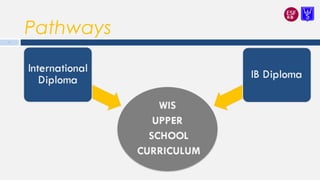
Pathways2
Our common goal
“WIS has a commitment to
provide an appropriate
education for all our
students regardless of their
ability range and preferred
learning style.”
3
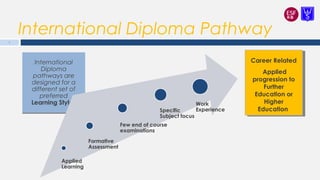
International Diploma Pathway
International
Diploma
pathways are
designed for a
different set of
preferred
Learning Styles
International
Diploma
pathways are
designed for a
different set of
preferred
Learning Styles
Applied
Learning
Formative
Assessment
Few end of course
examinations
Specific
Subject focus
Work
Experience
Career Related
Applied
progression to
Further
Education or
Higher
Education
Career Related
Applied
progression to
Further
Education or
Higher
Education
5
International Diploma Pathway
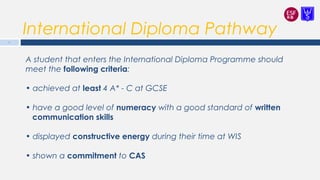
A student that enters the International Diploma Programme should
meet the following criteria:
• achieved at least 4 A* - C at GCSE
• have a good level of numeracy with a good standard of written
communication skills
• displayed constructive energy during their time at WIS
• shown a commitment to CAS
6
International Diploma Pathway
7
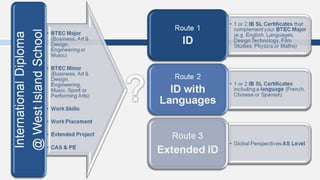
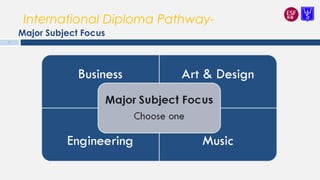
International Diploma Pathway-
Major Subject Focus
8
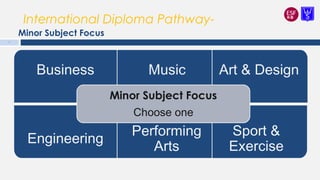
International Diploma Pathway-
Minor Subject Focus
9
Art & Design
Sport &
Exercise
Engineering
Business Music
Performing
Arts
Minor Subject Focus
Choose one
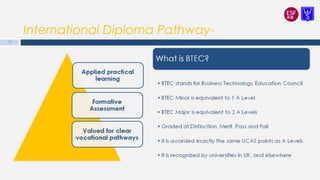
International Diploma Pathway-
10
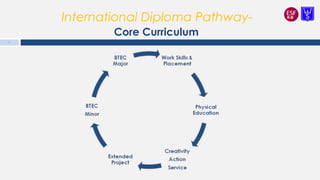
International Diploma Pathway-
Core Curriculum
11
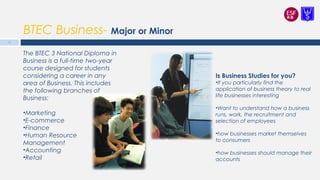
BTEC Business- Major or Minor
Is Business Studies for you?
•If you particularly find the
application of business theory to real
life businesses interesting
•Want to understand how a business
runs, work, the recruitment and
selection of employees
•how businesses market themselves
to consumers
•how businesses should manage their
accounts
The BTEC 3 National Diploma in
Business is a full-time two-year
course designed for students
considering a career in any
area of Business. This includes
the following branches of
Business:
•Marketing
•E-commerce
•Finance
•Human Resource
Management
•Accounting
•Retail
12
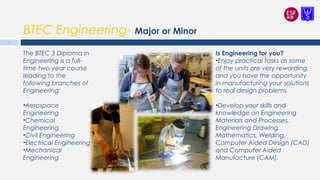
BTEC Engineering- Major or Minor
Is Engineering for you?
•Enjoy practical tasks as some
of the units are very rewarding
and you have the opportunity
in manufacturing your solutions
to real design problems
•Develop your skills and
knowledge on Engineering
Materials and Processes,
Engineering Drawing,
Mathematics, Welding,
Computer Aided Design (CAD)
and Computer Aided
Manufacture (CAM).
The BTEC 3 Diploma in
Engineering is a full-
time two-year course
leading to the
following branches of
Engineering:
•Aerospace
Engineering
•Chemical
Engineering
•Civil Engineering
•Electrical Engineering
•Mechanical
Engineering
13
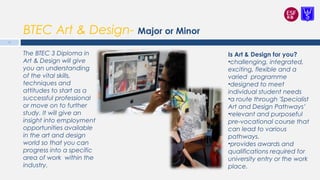
BTEC Art & Design- Major or Minor
The BTEC 3 Diploma in
Art & Design will give
you an understanding
of the vital skills,
techniques and
attitudes to start as a
successful professional
or move on to further
study. It will give an
insight into employment
opportunities available
in the art and design
world so that you can
progress into a specific
area of work within the
industry.
Is Art & Design for you?
•challenging, integrated,
exciting, flexible and a
varied programme
•designed to meet
individual student needs
•a route through 'Specialist
Art and Design Pathways’
•relevant and purposeful
pre-vocational course that
can lead to various
pathways.
•provides awards and
qualifications required for
university entry or the work
place.
14
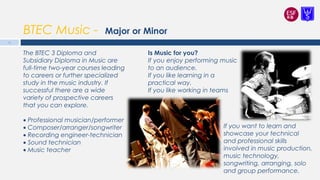
BTEC Music - Major or Minor
Is Music for you?
If you enjoy performing music
to an audience.
If you like learning in a
practical way.
If you like working in teams
15
The BTEC 3 Diploma and
Subsidiary Diploma in Music are
full-time two-year courses leading
to careers or further specialized
study in the music industry. If
successful there are a wide
variety of prospective careers
that you can explore.
 
• Professional musician/performer
• Composer/arranger/songwriter
• Recording engineer-technician
• Sound technician
• Music teacher
If you want to learn and
showcase your technical
and professional skills
involved in music production,
music technology,
songwriting, arranging, solo
and group performance.
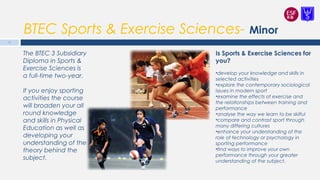
BTEC Sports & Exercise Sciences- Minor
Is Sports & Exercise Sciences for
you?
•develop your knowledge and skills in
selected activities
•explore the contemporary sociological
issues in modern sport
•examine the effects of exercise and
the relationships between training and
performance
•analyse the way we learn to be skilful
•compare and contrast sport through
many differing cultures
•enhance your understanding of the
role of technology or psychology in
sporting performance
•find ways to improve your own
performance through your greater
understanding of the subject.
The BTEC 3 Subsidiary
Diploma in Sports &
Exercise Sciences is
a full-time two-year.
If you enjoy sporting
activities the course
will broaden your all
round knowledge
and skills in Physical
Education as well as
developing your
understanding of the
theory behind the
subject.
16
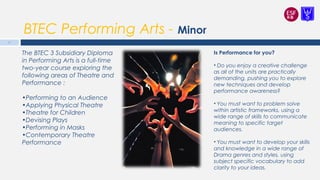
BTEC Performing Arts - Minor
Is Performance for you?
• Do you enjoy a creative challenge
as all of the units are practically
demanding, pushing you to explore
new techniques and develop
performance awareness?
• You must want to problem solve
within artistic frameworks, using a
wide range of skills to communicate
meaning to specific target
audiences.
• You must want to develop your skills
and knowledge in a wide range of
Drama genres and styles, using
subject specific vocabulary to add
clarity to your ideas.
17
The BTEC 3 Subsidiary Diploma
in Performing Arts is a full-time
two-year course exploring the
following areas of Theatre and
Performance :
•Performing to an Audience
•Applying Physical Theatre
•Theatre for Children
•Devising Plays
•Performing in Masks
•Contemporary Theatre
Performance
IB Diploma Programme
A student that enters the IB Diploma Programme should meet the following
criteria:
• Achieved at least 5 A* - C at GCSE including Math and English
Language
• Displayed constructive energy during their time at WIS
• Shown a commitment to CAS.
IB Diploma in ESF Secondary Schools
 IB Diploma Programme has been introduced for
Post 16 Students across the 5 Secondary Schools in
2007
 Students in Years 10-11 will continue to complete a
Middle Year Curriculum with IGCSE and GCSE
examinations.
IB Diploma at WIS
 First cohort of students completed their Diploma in
May 2009
 You will be the fifth cohort of IB and Advanced
Diploma students
The IB Diploma
 A balanced and comprehensive international
programme of study over two years for Post 16
students
 University entrance qualification recognized around
the world in over ninety countries
 Over 3000 participating schools in more than 138
countries
 752,000 Students
The Full IB Diploma Curriculum
 Study 6 subjects over two years
 Three subjects studied at HigherLevel
 Three subjects studied at Standard Level
 Study of the Theory of Knowledge
 Completion of an Extended Essay
 Participation in CAS (Creativity, Action, Service.)
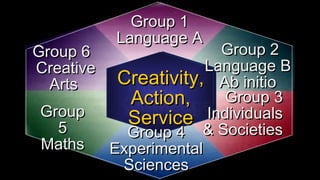
GroupGroup
55
MathsMaths
IBIBExtendedExtended
EssayEssay
Theory ofTheory of
KnowledgeKnowledge
Creativity,Creativity,
Action,Action,
ServiceService
Group 6Group 6
CreativeCreative
ArtsArts
Group 1Group 1
Language ALanguage A
Group 2Group 2
Language BLanguage B
Ab initioAb initio
Group 3Group 3
IndividualsIndividuals
& Societies& SocietiesGroup 4Group 4
ExperimentalExperimental
SciencesSciences
Group 1: Literature A1- English
 Demanding world literature course
 Most students will study texts in English. They study novels, plays,
non fiction and poetry from a range of countries and cultures
 Some of the texts studied are translated texts originally written in
non English languages.
 10 texts at Standard Level/13 texts at Higher level.
 Self Taught Option (SL Only)
Group 1: Language & Literature
A1 Chinese SL Only
 Demanding Language and Literature Course
 Students must be at a very high standard of Chinese
Group 2: Second Language
Study
Appropriate Challenge
• Language BHigher and Standard. This course meets the needs of
candidates for whom Language B is an academic foreign language.
Students m ust have studied this language before. Chinese, Spanish
and French will be offered.
 Ab Initio – Standard Level. This course is designed for candidates
who have a basic grasp of the Language or are relative beginners.
Chinese, Spanish and French will be offered. Although designed for
beginners this is no t an easy option.
Group 3: Individuals and societies
 Business and Management
 Economics
 Geography
 Psychology
 Philosophy
 History
 Environmental Systems and Society (Group 3 orGroup 4, also
Group 3 & Group 4)
Group 4 – Experimental Sciences
 Chemistry
 Biology
 Physics
 Design Technology:
Resistant Materials ( HL & SL )
CAD/CAM ( HL & SL )
Food ( SL )
Textiles ( SL )
 Environmental Systems and Society (Group 3 orGroup 4, also Group 3 &
Group 4)
Group 5: Mathematics and Computer
Science
 Maths Higher(HL) - designed for able mathematicians who will be
studying mathematics, engineering, physics, etc at university
 Maths Standard (SL) – challenging course for students requiring
mathematics skills for their university degree course.
 Maths Studies (SL) – focus on practical applications for those
unlikely to require mathematics in their future studies.
Group 5: Mathematics and Computer
Science
 ComputerScience - Write your own software using Java and
discover how computers work and communicate
 ComputerScience Higher(HL) - designed for those who will be
studying computer science, software engineering, computer gaming
at university
 ComputerScience Standard (SL) – challenging course for students
requiring computer engineering skills for an engineering related
university degree course
Group 6: Arts and electives
 Theatre Arts
 Visual Arts
 FilmStudies
 Music
 ComputerScience (specialist course – speakto Mr. Lewis)
 Students are expected to take a named Group 6 Arts course unless
they have specific evidence highlighting Higher Education
requirements to select a second subject from Groups 2-4.
Theory of Knowledge
 Interdisciplinary requirement
 Stimulate critical reflection on knowledge
 100 hours of teaching
 Assessment 1 essay + 1 10 minute presentation.
Extended Essay
 Original research
 Extended essay of 4,000 words
 Depth of analysis of a particular topic
Creativity, Action Service (CAS)
 150 hours over 2 years
 Creativity – wide range of arts as well as designing and
implementing service projects
 Action – individual and team sports but also taking part in
expeditions and local/international projects
 Service – community and social service activities
Assessment
 Terminal examinations in each subject
 Internal assessment in most subjects. Coursework from 30% to 70%
 Use made of criterion based grading system which is not norm
referenced like the current A Level system
 Each subject Graded 1-7 (7 highest)
 Diploma requirement 24 points
 Maximum 45 points (3 bonus points for Extended Essay and TOK)
 Students need a 4 to pass Higher Level subjects!! ESF Position
16x9
4x3
For further enquiries
www.wis.edu.hk
robert.stitch@wis.edu.hk

Whole upper school pp 2010

  • 1.
    YOUR UPPER SCHOOLEXPERIENCE West Island School, Hong Kong 2011-13 Inspiring Students to become responsible Global Citizens
  • 2.
  • 3.
    Our common goal “WIShas a commitment to provide an appropriate education for all our students regardless of their ability range and preferred learning style.” 3
  • 5.
    International Diploma Pathway International Diploma pathwaysare designed for a different set of preferred Learning Styles International Diploma pathways are designed for a different set of preferred Learning Styles Applied Learning Formative Assessment Few end of course examinations Specific Subject focus Work Experience Career Related Applied progression to Further Education or Higher Education Career Related Applied progression to Further Education or Higher Education 5
  • 6.
    International Diploma Pathway Astudent that enters the International Diploma Programme should meet the following criteria: • achieved at least 4 A* - C at GCSE • have a good level of numeracy with a good standard of written communication skills • displayed constructive energy during their time at WIS • shown a commitment to CAS 6
  • 7.
  • 8.
  • 9.
    International Diploma Pathway- MinorSubject Focus 9 Art & Design Sport & Exercise Engineering Business Music Performing Arts Minor Subject Focus Choose one
  • 10.
  • 11.
  • 12.
    BTEC Business- Majoror Minor Is Business Studies for you? •If you particularly find the application of business theory to real life businesses interesting •Want to understand how a business runs, work, the recruitment and selection of employees •how businesses market themselves to consumers •how businesses should manage their accounts The BTEC 3 National Diploma in Business is a full-time two-year course designed for students considering a career in any area of Business. This includes the following branches of Business: •Marketing •E-commerce •Finance •Human Resource Management •Accounting •Retail 12
  • 13.
    BTEC Engineering- Majoror Minor Is Engineering for you? •Enjoy practical tasks as some of the units are very rewarding and you have the opportunity in manufacturing your solutions to real design problems •Develop your skills and knowledge on Engineering Materials and Processes, Engineering Drawing, Mathematics, Welding, Computer Aided Design (CAD) and Computer Aided Manufacture (CAM). The BTEC 3 Diploma in Engineering is a full- time two-year course leading to the following branches of Engineering: •Aerospace Engineering •Chemical Engineering •Civil Engineering •Electrical Engineering •Mechanical Engineering 13
  • 14.
    BTEC Art &Design- Major or Minor The BTEC 3 Diploma in Art & Design will give you an understanding of the vital skills, techniques and attitudes to start as a successful professional or move on to further study. It will give an insight into employment opportunities available in the art and design world so that you can progress into a specific area of work within the industry. Is Art & Design for you? •challenging, integrated, exciting, flexible and a varied programme •designed to meet individual student needs •a route through 'Specialist Art and Design Pathways’ •relevant and purposeful pre-vocational course that can lead to various pathways. •provides awards and qualifications required for university entry or the work place. 14
  • 15.
    BTEC Music -Major or Minor Is Music for you? If you enjoy performing music to an audience. If you like learning in a practical way. If you like working in teams 15 The BTEC 3 Diploma and Subsidiary Diploma in Music are full-time two-year courses leading to careers or further specialized study in the music industry. If successful there are a wide variety of prospective careers that you can explore.   • Professional musician/performer • Composer/arranger/songwriter • Recording engineer-technician • Sound technician • Music teacher If you want to learn and showcase your technical and professional skills involved in music production, music technology, songwriting, arranging, solo and group performance.
  • 16.
    BTEC Sports &Exercise Sciences- Minor Is Sports & Exercise Sciences for you? •develop your knowledge and skills in selected activities •explore the contemporary sociological issues in modern sport •examine the effects of exercise and the relationships between training and performance •analyse the way we learn to be skilful •compare and contrast sport through many differing cultures •enhance your understanding of the role of technology or psychology in sporting performance •find ways to improve your own performance through your greater understanding of the subject. The BTEC 3 Subsidiary Diploma in Sports & Exercise Sciences is a full-time two-year. If you enjoy sporting activities the course will broaden your all round knowledge and skills in Physical Education as well as developing your understanding of the theory behind the subject. 16
  • 17.
    BTEC Performing Arts- Minor Is Performance for you? • Do you enjoy a creative challenge as all of the units are practically demanding, pushing you to explore new techniques and develop performance awareness? • You must want to problem solve within artistic frameworks, using a wide range of skills to communicate meaning to specific target audiences. • You must want to develop your skills and knowledge in a wide range of Drama genres and styles, using subject specific vocabulary to add clarity to your ideas. 17 The BTEC 3 Subsidiary Diploma in Performing Arts is a full-time two-year course exploring the following areas of Theatre and Performance : •Performing to an Audience •Applying Physical Theatre •Theatre for Children •Devising Plays •Performing in Masks •Contemporary Theatre Performance
  • 18.
    IB Diploma Programme Astudent that enters the IB Diploma Programme should meet the following criteria: • Achieved at least 5 A* - C at GCSE including Math and English Language • Displayed constructive energy during their time at WIS • Shown a commitment to CAS.
  • 19.
    IB Diploma inESF Secondary Schools  IB Diploma Programme has been introduced for Post 16 Students across the 5 Secondary Schools in 2007  Students in Years 10-11 will continue to complete a Middle Year Curriculum with IGCSE and GCSE examinations.
  • 20.
    IB Diploma atWIS  First cohort of students completed their Diploma in May 2009  You will be the fifth cohort of IB and Advanced Diploma students
  • 21.
    The IB Diploma A balanced and comprehensive international programme of study over two years for Post 16 students  University entrance qualification recognized around the world in over ninety countries  Over 3000 participating schools in more than 138 countries  752,000 Students
  • 22.
    The Full IBDiploma Curriculum  Study 6 subjects over two years  Three subjects studied at HigherLevel  Three subjects studied at Standard Level  Study of the Theory of Knowledge  Completion of an Extended Essay  Participation in CAS (Creativity, Action, Service.)
  • 23.
    GroupGroup 55 MathsMaths IBIBExtendedExtended EssayEssay Theory ofTheory of KnowledgeKnowledge Creativity,Creativity, Action,Action, ServiceService Group6Group 6 CreativeCreative ArtsArts Group 1Group 1 Language ALanguage A Group 2Group 2 Language BLanguage B Ab initioAb initio Group 3Group 3 IndividualsIndividuals & Societies& SocietiesGroup 4Group 4 ExperimentalExperimental SciencesSciences
  • 24.
    Group 1: LiteratureA1- English  Demanding world literature course  Most students will study texts in English. They study novels, plays, non fiction and poetry from a range of countries and cultures  Some of the texts studied are translated texts originally written in non English languages.  10 texts at Standard Level/13 texts at Higher level.  Self Taught Option (SL Only)
  • 25.
    Group 1: Language& Literature A1 Chinese SL Only  Demanding Language and Literature Course  Students must be at a very high standard of Chinese
  • 26.
    Group 2: SecondLanguage Study Appropriate Challenge • Language BHigher and Standard. This course meets the needs of candidates for whom Language B is an academic foreign language. Students m ust have studied this language before. Chinese, Spanish and French will be offered.  Ab Initio – Standard Level. This course is designed for candidates who have a basic grasp of the Language or are relative beginners. Chinese, Spanish and French will be offered. Although designed for beginners this is no t an easy option.
  • 27.
    Group 3: Individualsand societies  Business and Management  Economics  Geography  Psychology  Philosophy  History  Environmental Systems and Society (Group 3 orGroup 4, also Group 3 & Group 4)
  • 28.
    Group 4 –Experimental Sciences  Chemistry  Biology  Physics  Design Technology: Resistant Materials ( HL & SL ) CAD/CAM ( HL & SL ) Food ( SL ) Textiles ( SL )  Environmental Systems and Society (Group 3 orGroup 4, also Group 3 & Group 4)
  • 29.
    Group 5: Mathematicsand Computer Science  Maths Higher(HL) - designed for able mathematicians who will be studying mathematics, engineering, physics, etc at university  Maths Standard (SL) – challenging course for students requiring mathematics skills for their university degree course.  Maths Studies (SL) – focus on practical applications for those unlikely to require mathematics in their future studies.
  • 30.
    Group 5: Mathematicsand Computer Science  ComputerScience - Write your own software using Java and discover how computers work and communicate  ComputerScience Higher(HL) - designed for those who will be studying computer science, software engineering, computer gaming at university  ComputerScience Standard (SL) – challenging course for students requiring computer engineering skills for an engineering related university degree course
  • 31.
    Group 6: Artsand electives  Theatre Arts  Visual Arts  FilmStudies  Music  ComputerScience (specialist course – speakto Mr. Lewis)  Students are expected to take a named Group 6 Arts course unless they have specific evidence highlighting Higher Education requirements to select a second subject from Groups 2-4.
  • 32.
    Theory of Knowledge Interdisciplinary requirement  Stimulate critical reflection on knowledge  100 hours of teaching  Assessment 1 essay + 1 10 minute presentation.
  • 33.
    Extended Essay  Originalresearch  Extended essay of 4,000 words  Depth of analysis of a particular topic
  • 34.
    Creativity, Action Service(CAS)  150 hours over 2 years  Creativity – wide range of arts as well as designing and implementing service projects  Action – individual and team sports but also taking part in expeditions and local/international projects  Service – community and social service activities
  • 35.
    Assessment  Terminal examinationsin each subject  Internal assessment in most subjects. Coursework from 30% to 70%  Use made of criterion based grading system which is not norm referenced like the current A Level system  Each subject Graded 1-7 (7 highest)  Diploma requirement 24 points  Maximum 45 points (3 bonus points for Extended Essay and TOK)  Students need a 4 to pass Higher Level subjects!! ESF Position
  • 36.

Editor's Notes

  • #6 Increase text size
  • #24 * Students exposed to the two great traditions of learning: the humanities and the sciences; * At least 3, not more than 4 HL (240 hours); the others at SL (150 hours): students thus able to study some subjects in depth, some more broadly, which is a deliberate compromise between the early specialization preferred in some national systems and the breadth found in others. * Stress the interdisciplinary nature: science-oriented student challenged to learn a foreign language; the natural linguist learns laboratory procedures. Extended Essay: 4000 words; acquaints students with the kind of independent research and writing skills expected at university. TOK: interdisciplinary course intended to stimulate critical reflection upon the knowledge gained inside and outside the classroom. CAS: stresses the importance of life outside scholarship, provides a counter- balance to academic self-absorption