The way to success…


                      O. Тiurina, J. Mironova, T.
                      Oglezneva, D. Jurina, A. Patrusheva,
                      M. Ivanova, N. Akulova.
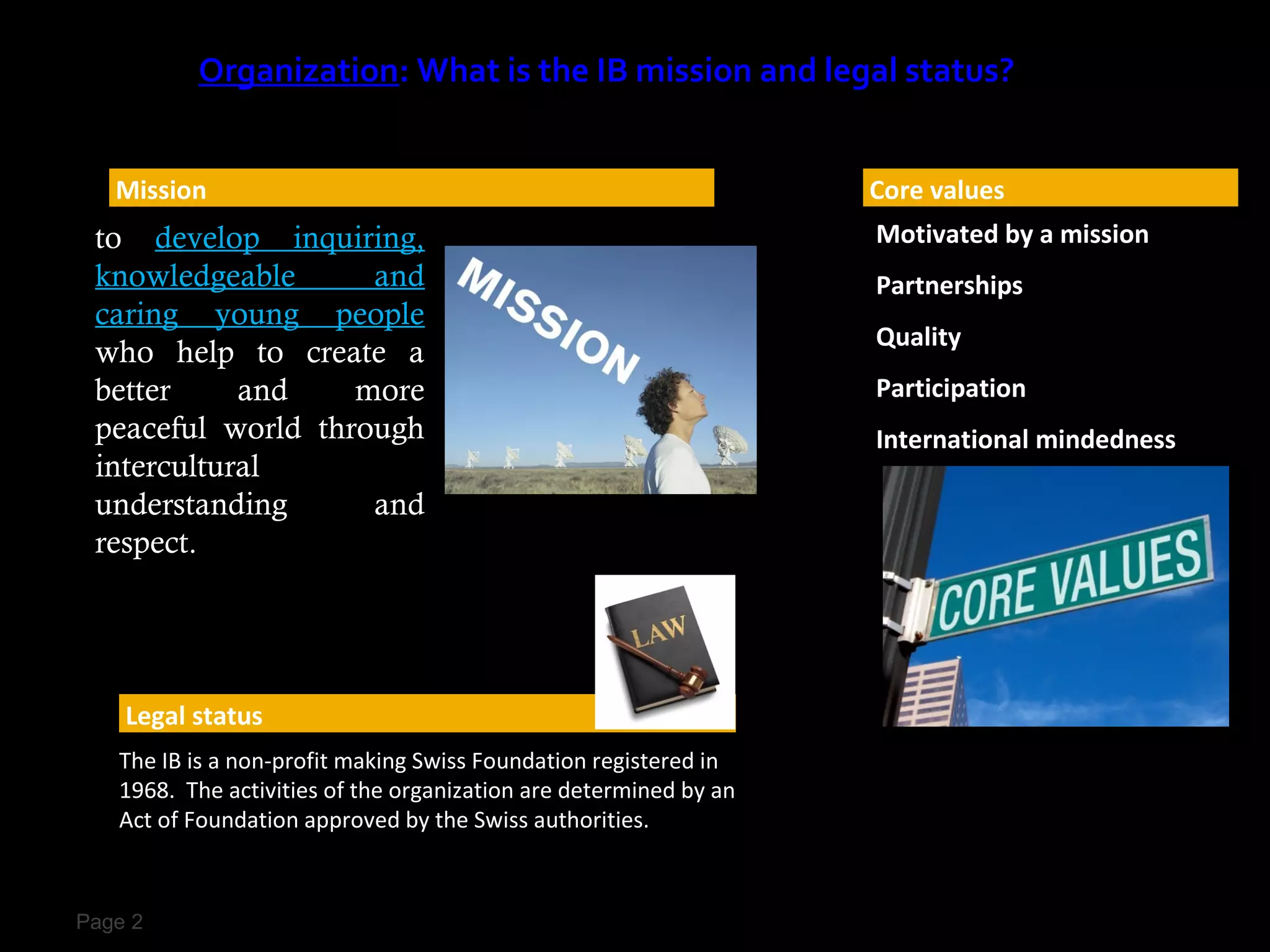
Organization: What is the IB mission and legal status?


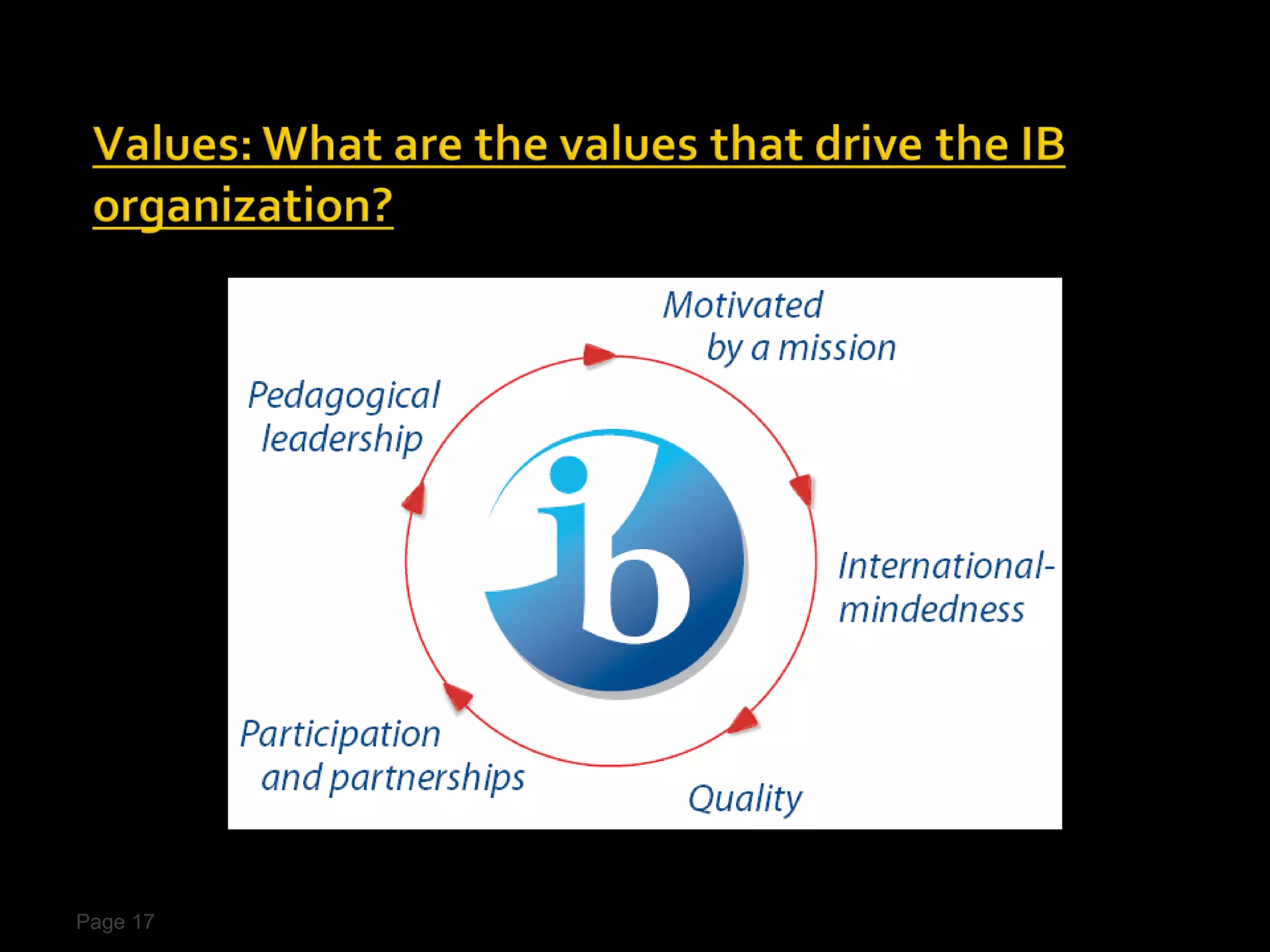
   Mission                                                         Core values
 to develop inquiring,                                             Motivated by a mission
 knowledgeable      and                                            Partnerships
 caring young people
                                                                   Quality
 who help to create a
 better     and    more                                            Participation
 peaceful world through                                            International mindedness
 intercultural
 understanding      and
 respect.


    Legal status
   The IB is a non-profit making Swiss Foundation registered in
   1968. The activities of the organization are determined by an
   Act of Foundation approved by the Swiss authorities.


Page 2
Programmes : What is the Learner Profile?


                                         IB learners strive to be:
                                         Inquirers
                                         Knowledgeable
                                         Thinkers
                                         Communicators
                                         Principled
                                         Open-minded
                                         Caring
                                         Risk-takers
                                         Balanced
                                         Reflective


Page 3
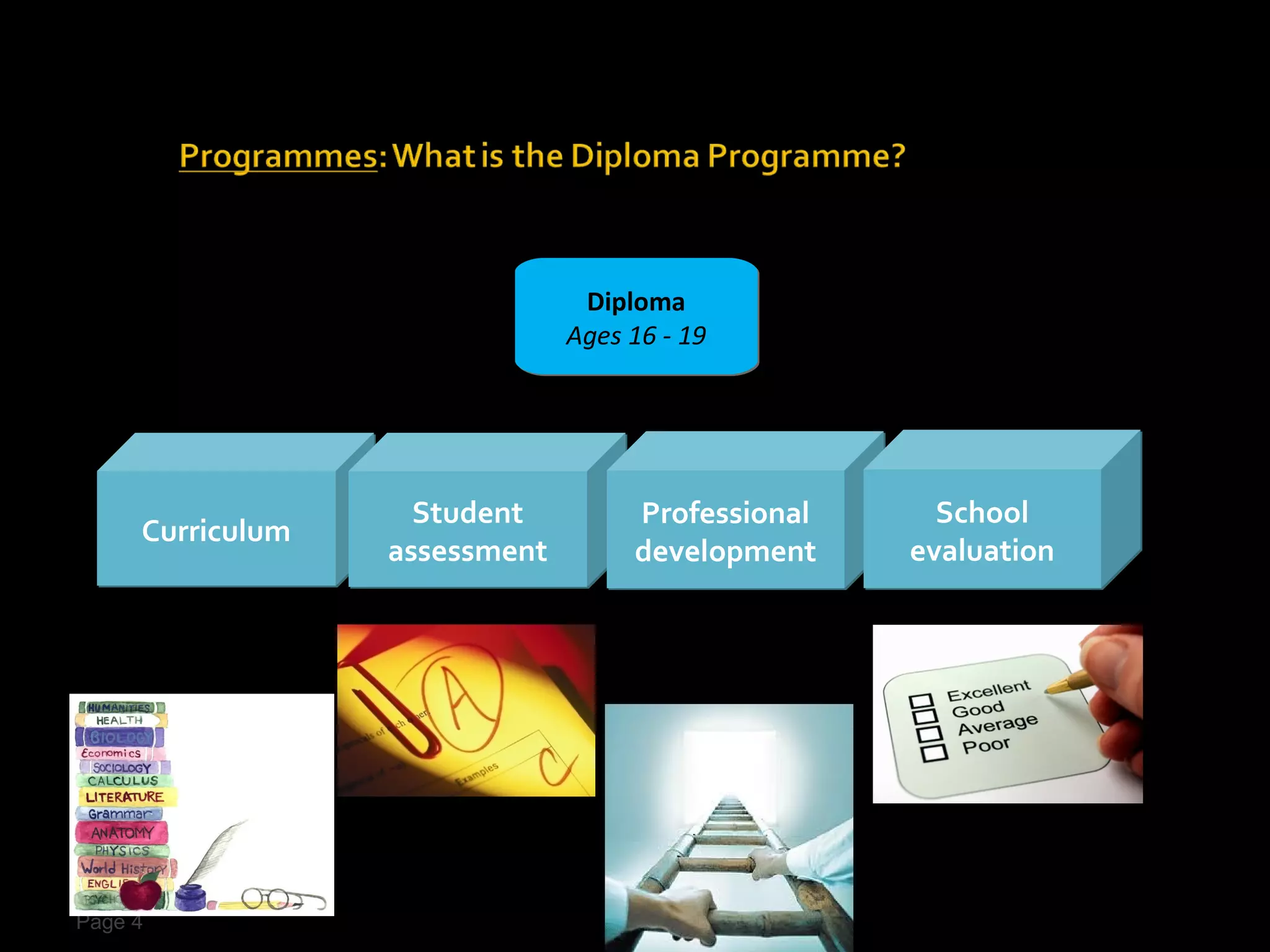
Diploma
                               Ages 16 - 19


                    Student         Professional     School
     Curriculum
                  assessment        development    evaluation


Page 4
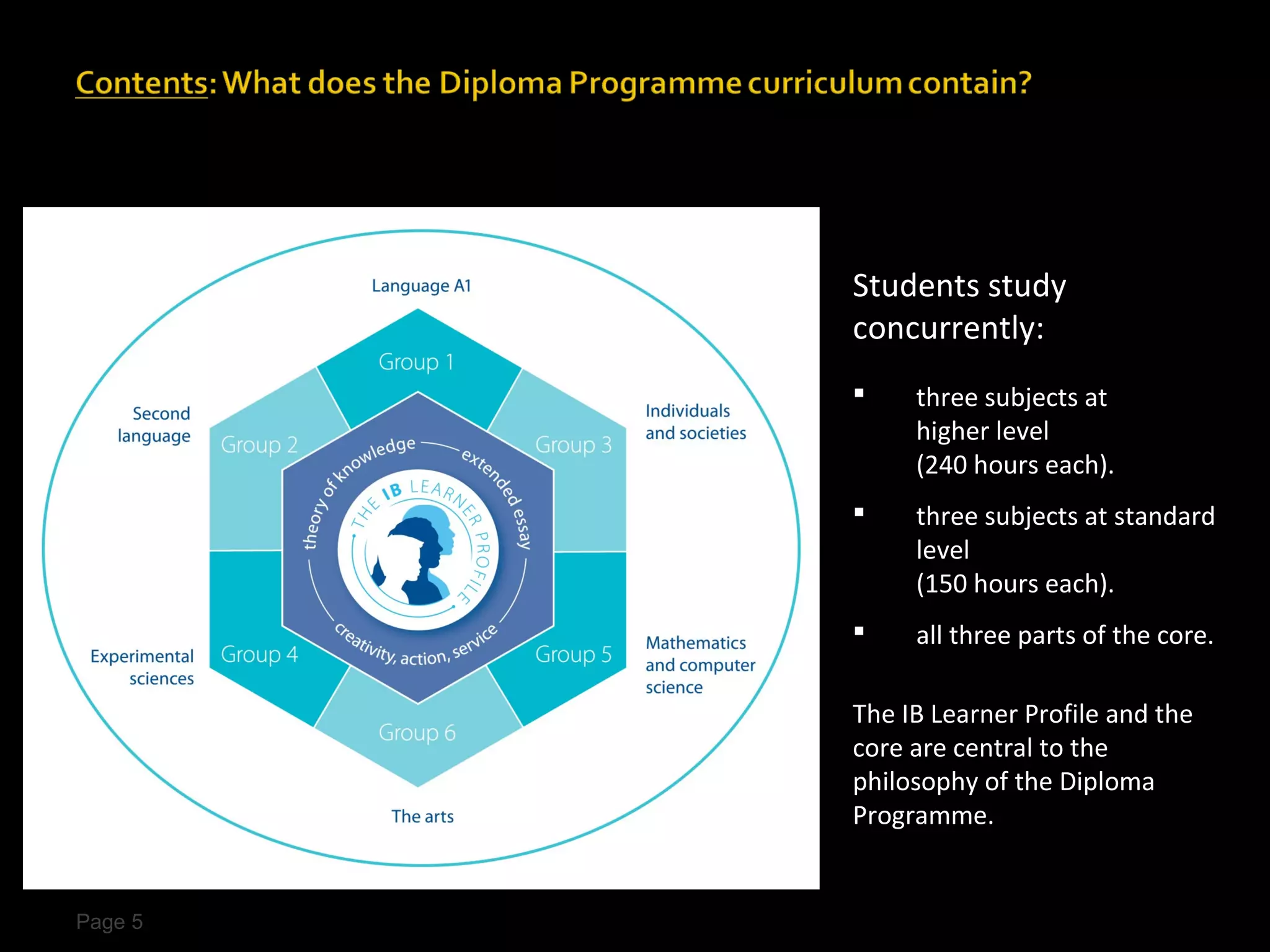
Students study
         concurrently:
             three subjects at
              higher level
              (240 hours each).
             three subjects at standard
              level
              (150 hours each).
             all three parts of the core.

         The IB Learner Profile and the
         core are central to the
         philosophy of the Diploma
         Programme.


Page 5
Based on student and teacher interest, course offerings include:

      GROUP 1                       GROUP 2                      GROUP 3
     HL English A1               SL/HL Language B          HL History of Americas
                                 (Spanish, French)              SL Psychology
                                                          SL Environmental Systems


       GROUP 4                      GROUP 5                     GROUP 6
        SL Biology                SL Mathematics               HL Visual Arts
SL Environmental Systems                                          HL Film
The extended essay:

   limit of 4,000 words

   investigate a topic of individual interest

   independent research and writing skills

         must include “…techniques appropriate to the discipline”

         students select topic and work with volunteer instructors in topic area
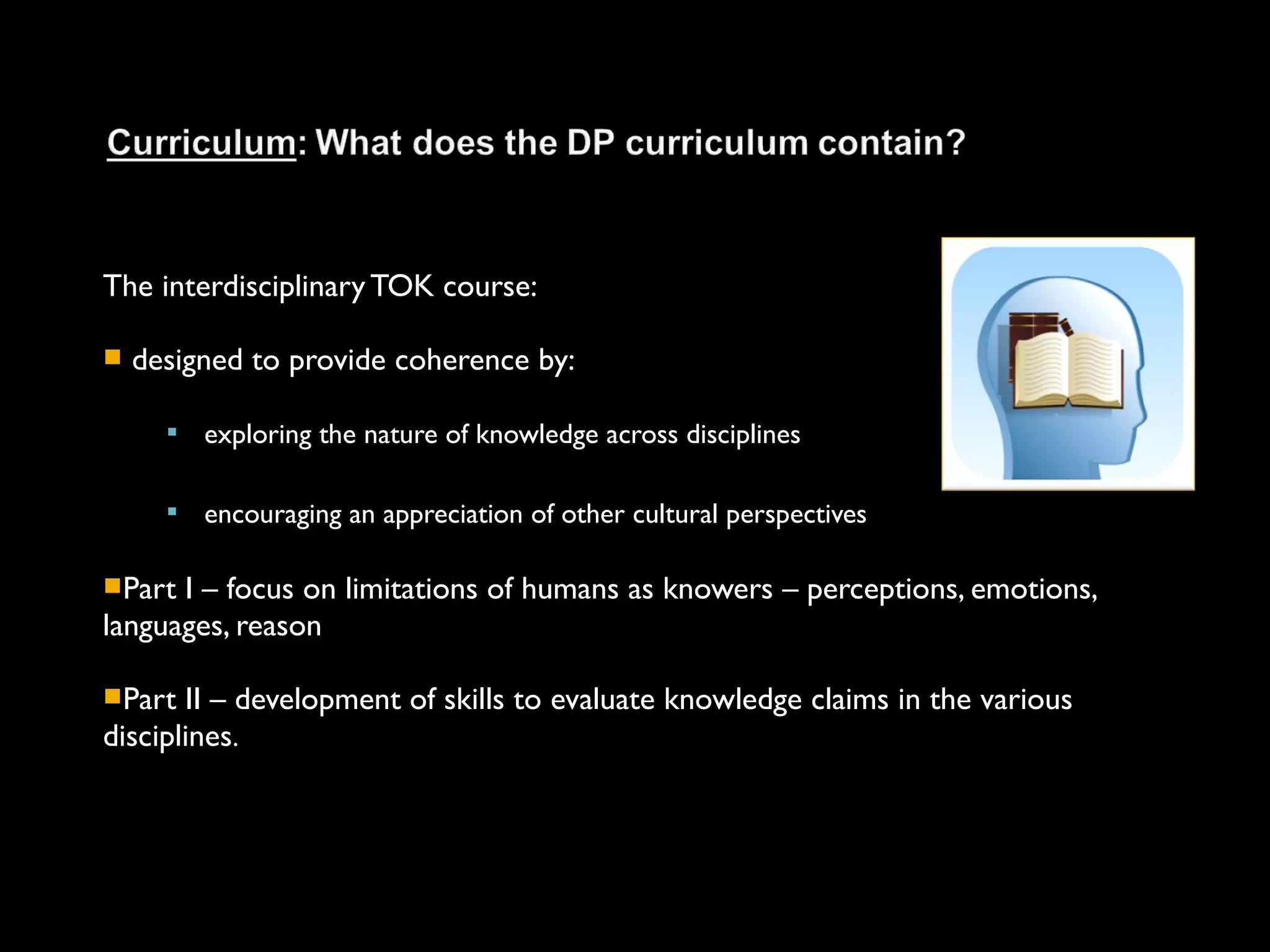
The interdisciplinary TOK course:

   designed to provide coherence by:

         exploring the nature of knowledge across disciplines

         encouraging an appreciation of other cultural perspectives

Part I – focus on limitations of humans as knowers – perceptions, emotions,
languages, reason

Part  II – development of skills to evaluate knowledge claims in the various
disciplines.
Participation in the school’s CAS program:
 to be involved in artistic pursuits, sports and
 community service work
   awareness and appreciation of life

       the hours are designed to be on-going; spanning the duration of the
        Diploma program
   The diploma is graded over 45
    Includes both final                       points giving ample scope to
    examinations and internal                 differentiate student ability
     assessment
                                              Marks awarded for each course
    All 4,000 examiners are ‘quality          range from 1 (lowest) to 7 (highest).
     checked’
                                              Diploma is awarded to students who
    The IB undertakes random                  gain at least 24 points.
     inspections of schools during
     exams.                                   The overall diploma pass rate is
                                               broadly consistent year on year
    Results are published on 5 July for
     May session and 5 January for the        Diploma Programme assessment –
     November session.                         principles and practice – available on
                                               www.ibo.org


    Page 10
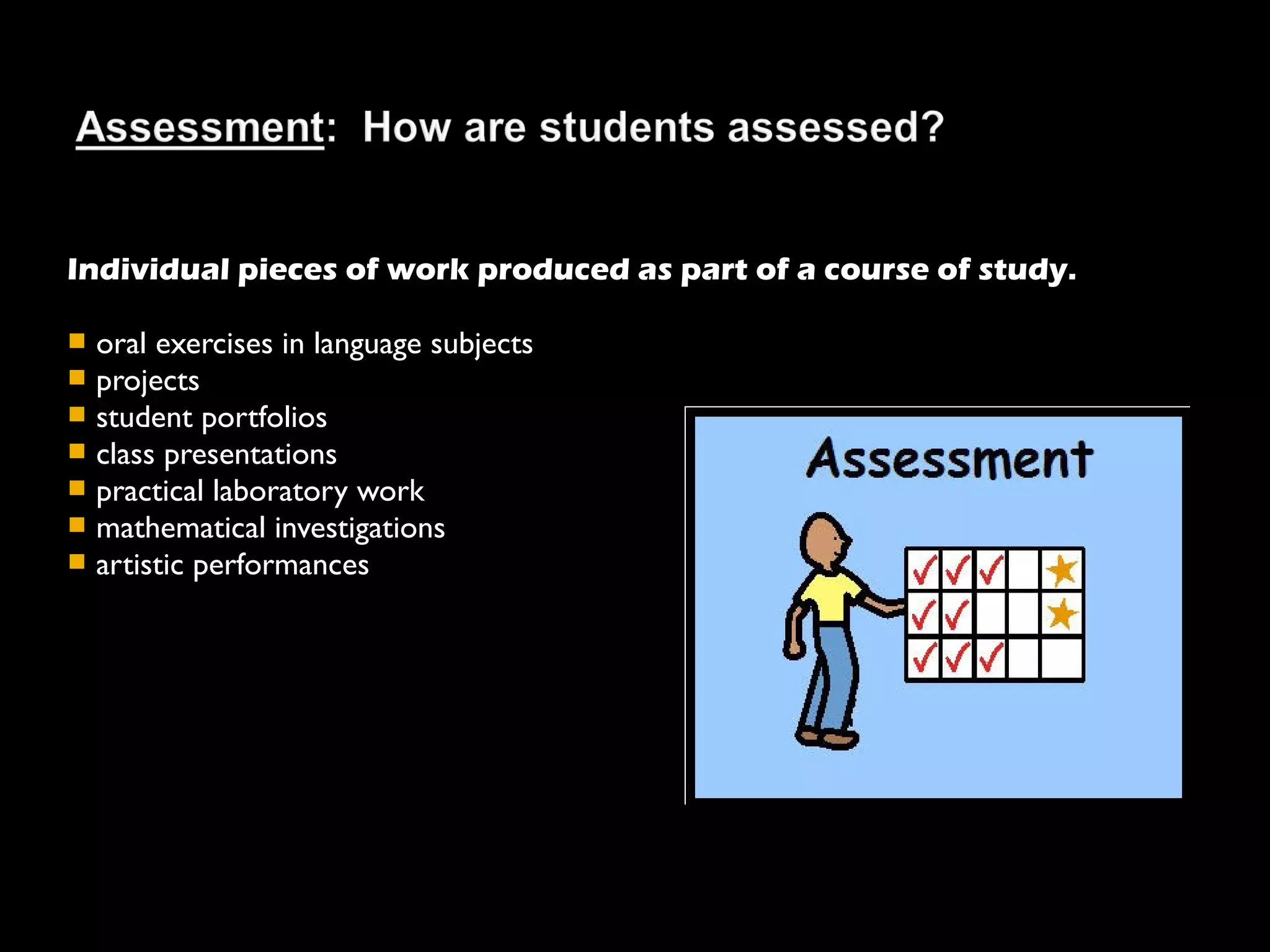
Individual pieces of work produced as part of a course of study.

   oral exercises in language subjects
   projects
   student portfolios
   class presentations
   practical laboratory work
   mathematical investigations
   artistic performances
Some assessment tasks marked externally by examiners.

   world literature assignments for language A1

   written assignments for language A2

   essays for theory of knowledge and extended essays.
   Externally marked examinations form the greatest share of the
    assessment for most subjects.

   The grading system is criterion-based
The IB works closely with universities in all regions of the world to
gain recognition for the IB diploma:


   Direct online access for university admissions
    officers and government officials to syllabuses
    and recent examination papers
   A database of university admission policies on www.ibo.org
   Recognition in over 100 countries
   Recognition by over 2,000 universities
   Some universities offer scholarships and advanced placement for IB students


 Page 14
   Universities consider the IB Diploma to be one of the most demanding
    secondary school curricula, offering ideal preparation for post-secondary
    studies. A student's participation in IB courses is, therefore, a very
    important consideration in admission decisions. It is to a student's distinct
    advantage to have completed IB courses, but especially so if the student is
    completing the IB Diploma.


                           - CURT (College & University Task Force), July, 2009
   Admissions assumptions: What do universities assume about the IB
    graduate?
     Accepts challenges
     Strong academic foundation
     Consistency
     Excellent research & writing skills
     Excellent critical thinking skills
     Strong oral presentation skills
     Community engagement
     Mature & responsible
Page 17
   “Through high quality education we create a better
     world.”

    Idealistic, peace promoting
    Culturally aware
    Quality, standards
    University recognition & challenge

    “International and Baccalaureate
       complementing opposites that make the IB.”


Page 18
Ib diploma

Ib diploma

  • 1.
    The way tosuccess… O. Тiurina, J. Mironova, T. Oglezneva, D. Jurina, A. Patrusheva, M. Ivanova, N. Akulova.
  • 2.
    Organization: What isthe IB mission and legal status? Mission Core values to develop inquiring, Motivated by a mission knowledgeable and Partnerships caring young people Quality who help to create a better and more Participation peaceful world through International mindedness intercultural understanding and respect. Legal status The IB is a non-profit making Swiss Foundation registered in 1968. The activities of the organization are determined by an Act of Foundation approved by the Swiss authorities. Page 2
  • 3.
    Programmes : Whatis the Learner Profile? IB learners strive to be: Inquirers Knowledgeable Thinkers Communicators Principled Open-minded Caring Risk-takers Balanced Reflective Page 3
  • 4.
    Diploma Ages 16 - 19 Student Professional School Curriculum assessment development evaluation Page 4
  • 5.
    Students study concurrently:  three subjects at higher level (240 hours each).  three subjects at standard level (150 hours each).  all three parts of the core. The IB Learner Profile and the core are central to the philosophy of the Diploma Programme. Page 5
  • 6.
    Based on studentand teacher interest, course offerings include: GROUP 1 GROUP 2 GROUP 3 HL English A1 SL/HL Language B HL History of Americas (Spanish, French) SL Psychology SL Environmental Systems GROUP 4 GROUP 5 GROUP 6 SL Biology SL Mathematics HL Visual Arts SL Environmental Systems HL Film
  • 7.
    The extended essay:  limit of 4,000 words  investigate a topic of individual interest  independent research and writing skills  must include “…techniques appropriate to the discipline”  students select topic and work with volunteer instructors in topic area
  • 8.
    The interdisciplinary TOKcourse:  designed to provide coherence by:  exploring the nature of knowledge across disciplines  encouraging an appreciation of other cultural perspectives Part I – focus on limitations of humans as knowers – perceptions, emotions, languages, reason Part II – development of skills to evaluate knowledge claims in the various disciplines.
  • 9.
    Participation in theschool’s CAS program:  to be involved in artistic pursuits, sports and community service work  awareness and appreciation of life  the hours are designed to be on-going; spanning the duration of the Diploma program
  • 10.
    The diploma is graded over 45  Includes both final points giving ample scope to  examinations and internal differentiate student ability assessment  Marks awarded for each course  All 4,000 examiners are ‘quality range from 1 (lowest) to 7 (highest). checked’  Diploma is awarded to students who  The IB undertakes random gain at least 24 points. inspections of schools during exams.  The overall diploma pass rate is broadly consistent year on year  Results are published on 5 July for May session and 5 January for the  Diploma Programme assessment – November session. principles and practice – available on www.ibo.org Page 10
  • 11.
    Individual pieces ofwork produced as part of a course of study.  oral exercises in language subjects  projects  student portfolios  class presentations  practical laboratory work  mathematical investigations  artistic performances
  • 12.
    Some assessment tasksmarked externally by examiners.  world literature assignments for language A1  written assignments for language A2  essays for theory of knowledge and extended essays.
  • 13.
    Externally marked examinations form the greatest share of the assessment for most subjects.  The grading system is criterion-based
  • 14.
    The IB worksclosely with universities in all regions of the world to gain recognition for the IB diploma:  Direct online access for university admissions officers and government officials to syllabuses and recent examination papers  A database of university admission policies on www.ibo.org  Recognition in over 100 countries  Recognition by over 2,000 universities  Some universities offer scholarships and advanced placement for IB students Page 14
  • 15.
    Universities consider the IB Diploma to be one of the most demanding secondary school curricula, offering ideal preparation for post-secondary studies. A student's participation in IB courses is, therefore, a very important consideration in admission decisions. It is to a student's distinct advantage to have completed IB courses, but especially so if the student is completing the IB Diploma. - CURT (College & University Task Force), July, 2009
  • 16.
    Admissions assumptions: What do universities assume about the IB graduate?  Accepts challenges  Strong academic foundation  Consistency  Excellent research & writing skills  Excellent critical thinking skills  Strong oral presentation skills  Community engagement  Mature & responsible
  • 17.
  • 18.
    “Through high quality education we create a better world.”  Idealistic, peace promoting  Culturally aware  Quality, standards  University recognition & challenge  “International and Baccalaureate complementing opposites that make the IB.” Page 18

Editor's Notes

  • #8 _____________________________________________________________________________________________________________________________________________________________________________________________________________________________________________________________________________________________
  • #9 _____________________________________________________________________________________________________________________________________________________________________________________________________________________________________________________________________________________________
  • #10 _____________________________________________________________________________________________________________________________________________________________________________________________________________________________________________________________________________________________
  • #12 _____________________________________________________________________________________________________________________________________________________________________________________________________________________________________________________________________________________________
  • #13 _____________________________________________________________________________________________________________________________________________________________________________________________________________________________________________________________________________________________
  • #14 _____________________________________________________________________________________________________________________________________________________________________________________________________________________________________________________________________________________________