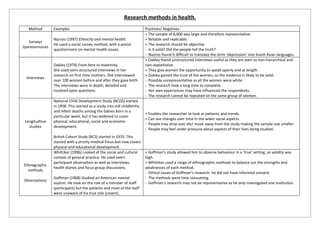
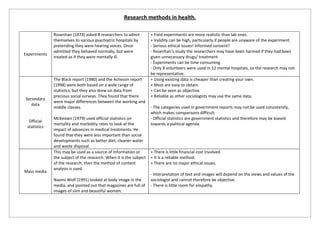
This document discusses and compares various research methods used in health research, including their positives and negatives. Surveys and questionnaires can gather data from large samples but may not be fully valid if participants do not respond truthfully. Interviews provide in-depth insights but take more time and may be less generalizable. Longitudinal studies enable examining trends over long periods but can lose participants. Ethnographic research in natural settings has high validity but raises ethical issues. Experiments test hypotheses directly but also pose ethical concerns. Secondary data analysis is efficient but relies on others' categorizations. Official statistics seem objective but may be politically biased. Content analysis of media is low-cost but interpretations rely on the researcher's views.