Who needs containers in a
serverless world?
@RedHatNews & @InstanaHQ
Vašek Pavlín & Matthias Lübken
@vpavlin & @luebken
Agenda for 23 min
● Intro
● Focus on developers
● What is serverless
● A serverless example
● Containers?
○ Developers Workflow
○ Architectural Considerations
○ DevOps responsibilities
● Opinions
See Slides:
bit.ly/containers-serverless
@vpavlin & @luebken
What this talk is not about
You need servers for serverless
You need containers to run serverless
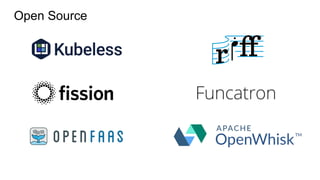
Open Source
Mr. Developer
What is serverless?
Terms
● FaaS: Function-As-A-Service
● Event driven
● BaaS: Backend-As-A-Service
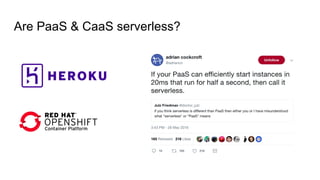
Are PaaS & CaaS serverless?
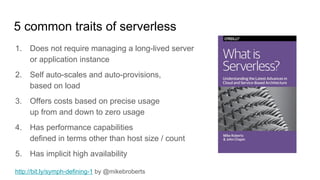
5 common traits of serverless
1. Does not require managing a long-lived server
or application instance
2. Self auto-scales and auto-provisions,
based on load
3. Offers costs based on precise usage
up from and down to zero usage
4. Has performance capabilities
defined in terms other than host size / count
5. Has implicit high availability
http://bit.ly/symph-defining-1 by @mikebroberts
A serverless example
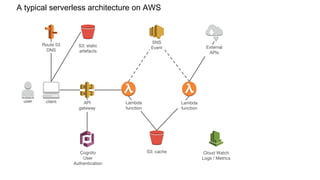
A typical serverless architecture on AWS
user client
S3: static
artefacts
Cognito
User
Authentication
API
gateway
S3: cache
Lambda
function
Cloud Watch
Logs / Metrics
SNS
Event
Lambda
function
External
APIs
Route 53
DNS
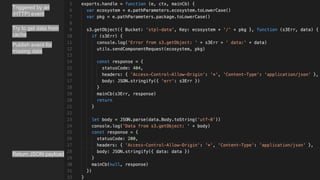
Error response
Triggered by an
(HTTP) event
Try to get data from
cache
Publish event for
missing data
Return JSON payload
And containers?
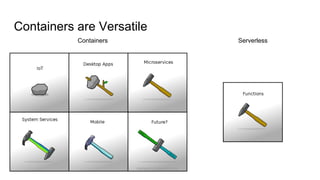
Containers are Versatile
Containers Serverless
Serverless & Containers
Developers’ workflow
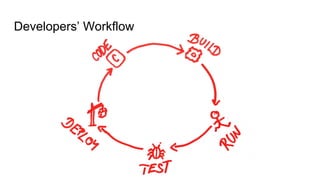
Developers’ Workflow
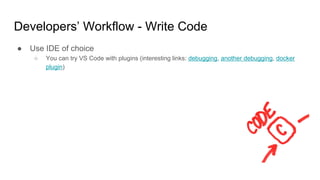
Developers’ Workflow - Write Code
● Use IDE of choice
○ You can try VS Code with plugins (interesting links: debugging, another debugging, docker
plugin)
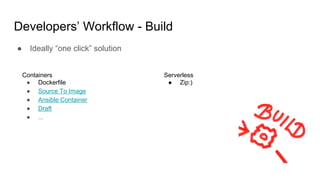
Developers’ Workflow - Build
● Ideally “one click” solution
Containers
● Dockerfile
● Source To Image
● Ansible Container
● Draft
● ...
Serverless
● Zip:)
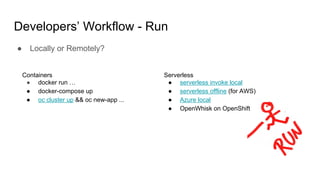
Developers’ Workflow - Run
● Locally or Remotely?
Containers
● docker run …
● docker-compose up
● oc cluster up && oc new-app ...
Serverless
● serverless invoke local
● serverless offline (for AWS)
● Azure local
● OpenWhisk on OpenShift
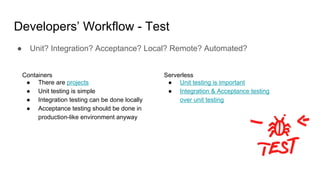
Developers’ Workflow - Test
● Unit? Integration? Acceptance? Local? Remote? Automated?
Containers
● There are projects
● Unit testing is simple
● Integration testing can be done locally
● Acceptance testing should be done in
production-like environment anyway
Serverless
● Unit testing is important
● Integration & Acceptance testing
over unit testing
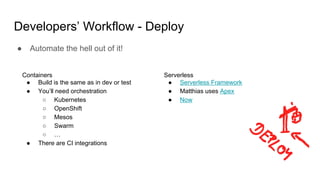
Developers’ Workflow - Deploy
● Automate the hell out of it!
Containers
● Build is the same as in dev or test
● You’ll need orchestration
○ Kubernetes
○ OpenShift
○ Mesos
○ Swarm
○ …
● There are CI integrations
Serverless
● Serverless Framework
● Matthias uses Apex
● Now
Architectural Considerations
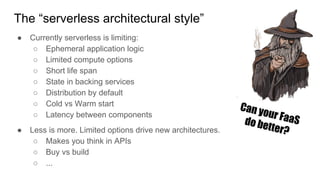
The “serverless architectural style”
● Currently serverless is limiting:
○ Ephemeral application logic
○ Limited compute options
○ Short life span
○ State in backing services
○ Distribution by default
○ Cold vs Warm start
○ Latency between components
● Less is more. Limited options drive new architectures.
○ Makes you think in APIs
○ Buy vs build
○ ...
Can your FaaSdo better?
Paper: Serverless computing: economic and architectural impact
Gojko Adzic, Robert Chatley
http://www.doc.ic.ac.uk/~rbc/papers/fse-serverless-17.pdf
● Removing economic incentives
for bundling
● Removing components like gatekeeper
due to request level authorization
● Removing Barriers to Versioning
Implicit within the system
DevOps responsibilities
DevOps responsibilities change
● DevOps? What is your definition?
● Even with serverless, there are still many OPs topics to be taken care of
around: Security, Performance, Tooling, CI/CD, (Distributed) Monitoring,
● But with serverless there is operability from the start
● DevOps promotes collaboration. Serverless mandates it.
=> Roles, responsibilities & teams evolve.
Managed vs Control
● You can host your own serverless platform
but note serverless leverages economy of scale
● Most orgs will choose some cloud vendor and give up control
So, how important is control to you?
● Ops is different with serverless
So ?
Opinions
Matthias: “Serverless is the greatest enabler”
● No costs for not running code is just mind blowing
● Serverless made me think differently:
○ APIs
■ What other APIs are others providing?
■ What can I expose as an API?
○ Modular
■ Does my function do too much?
○ Event driven
■ What are good domain events?
And it’s fun.
Vašek: “Containers give you freedom”
● Containers give freedom
○ Have you ever given freedom to developers? ;)
● You need to think on scale
● Orchestration is king
● It does not take traditional “ops” tasks away
● It was fun last 3 years, now it’s just work...
What if you could have both?
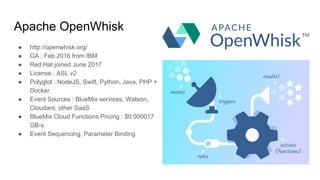
Apache OpenWhisk
● http://openwhisk.org/
● GA : Feb 2016 from IBM
● Red Hat joined June 2017
● License : ASL v2
● Polyglot : NodeJS, Swift, Python, Java, PHP +
Docker
● Event Sources : BlueMix services, Watson,
Cloudant, other SaaS
● BlueMix Cloud Functions Pricing : $0.000017
GB-s
● Event Sequencing, Parameter Binding
● serverless = faas & event driven & backend services
● pro container:
○ you can achieve similar characteristics with containers
○ containers & development are more versatile
○ they enable different architectures: monolith, µservices, faas
○ BTW containers are the enabling infrastructure
● pro serverless:
○ opinionated architecture
○ focus on writing application logic
○ precise cost based pricing powers new architectures
● OpenWhisk to the rescue
tl;dr
Thanks for listening
@vpavlin @luebken

Who needs containers in a serverless world

  • 1.
    Who needs containersin a serverless world? @RedHatNews & @InstanaHQ Vašek Pavlín & Matthias Lübken @vpavlin & @luebken
  • 2.
    Agenda for 23min ● Intro ● Focus on developers ● What is serverless ● A serverless example ● Containers? ○ Developers Workflow ○ Architectural Considerations ○ DevOps responsibilities ● Opinions See Slides: bit.ly/containers-serverless
  • 3.
  • 5.
    What this talkis not about You need servers for serverless You need containers to run serverless
  • 6.
  • 7.
  • 8.
  • 9.
    Terms ● FaaS: Function-As-A-Service ●Event driven ● BaaS: Backend-As-A-Service
  • 10.
    Are PaaS &CaaS serverless?
  • 11.
    5 common traitsof serverless 1. Does not require managing a long-lived server or application instance 2. Self auto-scales and auto-provisions, based on load 3. Offers costs based on precise usage up from and down to zero usage 4. Has performance capabilities defined in terms other than host size / count 5. Has implicit high availability http://bit.ly/symph-defining-1 by @mikebroberts
  • 12.
  • 13.
    A typical serverlessarchitecture on AWS user client S3: static artefacts Cognito User Authentication API gateway S3: cache Lambda function Cloud Watch Logs / Metrics SNS Event Lambda function External APIs Route 53 DNS
  • 14.
    Error response Triggered byan (HTTP) event Try to get data from cache Publish event for missing data Return JSON payload
  • 15.
  • 16.
  • 17.
  • 18.
  • 19.
    Developers’ Workflow -Write Code ● Use IDE of choice ○ You can try VS Code with plugins (interesting links: debugging, another debugging, docker plugin)
  • 20.
    Developers’ Workflow -Build ● Ideally “one click” solution Containers ● Dockerfile ● Source To Image ● Ansible Container ● Draft ● ... Serverless ● Zip:)
  • 21.
    Developers’ Workflow -Run ● Locally or Remotely? Containers ● docker run … ● docker-compose up ● oc cluster up && oc new-app ... Serverless ● serverless invoke local ● serverless offline (for AWS) ● Azure local ● OpenWhisk on OpenShift
  • 22.
    Developers’ Workflow -Test ● Unit? Integration? Acceptance? Local? Remote? Automated? Containers ● There are projects ● Unit testing is simple ● Integration testing can be done locally ● Acceptance testing should be done in production-like environment anyway Serverless ● Unit testing is important ● Integration & Acceptance testing over unit testing
  • 23.
    Developers’ Workflow -Deploy ● Automate the hell out of it! Containers ● Build is the same as in dev or test ● You’ll need orchestration ○ Kubernetes ○ OpenShift ○ Mesos ○ Swarm ○ … ● There are CI integrations Serverless ● Serverless Framework ● Matthias uses Apex ● Now
  • 24.
  • 25.
    The “serverless architecturalstyle” ● Currently serverless is limiting: ○ Ephemeral application logic ○ Limited compute options ○ Short life span ○ State in backing services ○ Distribution by default ○ Cold vs Warm start ○ Latency between components ● Less is more. Limited options drive new architectures. ○ Makes you think in APIs ○ Buy vs build ○ ... Can your FaaSdo better?
  • 26.
    Paper: Serverless computing:economic and architectural impact Gojko Adzic, Robert Chatley http://www.doc.ic.ac.uk/~rbc/papers/fse-serverless-17.pdf ● Removing economic incentives for bundling ● Removing components like gatekeeper due to request level authorization ● Removing Barriers to Versioning Implicit within the system
  • 27.
  • 28.
    DevOps responsibilities change ●DevOps? What is your definition? ● Even with serverless, there are still many OPs topics to be taken care of around: Security, Performance, Tooling, CI/CD, (Distributed) Monitoring, ● But with serverless there is operability from the start ● DevOps promotes collaboration. Serverless mandates it. => Roles, responsibilities & teams evolve.
  • 29.
    Managed vs Control ●You can host your own serverless platform but note serverless leverages economy of scale ● Most orgs will choose some cloud vendor and give up control So, how important is control to you? ● Ops is different with serverless
  • 30.
  • 31.
    Matthias: “Serverless isthe greatest enabler” ● No costs for not running code is just mind blowing ● Serverless made me think differently: ○ APIs ■ What other APIs are others providing? ■ What can I expose as an API? ○ Modular ■ Does my function do too much? ○ Event driven ■ What are good domain events? And it’s fun.
  • 32.
    Vašek: “Containers giveyou freedom” ● Containers give freedom ○ Have you ever given freedom to developers? ;) ● You need to think on scale ● Orchestration is king ● It does not take traditional “ops” tasks away ● It was fun last 3 years, now it’s just work...
  • 33.
    What if youcould have both?
  • 34.
    Apache OpenWhisk ● http://openwhisk.org/ ●GA : Feb 2016 from IBM ● Red Hat joined June 2017 ● License : ASL v2 ● Polyglot : NodeJS, Swift, Python, Java, PHP + Docker ● Event Sources : BlueMix services, Watson, Cloudant, other SaaS ● BlueMix Cloud Functions Pricing : $0.000017 GB-s ● Event Sequencing, Parameter Binding
  • 35.
    ● serverless =faas & event driven & backend services ● pro container: ○ you can achieve similar characteristics with containers ○ containers & development are more versatile ○ they enable different architectures: monolith, µservices, faas ○ BTW containers are the enabling infrastructure ● pro serverless: ○ opinionated architecture ○ focus on writing application logic ○ precise cost based pricing powers new architectures ● OpenWhisk to the rescue tl;dr
  • 36.