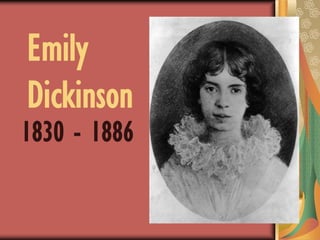
Emily
Dickinson
1830 - 1886
Born December 10, 1830 in Amherst, MA.
Educated at Amherst Academy.
At 17, began college at Mount Holyoke
Female Seminary; she became ill the
spring of her first year and did not return.
She would leave home only for short trips
for the remainder of her life, leading
scholars to speculate she may have been
agoraphobic.
Known for being a recluse, she didn’t
leave her family’s homestead for any
reason after the late 1860’s.
She almost always wore white.
She often lowered snacks and treats
in baskets to neighborhood children
from her window, careful never to let
them see her face.
Wrote many letters esp. love letters
to:
The Master Letters
Unknown man
Samuel Bowles
Dickinson’s editor
Susan Gilbert
Dickinson’s sister-in-law
Dickinson’s Poetry
Regular meter—hymn meter and
ballad meter, also known as Common
meter
Quatrains
The use of dashes
The use of capital letters
Influenced by nature and spiritual
themes
Dickinson’s Publishing Career
Sent poems to Thomas Wentworth
Higginson, a literary critic and family
friend.
He recognized her talent, but tried to
“improve” them, which made
Dickinson lose interest.
At the time of her death, only seven
of her poems had been published.
Publishing Career
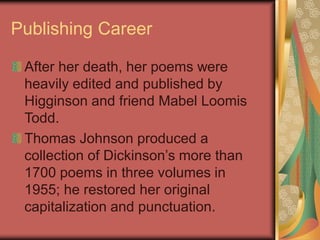
After her death, her poems were
heavily edited and published by
Higginson and friend Mabel Loomis
Todd.
Thomas Johnson produced a
collection of Dickinson’s more than
1700 poems in three volumes in
1955; he restored her original
capitalization and punctuation.
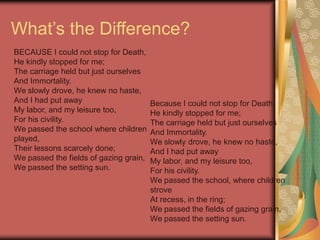
What’s the Difference?
BECAUSE I could not stop for Death,
He kindly stopped for me;
The carriage held but just ourselves
And Immortality.
We slowly drove, he knew no haste,
And I had put away
My labor, and my leisure too,
For his civility.
We passed the school where children
played,
Their lessons scarcely done;
We passed the fields of gazing grain,
We passed the setting sun.
Because I could not stop for Death,
He kindly stopped for me;
The carriage held but just ourselves
And Immortality.
We slowly drove, he knew no haste,
And I had put away
My labor, and my leisure too,
For his civility.
We passed the school, where children
strove
At recess, in the ring;
We passed the fields of gazing grain,
We passed the setting sun.
Dickinson’s Legacy
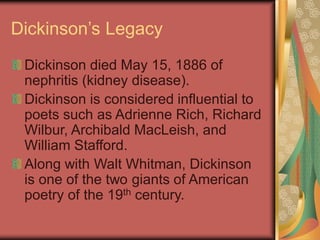
Dickinson died May 15, 1886 of
nephritis (kidney disease).
Dickinson is considered influential to
poets such as Adrienne Rich, Richard
Wilbur, Archibald MacLeish, and
William Stafford.
Along with Walt Whitman, Dickinson
is one of the two giants of American
poetry of the 19th century.
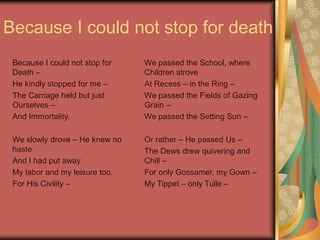
Because I could not stop for death
Because I could not stop for
Death –
He kindly stopped for me –
The Carriage held but just
Ourselves –
And Immortality.
We slowly drove – He knew no
haste
And I had put away
My labor and my leisure too,
For His Civility –
We passed the School, where
Children strove
At Recess – in the Ring –
We passed the Fields of Gazing
Grain –
We passed the Setting Sun –
Or rather – He passed Us –
The Dews drew quivering and
Chill –
For only Gossamer, my Gown –
My Tippet – only Tulle –
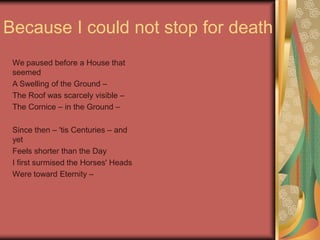
Because I could not stop for death
We paused before a House that
seemed
A Swelling of the Ground –
The Roof was scarcely visible –
The Cornice – in the Ground –
Since then – 'tis Centuries – and
yet
Feels shorter than the Day
I first surmised the Horses' Heads
Were toward Eternity –
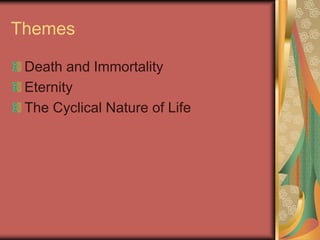
Themes
Death and Immortality
Eternity
The Cyclical Nature of Life
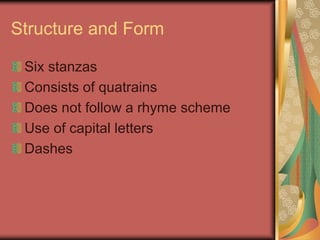
Structure and Form
Six stanzas
Consists of quatrains
Does not follow a rhyme scheme
Use of capital letters
Dashes
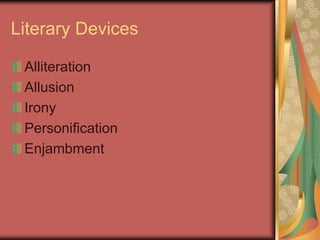
Literary Devices
Alliteration
Allusion
Irony
Personification
Enjambment

Topic 2. Because I could not stop for death.pdf

  • 1.
  • 2.
    Born December 10,1830 in Amherst, MA. Educated at Amherst Academy. At 17, began college at Mount Holyoke Female Seminary; she became ill the spring of her first year and did not return. She would leave home only for short trips for the remainder of her life, leading scholars to speculate she may have been agoraphobic.
  • 3.
    Known for beinga recluse, she didn’t leave her family’s homestead for any reason after the late 1860’s. She almost always wore white. She often lowered snacks and treats in baskets to neighborhood children from her window, careful never to let them see her face.
  • 4.
    Wrote many lettersesp. love letters to: The Master Letters Unknown man Samuel Bowles Dickinson’s editor Susan Gilbert Dickinson’s sister-in-law
  • 5.
    Dickinson’s Poetry Regular meter—hymnmeter and ballad meter, also known as Common meter Quatrains The use of dashes The use of capital letters Influenced by nature and spiritual themes
  • 6.
    Dickinson’s Publishing Career Sentpoems to Thomas Wentworth Higginson, a literary critic and family friend. He recognized her talent, but tried to “improve” them, which made Dickinson lose interest. At the time of her death, only seven of her poems had been published.
  • 7.
    Publishing Career After herdeath, her poems were heavily edited and published by Higginson and friend Mabel Loomis Todd. Thomas Johnson produced a collection of Dickinson’s more than 1700 poems in three volumes in 1955; he restored her original capitalization and punctuation.
  • 8.
    What’s the Difference? BECAUSEI could not stop for Death, He kindly stopped for me; The carriage held but just ourselves And Immortality. We slowly drove, he knew no haste, And I had put away My labor, and my leisure too, For his civility. We passed the school where children played, Their lessons scarcely done; We passed the fields of gazing grain, We passed the setting sun. Because I could not stop for Death, He kindly stopped for me; The carriage held but just ourselves And Immortality. We slowly drove, he knew no haste, And I had put away My labor, and my leisure too, For his civility. We passed the school, where children strove At recess, in the ring; We passed the fields of gazing grain, We passed the setting sun.
  • 9.
    Dickinson’s Legacy Dickinson diedMay 15, 1886 of nephritis (kidney disease). Dickinson is considered influential to poets such as Adrienne Rich, Richard Wilbur, Archibald MacLeish, and William Stafford. Along with Walt Whitman, Dickinson is one of the two giants of American poetry of the 19th century.
  • 10.
    Because I couldnot stop for death Because I could not stop for Death – He kindly stopped for me – The Carriage held but just Ourselves – And Immortality. We slowly drove – He knew no haste And I had put away My labor and my leisure too, For His Civility – We passed the School, where Children strove At Recess – in the Ring – We passed the Fields of Gazing Grain – We passed the Setting Sun – Or rather – He passed Us – The Dews drew quivering and Chill – For only Gossamer, my Gown – My Tippet – only Tulle –
  • 11.
    Because I couldnot stop for death We paused before a House that seemed A Swelling of the Ground – The Roof was scarcely visible – The Cornice – in the Ground – Since then – 'tis Centuries – and yet Feels shorter than the Day I first surmised the Horses' Heads Were toward Eternity –
  • 12.
  • 13.
    Structure and Form Sixstanzas Consists of quatrains Does not follow a rhyme scheme Use of capital letters Dashes
  • 14.