
Geo-Business Intelligence 
Benefits and implementation of geography 
within business intelligence 
by Didier Robert & Krishnakumar Satheesh
3 
Introduction.........................................................................................4 
Context: more and more geo..............................................................5 
How geography helps business........................................................6 
Definition and benefits of geo-BI......................................................7 
How to implement geo-BI..................................................................8 
Presentation 
definition, objectives, implementation
4 
Business Intelligence, as the name suggests is a practice to understand the right business drivers and factors to boost business & hence revenue. The practice of BI is now decades old and it has evolved and adapted to the global business scenario. 
It all started during the early 80’s when performance visualization was achieved through static reporting. Enterprises had access to Excel based reports for department views, data aggregation, information work-flows etc. This actually led to the growth of the various Management Information Systems & Executive Information Systems through the late 80’s. 
This practice has evolved to perform simple & complex multi-dimensional data analysis. 
Most of the businesses today are global and this calls for a new dimension for deriving better intelligence & information, Geography. Geography is not a new concept but something that has been in the database for long in the form of customer locations, addresses, office locations, delivery route, cabling route etc. The practice of linking geography to business parameters & deriving intelligence is called geo-BI. This may sound new, but the fact is by default most of the databases have geography disseminated across them. The system should use intelligent algorithms to consider the geographic perspective while delivering BI. 
The way consumers buy a product in America would be different from Australia or for that matter regional variations in consumer patterns exist also across regions within a country which any powerful BI cannot show, but a geographic BI can display parameters on a map along with other analytical intelligence making the BI space complete, for now. 
Geo-BI does not mean adding more data to the existing plethora of data, but utilizing the geographic information disseminated across existing databases. 
Geo-BI helps businesses analyze and understand business performance based on local potential, sales network coverage, local performance of Marketing Communications. 
Introduction
5 
Context: 
more and more geo 
Three trends explain the need & development of geo-BI within Companies: 
Mapmania 
Geography is more and more present in IT, either in BtoB and BtoC applications. Accessing a website with geo- location filters, viewing maps, proximity based searches, etc is becoming a common capability within many applications. Business Intelligence should not be an exception for this trend. 
Geographic optimization 
More and more Companies see the way they are geographically organized and the way they geographically operate as one of the profitability driver, something like a new frontier for business management. Understand and report business performance on a geographical basis - one of the geo-BI outcome - is part of this trend. 
Geographic possibilities 
Recently, geographic data has become affordable for many organization. Databases systems have integrated spatial extensions. Geographic technology also became easier and cheaper to integrate within a corporate system, for instance through web services. This makes geography accessible for almost all companies willing to incorporate this.
6 
How geography 
helps business 
Geography improves three major components of business: 
■ Strategy: geo helps to assess and target the right local markets, geo helps to adapt organizations to the defined local objectives. 
■ Operations: targeted local communication, sales visits, logistic deliveries... many operations largely benefit from geographic optimization. 
■ Performance: geographic solutions help to evaluate local performances and to understand over/under performance. 
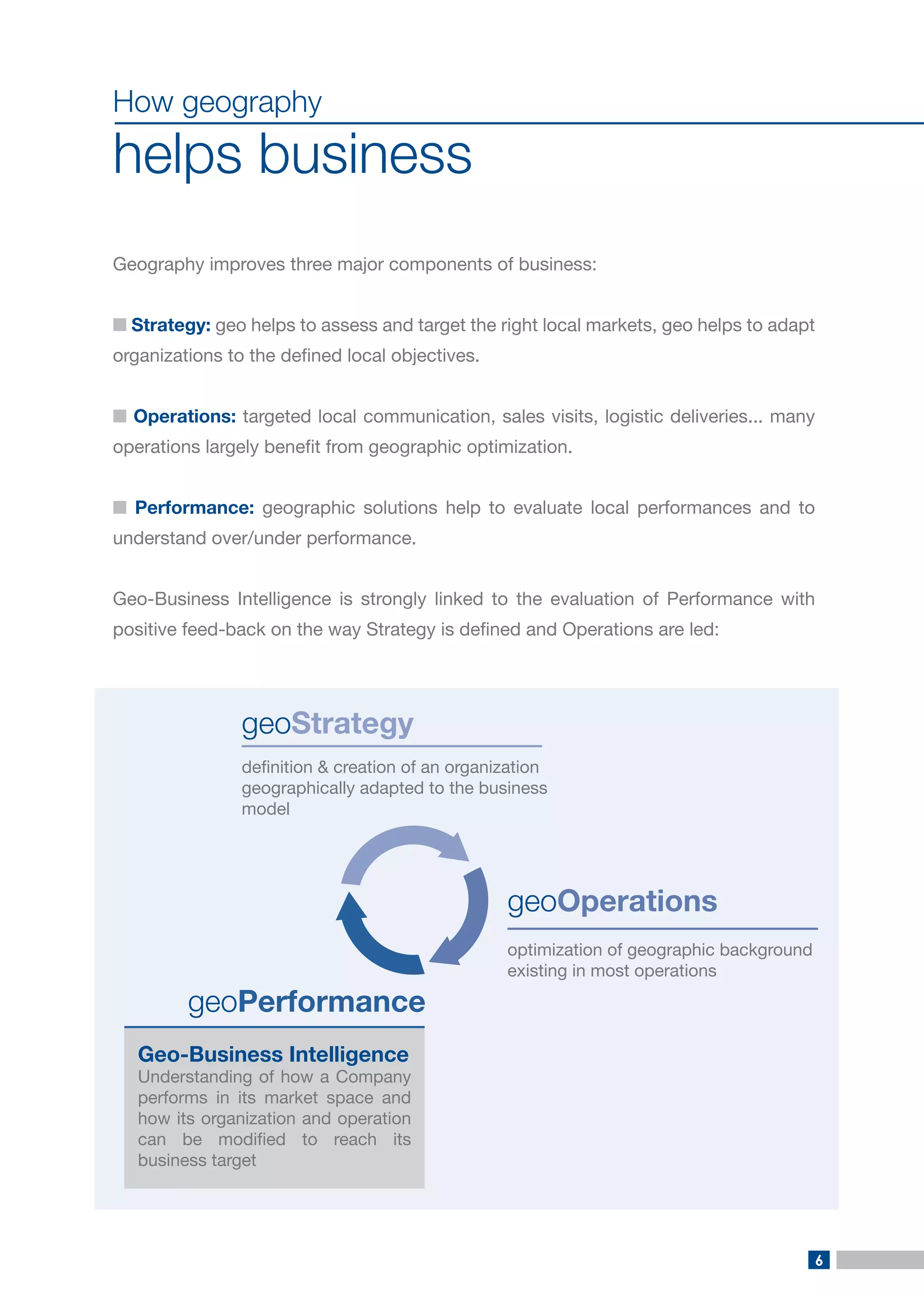
Geo-Business Intelligence is strongly linked to the evaluation of Performance with positive feed-back on the way Strategy is defined and Operations are led: 
geoStrategy 
geoOperations 
geoPerformance 
definition & creation of an organization 
geographically adapted to the business model 
optimization of geographic background existing in most operations 
Geo-Business Intelligence 
Understanding of how a Company performs in its market space and how its organization and operation can be modified to reach its business target
7 
Definition and benefits of 
geo-BI 
Broadly speaking, geoBI helps to understand market conditions and performance analysis for an organization, across business regions. Geography is powerful: it talks about local potential, local markets where everyday operations are performed, business achievements in a territory dominated by competition, purchasing potential etc. 
The key benefits, amongst other benefits delivered by geo-BI are : 
■ Sharing of objectives and common language within an organization 
Geo-BI helps to communicate market objectives to local operational teams. In other words, it desegregates global business plan at the lowest local level, the level of stores managers or sales districts managed by local representatives. Thus geo-BI helps all employees view the same business objective, but at a geographic level and this ensures focus & improved decision making. 
■ Performance analysis based on market potential 
The mapping of business indicators offers a clear view of how regional and local operations are performing. For instance, the display of sales results on a map helps instantaneously identify territory based performance. Moreover, geo-BI is helpful when it is based on the definition of geo-KPI: each store - and its catchment area - or each sales district have their own market potential and local competition structure thus KPI must be adapted to local markets. When taking these geographic differences into account, the analysis of results is more powerful and organizations enjoy smarter decision making. 
■ Problem Analysis 
A detailed geographic analysis of performance also helps to identify various problems: a change in consumer / customer pattern, local saturation of offer, aggressive local advertisements from competitors, etc. From these analysis, specific local decisions like an increase in local advertisements, modification of the pricing or merchandising strategy, disinvestment, etc can be decided.
8 
How to 
implement geo-BI 
The implementation of geo-BI within an organization requires 2 important prerequisites: 
1. Geography of business data should be stated 
Almost all data has geography disseminated across them. This needs to be recognized, structured and used within the company’s information system. For instance, all customers should have a standardized and geocoded address, all stores should be geolocated, all sales districts should be mapped, etc. 
2. Localization of market potential and objectives 
Once the Company’s geography mapped, local market potential and objective should be defined. This leads to the definition of geo-KPIs which leverage the power of geo- BI, not only in terms of «basic» mapping display of Company’s activity but also in terms of monitoring of local performance and achievements. 
The basic geo-BI solutions help: 
■ Easy mapping of activity indicators and local KPI’s; 
■ Navigation with respect to the organizational hierarchy of the Company (regions, stores network...) and the level of the user (store manager vs regional manager, sales reps vs head of sales...); 
■ Spatial query and computation of local indicators in order to create powerful market analysis and take better decisions; 
■ Encouragement of collaborative work with possibility to produce and share relevant geographic analysis and reports.
9 
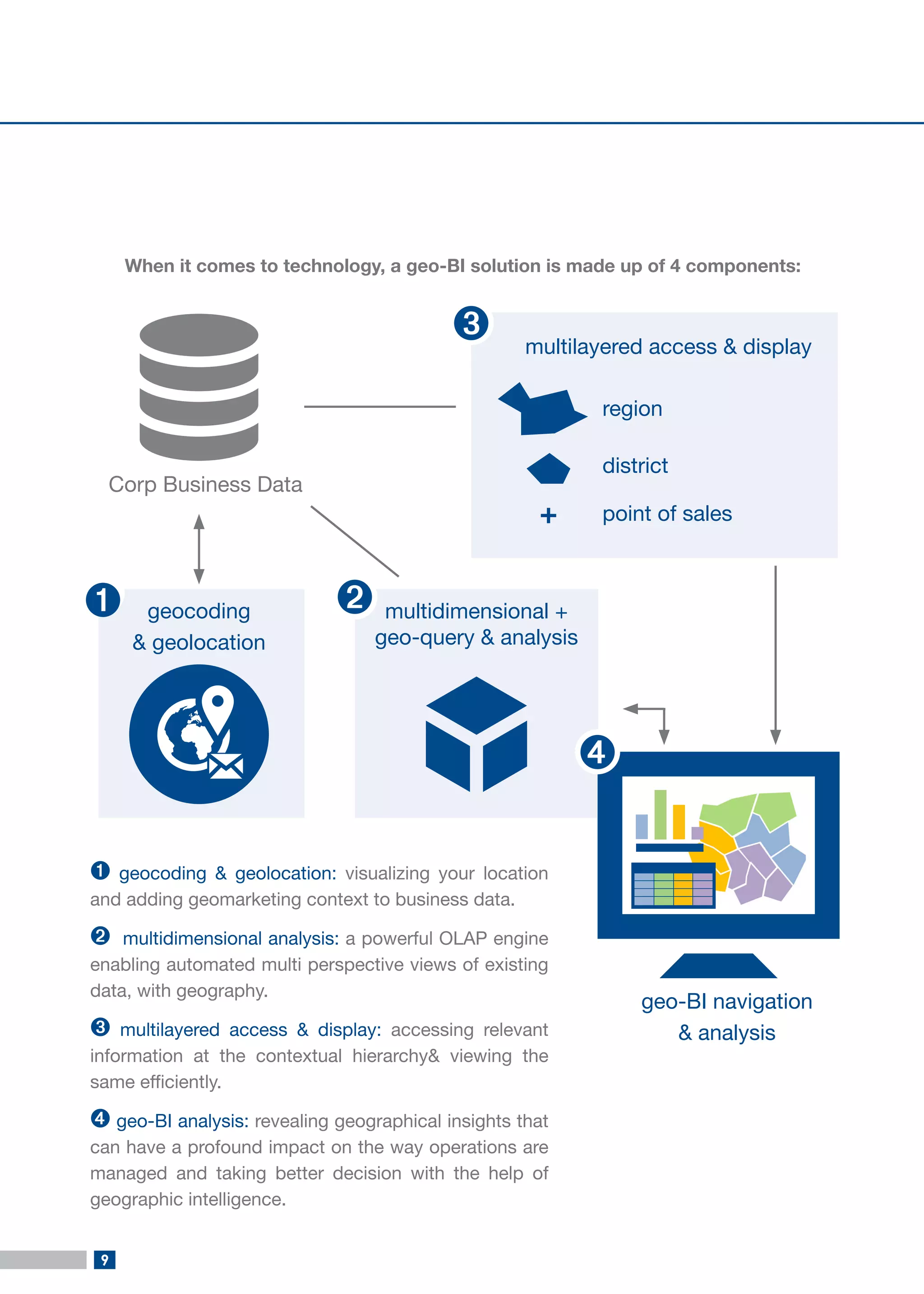
When it comes to technology, a geo-BI solution is made up of 4 components: 
geocoding 
& geolocation 
multilayered access & display 
region 
district 
point of sales 
+ 
multidimensional + 
geo-query & analysis 
➊ geocoding & geolocation: visualizing your location and adding geomarketing context to business data. 
➋ multidimensional analysis: a powerful OLAP engine enabling automated multi perspective views of existing data, with geography. 
➌ multilayered access & display: accessing relevant information at the contextual hierarchy& viewing the same efficiently. 
➍ geo-BI analysis: revealing geographical insights that can have a profound impact on the way operations are managed and taking better decision with the help of geographic intelligence. 
Corp Business Data 
➊ 
➋ 
➌ 
➍ 
geo-BI navigation 
& analysis
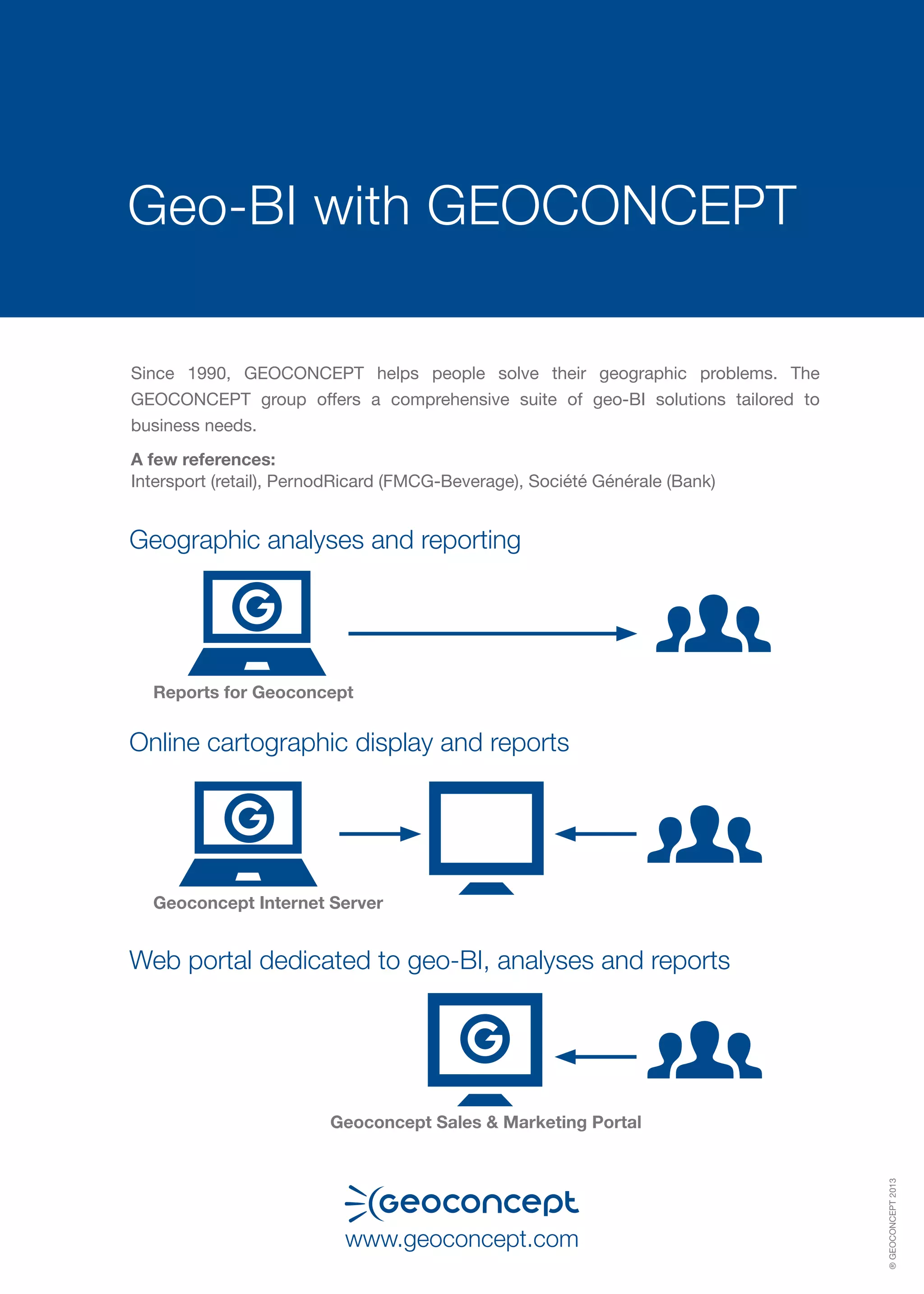
Since 1990, GEOCONCEPT helps people solve their geographic problems. The GEOCONCEPT group offers a comprehensive suite of geo-BI solutions tailored to business needs. 
A few references: 
Intersport (retail), PernodRicard (FMCG-Beverage), Société Générale (Bank) 
www.geoconcept.com 
Geo-BI with GEOCONCEPT 
® GEOCONCEPT 2013 
Geographic analyses and reporting 
Reports for Geoconcept 
Geoconcept Internet Server 
Geoconcept Sales & Marketing Portal 
Online cartographic display and reports 
Web portal dedicated to geo-BI, analyses and reports

Benefits and implementation of geography within business intelligence

  • 1.
    Geo-Business Intelligence Benefitsand implementation of geography within business intelligence by Didier Robert & Krishnakumar Satheesh
  • 3.
    3 Introduction.........................................................................................4 Context:more and more geo..............................................................5 How geography helps business........................................................6 Definition and benefits of geo-BI......................................................7 How to implement geo-BI..................................................................8 Presentation definition, objectives, implementation
  • 4.
    4 Business Intelligence,as the name suggests is a practice to understand the right business drivers and factors to boost business & hence revenue. The practice of BI is now decades old and it has evolved and adapted to the global business scenario. It all started during the early 80’s when performance visualization was achieved through static reporting. Enterprises had access to Excel based reports for department views, data aggregation, information work-flows etc. This actually led to the growth of the various Management Information Systems & Executive Information Systems through the late 80’s. This practice has evolved to perform simple & complex multi-dimensional data analysis. Most of the businesses today are global and this calls for a new dimension for deriving better intelligence & information, Geography. Geography is not a new concept but something that has been in the database for long in the form of customer locations, addresses, office locations, delivery route, cabling route etc. The practice of linking geography to business parameters & deriving intelligence is called geo-BI. This may sound new, but the fact is by default most of the databases have geography disseminated across them. The system should use intelligent algorithms to consider the geographic perspective while delivering BI. The way consumers buy a product in America would be different from Australia or for that matter regional variations in consumer patterns exist also across regions within a country which any powerful BI cannot show, but a geographic BI can display parameters on a map along with other analytical intelligence making the BI space complete, for now. Geo-BI does not mean adding more data to the existing plethora of data, but utilizing the geographic information disseminated across existing databases. Geo-BI helps businesses analyze and understand business performance based on local potential, sales network coverage, local performance of Marketing Communications. Introduction
  • 5.
    5 Context: moreand more geo Three trends explain the need & development of geo-BI within Companies: Mapmania Geography is more and more present in IT, either in BtoB and BtoC applications. Accessing a website with geo- location filters, viewing maps, proximity based searches, etc is becoming a common capability within many applications. Business Intelligence should not be an exception for this trend. Geographic optimization More and more Companies see the way they are geographically organized and the way they geographically operate as one of the profitability driver, something like a new frontier for business management. Understand and report business performance on a geographical basis - one of the geo-BI outcome - is part of this trend. Geographic possibilities Recently, geographic data has become affordable for many organization. Databases systems have integrated spatial extensions. Geographic technology also became easier and cheaper to integrate within a corporate system, for instance through web services. This makes geography accessible for almost all companies willing to incorporate this.
  • 6.
    6 How geography helps business Geography improves three major components of business: ■ Strategy: geo helps to assess and target the right local markets, geo helps to adapt organizations to the defined local objectives. ■ Operations: targeted local communication, sales visits, logistic deliveries... many operations largely benefit from geographic optimization. ■ Performance: geographic solutions help to evaluate local performances and to understand over/under performance. Geo-Business Intelligence is strongly linked to the evaluation of Performance with positive feed-back on the way Strategy is defined and Operations are led: geoStrategy geoOperations geoPerformance definition & creation of an organization geographically adapted to the business model optimization of geographic background existing in most operations Geo-Business Intelligence Understanding of how a Company performs in its market space and how its organization and operation can be modified to reach its business target
  • 7.
    7 Definition andbenefits of geo-BI Broadly speaking, geoBI helps to understand market conditions and performance analysis for an organization, across business regions. Geography is powerful: it talks about local potential, local markets where everyday operations are performed, business achievements in a territory dominated by competition, purchasing potential etc. The key benefits, amongst other benefits delivered by geo-BI are : ■ Sharing of objectives and common language within an organization Geo-BI helps to communicate market objectives to local operational teams. In other words, it desegregates global business plan at the lowest local level, the level of stores managers or sales districts managed by local representatives. Thus geo-BI helps all employees view the same business objective, but at a geographic level and this ensures focus & improved decision making. ■ Performance analysis based on market potential The mapping of business indicators offers a clear view of how regional and local operations are performing. For instance, the display of sales results on a map helps instantaneously identify territory based performance. Moreover, geo-BI is helpful when it is based on the definition of geo-KPI: each store - and its catchment area - or each sales district have their own market potential and local competition structure thus KPI must be adapted to local markets. When taking these geographic differences into account, the analysis of results is more powerful and organizations enjoy smarter decision making. ■ Problem Analysis A detailed geographic analysis of performance also helps to identify various problems: a change in consumer / customer pattern, local saturation of offer, aggressive local advertisements from competitors, etc. From these analysis, specific local decisions like an increase in local advertisements, modification of the pricing or merchandising strategy, disinvestment, etc can be decided.
  • 8.
    8 How to implement geo-BI The implementation of geo-BI within an organization requires 2 important prerequisites: 1. Geography of business data should be stated Almost all data has geography disseminated across them. This needs to be recognized, structured and used within the company’s information system. For instance, all customers should have a standardized and geocoded address, all stores should be geolocated, all sales districts should be mapped, etc. 2. Localization of market potential and objectives Once the Company’s geography mapped, local market potential and objective should be defined. This leads to the definition of geo-KPIs which leverage the power of geo- BI, not only in terms of «basic» mapping display of Company’s activity but also in terms of monitoring of local performance and achievements. The basic geo-BI solutions help: ■ Easy mapping of activity indicators and local KPI’s; ■ Navigation with respect to the organizational hierarchy of the Company (regions, stores network...) and the level of the user (store manager vs regional manager, sales reps vs head of sales...); ■ Spatial query and computation of local indicators in order to create powerful market analysis and take better decisions; ■ Encouragement of collaborative work with possibility to produce and share relevant geographic analysis and reports.
  • 9.
    9 When itcomes to technology, a geo-BI solution is made up of 4 components: geocoding & geolocation multilayered access & display region district point of sales + multidimensional + geo-query & analysis ➊ geocoding & geolocation: visualizing your location and adding geomarketing context to business data. ➋ multidimensional analysis: a powerful OLAP engine enabling automated multi perspective views of existing data, with geography. ➌ multilayered access & display: accessing relevant information at the contextual hierarchy& viewing the same efficiently. ➍ geo-BI analysis: revealing geographical insights that can have a profound impact on the way operations are managed and taking better decision with the help of geographic intelligence. Corp Business Data ➊ ➋ ➌ ➍ geo-BI navigation & analysis
  • 10.
    Since 1990, GEOCONCEPThelps people solve their geographic problems. The GEOCONCEPT group offers a comprehensive suite of geo-BI solutions tailored to business needs. A few references: Intersport (retail), PernodRicard (FMCG-Beverage), Société Générale (Bank) www.geoconcept.com Geo-BI with GEOCONCEPT ® GEOCONCEPT 2013 Geographic analyses and reporting Reports for Geoconcept Geoconcept Internet Server Geoconcept Sales & Marketing Portal Online cartographic display and reports Web portal dedicated to geo-BI, analyses and reports