CHARTING SPATIAL
BUSINESS TRANSFORMATION
An in-depth look at the business patterns of GIS and
location intelligence adoption in the private sector
EXECUTIVE SUMMARY
The global use of geographic information systems (GIS) and location analytics
is expected to double by 2023, becoming a $10 billion industry. A key driver
in this growth is the use of location intelligence by the private sector. With 80%
of business data containing geographic information, GIS promises insights into
business strategies and decisions that can enhance business success.
The purpose of this industry survey is to develop an in-depth understanding
of business patterns of GIS/location analytics use. The focus of the study is
on location value chain, which is the value of location intelligence across a
spectrum of business functions. In a related manner, the study also analyzes
the level of spatial business maturity, which is the depth of GIS enterprise
integration that enables sustained business use of locational intelligence.
The survey found that business value of GIS in these companies spans across
several business functions, with 86% reporting substantial use in more than one
department. Further, location analytics use is poised for considerable growth in
delivering business value over the next three years, with 38-51% expected high
GIS use in three years for top business functions such as business research
and development, sales, marketing, and operations.
The survey also found that 22% of surveyed companies have achieved a high
level of spatial business maturity in using locational intelligence for competitive
advantage and key to achieving this level of maturity is having high perceived
value of location-based customer and business insights, a coherent GIS
strategy, best-in-class technology, executive support and sponsorship, and
clear articulation of the return on investment from GIS.
The study also provides insights on how companies can progress to achieve
“spatial transformation,” namely achieving integrated value from location
intelligence for business success. Five specific actions are recommended
including: pursue multi-function business growth, focus on customer and
operational opportunities, develop a means to assess the value and ROI of
location analytics, develop a clear and cohesive location intelligence strategy.
86%
Businesses use
location analytics
in more than one
organizational function.
59%
Businesses perceive
value in location-based
business and consumer
insights.
22%
Businesses are currently
best-in-class, spatially
mature enterprises.
38-51%
Expected high GIS use
in three years for top
business functions.
HIGHLIGHTS
CURRENT GIS VALUE CHAIN
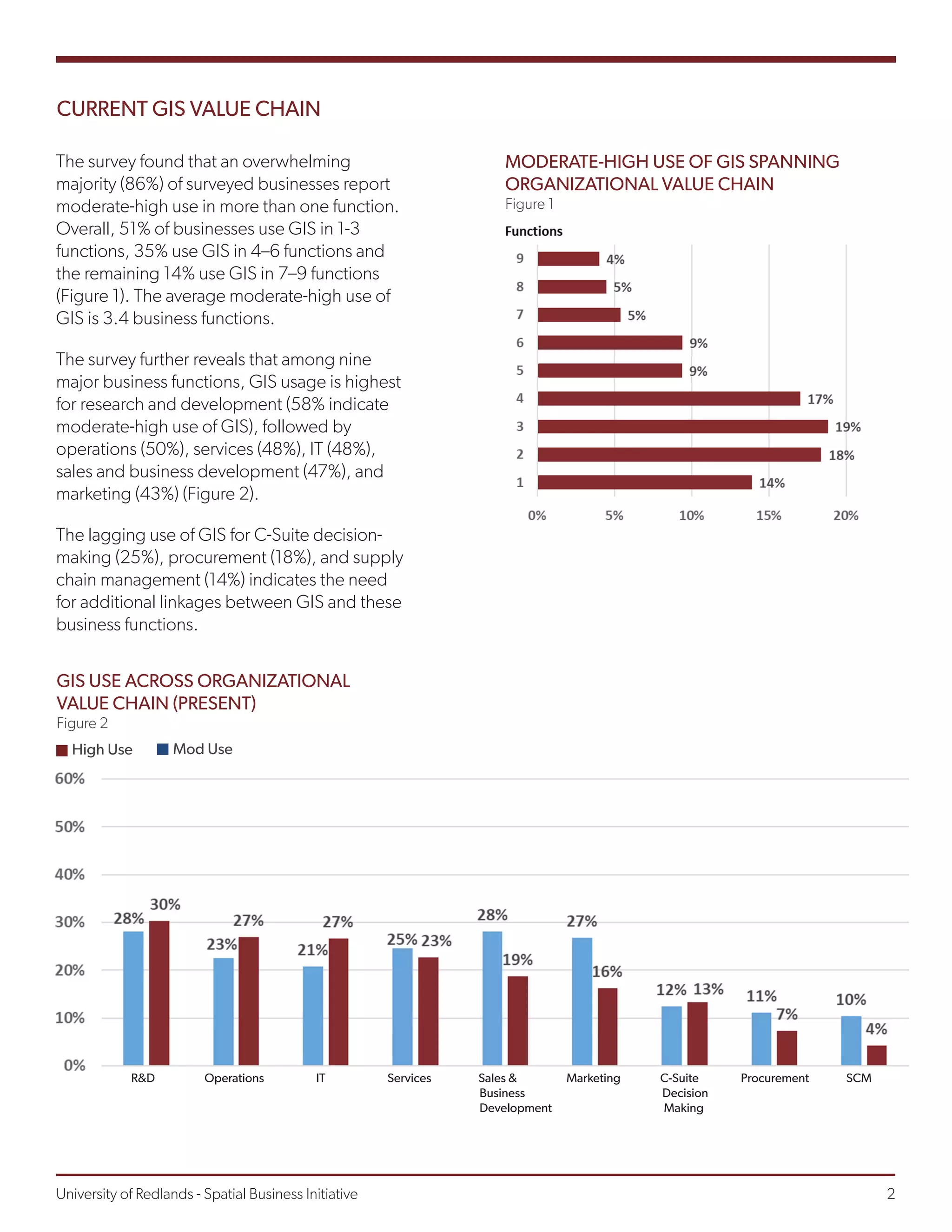
The survey found that an overwhelming
majority (86%) of surveyed businesses report
moderate-high use in more than one function.
Overall, 51% of businesses use GIS in 1-3
functions, 35% use GIS in 4–6 functions and
the remaining 14% use GIS in 7–9 functions
(Figure 1). The average moderate-high use of
GIS is 3.4 business functions.
The survey further reveals that among nine
major business functions, GIS usage is highest
for research and development (58% indicate
moderate-high use of GIS), followed by
operations (50%), services (48%), IT (48%),
sales and business development (47%), and
marketing (43%) (Figure 2).
The lagging use of GIS for C-Suite decision-
making (25%), procurement (18%), and supply
chain management (14%) indicates the need
for additional linkages between GIS and these
business functions.
MODERATE-HIGH USE OF GIS SPANNING
ORGANIZATIONAL VALUE CHAIN
Figure 1
GIS USE ACROSS ORGANIZATIONAL
VALUE CHAIN (PRESENT)
Figure 2
High Use Mod Use
	 R&D Operations IT Services Sales & Marketing C-Suite Procurement SCM
		 					 Business	 	 Decision
							 Development		 Making
University of Redlands - Spatial Business Initiative									 2
CUSTOMER CENTRIC ACTIVITIES
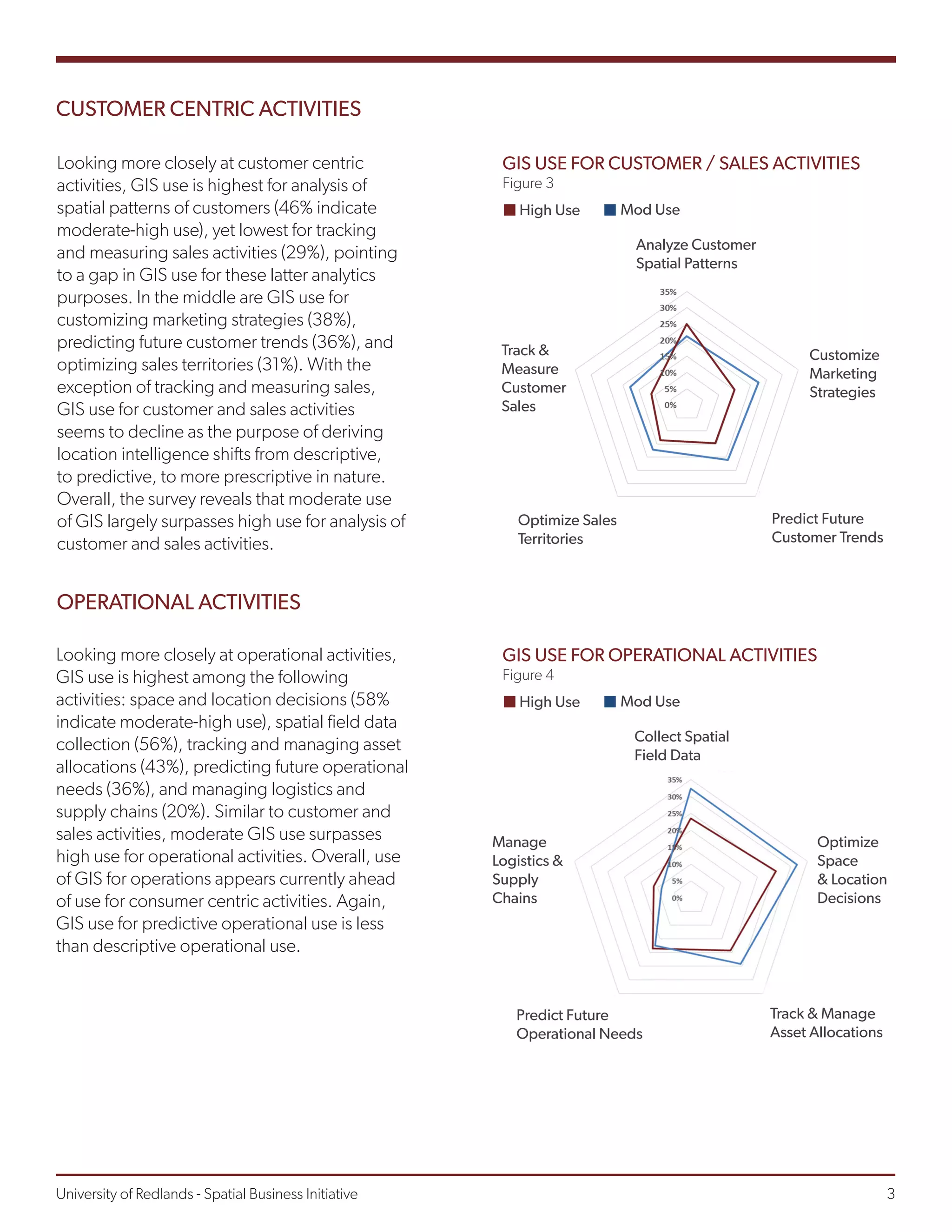
Looking more closely at customer centric
activities, GIS use is highest for analysis of
spatial patterns of customers (46% indicate
moderate-high use), yet lowest for tracking
and measuring sales activities (29%), pointing
to a gap in GIS use for these latter analytics
purposes. In the middle are GIS use for
customizing marketing strategies (38%),
predicting future customer trends (36%), and
optimizing sales territories (31%). With the
exception of tracking and measuring sales,
GIS use for customer and sales activities
seems to decline as the purpose of deriving
location intelligence shifts from descriptive,
to predictive, to more prescriptive in nature.
Overall, the survey reveals that moderate use
of GIS largely surpasses high use for analysis of
customer and sales activities.
OPERATIONAL ACTIVITIES
Looking more closely at operational activities,
GIS use is highest among the following
activities: space and location decisions (58%
indicate moderate-high use), spatial field data
collection (56%), tracking and managing asset
allocations (43%), predicting future operational
needs (36%), and managing logistics and
supply chains (20%). Similar to customer and
sales activities, moderate GIS use surpasses
high use for operational activities. Overall, use
of GIS for operations appears currently ahead
of use for consumer centric activities. Again,
GIS use for predictive operational use is less
than descriptive operational use.
GIS USE FOR CUSTOMER / SALES ACTIVITIES
Figure 3
Analyze Customer
Spatial Patterns
Customize
Marketing
Strategies
Predict Future
Customer Trends
Optimize Sales
Territories
Track &
Measure
Customer
Sales
High Use Mod Use
GIS USE FOR OPERATIONAL ACTIVITIES
Figure 4
Collect Spatial
Field Data
Optimize
Space
& Location
Decisions
Track & Manage
Asset Allocations
Predict Future
Operational Needs
Manage
Logistics &
Supply
Chains
High Use Mod Use
University of Redlands - Spatial Business Initiative									 3
STRATEGIC OBJECTIVES
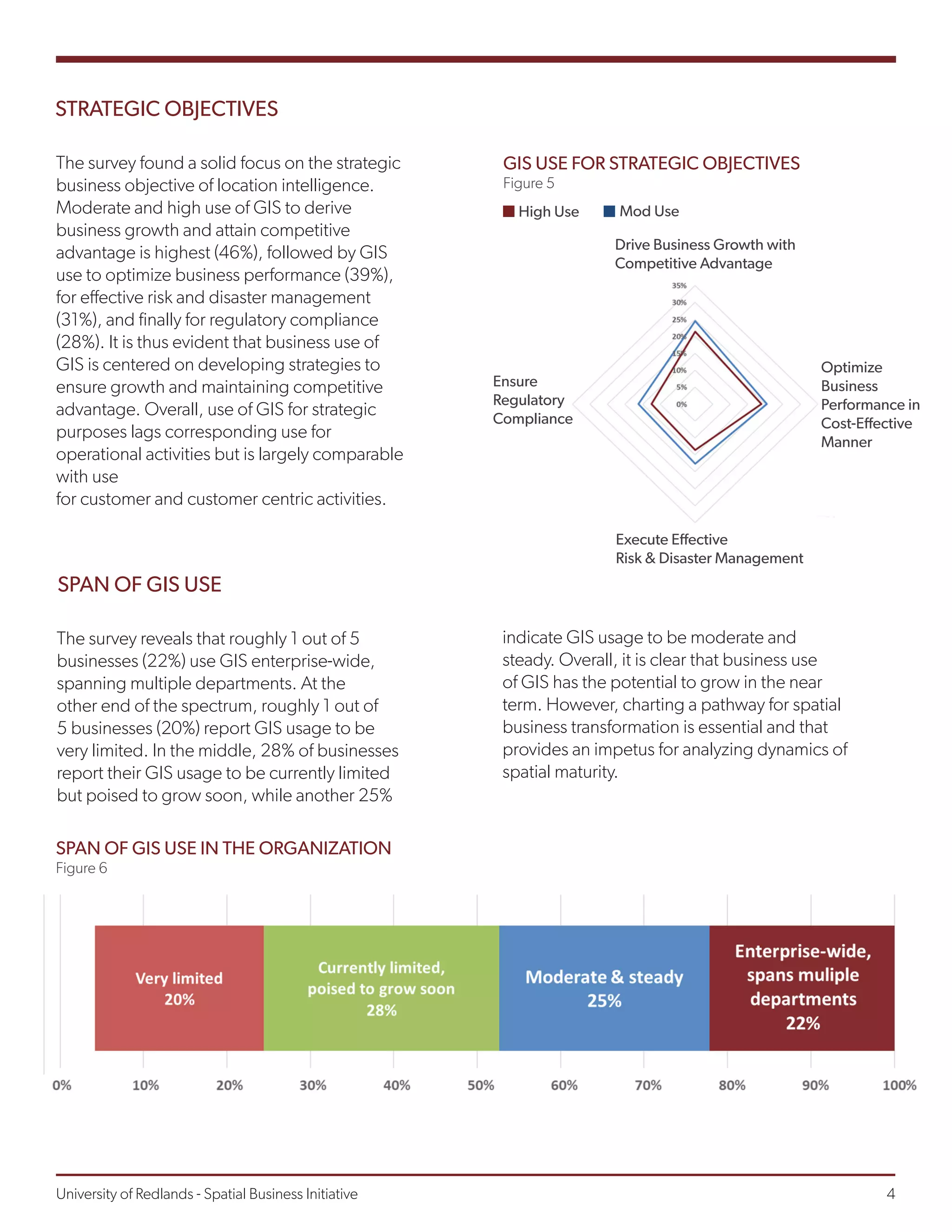
The survey found a solid focus on the strategic
business objective of location intelligence.
Moderate and high use of GIS to derive
business growth and attain competitive
advantage is highest (46%), followed by GIS
use to optimize business performance (39%),
for effective risk and disaster management
(31%), and finally for regulatory compliance
(28%). It is thus evident that business use of
GIS is centered on developing strategies to
ensure growth and maintaining competitive
advantage. Overall, use of GIS for strategic
purposes lags corresponding use for
operational activities but is largely comparable
with use
for customer and customer centric activities.
GIS USE FOR STRATEGIC OBJECTIVES
Figure 5
Drive Business Growth with
Competitive Advantage
Optimize
Business
Performance in
Cost-Effective
Manner
Execute Effective
Risk & Disaster Management
Ensure
Regulatory
Compliance
High Use Mod Use
SPAN OF GIS USE IN THE ORGANIZATION
Figure 6
SPAN OF GIS USE
The survey reveals that roughly 1 out of 5
businesses (22%) use GIS enterprise-wide,
spanning multiple departments. At the
other end of the spectrum, roughly 1 out of
5 businesses (20%) report GIS usage to be
very limited. In the middle, 28% of businesses
report their GIS usage to be currently limited
but poised to grow soon, while another 25%
indicate GIS usage to be moderate and
steady. Overall, it is clear that business use
of GIS has the potential to grow in the near
term. However, charting a pathway for spatial
business transformation is essential and that
provides an impetus for analyzing dynamics of
spatial maturity.
University of Redlands - Spatial Business Initiative									 4
CURRENT SPATIAL MATURITY
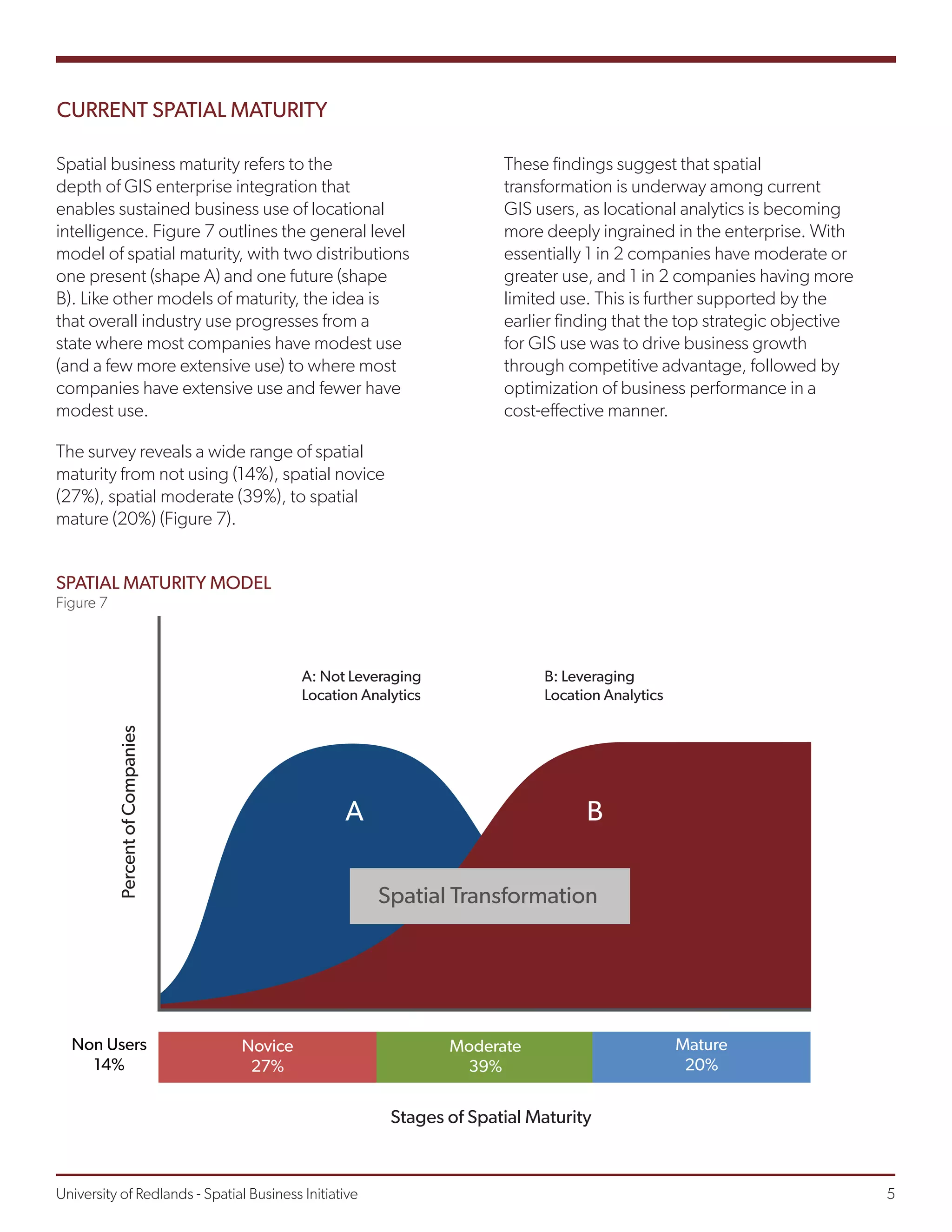
Spatial business maturity refers to the
depth of GIS enterprise integration that
enables sustained business use of locational
intelligence. Figure 7 outlines the general level
model of spatial maturity, with two distributions
one present (shape A) and one future (shape
B). Like other models of maturity, the idea is
that overall industry use progresses from a
state where most companies have modest use
(and a few more extensive use) to where most
companies have extensive use and fewer have
modest use.
The survey reveals a wide range of spatial
maturity from not using (14%), spatial novice
(27%), spatial moderate (39%), to spatial
mature (20%) (Figure 7).
These findings suggest that spatial
transformation is underway among current
GIS users, as locational analytics is becoming
more deeply ingrained in the enterprise. With
essentially 1 in 2 companies have moderate or
greater use, and 1 in 2 companies having more
limited use. This is further supported by the
earlier finding that the top strategic objective
for GIS use was to drive business growth
through competitive advantage, followed by
optimization of business performance in a
cost-effective manner.
Stages of Spatial Maturity
Novice
27%
Moderate
39%
Mature
20%
SPATIAL MATURITY MODEL
Figure 7
Non Users
14%
PercentofCompanies
A: Not Leveraging
Location Analytics
B: Leveraging
Location Analytics
A B
Spatial Transformation
University of Redlands - Spatial Business Initiative									 5
VALUE CHAIN IN 3 YEARS
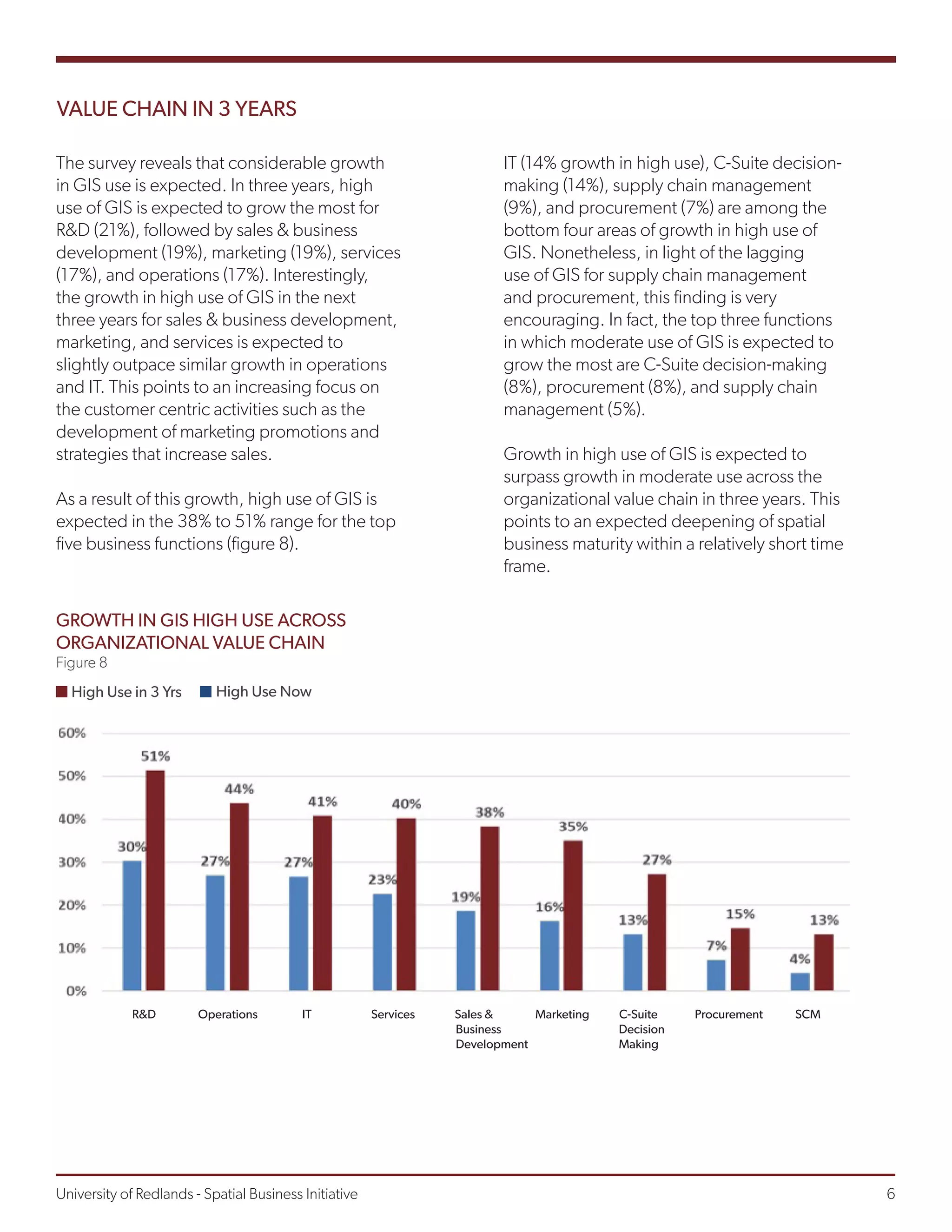
The survey reveals that considerable growth
in GIS use is expected. In three years, high
use of GIS is expected to grow the most for
R&D (21%), followed by sales & business
development (19%), marketing (19%), services
(17%), and operations (17%). Interestingly,
the growth in high use of GIS in the next
three years for sales & business development,
marketing, and services is expected to
slightly outpace similar growth in operations
and IT. This points to an increasing focus on
the customer centric activities such as the
development of marketing promotions and
strategies that increase sales.
As a result of this growth, high use of GIS is
expected in the 38% to 51% range for the top
five business functions (figure 8).
GROWTH IN GIS HIGH USE ACROSS
ORGANIZATIONAL VALUE CHAIN
Figure 8
High Use in 3 Yrs High Use Now
IT (14% growth in high use), C-Suite decision-
making (14%), supply chain management
(9%), and procurement (7%) are among the
bottom four areas of growth in high use of
GIS. Nonetheless, in light of the lagging
use of GIS for supply chain management
and procurement, this finding is very
encouraging. In fact, the top three functions
in which moderate use of GIS is expected to
grow the most are C-Suite decision-making
(8%), procurement (8%), and supply chain
management (5%).
Growth in high use of GIS is expected to
surpass growth in moderate use across the
organizational value chain in three years. This
points to an expected deepening of spatial
business maturity within a relatively short time
frame.
	 R&D Operations IT Services Sales & Marketing C-Suite Procurement SCM
		 					 Business	 	 Decision
							 Development		 Making
University of Redlands - Spatial Business Initiative									 6
DRIVERS OF SPATIAL MATURITY
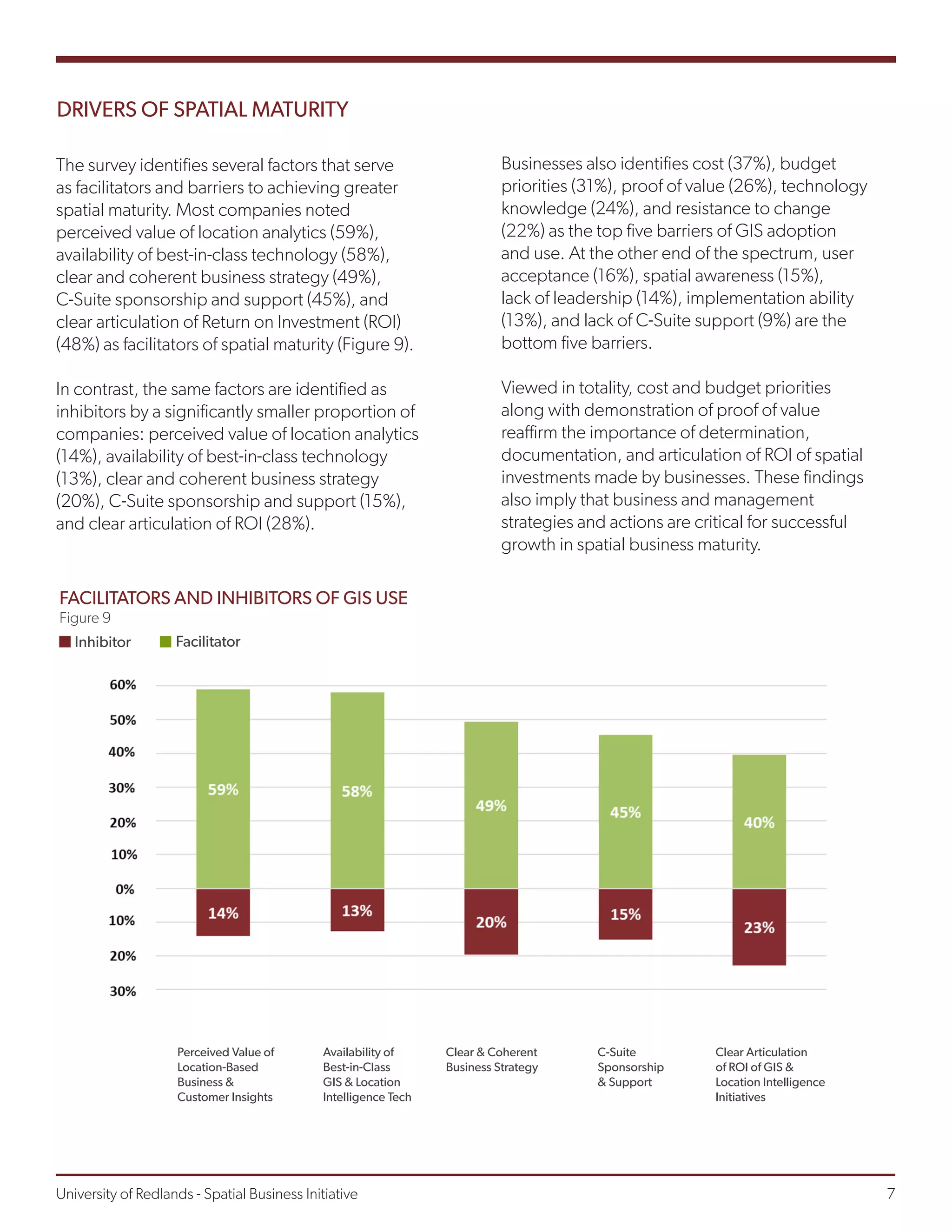
The survey identifies several factors that serve
as facilitators and barriers to achieving greater
spatial maturity. Most companies noted
perceived value of location analytics (59%),
availability of best-in-class technology (58%),
clear and coherent business strategy (49%),
C-Suite sponsorship and support (45%), and
clear articulation of Return on Investment (ROI)
(48%) as facilitators of spatial maturity (Figure 9).
In contrast, the same factors are identified as
inhibitors by a significantly smaller proportion of
companies: perceived value of location analytics
(14%), availability of best-in-class technology
(13%), clear and coherent business strategy
(20%), C-Suite sponsorship and support (15%),
and clear articulation of ROI (28%).
Businesses also identifies cost (37%), budget
priorities (31%), proof of value (26%), technology
knowledge (24%), and resistance to change
(22%) as the top five barriers of GIS adoption
and use. At the other end of the spectrum, user
acceptance (16%), spatial awareness (15%),
lack of leadership (14%), implementation ability
(13%), and lack of C-Suite support (9%) are the
bottom five barriers.
Viewed in totality, cost and budget priorities
along with demonstration of proof of value
reaffirm the importance of determination,
documentation, and articulation of ROI of spatial
investments made by businesses. These findings
also imply that business and management
strategies and actions are critical for successful
growth in spatial business maturity.
FACILITATORS AND INHIBITORS OF GIS USE
Figure 9
Inhibitor Facilitator
Perceived Value of
Location-Based
Business &
Customer Insights
Availability of
Best-in-Class
GIS & Location
Intelligence Tech
Clear & Coherent
Business Strategy
C-Suite
Sponsorship
& Support
Clear Articulation
of ROI of GIS &
Location Intelligence
Initiatives
University of Redlands - Spatial Business Initiative									 7
ATTRIBUTES OF SPATIAL MATURITY
The survey indicates the extent to which
perceived value of location analytics,
availability of best-in-class technology, clear
and coherent business strategy, C-Suite
sponsorship and support, and clear articulation
of ROI are viewed as differentiators of spatial
maturity. A very high proportion of spatially
mature companies (over 70%) perceive these
factors as facilitators, while the strength of
these facilitators declines as one slides down
the scale of spatial maturity with the largest
reported gap between spatially mature
industry leaders versus spatial novices for ROI
of GIS initiatives (Figure 10).
Earlier, this report provided insights into GIS
use for customer and operational activities.
Perceived Value of
Location-Based
Business &
Customer Insights
Availability of
Best-in-Class GIS &
Location Intelligence
Technology
Clear & Coherent
Business Strategy
C-Suite Sponsorship
& Support
Clear Articulation of ROI of
GIS & Location Intelligence
Initiatives
Novice in GIS
Moved Beyond Novice Stage, Yet to Attain Spatial Maturity
Spatially Mature Business with Enterprise-Wide GIS
Spatially Mature Industry Leader and Deploys GIS for Competitive Advantage
ANATOMY OF A SPATIALLY MATURE BUSINESS
Figure 10
From this analysis, it is clear that spatially
mature companies are more focused on
using GIS to analyze spatial patterns of
customers (67%), predict customer trends
(61%), customize marketing strategies (44%),
and optimize sales territories (33%). Spatially
mature companies are also more focused on
applying GIS across operations, including
optimizing locations (68%), collecting spatial
field data (58%), predicting future operational
needs (37%), managing logistics and supply
chains (32%), and tracking and managing
assets (32%).
While spatial maturity entails finding location
value across a range of business functions,
customer and operational dimensions are
critical for realizing locational value tied to
business success.
University of Redlands - Spatial Business Initiative									 8
CHARTING TRANSFORMATION
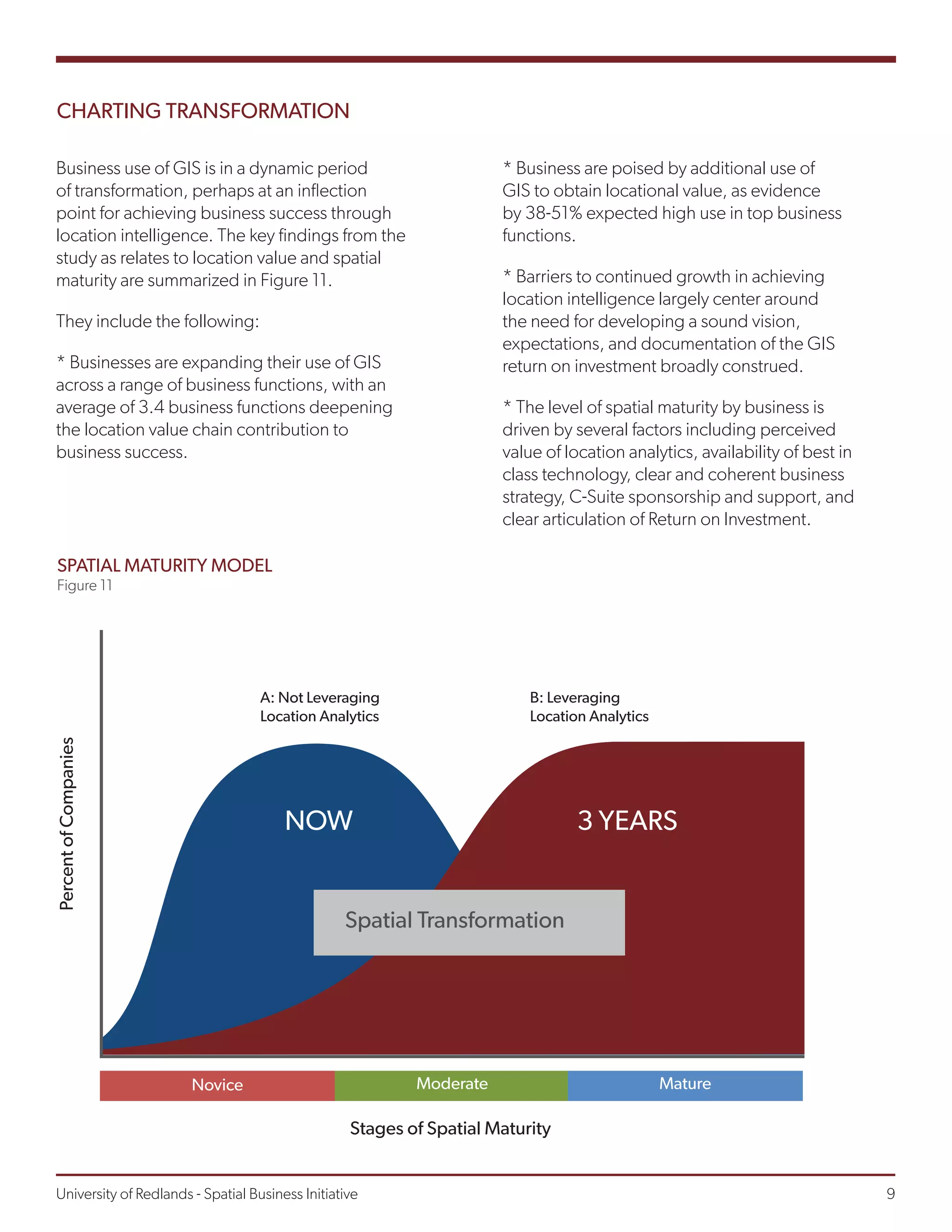
Business use of GIS is in a dynamic period
of transformation, perhaps at an inflection
point for achieving business success through
location intelligence. The key findings from the
study as relates to location value and spatial
maturity are summarized in Figure 11.
They include the following:
* Businesses are expanding their use of GIS
across a range of business functions, with an
average of 3.4 business functions deepening
the location value chain contribution to
business success.
* Business are poised by additional use of
GIS to obtain locational value, as evidence
by 38-51% expected high use in top business
functions.
* Barriers to continued growth in achieving
location intelligence largely center around
the need for developing a sound vision,
expectations, and documentation of the GIS
return on investment broadly construed.
* The level of spatial maturity by business is
driven by several factors including perceived
value of location analytics, availability of best in
class technology, clear and coherent business
strategy, C-Suite sponsorship and support, and
clear articulation of Return on Investment.
Stages of Spatial Maturity
Novice Moderate Mature
SPATIAL MATURITY MODEL
Figure 11
University of Redlands - Spatial Business Initiative									 9
PercentofCompanies
A: Not Leveraging
Location Analytics
B: Leveraging
Location Analytics
NOW 3 YEARS
Spatial Transformation
SPATIAL TRANSFORMER ACTIONS
The business growth in location intelligence use
is highly dependent on actions taken within the
company to advance GIS implementations in a
value-added manner. The survey results support
the following five actions that can be taken to
enhance business success through location
intelligence:
1) Multi-Function Growth: Assess opportunities
to expand GIS usage across multiple business
functions as relates to business needs. Consider
the most natural evolution points within the
business where location intelligence can make a
significant contribution.
2) Customer/Operations: Customer centric
and operations represent particular strong
opportunities for value creation through location
intelligence and should closely be considered
and pursued, as appropriate to the nature of the
business.
3) Value Focus: Develop a consistent means
to consider and assess the value of location
analytics to the business, from both qualitative and
quantitative perspectives. ROI should be tracked
and communicated through the management
chain.
4) Business Strategy: Develop a strategic
approach to GIS that links the value of location
intelligence to key growth, competitiveness,
cost-efficiency, and risk management goals of the
business.
5) Management Support: Secure C-Suite support
for location intelligence strategy by having a clear
and compelling articulation of the business need
and value of GIS use in the business.
*Full report of survey findings
with additional analysis.
*Follow-on research on location
value and implications for realizing
business gain.
*Case studies and lessons learned
from best-in-class spatially mature
businesses.
SPATIAL BUSINESS INITIATIVE
NEXT STEPS:
University of Redlands - Spatial Business Initiative									 10
ABOUT THE SURVEY
The analysis and findings in this report
are based on a comprehensive survey
that was developed to obtain an in-depth
understanding of business patterns of GIS
and location intelligence use. The focus of the
study is on locational value chain in businesses,
and how such businesses advance in their
spatial maturity in use of location intelligence.
The survey was developed by faculty
researchers and graduate students at the
University of Redlands School of Business and
administered electronically to a large database
of Esri business partners, clients, and users in
June 2018. The findings in this report are based
on a sample size of close to 300 responses
with sample size varying for questions
depending on non-response rates (2–7%). 67%
of all respondents were from the United States.
For 60% of respondents, GIS and location
intelligence were the primary responsibility.
35% of respondents were in organizations with
at least 1,000 employees, and close to 20%
had an IT workforce of at least 100. Real Estate
(14%), Professional, Scientific, and Technical
Services (10%), IT (7%), Retail (6.25%), and
Utilities (6.25%) were the five leading industry
categories among respondents. Responses
were aggregated, descriptive statistics were
computed, and data visualizations were
developed using statistical and analytical
software packages.
The Spatial Business Initiative is a unique
partnership between the University of Redlands
School of Business and Esri, the global
leader in location intelligence and geospatial
technologies. The Initiative aims to maximize
the understanding and effectiveness of GIS in
business through education, publishing, case
studies documenting innovative applications
of GIS in business, culminating in a Spatial
Business book (published by Esri Press) aimed
at professional and business school audiences.
ESRI BUSINESS SUMMIT EDITION
This report was prepared for distribution
at the Esri Business Summit 2018. An
extensive version of the report to be
released in fall of 2018.
CONTACT THE
UNIVERSITY OF REDLANDS
sbi@redlands.edu
Redlands.edu/SBI
To cite this report, please use:
Spatial Business Initiative. (July 2018). Charting
Spatial Business Transformation. University of
Redlands, Redlands, CA: Author.
SPATIAL BUSINESS INITIATIVE
Research Sponsored by:
University of Redlands - Spatial Business Initiative									 11
Charting Spatial Transformation Study

Charting Spatial Transformation Study

  • 1.
    CHARTING SPATIAL BUSINESS TRANSFORMATION Anin-depth look at the business patterns of GIS and location intelligence adoption in the private sector EXECUTIVE SUMMARY The global use of geographic information systems (GIS) and location analytics is expected to double by 2023, becoming a $10 billion industry. A key driver in this growth is the use of location intelligence by the private sector. With 80% of business data containing geographic information, GIS promises insights into business strategies and decisions that can enhance business success. The purpose of this industry survey is to develop an in-depth understanding of business patterns of GIS/location analytics use. The focus of the study is on location value chain, which is the value of location intelligence across a spectrum of business functions. In a related manner, the study also analyzes the level of spatial business maturity, which is the depth of GIS enterprise integration that enables sustained business use of locational intelligence. The survey found that business value of GIS in these companies spans across several business functions, with 86% reporting substantial use in more than one department. Further, location analytics use is poised for considerable growth in delivering business value over the next three years, with 38-51% expected high GIS use in three years for top business functions such as business research and development, sales, marketing, and operations. The survey also found that 22% of surveyed companies have achieved a high level of spatial business maturity in using locational intelligence for competitive advantage and key to achieving this level of maturity is having high perceived value of location-based customer and business insights, a coherent GIS strategy, best-in-class technology, executive support and sponsorship, and clear articulation of the return on investment from GIS. The study also provides insights on how companies can progress to achieve “spatial transformation,” namely achieving integrated value from location intelligence for business success. Five specific actions are recommended including: pursue multi-function business growth, focus on customer and operational opportunities, develop a means to assess the value and ROI of location analytics, develop a clear and cohesive location intelligence strategy. 86% Businesses use location analytics in more than one organizational function. 59% Businesses perceive value in location-based business and consumer insights. 22% Businesses are currently best-in-class, spatially mature enterprises. 38-51% Expected high GIS use in three years for top business functions. HIGHLIGHTS
  • 2.
    CURRENT GIS VALUECHAIN The survey found that an overwhelming majority (86%) of surveyed businesses report moderate-high use in more than one function. Overall, 51% of businesses use GIS in 1-3 functions, 35% use GIS in 4–6 functions and the remaining 14% use GIS in 7–9 functions (Figure 1). The average moderate-high use of GIS is 3.4 business functions. The survey further reveals that among nine major business functions, GIS usage is highest for research and development (58% indicate moderate-high use of GIS), followed by operations (50%), services (48%), IT (48%), sales and business development (47%), and marketing (43%) (Figure 2). The lagging use of GIS for C-Suite decision- making (25%), procurement (18%), and supply chain management (14%) indicates the need for additional linkages between GIS and these business functions. MODERATE-HIGH USE OF GIS SPANNING ORGANIZATIONAL VALUE CHAIN Figure 1 GIS USE ACROSS ORGANIZATIONAL VALUE CHAIN (PRESENT) Figure 2 High Use Mod Use R&D Operations IT Services Sales & Marketing C-Suite Procurement SCM Business Decision Development Making University of Redlands - Spatial Business Initiative 2
  • 3.
    CUSTOMER CENTRIC ACTIVITIES Lookingmore closely at customer centric activities, GIS use is highest for analysis of spatial patterns of customers (46% indicate moderate-high use), yet lowest for tracking and measuring sales activities (29%), pointing to a gap in GIS use for these latter analytics purposes. In the middle are GIS use for customizing marketing strategies (38%), predicting future customer trends (36%), and optimizing sales territories (31%). With the exception of tracking and measuring sales, GIS use for customer and sales activities seems to decline as the purpose of deriving location intelligence shifts from descriptive, to predictive, to more prescriptive in nature. Overall, the survey reveals that moderate use of GIS largely surpasses high use for analysis of customer and sales activities. OPERATIONAL ACTIVITIES Looking more closely at operational activities, GIS use is highest among the following activities: space and location decisions (58% indicate moderate-high use), spatial field data collection (56%), tracking and managing asset allocations (43%), predicting future operational needs (36%), and managing logistics and supply chains (20%). Similar to customer and sales activities, moderate GIS use surpasses high use for operational activities. Overall, use of GIS for operations appears currently ahead of use for consumer centric activities. Again, GIS use for predictive operational use is less than descriptive operational use. GIS USE FOR CUSTOMER / SALES ACTIVITIES Figure 3 Analyze Customer Spatial Patterns Customize Marketing Strategies Predict Future Customer Trends Optimize Sales Territories Track & Measure Customer Sales High Use Mod Use GIS USE FOR OPERATIONAL ACTIVITIES Figure 4 Collect Spatial Field Data Optimize Space & Location Decisions Track & Manage Asset Allocations Predict Future Operational Needs Manage Logistics & Supply Chains High Use Mod Use University of Redlands - Spatial Business Initiative 3
  • 4.
    STRATEGIC OBJECTIVES The surveyfound a solid focus on the strategic business objective of location intelligence. Moderate and high use of GIS to derive business growth and attain competitive advantage is highest (46%), followed by GIS use to optimize business performance (39%), for effective risk and disaster management (31%), and finally for regulatory compliance (28%). It is thus evident that business use of GIS is centered on developing strategies to ensure growth and maintaining competitive advantage. Overall, use of GIS for strategic purposes lags corresponding use for operational activities but is largely comparable with use for customer and customer centric activities. GIS USE FOR STRATEGIC OBJECTIVES Figure 5 Drive Business Growth with Competitive Advantage Optimize Business Performance in Cost-Effective Manner Execute Effective Risk & Disaster Management Ensure Regulatory Compliance High Use Mod Use SPAN OF GIS USE IN THE ORGANIZATION Figure 6 SPAN OF GIS USE The survey reveals that roughly 1 out of 5 businesses (22%) use GIS enterprise-wide, spanning multiple departments. At the other end of the spectrum, roughly 1 out of 5 businesses (20%) report GIS usage to be very limited. In the middle, 28% of businesses report their GIS usage to be currently limited but poised to grow soon, while another 25% indicate GIS usage to be moderate and steady. Overall, it is clear that business use of GIS has the potential to grow in the near term. However, charting a pathway for spatial business transformation is essential and that provides an impetus for analyzing dynamics of spatial maturity. University of Redlands - Spatial Business Initiative 4
  • 5.
    CURRENT SPATIAL MATURITY Spatialbusiness maturity refers to the depth of GIS enterprise integration that enables sustained business use of locational intelligence. Figure 7 outlines the general level model of spatial maturity, with two distributions one present (shape A) and one future (shape B). Like other models of maturity, the idea is that overall industry use progresses from a state where most companies have modest use (and a few more extensive use) to where most companies have extensive use and fewer have modest use. The survey reveals a wide range of spatial maturity from not using (14%), spatial novice (27%), spatial moderate (39%), to spatial mature (20%) (Figure 7). These findings suggest that spatial transformation is underway among current GIS users, as locational analytics is becoming more deeply ingrained in the enterprise. With essentially 1 in 2 companies have moderate or greater use, and 1 in 2 companies having more limited use. This is further supported by the earlier finding that the top strategic objective for GIS use was to drive business growth through competitive advantage, followed by optimization of business performance in a cost-effective manner. Stages of Spatial Maturity Novice 27% Moderate 39% Mature 20% SPATIAL MATURITY MODEL Figure 7 Non Users 14% PercentofCompanies A: Not Leveraging Location Analytics B: Leveraging Location Analytics A B Spatial Transformation University of Redlands - Spatial Business Initiative 5
  • 6.
    VALUE CHAIN IN3 YEARS The survey reveals that considerable growth in GIS use is expected. In three years, high use of GIS is expected to grow the most for R&D (21%), followed by sales & business development (19%), marketing (19%), services (17%), and operations (17%). Interestingly, the growth in high use of GIS in the next three years for sales & business development, marketing, and services is expected to slightly outpace similar growth in operations and IT. This points to an increasing focus on the customer centric activities such as the development of marketing promotions and strategies that increase sales. As a result of this growth, high use of GIS is expected in the 38% to 51% range for the top five business functions (figure 8). GROWTH IN GIS HIGH USE ACROSS ORGANIZATIONAL VALUE CHAIN Figure 8 High Use in 3 Yrs High Use Now IT (14% growth in high use), C-Suite decision- making (14%), supply chain management (9%), and procurement (7%) are among the bottom four areas of growth in high use of GIS. Nonetheless, in light of the lagging use of GIS for supply chain management and procurement, this finding is very encouraging. In fact, the top three functions in which moderate use of GIS is expected to grow the most are C-Suite decision-making (8%), procurement (8%), and supply chain management (5%). Growth in high use of GIS is expected to surpass growth in moderate use across the organizational value chain in three years. This points to an expected deepening of spatial business maturity within a relatively short time frame. R&D Operations IT Services Sales & Marketing C-Suite Procurement SCM Business Decision Development Making University of Redlands - Spatial Business Initiative 6
  • 7.
    DRIVERS OF SPATIALMATURITY The survey identifies several factors that serve as facilitators and barriers to achieving greater spatial maturity. Most companies noted perceived value of location analytics (59%), availability of best-in-class technology (58%), clear and coherent business strategy (49%), C-Suite sponsorship and support (45%), and clear articulation of Return on Investment (ROI) (48%) as facilitators of spatial maturity (Figure 9). In contrast, the same factors are identified as inhibitors by a significantly smaller proportion of companies: perceived value of location analytics (14%), availability of best-in-class technology (13%), clear and coherent business strategy (20%), C-Suite sponsorship and support (15%), and clear articulation of ROI (28%). Businesses also identifies cost (37%), budget priorities (31%), proof of value (26%), technology knowledge (24%), and resistance to change (22%) as the top five barriers of GIS adoption and use. At the other end of the spectrum, user acceptance (16%), spatial awareness (15%), lack of leadership (14%), implementation ability (13%), and lack of C-Suite support (9%) are the bottom five barriers. Viewed in totality, cost and budget priorities along with demonstration of proof of value reaffirm the importance of determination, documentation, and articulation of ROI of spatial investments made by businesses. These findings also imply that business and management strategies and actions are critical for successful growth in spatial business maturity. FACILITATORS AND INHIBITORS OF GIS USE Figure 9 Inhibitor Facilitator Perceived Value of Location-Based Business & Customer Insights Availability of Best-in-Class GIS & Location Intelligence Tech Clear & Coherent Business Strategy C-Suite Sponsorship & Support Clear Articulation of ROI of GIS & Location Intelligence Initiatives University of Redlands - Spatial Business Initiative 7
  • 8.
    ATTRIBUTES OF SPATIALMATURITY The survey indicates the extent to which perceived value of location analytics, availability of best-in-class technology, clear and coherent business strategy, C-Suite sponsorship and support, and clear articulation of ROI are viewed as differentiators of spatial maturity. A very high proportion of spatially mature companies (over 70%) perceive these factors as facilitators, while the strength of these facilitators declines as one slides down the scale of spatial maturity with the largest reported gap between spatially mature industry leaders versus spatial novices for ROI of GIS initiatives (Figure 10). Earlier, this report provided insights into GIS use for customer and operational activities. Perceived Value of Location-Based Business & Customer Insights Availability of Best-in-Class GIS & Location Intelligence Technology Clear & Coherent Business Strategy C-Suite Sponsorship & Support Clear Articulation of ROI of GIS & Location Intelligence Initiatives Novice in GIS Moved Beyond Novice Stage, Yet to Attain Spatial Maturity Spatially Mature Business with Enterprise-Wide GIS Spatially Mature Industry Leader and Deploys GIS for Competitive Advantage ANATOMY OF A SPATIALLY MATURE BUSINESS Figure 10 From this analysis, it is clear that spatially mature companies are more focused on using GIS to analyze spatial patterns of customers (67%), predict customer trends (61%), customize marketing strategies (44%), and optimize sales territories (33%). Spatially mature companies are also more focused on applying GIS across operations, including optimizing locations (68%), collecting spatial field data (58%), predicting future operational needs (37%), managing logistics and supply chains (32%), and tracking and managing assets (32%). While spatial maturity entails finding location value across a range of business functions, customer and operational dimensions are critical for realizing locational value tied to business success. University of Redlands - Spatial Business Initiative 8
  • 9.
    CHARTING TRANSFORMATION Business useof GIS is in a dynamic period of transformation, perhaps at an inflection point for achieving business success through location intelligence. The key findings from the study as relates to location value and spatial maturity are summarized in Figure 11. They include the following: * Businesses are expanding their use of GIS across a range of business functions, with an average of 3.4 business functions deepening the location value chain contribution to business success. * Business are poised by additional use of GIS to obtain locational value, as evidence by 38-51% expected high use in top business functions. * Barriers to continued growth in achieving location intelligence largely center around the need for developing a sound vision, expectations, and documentation of the GIS return on investment broadly construed. * The level of spatial maturity by business is driven by several factors including perceived value of location analytics, availability of best in class technology, clear and coherent business strategy, C-Suite sponsorship and support, and clear articulation of Return on Investment. Stages of Spatial Maturity Novice Moderate Mature SPATIAL MATURITY MODEL Figure 11 University of Redlands - Spatial Business Initiative 9 PercentofCompanies A: Not Leveraging Location Analytics B: Leveraging Location Analytics NOW 3 YEARS Spatial Transformation
  • 10.
    SPATIAL TRANSFORMER ACTIONS Thebusiness growth in location intelligence use is highly dependent on actions taken within the company to advance GIS implementations in a value-added manner. The survey results support the following five actions that can be taken to enhance business success through location intelligence: 1) Multi-Function Growth: Assess opportunities to expand GIS usage across multiple business functions as relates to business needs. Consider the most natural evolution points within the business where location intelligence can make a significant contribution. 2) Customer/Operations: Customer centric and operations represent particular strong opportunities for value creation through location intelligence and should closely be considered and pursued, as appropriate to the nature of the business. 3) Value Focus: Develop a consistent means to consider and assess the value of location analytics to the business, from both qualitative and quantitative perspectives. ROI should be tracked and communicated through the management chain. 4) Business Strategy: Develop a strategic approach to GIS that links the value of location intelligence to key growth, competitiveness, cost-efficiency, and risk management goals of the business. 5) Management Support: Secure C-Suite support for location intelligence strategy by having a clear and compelling articulation of the business need and value of GIS use in the business. *Full report of survey findings with additional analysis. *Follow-on research on location value and implications for realizing business gain. *Case studies and lessons learned from best-in-class spatially mature businesses. SPATIAL BUSINESS INITIATIVE NEXT STEPS: University of Redlands - Spatial Business Initiative 10
  • 11.
    ABOUT THE SURVEY Theanalysis and findings in this report are based on a comprehensive survey that was developed to obtain an in-depth understanding of business patterns of GIS and location intelligence use. The focus of the study is on locational value chain in businesses, and how such businesses advance in their spatial maturity in use of location intelligence. The survey was developed by faculty researchers and graduate students at the University of Redlands School of Business and administered electronically to a large database of Esri business partners, clients, and users in June 2018. The findings in this report are based on a sample size of close to 300 responses with sample size varying for questions depending on non-response rates (2–7%). 67% of all respondents were from the United States. For 60% of respondents, GIS and location intelligence were the primary responsibility. 35% of respondents were in organizations with at least 1,000 employees, and close to 20% had an IT workforce of at least 100. Real Estate (14%), Professional, Scientific, and Technical Services (10%), IT (7%), Retail (6.25%), and Utilities (6.25%) were the five leading industry categories among respondents. Responses were aggregated, descriptive statistics were computed, and data visualizations were developed using statistical and analytical software packages. The Spatial Business Initiative is a unique partnership between the University of Redlands School of Business and Esri, the global leader in location intelligence and geospatial technologies. The Initiative aims to maximize the understanding and effectiveness of GIS in business through education, publishing, case studies documenting innovative applications of GIS in business, culminating in a Spatial Business book (published by Esri Press) aimed at professional and business school audiences. ESRI BUSINESS SUMMIT EDITION This report was prepared for distribution at the Esri Business Summit 2018. An extensive version of the report to be released in fall of 2018. CONTACT THE UNIVERSITY OF REDLANDS sbi@redlands.edu Redlands.edu/SBI To cite this report, please use: Spatial Business Initiative. (July 2018). Charting Spatial Business Transformation. University of Redlands, Redlands, CA: Author. SPATIAL BUSINESS INITIATIVE Research Sponsored by: University of Redlands - Spatial Business Initiative 11