White Blood Cells/
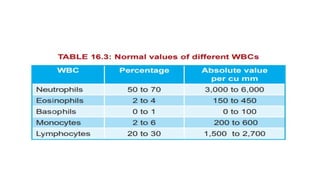
Leucocytes
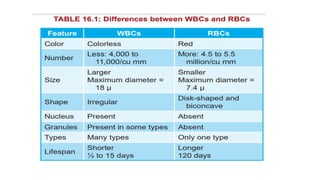
‱ White blood cells (WBCs) or leukocytes are the colorless and
nucleated formed elements of blood.
‱ WBCs are larger in size and lesser in number.
‱ CLASSIFICATION
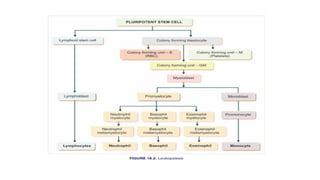
‱ Granulocytes which have granules.
‱ Agranulocytes which do not have granules.
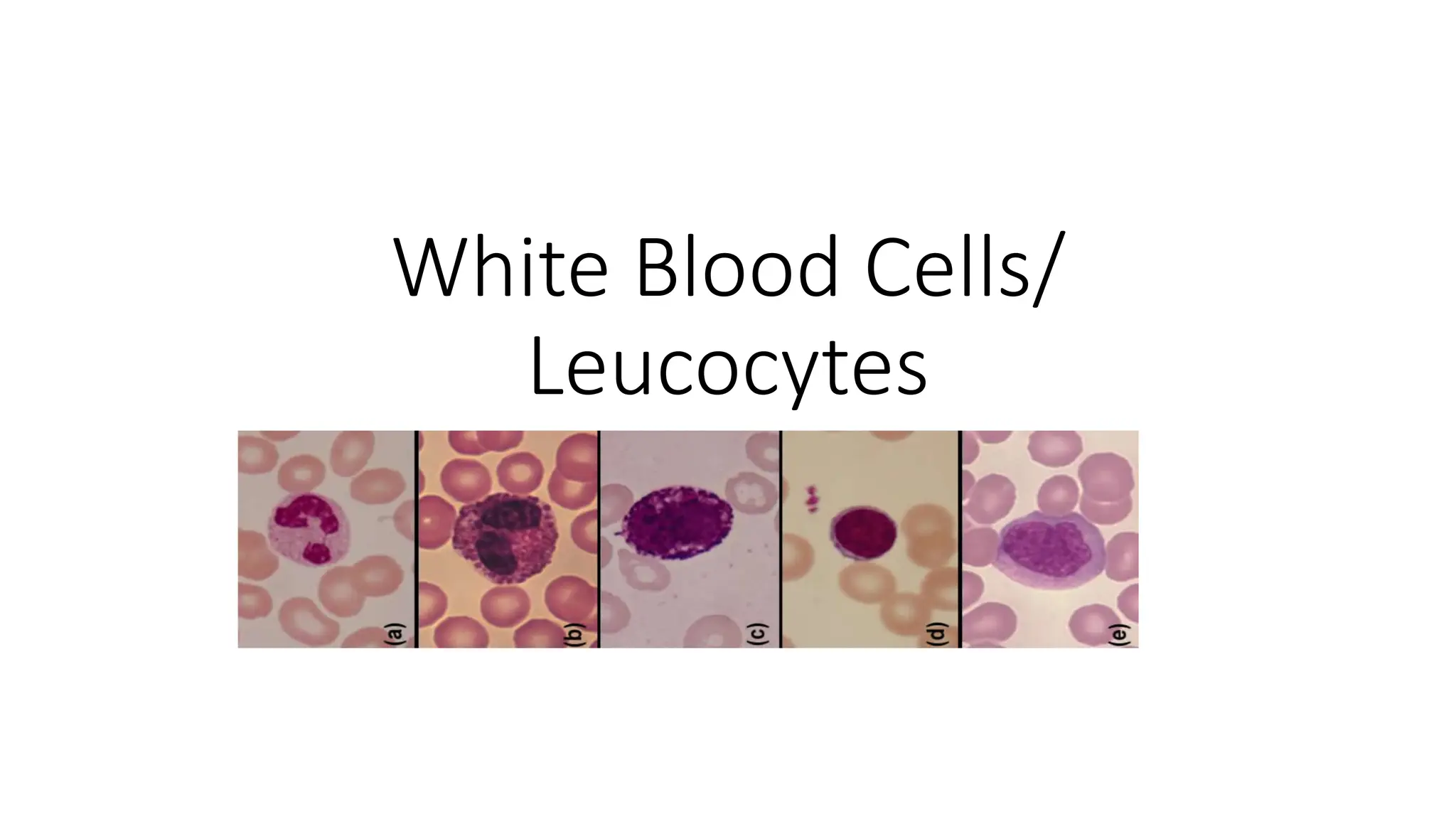
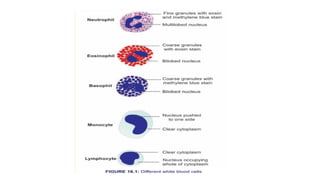
‱ Granulocytes Depending upon the staining property of granules, the
granulocytes are classified into three types:
‱ i. Neutrophils with granules taking both acidic and basic stains.
‱ ii. Eosinophils with granules taking acidic stain.
‱ iii. Basophils with granules taking basic stain.
‱ Agranulocytes have plain cytoplasm without granules.
‱ Agranulocytes are of two types:
‱ i. Monocytes.
‱ ii. Lymphocytes.
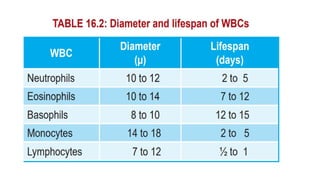
‱ Large lymphocytes: Younger cells with a diameter of 10 to 12 ”.
‱ Small lymphocytes: Older cells with a diameter of 7 to 10 ”.
‱ Depending upon the function, lymphocytes are divided into two
types:
‱ T lymphocytes: Cells concerned with cellular immunity.
‱ B lymphocytes: Cells concerned with humoral immunity.
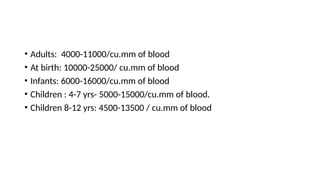
‱ Adults: 4000-11000/cu.mm of blood
‱ At birth: 10000-25000/ cu.mm of blood
‱ Infants: 6000-16000/cu.mm of blood
‱ Children : 4-7 yrs- 5000-15000/cu.mm of blood.
‱ Children 8-12 yrs: 4500-13500 / cu.mm of blood
VARIATIONS IN WHITE BLOOD CELL COUNT
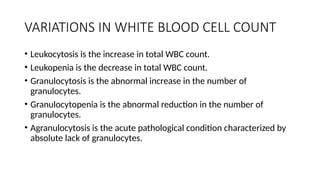
‱ Leukocytosis is the increase in total WBC count.
‱ Leukopenia is the decrease in total WBC count.
‱ Granulocytosis is the abnormal increase in the number of
granulocytes.
‱ Granulocytopenia is the abnormal reduction in the number of
granulocytes.
‱ Agranulocytosis is the acute pathological condition characterized by
absolute lack of granulocytes.
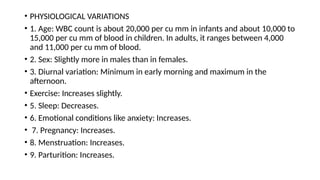
‱ PHYSIOLOGICAL VARIATIONS
‱ 1. Age: WBC count is about 20,000 per cu mm in infants and about 10,000 to
15,000 per cu mm of blood in children. In adults, it ranges between 4,000
and 11,000 per cu mm of blood.
‱ 2. Sex: Slightly more in males than in females.
‱ 3. Diurnal variation: Minimum in early morning and maximum in the
afternoon.
‱ Exercise: Increases slightly.
‱ 5. Sleep: Decreases.
‱ 6. Emotional conditions like anxiety: Increases.
‱ 7. Pregnancy: Increases.
‱ 8. Menstruation: Increases.
‱ 9. Parturition: Increases.
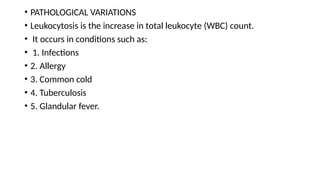
‱ PATHOLOGICAL VARIATIONS
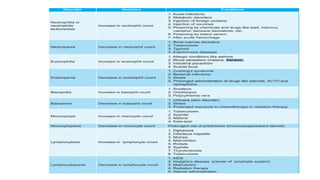
‱ Leukocytosis is the increase in total leukocyte (WBC) count.
‱ It occurs in conditions such as:
‱ 1. Infections
‱ 2. Allergy
‱ 3. Common cold
‱ 4. Tuberculosis
‱ 5. Glandular fever.
‱ Leukemia
‱ Leukemia is the condition which is characterized by abnormal and
uncontrolled increase in leukocyte count more than 1,000,000/cu
mm.
‱ It is also called blood cancer.
‱ Leukopenia
‱ Leukopenia is the decrease in the total WBC count.
‱ It occurs in the following pathological conditions:
‱ 1. Anaphylactic shock
‱ 2. Cirrhosis of liver
‱ 3. Disorders of spleen
‱ 4. Pernicious anemia
‱ 5. Typhoid and paratyphoid
‱ 6. Viral infections.
‱ PROPERTIES OF WHITE BLOOD CELLS
‱ 1. Diapedesis is the process by which the leukocytes squeeze through
the narrow blood vessels.
‱ 2. Ameboid Movement Neutrophils, monocytes and lymphocytes
show amebic movement, characterized by protrusion of the
cytoplasm and change in the shape.
‱ 3. Chemotaxis is the attraction of WBCs towards the injured tissues by
the chemical substances released at the site of injury.
‱ 4. Phagocytosis Neutrophils and monocytes engulf the foreign bodies
by means of phagocytosis
‱ FUNCTIONS OF WHITE BLOOD CELLS
‱ Generally, WBCs play an important role in defense mechanism.
‱ NEUTROPHILS
‱ Neutrophils play an important role in the defense mechanism of the
body.
‱ EOSINOPHILS
‱ Eosinophils play an important role in the defense mechanism of the
body against the parasites
‱ BASOPHILS
‱ Basophils play an important role in healing processes. So their
number increases during healing process.
‱ MONOCYTES
‱ Monocytes are the largest cells among the leukocytes.
‱ Monocytes play an important role in defense of the body.
‱ LYMPHOCYTES
‱ Lymphocytes play an important role in immunity.

White Blood Cells.powerpoint presentation

  • 1.
  • 2.
    ‱ White bloodcells (WBCs) or leukocytes are the colorless and nucleated formed elements of blood. ‱ WBCs are larger in size and lesser in number. ‱ CLASSIFICATION ‱ Granulocytes which have granules. ‱ Agranulocytes which do not have granules.
  • 3.
    ‱ Granulocytes Dependingupon the staining property of granules, the granulocytes are classified into three types: ‱ i. Neutrophils with granules taking both acidic and basic stains. ‱ ii. Eosinophils with granules taking acidic stain. ‱ iii. Basophils with granules taking basic stain. ‱ Agranulocytes have plain cytoplasm without granules. ‱ Agranulocytes are of two types: ‱ i. Monocytes. ‱ ii. Lymphocytes.
  • 5.
    ‱ Large lymphocytes:Younger cells with a diameter of 10 to 12 ”. ‱ Small lymphocytes: Older cells with a diameter of 7 to 10 ”. ‱ Depending upon the function, lymphocytes are divided into two types: ‱ T lymphocytes: Cells concerned with cellular immunity. ‱ B lymphocytes: Cells concerned with humoral immunity.
  • 8.
    ‱ Adults: 4000-11000/cu.mmof blood ‱ At birth: 10000-25000/ cu.mm of blood ‱ Infants: 6000-16000/cu.mm of blood ‱ Children : 4-7 yrs- 5000-15000/cu.mm of blood. ‱ Children 8-12 yrs: 4500-13500 / cu.mm of blood
  • 10.
    VARIATIONS IN WHITEBLOOD CELL COUNT ‱ Leukocytosis is the increase in total WBC count. ‱ Leukopenia is the decrease in total WBC count. ‱ Granulocytosis is the abnormal increase in the number of granulocytes. ‱ Granulocytopenia is the abnormal reduction in the number of granulocytes. ‱ Agranulocytosis is the acute pathological condition characterized by absolute lack of granulocytes.
  • 11.
    ‱ PHYSIOLOGICAL VARIATIONS ‱1. Age: WBC count is about 20,000 per cu mm in infants and about 10,000 to 15,000 per cu mm of blood in children. In adults, it ranges between 4,000 and 11,000 per cu mm of blood. ‱ 2. Sex: Slightly more in males than in females. ‱ 3. Diurnal variation: Minimum in early morning and maximum in the afternoon. ‱ Exercise: Increases slightly. ‱ 5. Sleep: Decreases. ‱ 6. Emotional conditions like anxiety: Increases. ‱ 7. Pregnancy: Increases. ‱ 8. Menstruation: Increases. ‱ 9. Parturition: Increases.
  • 12.
    ‱ PATHOLOGICAL VARIATIONS ‱Leukocytosis is the increase in total leukocyte (WBC) count. ‱ It occurs in conditions such as: ‱ 1. Infections ‱ 2. Allergy ‱ 3. Common cold ‱ 4. Tuberculosis ‱ 5. Glandular fever.
  • 13.
    ‱ Leukemia ‱ Leukemiais the condition which is characterized by abnormal and uncontrolled increase in leukocyte count more than 1,000,000/cu mm. ‱ It is also called blood cancer.
  • 14.
    ‱ Leukopenia ‱ Leukopeniais the decrease in the total WBC count. ‱ It occurs in the following pathological conditions: ‱ 1. Anaphylactic shock ‱ 2. Cirrhosis of liver ‱ 3. Disorders of spleen ‱ 4. Pernicious anemia ‱ 5. Typhoid and paratyphoid ‱ 6. Viral infections.
  • 16.
    ‱ PROPERTIES OFWHITE BLOOD CELLS ‱ 1. Diapedesis is the process by which the leukocytes squeeze through the narrow blood vessels. ‱ 2. Ameboid Movement Neutrophils, monocytes and lymphocytes show amebic movement, characterized by protrusion of the cytoplasm and change in the shape. ‱ 3. Chemotaxis is the attraction of WBCs towards the injured tissues by the chemical substances released at the site of injury. ‱ 4. Phagocytosis Neutrophils and monocytes engulf the foreign bodies by means of phagocytosis
  • 18.
    ‱ FUNCTIONS OFWHITE BLOOD CELLS ‱ Generally, WBCs play an important role in defense mechanism. ‱ NEUTROPHILS ‱ Neutrophils play an important role in the defense mechanism of the body. ‱ EOSINOPHILS ‱ Eosinophils play an important role in the defense mechanism of the body against the parasites
  • 19.
    ‱ BASOPHILS ‱ Basophilsplay an important role in healing processes. So their number increases during healing process. ‱ MONOCYTES ‱ Monocytes are the largest cells among the leukocytes. ‱ Monocytes play an important role in defense of the body. ‱ LYMPHOCYTES ‱ Lymphocytes play an important role in immunity.