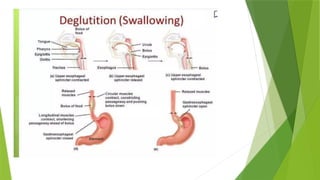
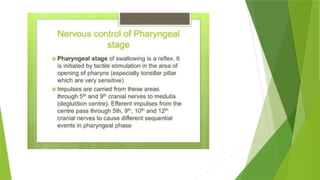
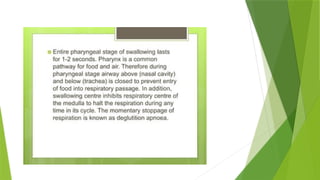
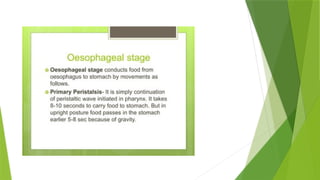
DEGLUTITION STAGES
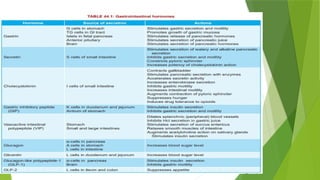
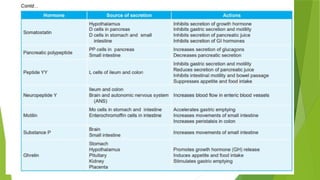
Gastrointestinal Hormones.
Digestion and absorption of GIT
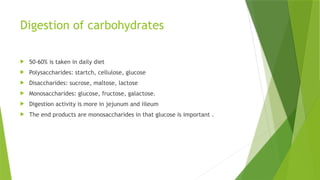
Digestion of carbohydrates
 50-60% is taken in daily diet
 Polysaccharides: startch, cellulose, glucose
 Disaccharides: sucrose, maltose, lactose
 Monosaccharides: glucose, fructose, galactose.
 Digestion activity is more in jejunum and iileum
 The end products are monosaccharides in that glucose is important .
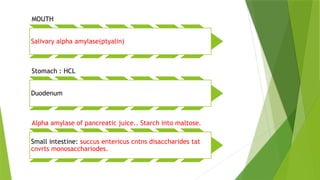
MOUTH
Salivary alpha amylase(ptyalin)
Stomach : HCL
Duodenum
Alpha amylase of pancreatic juice.. Starch into maltose.
Small intestine: succus entericus cntns disaccharides tat
cnvrts monosacchariodes.
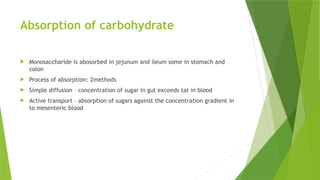
Absorption of carbohydrate
 Monosaccharide is abosorbed in jejunum and ileum some in stomach and
colon
 Process of absorption: 2methods
 Simple diffusion – concentration of sugar in gut exceeds tat in blood
 Active transport – absorption of sugars against the concentration gradient in
to mesenteric blood
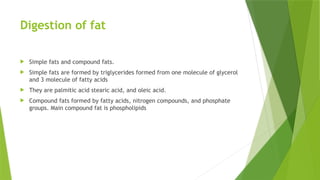
Digestion of fat
 Simple fats and compound fats.
 Simple fats are formed by triglycerides formed from one molecule of glycerol
and 3 molecule of fatty acids
 They are palmitic acid stearic acid, and oleic acid.
 Compound fats formed by fatty acids, nitrogen compounds, and phosphate
groups. Main compound fat is phospholipids
 Small intestine: pancreatic lipase and bile salts enter the 2nd
part of
duodenum and helps in fat digestion.
 Pancreatic juice (7.8- 8.4) converts and adjusted to high acidic chyme(6) to
(7) so it s optimal for lipase action.
 Bile salts play a role in activating lipase
 Lipase act on emulsified fat and converts it in to triglycerides, diglycerides.
And monosaccharides,
Absorption of lipids
 Miscelles features.
 They are water soluble complexes, 3-10nm in variable lipid concentration.
 They are passively absorbed in luminal brush border.
Digestion and absorption of proteins
physiology DEGLUTITION STAGES. power point

physiology DEGLUTITION STAGES. power point

  • 1.
  • 17.
  • 20.
  • 21.
    Digestion of carbohydrates 50-60% is taken in daily diet  Polysaccharides: startch, cellulose, glucose  Disaccharides: sucrose, maltose, lactose  Monosaccharides: glucose, fructose, galactose.  Digestion activity is more in jejunum and iileum  The end products are monosaccharides in that glucose is important .
  • 22.
    MOUTH Salivary alpha amylase(ptyalin) Stomach: HCL Duodenum Alpha amylase of pancreatic juice.. Starch into maltose. Small intestine: succus entericus cntns disaccharides tat cnvrts monosacchariodes.
  • 23.
    Absorption of carbohydrate Monosaccharide is abosorbed in jejunum and ileum some in stomach and colon  Process of absorption: 2methods  Simple diffusion – concentration of sugar in gut exceeds tat in blood  Active transport – absorption of sugars against the concentration gradient in to mesenteric blood
  • 24.
    Digestion of fat Simple fats and compound fats.  Simple fats are formed by triglycerides formed from one molecule of glycerol and 3 molecule of fatty acids  They are palmitic acid stearic acid, and oleic acid.  Compound fats formed by fatty acids, nitrogen compounds, and phosphate groups. Main compound fat is phospholipids
  • 25.
     Small intestine:pancreatic lipase and bile salts enter the 2nd part of duodenum and helps in fat digestion.  Pancreatic juice (7.8- 8.4) converts and adjusted to high acidic chyme(6) to (7) so it s optimal for lipase action.  Bile salts play a role in activating lipase  Lipase act on emulsified fat and converts it in to triglycerides, diglycerides. And monosaccharides,
  • 26.
    Absorption of lipids Miscelles features.  They are water soluble complexes, 3-10nm in variable lipid concentration.  They are passively absorbed in luminal brush border.
  • 27.