Which Model Does Not Belong?
A Dialogue (Monologue?)
Michael R. Gryk & Bertram T. Ludäscher
Center for Informatics Research in Science & Scholarship (CIRSS)
School of Information Sciences
University of Illinois, Urbana-Champaign
JCDL 2020 Workshop on
Conceptual Modeling. SIGCM
August 1, 2020https://github.com/sig-cm/JCDL-2020
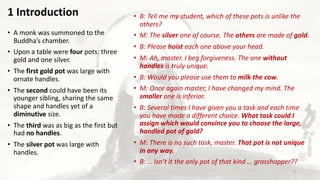
• B: Tell me my student, which of these pots is unlike the
others?
• M: The silver one of course. The others are made of gold.
• B: Please hoist each one above your head.
• M: Ah, master. I beg forgiveness. The one without
handles is truly unique.
• B: Would you please use them to milk the cow.
• M: Once again master, I have changed my mind. The
smaller one is inferior.
• B: Several times I have given you a task and each time
you have made a different choice. What task could I
assign which would convince you to choose the large,
handled pot of gold?
• M: There is no such task, master. That pot is not unique
in any way.
• B: … Isn’t it the only pot of that kind … grasshopper??
• A monk was summoned to the
Buddha’s chamber.
• Upon a table were four pots: three
gold and one silver.
• The first gold pot was large with
ornate handles.
• The second could have been its
younger sibling, sharing the same
shape and handles yet of a
diminutive size.
• The third was as big as the first but
had no handles.
• The silver pot was large with
handles.
1 Introduction
2
2. Cutting to the Chase …
• WODB (which one doesn’t belong) is a great educational tool for CM!
• ... Datalog and Answer Set Programming are power tools for WODB (and CM in general)
• Step 1: Define what is (and isn’t!) part of your model:
• Observables (things/concepts you can ask about)
• Ignorables (… you cannot ask about!)
• Step 2: Fitness-for-Purpose (FFP) and Conceptual Resolution (CR) via Queries:
• FFP/Q: Can you answer the questions you care about?
• CR/Q: What questions can you answer (what concepts can you distinguish) in principle?
3
... cutting to the chase …
• Step 3 (The WODB Point): Explainable Answers:
• How do you justify Which-One-Doesn’t-Belong (WODB)?
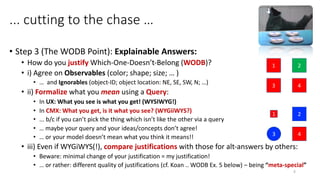
• i) Agree on Observables (color; shape; size; … )
• … and Ignorables (object-ID; object location: NE, SE, SW, N; …)
• ii) Formalize what you mean using a Query:
• In UX: What you see is what you get! (WYSIWYG!)
• In CMX: What you get, is it what you see? (WYGiiWYS?)
• ... b/c if you can’t pick the thing which isn’t like the other via a query
• … maybe your query and your ideas/concepts don’t agree!
• … or your model doesn’t mean what you think it means!!
• iii) Even if WYGiWYS(!), compare justifications with those for alt-answers by others:
• Beware: minimal change of your justification = my justification!
• … or rather: different quality of justifications (cf. Koan .. WODB Ex. 5 below) – being “meta-special”
1
4
2
3
1
3 4
2
4
... cutting to the chase …
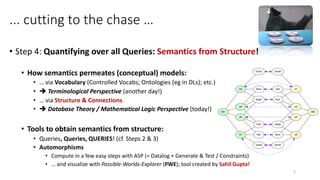
• Step 4: Quantifying over all Queries: Semantics from Structure!
• How semantics permeates (conceptual) models:
• … via Vocabulary (Controlled Vocabs; Ontologies (eg in DLs); etc.)
• è Terminological Perspective (another day!)
• … via Structure & Connections
• è Database Theory / Mathematical Logic Perspective (today!)
• Tools to obtain semantics from structure:
• Queries, Queries, QUERIES! (cf. Steps 2 & 3)
• Automorphisms
• Compute in a few easy steps with ASP (= Datalog + Generate & Test / Constraints)
• … and visualize with Possible-Worlds-Explorer (PWE); tool created by Sahil Gupta!
5
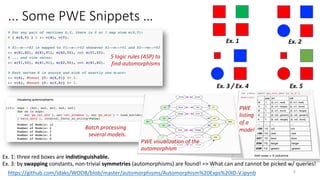
... Some PWE Snippets …
6
Ex. 1 Ex. 2
Ex. 3 / Ex. 4 Ex. 5
https://github.com/idaks/WODB/blob/master/automorphisms/Automorphism%20Exps%20ID-V.ipynb
Ex. 1: three red boxes are indistinguishable.
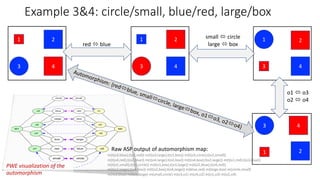
Ex. 3: by swapping constants, non-trivial symmetries (automorphisms) are found! => What can and cannot be picked w/ queries!
5 logic rules (ASP) to
find automorphisms
Batch processing
several models.
PWE visualization of the
automorphism
PWE
listing
of a
model
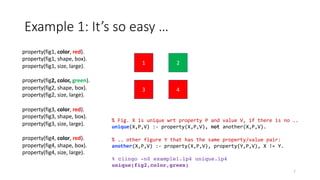
property(fig1, color, red).
property(fig1, shape, box).
property(fig1, size, large).
property(fig2, color, green).
property(fig2, shape, box).
property(fig2, size, large).
property(fig3, color, red).
property(fig3, shape, box).
property(fig3, size, large).
property(fig4, color, red).
property(fig4, shape, box).
property(fig4, size, large).
1
4
2
3
% Fig. X is unique wrt property P and value V, if there is no ..
unique(X,P,V) :- property(X,P,V), not another(X,P,V).
% .. other figure Y that has the same property/value pair:
another(X,P,V) :- property(X,P,V), property(Y,P,V), X != Y.
% clingo -n0 example1.lp4 unique.lp4
unique(fig2,color,green)
Example 1: It’s so easy …
7
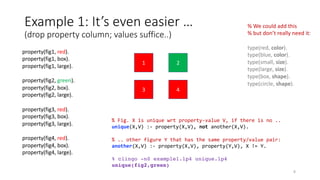
property(fig1, red).
property(fig1, box).
property(fig1, large).
property(fig2, green).
property(fig2, box).
property(fig2, large).
property(fig3, red).
property(fig3, box).
property(fig3, large).
property(fig4, red).
property(fig4, box).
property(fig4, large).
1
4
2
3
Example 1: It’s even easier …
(drop property column; values suffice..)
% We could add this
% but don’t really need it:
type(red, color).
type(blue, color).
type(small, size).
type(large, size).
type(box, shape).
type(circle, shape).
8
% Fig. X is unique wrt property-value V, if there is no ..
unique(X,V) :- property(X,V), not another(X,V).
% .. other figure Y that has the same property/value pair:
another(X,V) :- property(X,V), property(Y,V), X != Y.
% clingo -n0 example1.lp4 unique.lp4
unique(fig2,green)
1
3 4
2
property(fig1, red).
property(fig1, box).
property(fig1, large).
property(fig2, blue).
property(fig2, box).
property(fig2, large).
property(fig3, blue).
property(fig3, circle).
property(fig3, large).
property(fig4, red).
property(fig4, box).
property(fig4, large).
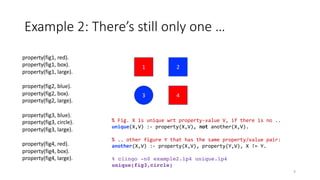
Example 2: There’s still only one …
9
% Fig. X is unique wrt property-value V, if there is no ..
unique(X,V) :- property(X,V), not another(X,V).
% .. other figure Y that has the same property/value pair:
another(X,V) :- property(X,V), property(Y,V), X != Y.
% clingo -n0 example2.lp4 unique.lp4
unique(fig3,circle)
1
3 4
2
property(fig1, red).
property(fig1, box).
property(fig1, small).
property(fig2, blue).
property(fig2, box).
property(fig2, large).
property(fig3, blue).
property(fig3, circle).
property(fig3, large).
property(fig4, red).
property(fig4, box).
property(fig4, large).
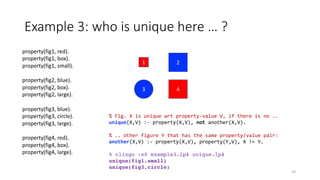
Example 3: who is unique here … ?
10
% Fig. X is unique wrt property-value V, if there is no ..
unique(X,V) :- property(X,V), not another(X,V).
% .. other figure Y that has the same property/value pair:
another(X,V) :- property(X,V), property(Y,V), X != Y.
% clingo -n0 example3.lp4 unique.lp4
unique(fig1,small)
unique(fig3,circle)
3
1 2
4
Example 3&4: circle/small, blue/red, large/box
1
3 4
2
1
3 4
2
1
3 4
2
red ó blue
small ó circle
large ó box
o1 ó o3
o2 ó o4
Raw ASP output of automorphism map:
m(t(o3,blue),t(o1,red)) m(t(o3,large),t(o1,box)) m(t(o3,circle),t(o1,small))
m(t(o4,red),t(o2,blue)) m(t(o4,large),t(o2,box)) m(t(o4,box),t(o2,large)) m(t(o1,red),t(o3,blue))
m(t(o1,small),t(o3,circle)) m(t(o1,box),t(o3,large)) m(t(o2,blue),t(o4,red))
m(t(o2,large),t(o4,box)) m(t(o2,box),t(o4,large)) m(blue,red) m(large,box) m(circle,small)
m(red,blue) m(box,large) m(small,circle) m(o3,o1) m(o4,o2) m(o1,o3) m(o2,o4)
Automorphism: {redóblue, smallócircle, largeóbox, o1óo3, o2óo4}
PWE visualization of the
automorphism
1
3 4
2property(fig1, red).
property(fig1, box).
property(fig1, small).
property(fig2, green).
property(fig2, box).
property(fig2, large).
property(fig3, red).
property(fig3, circle).
property(fig3, large).
property(fig4, red).
property(fig4, box).
property(fig4, large).
% Fig. X is unique wrt property-value V, if there is no ..
unique(X,V) :- property(X,V), not another(X,V).
% .. other figure Y that has the same property/value pair:
another(X,V) :- property(X,V), property(Y,V), X != Y.
% clingo -n0 example4.lp4 unique.lp4
unique(fig1,small)
unique(fig2,green)
unique(fig3,circle)
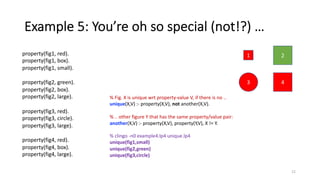
Example 5: You’re oh so special (not!?) …
12
property(fig1, red).
property(fig1, box).
property(fig1, small).
property(fig2, green).
property(fig2, box).
property(fig2, large).
property(fig3, red).
property(fig3, circle).
property(fig3, large).
property(fig4, red).
property(fig4, box).
property(fig4, large).
% Fig. X is unique wrt property-value V, if there is no ..
unique(X,V) :- property(X,V), not another(X,V).
% .. other figure Y that has the same property/value pair:
another(X,V) :- property(X,V), property(Y,V), X != Y.
% Which figure X is special (wrt some property / value)
special(X) :- unique(X,_).
normal(X) :- property(X,_), not special(X).
% clingo -n0 example5.lp4 unique.lp4
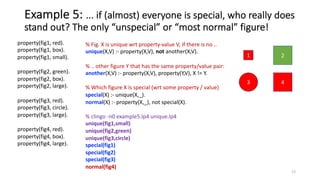
unique(fig1,small)
unique(fig2,green)
unique(fig3,circle)
special(fig1)
special(fig2)
special(fig3)
normal(fig4)
Example 5: ... if (almost) everyone is special, who really does
stand out? The only “unspecial” or “most normal” figure!
13
1
3 4
2
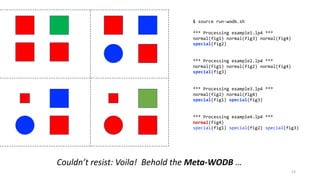
Couldn’t resist: Voila! Behold the Meta-WODB …
$ source run-wodb.sh
*** Processing example1.lp4 ***
normal(fig1) normal(fig3) normal(fig4)
special(fig2)
*** Processing example2.lp4 ***
normal(fig1) normal(fig2) normal(fig4)
special(fig3)
*** Processing example3.lp4 ***
normal(fig2) normal(fig4)
special(fig1) special(fig3)
*** Processing example4.lp4 ***
normal(fig4)
special(fig1) special(fig2) special(fig3)
14
Observations/ Preliminary Conclusions
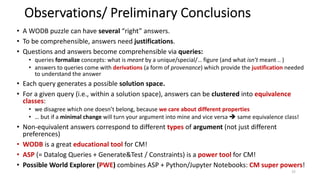
• A WODB puzzle can have several “right” answers.
• To be comprehensible, answers need justifications.
• Questions and answers become comprehensible via queries:
• queries formalize concepts: what is meant by a unique/special/… figure (and what isn’t meant .. )
• answers to queries come with derivations (a form of provenance) which provide the justification needed
to understand the answer
• Each query generates a possible solution space.
• For a given query (i.e., within a solution space), answers can be clustered into equivalence
classes:
• we disagree which one doesn’t belong, because we care about different properties
• … but if a minimal change will turn your argument into mine and vice versa è same equivalence class!
• Non-equivalent answers correspond to different types of argument (not just different
preferences)
• WODB is a great educational tool for CM!
• ASP (= Datalog Queries + Generate&Test / Constraints) is a power tool for CM!
• Possible World Explorer (PWE) combines ASP + Python/Jupyter Notebooks: CM super powers!
15
3. M’s Story (cont’d)
16
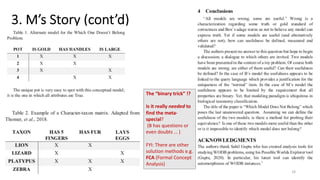
The “binary trick” !?
Is it really needed to
find the meta-
special?
(B has questions or
even doubts … )
FYI: There are other
solution methods e.g.
FCA (Formal Concept
Analysis)
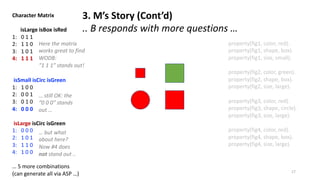
property(fig1, color, red).
property(fig1, shape, box).
property(fig1, size, small).
property(fig2, color, green).
property(fig2, shape, box).
property(fig2, size, large).
property(fig3, color, red).
property(fig3, shape, circle).
property(fig3, size, large).
property(fig4, color, red).
property(fig4, shape, box).
property(fig4, size, large).
Character Matrix
isLarge isBox isRed
1: 0 1 1
2: 1 1 0
3: 1 0 1
4: 1 1 1
isSmall isCirc isGreen
1: 1 0 0
2: 0 0 1
3: 0 1 0
4: 0 0 0
isLarge isCirc isGreen
1: 0 0 0
2: 1 0 1
3: 1 1 0
4: 1 0 0
… 5 more combinations
(can generate all via ASP …) 17
3. M’s Story (Cont’d)
.. B responds with more questions …
Here the matrix
works great to find
WODB:
“1 1 1” stands out!
… still OK: the
“0 0 0” stands
out …
… but what
about here?
Now #4 does
not stand out ..
32 451
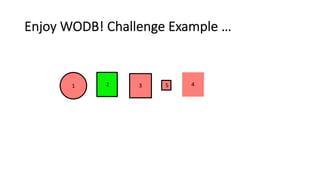
Enjoy WODB! Challenge Example …
Some References
• WODB/ASP/PWE Source code: https://github.com/idaks/WODB
• WODB web site: http://wodb.ca/index.html
• A book: https://www.stenhouse.com/content/which-one-doesnt-belong
• Sesame Street: One of these things is not like the others ..
• Easy: https://www.youtube.com/watch?v=rsRjQDrDnY8
• A bit more tricky: https://www.youtube.com/watch?v=lqegob0v9W8
• Quite tricky:
• https://twitter.com/mcnally_gerry/status/1243582829507813376?s=20
• https://twitter.com/search?q=%23wodb&src=typd
19

Which Model Does Not Belong: A Dialogue

  • 1.
    Which Model DoesNot Belong? A Dialogue (Monologue?) Michael R. Gryk & Bertram T. Ludäscher Center for Informatics Research in Science & Scholarship (CIRSS) School of Information Sciences University of Illinois, Urbana-Champaign JCDL 2020 Workshop on Conceptual Modeling. SIGCM August 1, 2020https://github.com/sig-cm/JCDL-2020
  • 2.
    • B: Tellme my student, which of these pots is unlike the others? • M: The silver one of course. The others are made of gold. • B: Please hoist each one above your head. • M: Ah, master. I beg forgiveness. The one without handles is truly unique. • B: Would you please use them to milk the cow. • M: Once again master, I have changed my mind. The smaller one is inferior. • B: Several times I have given you a task and each time you have made a different choice. What task could I assign which would convince you to choose the large, handled pot of gold? • M: There is no such task, master. That pot is not unique in any way. • B: … Isn’t it the only pot of that kind … grasshopper?? • A monk was summoned to the Buddha’s chamber. • Upon a table were four pots: three gold and one silver. • The first gold pot was large with ornate handles. • The second could have been its younger sibling, sharing the same shape and handles yet of a diminutive size. • The third was as big as the first but had no handles. • The silver pot was large with handles. 1 Introduction 2
  • 3.
    2. Cutting tothe Chase … • WODB (which one doesn’t belong) is a great educational tool for CM! • ... Datalog and Answer Set Programming are power tools for WODB (and CM in general) • Step 1: Define what is (and isn’t!) part of your model: • Observables (things/concepts you can ask about) • Ignorables (… you cannot ask about!) • Step 2: Fitness-for-Purpose (FFP) and Conceptual Resolution (CR) via Queries: • FFP/Q: Can you answer the questions you care about? • CR/Q: What questions can you answer (what concepts can you distinguish) in principle? 3
  • 4.
    ... cutting tothe chase … • Step 3 (The WODB Point): Explainable Answers: • How do you justify Which-One-Doesn’t-Belong (WODB)? • i) Agree on Observables (color; shape; size; … ) • … and Ignorables (object-ID; object location: NE, SE, SW, N; …) • ii) Formalize what you mean using a Query: • In UX: What you see is what you get! (WYSIWYG!) • In CMX: What you get, is it what you see? (WYGiiWYS?) • ... b/c if you can’t pick the thing which isn’t like the other via a query • … maybe your query and your ideas/concepts don’t agree! • … or your model doesn’t mean what you think it means!! • iii) Even if WYGiWYS(!), compare justifications with those for alt-answers by others: • Beware: minimal change of your justification = my justification! • … or rather: different quality of justifications (cf. Koan .. WODB Ex. 5 below) – being “meta-special” 1 4 2 3 1 3 4 2 4
  • 5.
    ... cutting tothe chase … • Step 4: Quantifying over all Queries: Semantics from Structure! • How semantics permeates (conceptual) models: • … via Vocabulary (Controlled Vocabs; Ontologies (eg in DLs); etc.) • è Terminological Perspective (another day!) • … via Structure & Connections • è Database Theory / Mathematical Logic Perspective (today!) • Tools to obtain semantics from structure: • Queries, Queries, QUERIES! (cf. Steps 2 & 3) • Automorphisms • Compute in a few easy steps with ASP (= Datalog + Generate & Test / Constraints) • … and visualize with Possible-Worlds-Explorer (PWE); tool created by Sahil Gupta! 5
  • 6.
    ... Some PWESnippets … 6 Ex. 1 Ex. 2 Ex. 3 / Ex. 4 Ex. 5 https://github.com/idaks/WODB/blob/master/automorphisms/Automorphism%20Exps%20ID-V.ipynb Ex. 1: three red boxes are indistinguishable. Ex. 3: by swapping constants, non-trivial symmetries (automorphisms) are found! => What can and cannot be picked w/ queries! 5 logic rules (ASP) to find automorphisms Batch processing several models. PWE visualization of the automorphism PWE listing of a model
  • 7.
    property(fig1, color, red). property(fig1,shape, box). property(fig1, size, large). property(fig2, color, green). property(fig2, shape, box). property(fig2, size, large). property(fig3, color, red). property(fig3, shape, box). property(fig3, size, large). property(fig4, color, red). property(fig4, shape, box). property(fig4, size, large). 1 4 2 3 % Fig. X is unique wrt property P and value V, if there is no .. unique(X,P,V) :- property(X,P,V), not another(X,P,V). % .. other figure Y that has the same property/value pair: another(X,P,V) :- property(X,P,V), property(Y,P,V), X != Y. % clingo -n0 example1.lp4 unique.lp4 unique(fig2,color,green) Example 1: It’s so easy … 7
  • 8.
    property(fig1, red). property(fig1, box). property(fig1,large). property(fig2, green). property(fig2, box). property(fig2, large). property(fig3, red). property(fig3, box). property(fig3, large). property(fig4, red). property(fig4, box). property(fig4, large). 1 4 2 3 Example 1: It’s even easier … (drop property column; values suffice..) % We could add this % but don’t really need it: type(red, color). type(blue, color). type(small, size). type(large, size). type(box, shape). type(circle, shape). 8 % Fig. X is unique wrt property-value V, if there is no .. unique(X,V) :- property(X,V), not another(X,V). % .. other figure Y that has the same property/value pair: another(X,V) :- property(X,V), property(Y,V), X != Y. % clingo -n0 example1.lp4 unique.lp4 unique(fig2,green)
  • 9.
    1 3 4 2 property(fig1, red). property(fig1,box). property(fig1, large). property(fig2, blue). property(fig2, box). property(fig2, large). property(fig3, blue). property(fig3, circle). property(fig3, large). property(fig4, red). property(fig4, box). property(fig4, large). Example 2: There’s still only one … 9 % Fig. X is unique wrt property-value V, if there is no .. unique(X,V) :- property(X,V), not another(X,V). % .. other figure Y that has the same property/value pair: another(X,V) :- property(X,V), property(Y,V), X != Y. % clingo -n0 example2.lp4 unique.lp4 unique(fig3,circle)
  • 10.
    1 3 4 2 property(fig1, red). property(fig1,box). property(fig1, small). property(fig2, blue). property(fig2, box). property(fig2, large). property(fig3, blue). property(fig3, circle). property(fig3, large). property(fig4, red). property(fig4, box). property(fig4, large). Example 3: who is unique here … ? 10 % Fig. X is unique wrt property-value V, if there is no .. unique(X,V) :- property(X,V), not another(X,V). % .. other figure Y that has the same property/value pair: another(X,V) :- property(X,V), property(Y,V), X != Y. % clingo -n0 example3.lp4 unique.lp4 unique(fig1,small) unique(fig3,circle)
  • 11.
    3 1 2 4 Example 3&4:circle/small, blue/red, large/box 1 3 4 2 1 3 4 2 1 3 4 2 red ó blue small ó circle large ó box o1 ó o3 o2 ó o4 Raw ASP output of automorphism map: m(t(o3,blue),t(o1,red)) m(t(o3,large),t(o1,box)) m(t(o3,circle),t(o1,small)) m(t(o4,red),t(o2,blue)) m(t(o4,large),t(o2,box)) m(t(o4,box),t(o2,large)) m(t(o1,red),t(o3,blue)) m(t(o1,small),t(o3,circle)) m(t(o1,box),t(o3,large)) m(t(o2,blue),t(o4,red)) m(t(o2,large),t(o4,box)) m(t(o2,box),t(o4,large)) m(blue,red) m(large,box) m(circle,small) m(red,blue) m(box,large) m(small,circle) m(o3,o1) m(o4,o2) m(o1,o3) m(o2,o4) Automorphism: {redóblue, smallócircle, largeóbox, o1óo3, o2óo4} PWE visualization of the automorphism
  • 12.
    1 3 4 2property(fig1, red). property(fig1,box). property(fig1, small). property(fig2, green). property(fig2, box). property(fig2, large). property(fig3, red). property(fig3, circle). property(fig3, large). property(fig4, red). property(fig4, box). property(fig4, large). % Fig. X is unique wrt property-value V, if there is no .. unique(X,V) :- property(X,V), not another(X,V). % .. other figure Y that has the same property/value pair: another(X,V) :- property(X,V), property(Y,V), X != Y. % clingo -n0 example4.lp4 unique.lp4 unique(fig1,small) unique(fig2,green) unique(fig3,circle) Example 5: You’re oh so special (not!?) … 12
  • 13.
    property(fig1, red). property(fig1, box). property(fig1,small). property(fig2, green). property(fig2, box). property(fig2, large). property(fig3, red). property(fig3, circle). property(fig3, large). property(fig4, red). property(fig4, box). property(fig4, large). % Fig. X is unique wrt property-value V, if there is no .. unique(X,V) :- property(X,V), not another(X,V). % .. other figure Y that has the same property/value pair: another(X,V) :- property(X,V), property(Y,V), X != Y. % Which figure X is special (wrt some property / value) special(X) :- unique(X,_). normal(X) :- property(X,_), not special(X). % clingo -n0 example5.lp4 unique.lp4 unique(fig1,small) unique(fig2,green) unique(fig3,circle) special(fig1) special(fig2) special(fig3) normal(fig4) Example 5: ... if (almost) everyone is special, who really does stand out? The only “unspecial” or “most normal” figure! 13 1 3 4 2
  • 14.
    Couldn’t resist: Voila!Behold the Meta-WODB … $ source run-wodb.sh *** Processing example1.lp4 *** normal(fig1) normal(fig3) normal(fig4) special(fig2) *** Processing example2.lp4 *** normal(fig1) normal(fig2) normal(fig4) special(fig3) *** Processing example3.lp4 *** normal(fig2) normal(fig4) special(fig1) special(fig3) *** Processing example4.lp4 *** normal(fig4) special(fig1) special(fig2) special(fig3) 14
  • 15.
    Observations/ Preliminary Conclusions •A WODB puzzle can have several “right” answers. • To be comprehensible, answers need justifications. • Questions and answers become comprehensible via queries: • queries formalize concepts: what is meant by a unique/special/… figure (and what isn’t meant .. ) • answers to queries come with derivations (a form of provenance) which provide the justification needed to understand the answer • Each query generates a possible solution space. • For a given query (i.e., within a solution space), answers can be clustered into equivalence classes: • we disagree which one doesn’t belong, because we care about different properties • … but if a minimal change will turn your argument into mine and vice versa è same equivalence class! • Non-equivalent answers correspond to different types of argument (not just different preferences) • WODB is a great educational tool for CM! • ASP (= Datalog Queries + Generate&Test / Constraints) is a power tool for CM! • Possible World Explorer (PWE) combines ASP + Python/Jupyter Notebooks: CM super powers! 15
  • 16.
    3. M’s Story(cont’d) 16 The “binary trick” !? Is it really needed to find the meta- special? (B has questions or even doubts … ) FYI: There are other solution methods e.g. FCA (Formal Concept Analysis)
  • 17.
    property(fig1, color, red). property(fig1,shape, box). property(fig1, size, small). property(fig2, color, green). property(fig2, shape, box). property(fig2, size, large). property(fig3, color, red). property(fig3, shape, circle). property(fig3, size, large). property(fig4, color, red). property(fig4, shape, box). property(fig4, size, large). Character Matrix isLarge isBox isRed 1: 0 1 1 2: 1 1 0 3: 1 0 1 4: 1 1 1 isSmall isCirc isGreen 1: 1 0 0 2: 0 0 1 3: 0 1 0 4: 0 0 0 isLarge isCirc isGreen 1: 0 0 0 2: 1 0 1 3: 1 1 0 4: 1 0 0 … 5 more combinations (can generate all via ASP …) 17 3. M’s Story (Cont’d) .. B responds with more questions … Here the matrix works great to find WODB: “1 1 1” stands out! … still OK: the “0 0 0” stands out … … but what about here? Now #4 does not stand out ..
  • 18.
    32 451 Enjoy WODB!Challenge Example …
  • 19.
    Some References • WODB/ASP/PWESource code: https://github.com/idaks/WODB • WODB web site: http://wodb.ca/index.html • A book: https://www.stenhouse.com/content/which-one-doesnt-belong • Sesame Street: One of these things is not like the others .. • Easy: https://www.youtube.com/watch?v=rsRjQDrDnY8 • A bit more tricky: https://www.youtube.com/watch?v=lqegob0v9W8 • Quite tricky: • https://twitter.com/mcnally_gerry/status/1243582829507813376?s=20 • https://twitter.com/search?q=%23wodb&src=typd 19