The I–Tell Project: Intercultural
telecollaborative learning
before students mobility abroad
Marta Giralt & Catherine Jeanneau
School of Modern Languages & Applied Linguistics
University of Limerick, Ireland
The I–Tell Project
Presentation overview
• Rationale for project
• Project description
• Data gathering
• Findings
– Students’ feedback: Tasks & Technologies used
– Project outcomes: Impact on students:
•Intercultural awareness
•Language Learning
•Preparation for the mobility period
• Limitations, conclusions and recommendations
Rationale for the I-Tell project
• Period abroad (Erasmus, work placement):
significant part of the Higher Education
language learning experience.
• Crucial to increase the opportunities for
students to go abroad.
• Paramount to prepare them for their mobility
period to fully benefit from this experience
(Byram & Dervin, 2008)
The better prepared
students are before their
placement, the better their
experience will be
« Apprendre à être étranger :
des parcours de formation
interculturelle pour les étudiants
de mobilité »
(Mathilde Anquetil, 2008)
Data gathering
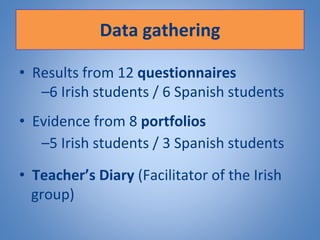
• Results from 12 questionnaires
–6 Irish students / 6 Spanish students
• Evidence from 8 portfolios
–5 Irish students / 3 Spanish students
• Teacher’s Diary (Facilitator of the Irish
group)
Project aims & objectives
• For students to be better prepared for
their period abroad and learn more
about the country they will be travelling
to (impacting directly and positively on
student experience).
• To develop the participants'
intercultural, linguistic and digital skills.
What is Telecollaboration?
The engagement of groups of students in online
intercultural interaction and collaboration with
partner classes from other cultural contexts or
geographical locations, under the guidance of
educators and/or expert facilitators
(Robert O’Dowd, 2014)
Project description
website of the project
Project program: 8 contact sessions
4 Tasks: one task to be completed every 2 weeks
research has proven that …the negotiation of meaning
and the resultant learner modifications are much more
prevalent in goal-oriented, task-based interaction
than in usual conversation (Pellettieri, 2000: 64)
Exchanges: 2 per week
asynchronous & synchronous;
multimodal communication
50% Spanish 50% English
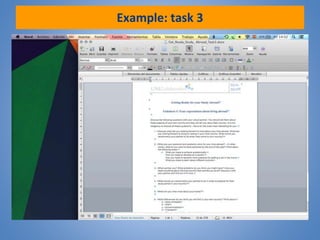
Example: task 3
Students’ feedback on overall project:
TASKS - Irish students
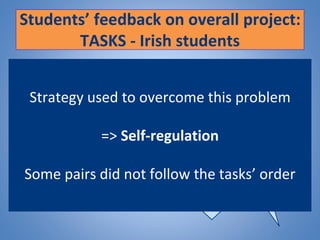
Main issue: TIME
It was not
difficult to know
what we should
be doing
Was hard to find the
time to do it
considering you really
have to sit down and
think about what you
are going to say
It was easy to keep up with the
tasks but I found it difficult to do
it on a weekly basis because if
one of us did not reply
immediately than it would result
in a rush to finish the tasks due.
Strategy used to overcome this problem
=> Self-regulation
Some pairs did not follow the tasks’ order
Students’ feedback on overall project:
TASKS - Irish students
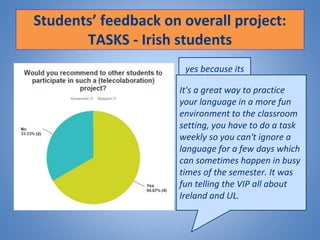
yes because its
very beneficial.
It is a great way to
practise Spanish
with someone your
age in a relaxed
manner
It's a great way to practice
your language in a more fun
environment to the classroom
setting, you have to do a task
weekly so you can't ignore a
language for a few days which
can sometimes happen in busy
times of the semester. It was
fun telling the VIP all about
Ireland and UL.
Students’ feedback on overall project:
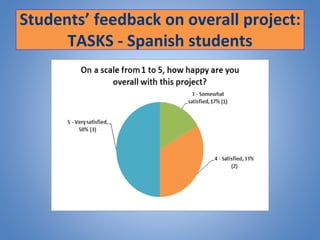
TASKS - Spanish students
For me, the project is
well organized, the
tasks, the exchange, the
tools suggested..
I think tasks
are fine as
they are.
We just have
problems in
finding free time
to communicate
each other [sic]
Students’ feedback on overall project:
TASKS - Spanish students
Students’ feedback on overall project:
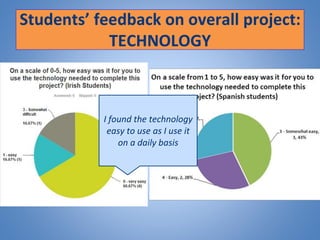
TECHNOLOGY
I found the technology
easy to use as I use it
on a daily basis
Students’ feedback on overall project:
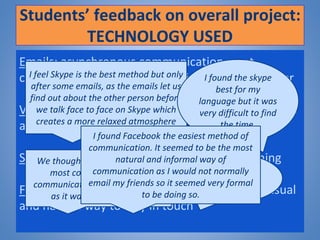
TECHNOLOGY USED
Emails: asynchronous communication most
convenient and easy to maintain, good ice-breaker
Voicethread: The most challenging for students but
a good preparation to skype
Skype: The most beneficial for language learning
Facebook: Introduced by students as a more casual
and natural way to stay in touch
We thought that email was the
most convenient form of
communication for the exchange
as it was quick and easy
I had never talked
by email with
anyone
I feel Skype is the best method but only
after some emails, as the emails let us
find out about the other person before
we talk face to face on Skype which
creates a more relaxed atmosphere
I found the skype
best for my
language but it was
very difficult to find
the time.
I found Facebook the easiest method of
communication. It seemed to be the most
natural and informal way of
communication as I would not normally
email my friends so it seemed very formal
to be doing so.
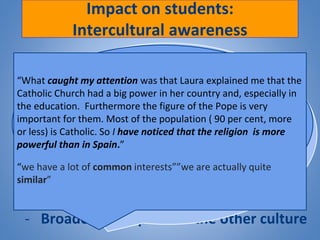
Impact on students:
Intercultural awareness
- Discovering and comparing:
Differences: Timetables, routines, prices
Social interaction
Festivals & Celebrations
Similarities Deeper reflexions
- Breaking pre-conceived ideas
- Broaden perception of the other culture
“Nights out are much later in Spain, alcohol is
a lot cheaper and entries to clubs are cheaper
also”
“In Ireland, while they always have respect,
they talk to them using their first name, which
it's more casual”
“Before talking with her I didn’t know how
similar both countries were in religion”
“I think we both have learned about the others
language and culture and above all, that
behind the little differences between both
countries, it exists a common willing of
knowing!” “I think that talking with Ashley has
changed the way in which I consider Ireland.”
“Something that has
surprised me is that they
cook with ‘aceite de oliva’ as
we do in Spain, I thought
that they cooked with
butter!”
“What caught my attention was that Laura explained me that the
Catholic Church had a big power in her country and, especially in
the education. Furthermore the figure of the Pope is very
important for them. Most of the population ( 90 per cent, more
or less) is Catholic. So I have noticed that the religion is more
powerful than in Spain.”
“we have a lot of common interests””we are actually quite
similar”
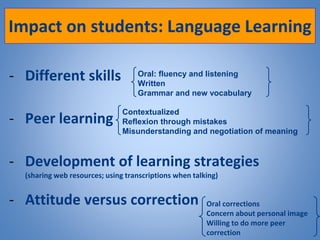
Impact on students: Language Learning
- Different skills
- Peer learning
- Development of learning strategies
(sharing web resources; using transcriptions when talking)
- Attitude versus correction
Oral: fluency and listening
Written
Grammar and new vocabulary
Contextualized
Reflexion through mistakes
Misunderstanding and negotiation of meaning
Oral corrections
Concern about personal image
Willing to do more peer
correction
Impact on students: Preparation for
mobility period
LOGISTICS SIDE [COMMUNICATION BASED ON
INFORMATION EXCHANGE]
- Practical information (university system;
culture)
HUMAN SIDE [COMMUNICATION BASED ON
PERSONAL RELATIONSHIP OF TRUST]
- Emotional support & encouragement
“Things are organized quite differently. I think Irish Universities
have a lot more facilities and clubs and societies. The timetable
structure is also very different.”
“I learned that their university have their exams after Christmas
whereas in my college we have them before the Christmas break.”
“Bego also told me places in Spain that I should visit when I go
there on Erasmus, like the various monuments and festivals (eg.
San Fermin and La Tomatina)...I think with all the information I got
from Bego I think I would feel comfortable with living in Spain.”
“It has made me feel better telling her how I feel about living abroad
as she is in the same situation as me. And I definitely feel more
prepared for my erasmus than before I started this project.”
“I’ve been talking with her about this and we both feel frightened
about how it will be to leave our countries, our homes, our families
and friends…”
“I encouraged him to go as it is vital for his language learning and I
told him what I knew about the Universities he was considering.”
“...the timing and atmosphere of university in Spain appeals to me
from what Patricia told me”
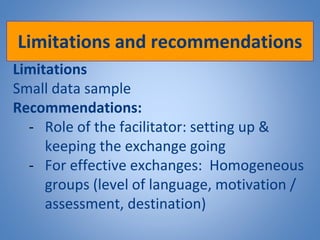
Limitations and recommendations
Limitations
Small data sample
Recommendations:
- Role of the facilitator: setting up &
keeping the exchange going
- For effective exchanges: Homogeneous
groups (level of language, motivation /
assessment, destination)
Conclusions
- Overall success of the project
- High satisfaction level amongst students
- Positive engagement from our learners
- Role of the social media
- More authentic for our students
- Good to discover L2 culture
- Good extension to the project: 4 Irish
students out of 6 plan to stay in touch with
partners via Facebook
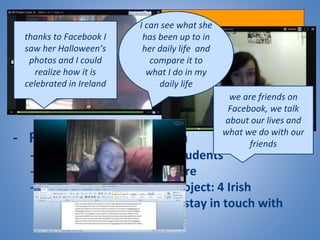
thanks to Facebook I
saw her Halloween’s
photos and I could
realize how it is
celebrated in Ireland
I can see what she
has been up to in
her daily life and
compare it to
what I do in my
daily life
we are friends on
Facebook, we talk
about our lives and
what we do with our
friends
THANK YOU
marta.giralt@ul.ie
catherine.jeanneau@ul.ie

Itell.pptx (2)

  • 1.
    The I–Tell Project:Intercultural telecollaborative learning before students mobility abroad Marta Giralt & Catherine Jeanneau School of Modern Languages & Applied Linguistics University of Limerick, Ireland
  • 2.
    The I–Tell Project Presentationoverview • Rationale for project • Project description • Data gathering • Findings – Students’ feedback: Tasks & Technologies used – Project outcomes: Impact on students: •Intercultural awareness •Language Learning •Preparation for the mobility period • Limitations, conclusions and recommendations
  • 3.
    Rationale for theI-Tell project • Period abroad (Erasmus, work placement): significant part of the Higher Education language learning experience. • Crucial to increase the opportunities for students to go abroad. • Paramount to prepare them for their mobility period to fully benefit from this experience (Byram & Dervin, 2008) The better prepared students are before their placement, the better their experience will be « Apprendre à être étranger : des parcours de formation interculturelle pour les étudiants de mobilité » (Mathilde Anquetil, 2008)
  • 4.
    Data gathering • Resultsfrom 12 questionnaires –6 Irish students / 6 Spanish students • Evidence from 8 portfolios –5 Irish students / 3 Spanish students • Teacher’s Diary (Facilitator of the Irish group)
  • 5.
    Project aims &objectives • For students to be better prepared for their period abroad and learn more about the country they will be travelling to (impacting directly and positively on student experience). • To develop the participants' intercultural, linguistic and digital skills.
  • 6.
    What is Telecollaboration? Theengagement of groups of students in online intercultural interaction and collaboration with partner classes from other cultural contexts or geographical locations, under the guidance of educators and/or expert facilitators (Robert O’Dowd, 2014)
  • 7.
    Project description website ofthe project Project program: 8 contact sessions 4 Tasks: one task to be completed every 2 weeks research has proven that …the negotiation of meaning and the resultant learner modifications are much more prevalent in goal-oriented, task-based interaction than in usual conversation (Pellettieri, 2000: 64) Exchanges: 2 per week asynchronous & synchronous; multimodal communication 50% Spanish 50% English
  • 8.
  • 9.
    Students’ feedback onoverall project: TASKS - Irish students Main issue: TIME It was not difficult to know what we should be doing Was hard to find the time to do it considering you really have to sit down and think about what you are going to say It was easy to keep up with the tasks but I found it difficult to do it on a weekly basis because if one of us did not reply immediately than it would result in a rush to finish the tasks due. Strategy used to overcome this problem => Self-regulation Some pairs did not follow the tasks’ order
  • 10.
    Students’ feedback onoverall project: TASKS - Irish students yes because its very beneficial. It is a great way to practise Spanish with someone your age in a relaxed manner It's a great way to practice your language in a more fun environment to the classroom setting, you have to do a task weekly so you can't ignore a language for a few days which can sometimes happen in busy times of the semester. It was fun telling the VIP all about Ireland and UL.
  • 11.
    Students’ feedback onoverall project: TASKS - Spanish students For me, the project is well organized, the tasks, the exchange, the tools suggested.. I think tasks are fine as they are. We just have problems in finding free time to communicate each other [sic]
  • 12.
    Students’ feedback onoverall project: TASKS - Spanish students
  • 13.
    Students’ feedback onoverall project: TECHNOLOGY I found the technology easy to use as I use it on a daily basis
  • 14.
    Students’ feedback onoverall project: TECHNOLOGY USED Emails: asynchronous communication most convenient and easy to maintain, good ice-breaker Voicethread: The most challenging for students but a good preparation to skype Skype: The most beneficial for language learning Facebook: Introduced by students as a more casual and natural way to stay in touch We thought that email was the most convenient form of communication for the exchange as it was quick and easy I had never talked by email with anyone I feel Skype is the best method but only after some emails, as the emails let us find out about the other person before we talk face to face on Skype which creates a more relaxed atmosphere I found the skype best for my language but it was very difficult to find the time. I found Facebook the easiest method of communication. It seemed to be the most natural and informal way of communication as I would not normally email my friends so it seemed very formal to be doing so.
  • 15.
    Impact on students: Interculturalawareness - Discovering and comparing: Differences: Timetables, routines, prices Social interaction Festivals & Celebrations Similarities Deeper reflexions - Breaking pre-conceived ideas - Broaden perception of the other culture “Nights out are much later in Spain, alcohol is a lot cheaper and entries to clubs are cheaper also” “In Ireland, while they always have respect, they talk to them using their first name, which it's more casual” “Before talking with her I didn’t know how similar both countries were in religion” “I think we both have learned about the others language and culture and above all, that behind the little differences between both countries, it exists a common willing of knowing!” “I think that talking with Ashley has changed the way in which I consider Ireland.” “Something that has surprised me is that they cook with ‘aceite de oliva’ as we do in Spain, I thought that they cooked with butter!” “What caught my attention was that Laura explained me that the Catholic Church had a big power in her country and, especially in the education. Furthermore the figure of the Pope is very important for them. Most of the population ( 90 per cent, more or less) is Catholic. So I have noticed that the religion is more powerful than in Spain.” “we have a lot of common interests””we are actually quite similar”
  • 16.
    Impact on students:Language Learning - Different skills - Peer learning - Development of learning strategies (sharing web resources; using transcriptions when talking) - Attitude versus correction Oral: fluency and listening Written Grammar and new vocabulary Contextualized Reflexion through mistakes Misunderstanding and negotiation of meaning Oral corrections Concern about personal image Willing to do more peer correction
  • 17.
    Impact on students:Preparation for mobility period LOGISTICS SIDE [COMMUNICATION BASED ON INFORMATION EXCHANGE] - Practical information (university system; culture) HUMAN SIDE [COMMUNICATION BASED ON PERSONAL RELATIONSHIP OF TRUST] - Emotional support & encouragement “Things are organized quite differently. I think Irish Universities have a lot more facilities and clubs and societies. The timetable structure is also very different.” “I learned that their university have their exams after Christmas whereas in my college we have them before the Christmas break.” “Bego also told me places in Spain that I should visit when I go there on Erasmus, like the various monuments and festivals (eg. San Fermin and La Tomatina)...I think with all the information I got from Bego I think I would feel comfortable with living in Spain.” “It has made me feel better telling her how I feel about living abroad as she is in the same situation as me. And I definitely feel more prepared for my erasmus than before I started this project.” “I’ve been talking with her about this and we both feel frightened about how it will be to leave our countries, our homes, our families and friends…” “I encouraged him to go as it is vital for his language learning and I told him what I knew about the Universities he was considering.” “...the timing and atmosphere of university in Spain appeals to me from what Patricia told me”
  • 18.
    Limitations and recommendations Limitations Smalldata sample Recommendations: - Role of the facilitator: setting up & keeping the exchange going - For effective exchanges: Homogeneous groups (level of language, motivation / assessment, destination)
  • 19.
    Conclusions - Overall successof the project - High satisfaction level amongst students - Positive engagement from our learners - Role of the social media - More authentic for our students - Good to discover L2 culture - Good extension to the project: 4 Irish students out of 6 plan to stay in touch with partners via Facebook thanks to Facebook I saw her Halloween’s photos and I could realize how it is celebrated in Ireland I can see what she has been up to in her daily life and compare it to what I do in my daily life we are friends on Facebook, we talk about our lives and what we do with our friends
  • 20.