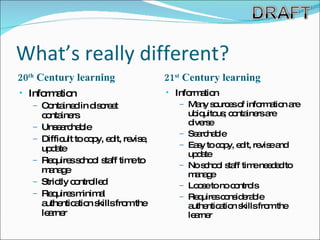
What’s really different? 20 th  Century learning 21 st  Century learning Information Contained in discreet containers Unsearchable Difficult to copy, edit, revise, update Requires school staff time to manage Strictly controlled Requires minimal authentication skills from the learner Information Many sources of information are ubiquitous; containers are diverse  Searchable Easy to copy, edit, revise and update No school staff time needed to manage Loose to no controls Requires considerable authentication skills from the learner
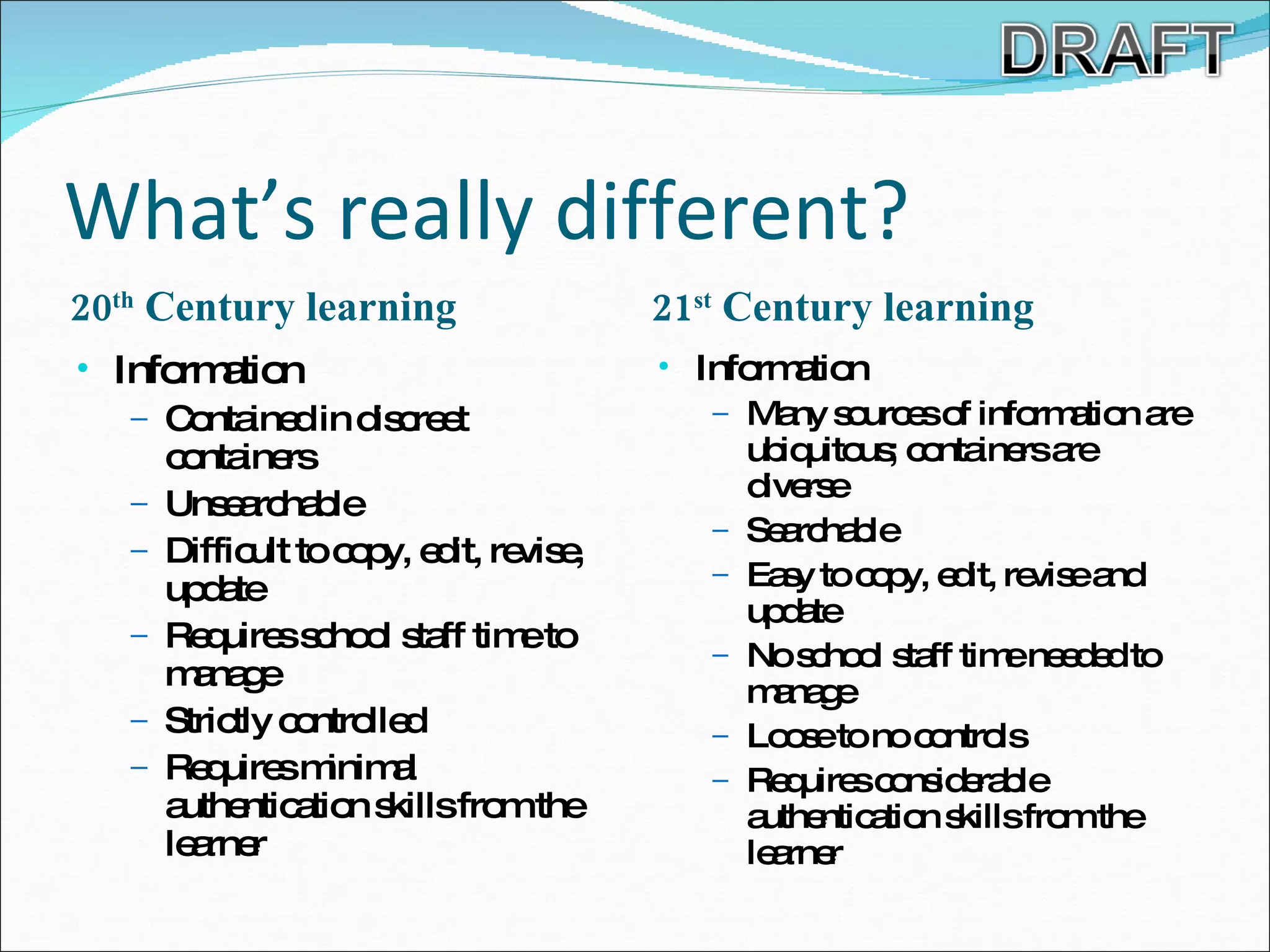
What’s really different? 20 th  Century learning 21 st  Century learning Authorship and Creativity Individual activity is the norm with some collaborative efforts The revising and editing process involves considerable rewriting time Boys tend to dislike authorship activities Audience consists of the teacher or the classroom… occasionally the school Primarily expressed in writing and drawing Authorship and Creativity Activities can easily be individual and/or highly collaborative More time is available for revising and editing by not rewriting Boys find more interest Audience can be the teacher, the classroom, the community, the nation or even the world Expressed in a wide array of forms including writing, imagery, video, audio
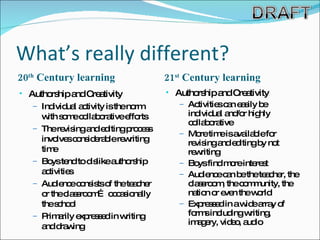
What’s really different? 20 th  Century learning 21 st  Century learning Participation Verbal is the exclusive method for group discussion Participatory learning tends to stop when the bell rings  Involvement with individuals from outside the classroom requires extensive coordination and expense Involvement in real issues is usually staged or role-play Learners who are not strong self-advocates have few means of expression Community participation is local Skills mastered during a formative education will be employed for life. Participation  Methods can be verbal, text, video, synchronous or asynchronous Participatory learning is not limited to bell schedules Involvement of individuals from outside the classroom is easy, inexpensive and can be a daily occurrence Legitimate involvement in real issues  Learners who are not strong self-advocates can find easy ways to participate Community participation spans local, state, national and global based on interest Skills are under constant redevelopment (change adept)
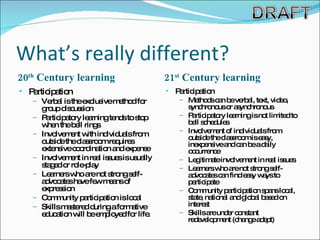
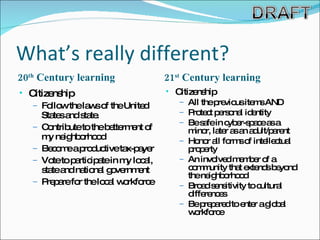
What’s really different? 20 th  Century learning 21 st  Century learning Citizenship Follow the laws of the United States and state. Contribute to the betterment of my neighborhood Become a productive tax-payer Vote to participate in my local, state and national government Prepare for the local workforce Citizenship  All the previous items AND Protect personal identity Be safe in cyber-space as a minor, later as an adult/parent Honor all forms of intellectual property An involved member of a community that extends beyond the neighborhood Broad sensitivity to cultural differences Be prepared to enter a global workforce
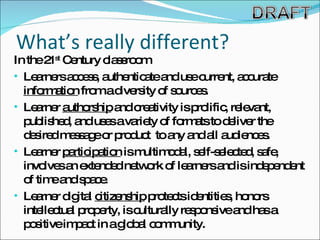
What’s really different? In the 21 st  Century classroom Learners access, authenticate and use current, accurate  information  from a diversity of sources. Learner  authorship  and creativity is prolific, relevant, published, and uses a variety of formats to deliver the desired message or product  to any and all audiences.  Learner  participation  is multimodal, self-selected, safe, involves an extended network of learners and is independent of time and space. Learner digital  citizenship  protects identities, honors intellectual property, is culturally responsive and has a positive impact in a global community.

What’S Really Different V2

  • 1.
    What’s really different?20 th Century learning 21 st Century learning Information Contained in discreet containers Unsearchable Difficult to copy, edit, revise, update Requires school staff time to manage Strictly controlled Requires minimal authentication skills from the learner Information Many sources of information are ubiquitous; containers are diverse Searchable Easy to copy, edit, revise and update No school staff time needed to manage Loose to no controls Requires considerable authentication skills from the learner
  • 2.
    What’s really different?20 th Century learning 21 st Century learning Authorship and Creativity Individual activity is the norm with some collaborative efforts The revising and editing process involves considerable rewriting time Boys tend to dislike authorship activities Audience consists of the teacher or the classroom… occasionally the school Primarily expressed in writing and drawing Authorship and Creativity Activities can easily be individual and/or highly collaborative More time is available for revising and editing by not rewriting Boys find more interest Audience can be the teacher, the classroom, the community, the nation or even the world Expressed in a wide array of forms including writing, imagery, video, audio
  • 3.
    What’s really different?20 th Century learning 21 st Century learning Participation Verbal is the exclusive method for group discussion Participatory learning tends to stop when the bell rings Involvement with individuals from outside the classroom requires extensive coordination and expense Involvement in real issues is usually staged or role-play Learners who are not strong self-advocates have few means of expression Community participation is local Skills mastered during a formative education will be employed for life. Participation Methods can be verbal, text, video, synchronous or asynchronous Participatory learning is not limited to bell schedules Involvement of individuals from outside the classroom is easy, inexpensive and can be a daily occurrence Legitimate involvement in real issues Learners who are not strong self-advocates can find easy ways to participate Community participation spans local, state, national and global based on interest Skills are under constant redevelopment (change adept)
  • 4.
    What’s really different?20 th Century learning 21 st Century learning Citizenship Follow the laws of the United States and state. Contribute to the betterment of my neighborhood Become a productive tax-payer Vote to participate in my local, state and national government Prepare for the local workforce Citizenship All the previous items AND Protect personal identity Be safe in cyber-space as a minor, later as an adult/parent Honor all forms of intellectual property An involved member of a community that extends beyond the neighborhood Broad sensitivity to cultural differences Be prepared to enter a global workforce
  • 5.
    What’s really different?In the 21 st Century classroom Learners access, authenticate and use current, accurate information from a diversity of sources. Learner authorship and creativity is prolific, relevant, published, and uses a variety of formats to deliver the desired message or product to any and all audiences. Learner participation is multimodal, self-selected, safe, involves an extended network of learners and is independent of time and space. Learner digital citizenship protects identities, honors intellectual property, is culturally responsive and has a positive impact in a global community.