52 | Baltic Transport Journal | 6/2017
A port of the future
F
uture has its roots in the past; there-
fore its seeds lay somewhere here
and now. According to Trelleborg
Marine Systems and Vonck, some of
the most crucial aspects in which the ports
will develop are automation, digitalization,
the use of big data (or IT in general), as well
as cooperation and sustainability.
Ports under pressure
Indeed – Vonck says – increased com-
plexity, revenue and costs, as well as energy
transition are the three main sources of
pressure put on ports and shipping. In
detail, first of these stands for technologi-
cal challenges, sustainability, and global
trade flows; pressure on revenue and costs
can be divided into price volatility, operat-
ing costs, and capital costs; while energy
transition consists of growth in demand,
energy mix, carbon shift, and energy effi-
ciency. In all of the points ports try – or
rather have to – achieve the best results.
“Data will become the new business cur-
rency: ports, terminals and vessels alike
should be gathering data now, to analyze and
act upon to be best placed for the future,”
Preparing for the port of the Future reads.
According to the research, almost all agree
– 92% of ports and terminals respondents
We would all like to know the answer to this question. Some hints may be found in the paper provided
by Trelleborg Marine Systems Preparing for the port of the Future, as well as in the presentation by Indra
Vonck, Deloitte Port Services, titled Ports of the future. A Vision – both based on surveys. Let’s then ex-
amine how ports can change in the decades ahead.
and 96% of shippers believe that big data
will somewhat or significantly impact the
shipping industry. But, when it comes to
real preparations, only 29% of the respond-
ents electronically track and standardize
data on pilot performance and adherence
to approach routes. While almost 80%
track times at berth, less than 30% monitor
mooring line tension and 16% collect data
on fender loads at the same time. A direct
consequence of this is that port operators
don’t know what caused a delay, they can’t
define the problem, and therefore can’t find a
proper solution. Trelleborg Marine Systems’
study reveals that only 24% automatically
store data and use it in their decision-mak-
ing. So the issue is not that much about the
awareness because its level is quite high –
it’s about action.
What will change?
“Changes will come over the coming
decade,” Gerd Leonhard, Futurist,
answered Trelleborg Marine Systems’
question. The disruption will not come
from the big shipping companies, but
start-ups and the IT business. The con-
clusion is simple – the future belongs to
those who can make use of data and smart
technologies, not to those who passively
adhere to the latest developments if even-
tually forced to do that.
In such a world, ports will become an
integral part of smart cities, driven by big
data and Artificial Intelligence. The rela-
tions among seaports will change as well
– Vonck said – and “technological innova-
tion will push ports to work together.” The
shipping business model will change into
one integrated logistical platform of ship-
ping lines and terminals. Therefore a special
operating system will be required to ensure
smooth communication among all parties
involved. And since there will be a universal
platform, we will require common standards
and legislation.
Sustainability, aided by tech, will be
another important factor of a next-gen port.
It’s going to be more visible when it comes
to fuel and equipment because port authori-
ties will play an important role in promot-
ing renewable energy and cleaner forms of
the port-related industries. The fleet will be
using alternative propulsion, such as elec-
tricity for trucks and Liquefied Natural gas
(LNG) for ships. Overall, ports will follow
the triple P rule – People, Planet, Profit – to
grow in a sustainable manner.
What and when will change, especially
in the view of the people from the business?
Photos:www.pexels.com
What
will it look
like?
by Maciej Kniter
6/2017 | Baltic Transport Journal | 53
Focus
Vonck provided interesting answers to a
number of questions. People actually do not
believe that a lot is happening right now –
only 2% of the respondents say that autono-
mous vehicles partake in inland navigation;
5% claim that drones are used in emergency
situations while another 5% see drones in
regular logistics; 9% recognize that auton-
omous drones are used in ports; and 15%
say that terminal equipment is already
autonomous.
Then again, quite a decent percent-
age of respondents (43%) think that in a
rather short term perspective (up to three
years) drones will be used in port services.
As many as 61% expect that self-driving
vessels will be in service in more than
10 years ahead. Similarly, when it comes
to autonomous inland navigation, 62%
suppose it will be in place in more than
a decade. The number of people who feel
the same about rail is much smaller – 46%.
As many as 54% of respondents speculate
that self-driving vans will be on our roads
after one decade, while 48% are convinced
about having driverless trucks in the same
amount of time. A slightly smaller number
of respondents (40%) think that we will
have autonomous terminals equipment
after one decade.
There’s a gloomier side to this as well.
According to the estimates, as a result of
automation processes, 25% of employees
will lose their jobs (compared to 2015).
This number comprises ports (with the
highest 8.2% rate among all), maritime
suppliers, yachting and sport, maritime
services, fisheries, marine, aquaculture,
inland navigation, offshore, shipbuilding,
and shipping.
Regulations – ports finding their role
As mentioned, in this new reality there
will be a need to set rules, and business will
have a leading role in this process. Vonck
predicts that ports and shipping will support
the regulator during the process of estab-
lishing new laws; they will “facilitate the
transition to a new digital workforce.” Port
authorities will need to reward green initia-
tives and raise cyber-awareness in order to
prevent cyber-threats.
The regulator, on the other hand, will
need to establish a common standard,
especially in the cyber-environment, and
increase the appeal of investments in the
production of digital solutions.
Should ports and shipping be worried?
Definitely not, because the sector will be
growing. Transport is always in vogue, so
to speak, and according to Vonck, “The
future of ports is challenging but bright
since innovation will have a greater role to
play and will enable the port to generate sig-
nificant value for customers, shareholders,
and employees.” Trelleborg Marine Systems
reminds that success lies in taking small
steps while still pursuing the big goal.  ‚
© 2017 Deloitte Port Services
Seaside Port Landside
Producer
Transport
node
Maritime
transport
Approach
services
Loading/
unloading
Storage
Industrial
processing
Intermodal
transport
Dry port
Hinterland
transport
Virtual
Reality
Commodity
data analytics
Intelligent
Asset Development
IoT enabled
remote operations
Big data
Analytics
Big data
Analytics
Cross-functional
and geographical
working
Drones/
RoVs
Drones/
RoVs
Smart
Cities
Smart
grids
Safety
Analytics
Internet
of Things
Drones/
RoVs
Machine to
machine
communication
Platform
solutions
Smart energy
management
Autonomous
transport
Smart metering
Supply
analytics Demand analytics3D Printing
RFID for
logistics and
transportation
RFID for
logistics and
transportation
Intelligent risk
and compliance
Intelligent risk
and compliance
Robotics
Robotics
Robotics
OutsourcingOutsourcing
Predictive
maintenance
Predictive maintenance
Autonomous
transport
Autonomous
transport
Collaboration
tools
Collaboration
tools
Supply chain
and vendor
optimization
Supply chain
and vendor
optimization
Single view
of stock
Single view
of stock
Real-time
digital resource
management Pricing analyticsRobotics
Intelligent
Asset Development
Mobile Workforce
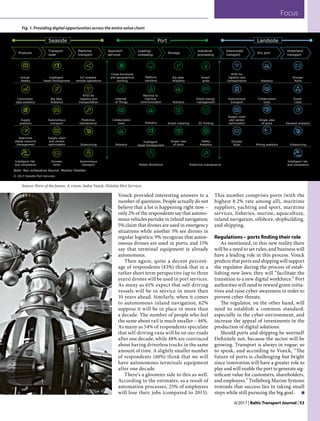
Note: Non exhaustive Source: Monitor Deloitte
Fig. 1. Providing digital opportunities across the entire value chain
Source: Ports of the future. A vision, Indra Vonck, Deloitte Port Services

What will it look like

  • 1.
    52 | BalticTransport Journal | 6/2017 A port of the future F uture has its roots in the past; there- fore its seeds lay somewhere here and now. According to Trelleborg Marine Systems and Vonck, some of the most crucial aspects in which the ports will develop are automation, digitalization, the use of big data (or IT in general), as well as cooperation and sustainability. Ports under pressure Indeed – Vonck says – increased com- plexity, revenue and costs, as well as energy transition are the three main sources of pressure put on ports and shipping. In detail, first of these stands for technologi- cal challenges, sustainability, and global trade flows; pressure on revenue and costs can be divided into price volatility, operat- ing costs, and capital costs; while energy transition consists of growth in demand, energy mix, carbon shift, and energy effi- ciency. In all of the points ports try – or rather have to – achieve the best results. “Data will become the new business cur- rency: ports, terminals and vessels alike should be gathering data now, to analyze and act upon to be best placed for the future,” Preparing for the port of the Future reads. According to the research, almost all agree – 92% of ports and terminals respondents We would all like to know the answer to this question. Some hints may be found in the paper provided by Trelleborg Marine Systems Preparing for the port of the Future, as well as in the presentation by Indra Vonck, Deloitte Port Services, titled Ports of the future. A Vision – both based on surveys. Let’s then ex- amine how ports can change in the decades ahead. and 96% of shippers believe that big data will somewhat or significantly impact the shipping industry. But, when it comes to real preparations, only 29% of the respond- ents electronically track and standardize data on pilot performance and adherence to approach routes. While almost 80% track times at berth, less than 30% monitor mooring line tension and 16% collect data on fender loads at the same time. A direct consequence of this is that port operators don’t know what caused a delay, they can’t define the problem, and therefore can’t find a proper solution. Trelleborg Marine Systems’ study reveals that only 24% automatically store data and use it in their decision-mak- ing. So the issue is not that much about the awareness because its level is quite high – it’s about action. What will change? “Changes will come over the coming decade,” Gerd Leonhard, Futurist, answered Trelleborg Marine Systems’ question. The disruption will not come from the big shipping companies, but start-ups and the IT business. The con- clusion is simple – the future belongs to those who can make use of data and smart technologies, not to those who passively adhere to the latest developments if even- tually forced to do that. In such a world, ports will become an integral part of smart cities, driven by big data and Artificial Intelligence. The rela- tions among seaports will change as well – Vonck said – and “technological innova- tion will push ports to work together.” The shipping business model will change into one integrated logistical platform of ship- ping lines and terminals. Therefore a special operating system will be required to ensure smooth communication among all parties involved. And since there will be a universal platform, we will require common standards and legislation. Sustainability, aided by tech, will be another important factor of a next-gen port. It’s going to be more visible when it comes to fuel and equipment because port authori- ties will play an important role in promot- ing renewable energy and cleaner forms of the port-related industries. The fleet will be using alternative propulsion, such as elec- tricity for trucks and Liquefied Natural gas (LNG) for ships. Overall, ports will follow the triple P rule – People, Planet, Profit – to grow in a sustainable manner. What and when will change, especially in the view of the people from the business? Photos:www.pexels.com What will it look like? by Maciej Kniter
  • 2.
    6/2017 | BalticTransport Journal | 53 Focus Vonck provided interesting answers to a number of questions. People actually do not believe that a lot is happening right now – only 2% of the respondents say that autono- mous vehicles partake in inland navigation; 5% claim that drones are used in emergency situations while another 5% see drones in regular logistics; 9% recognize that auton- omous drones are used in ports; and 15% say that terminal equipment is already autonomous. Then again, quite a decent percent- age of respondents (43%) think that in a rather short term perspective (up to three years) drones will be used in port services. As many as 61% expect that self-driving vessels will be in service in more than 10 years ahead. Similarly, when it comes to autonomous inland navigation, 62% suppose it will be in place in more than a decade. The number of people who feel the same about rail is much smaller – 46%. As many as 54% of respondents speculate that self-driving vans will be on our roads after one decade, while 48% are convinced about having driverless trucks in the same amount of time. A slightly smaller number of respondents (40%) think that we will have autonomous terminals equipment after one decade. There’s a gloomier side to this as well. According to the estimates, as a result of automation processes, 25% of employees will lose their jobs (compared to 2015). This number comprises ports (with the highest 8.2% rate among all), maritime suppliers, yachting and sport, maritime services, fisheries, marine, aquaculture, inland navigation, offshore, shipbuilding, and shipping. Regulations – ports finding their role As mentioned, in this new reality there will be a need to set rules, and business will have a leading role in this process. Vonck predicts that ports and shipping will support the regulator during the process of estab- lishing new laws; they will “facilitate the transition to a new digital workforce.” Port authorities will need to reward green initia- tives and raise cyber-awareness in order to prevent cyber-threats. The regulator, on the other hand, will need to establish a common standard, especially in the cyber-environment, and increase the appeal of investments in the production of digital solutions. Should ports and shipping be worried? Definitely not, because the sector will be growing. Transport is always in vogue, so to speak, and according to Vonck, “The future of ports is challenging but bright since innovation will have a greater role to play and will enable the port to generate sig- nificant value for customers, shareholders, and employees.” Trelleborg Marine Systems reminds that success lies in taking small steps while still pursuing the big goal.  ‚ © 2017 Deloitte Port Services Seaside Port Landside Producer Transport node Maritime transport Approach services Loading/ unloading Storage Industrial processing Intermodal transport Dry port Hinterland transport Virtual Reality Commodity data analytics Intelligent Asset Development IoT enabled remote operations Big data Analytics Big data Analytics Cross-functional and geographical working Drones/ RoVs Drones/ RoVs Smart Cities Smart grids Safety Analytics Internet of Things Drones/ RoVs Machine to machine communication Platform solutions Smart energy management Autonomous transport Smart metering Supply analytics Demand analytics3D Printing RFID for logistics and transportation RFID for logistics and transportation Intelligent risk and compliance Intelligent risk and compliance Robotics Robotics Robotics OutsourcingOutsourcing Predictive maintenance Predictive maintenance Autonomous transport Autonomous transport Collaboration tools Collaboration tools Supply chain and vendor optimization Supply chain and vendor optimization Single view of stock Single view of stock Real-time digital resource management Pricing analyticsRobotics Intelligent Asset Development Mobile Workforce Note: Non exhaustive Source: Monitor Deloitte Fig. 1. Providing digital opportunities across the entire value chain Source: Ports of the future. A vision, Indra Vonck, Deloitte Port Services