What to
Expect
after
laSIK
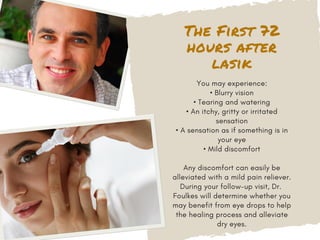
The First 72
hours after
lasik
You may experience:
• Blurry vision
• Tearing and watering
• An itchy, gritty or irritated
sensation
• A sensation as if something is in
your eye
• Mild discomfort
Any discomfort can easily be
alleviated with a mild pain reliever.
During your follow-up visit, Dr.
Foulkes will determine whether you
may benefit from eye drops to help
the healing process and alleviate
dry eyes.
Relax for a few
days
For the first few days after LASIK, avoid
running, athletics, and other activiteis
that can potentially impact the healing
process. Book off some time to relax
while your eyes heal.
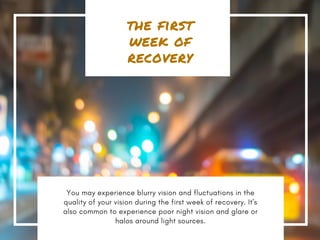
the first
week of
recovery
You may experience blurry vision and fluctuations in the
quality of your vision during the first week of recovery. It's
also common to experience poor night vision and glare or
halos around light sources.
4-6 weeks
after lasik
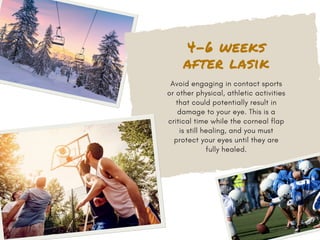
Avoid engaging in contact sports
or other physical, athletic activities
that could potentially result in
damage to your eye. This is a
critical time while the corneal flap
is still healing, and you must
protect your eyes until they are
fully healed.
3-6 months after lasik
It may take 3-6 months for your vision to stabilize after LASIK. During
this time, you may still experience periodic fluctuations in vision.
Symptoms such as glare and halos, while rare, may still persist until
your vision has fully stabilized. Make sure you discuss any fluctuations
in vision or other issues with Dr. Foulkes during your follow up visits.
long-term vision
expectations
According to WebMD, more than
94% of LASIK patients will achieve
20/40 vision or better. The vast
majority if Dr. Foulkes' patients
achieve 20/20 vision or better.
At Foulkes Vision, our goal is for
you to achieve "20/happy" vision.
This may or may not be 20/20
vision, but it refers to a level of
vision that is close enough to
20/20 that you will be able to go
through daily life without dealing
with the hassles associated with
glasses or contact lenses.
you may still need
reading glasses
Keep in mind that unless you undergo
monovision LASIK,  you may still need to
wear reading glasses to address near-
vision issues associated with
presbyopia, an age-related vision
condition impacting individuals in  their
40s and beyond.
high satisfaction rate
An analysis of 97 LASIK studies involving over 68,000
LASIK patients found that 98.8% of patients were
satisfied with their results. Very few surgical
procedures boast as high of a satisfaction rate as
LASIK.
Source: http://www.jcrsjournal.org/article/S0886-3350(16)30269-3/fulltext
Thank You!
Would you like to find out if LASIK is
right for you? Please call
630-724-1400 to schedule a free
consultation. Foulkes Vision serves
patients in the Chicago area.

What to Expect after LASIK

  • 1.
  • 2.
    The First 72 hoursafter lasik You may experience: • Blurry vision • Tearing and watering • An itchy, gritty or irritated sensation • A sensation as if something is in your eye • Mild discomfort Any discomfort can easily be alleviated with a mild pain reliever. During your follow-up visit, Dr. Foulkes will determine whether you may benefit from eye drops to help the healing process and alleviate dry eyes.
  • 3.
    Relax for afew days For the first few days after LASIK, avoid running, athletics, and other activiteis that can potentially impact the healing process. Book off some time to relax while your eyes heal.
  • 4.
    the first week of recovery Youmay experience blurry vision and fluctuations in the quality of your vision during the first week of recovery. It's also common to experience poor night vision and glare or halos around light sources.
  • 5.
    4-6 weeks after lasik Avoidengaging in contact sports or other physical, athletic activities that could potentially result in damage to your eye. This is a critical time while the corneal flap is still healing, and you must protect your eyes until they are fully healed.
  • 6.
    3-6 months afterlasik It may take 3-6 months for your vision to stabilize after LASIK. During this time, you may still experience periodic fluctuations in vision. Symptoms such as glare and halos, while rare, may still persist until your vision has fully stabilized. Make sure you discuss any fluctuations in vision or other issues with Dr. Foulkes during your follow up visits.
  • 7.
    long-term vision expectations According toWebMD, more than 94% of LASIK patients will achieve 20/40 vision or better. The vast majority if Dr. Foulkes' patients achieve 20/20 vision or better. At Foulkes Vision, our goal is for you to achieve "20/happy" vision. This may or may not be 20/20 vision, but it refers to a level of vision that is close enough to 20/20 that you will be able to go through daily life without dealing with the hassles associated with glasses or contact lenses.
  • 8.
    you may stillneed reading glasses Keep in mind that unless you undergo monovision LASIK,  you may still need to wear reading glasses to address near- vision issues associated with presbyopia, an age-related vision condition impacting individuals in  their 40s and beyond.
  • 9.
    high satisfaction rate Ananalysis of 97 LASIK studies involving over 68,000 LASIK patients found that 98.8% of patients were satisfied with their results. Very few surgical procedures boast as high of a satisfaction rate as LASIK. Source: http://www.jcrsjournal.org/article/S0886-3350(16)30269-3/fulltext
  • 10.
    Thank You! Would youlike to find out if LASIK is right for you? Please call 630-724-1400 to schedule a free consultation. Foulkes Vision serves patients in the Chicago area.