What the heck is Eclipse Modeling
and why should you care !
me
CTO at Obeo – cedric.brun@obeo.fr
Strategic Member of the Eclipse Foundation
Projet lead of:
● EMF Compare
● Modeling Amalgamation
Commiter:
● Acceleo
● Mylyn Intent
● Eclipse Packaging Project
Eclipse Architecture and Planning Council
Rich and diverse Ecosystem
Mature technologies and frameworks to build
applications
dedicated tools
You can try at a very low cost
Happy birthday
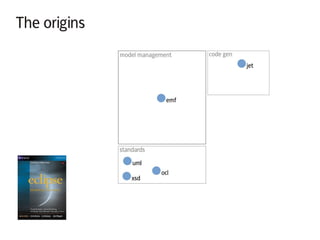
The origins
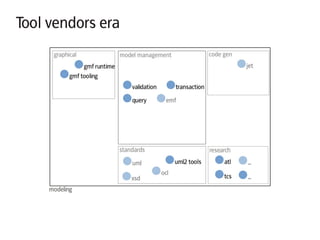
Tool vendors era
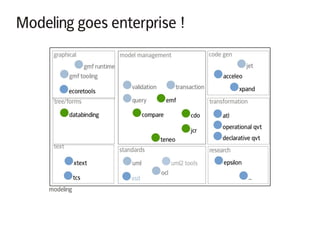
Modeling goes enterprise !
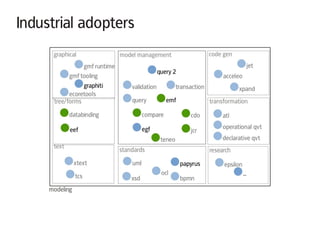
Industrial adopters
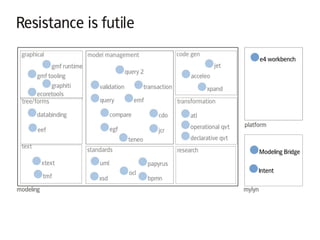
Resistance is futile
The Eclipse Modeling
Project
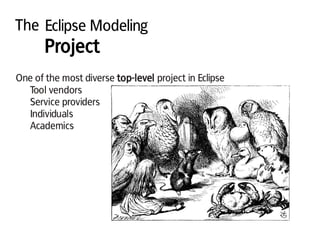
One of the most diverse top-level project in Eclipse
Tool vendors
Service providers
Individuals
Academics
The Eclipse Modeling
Project
Wide range of public
Wide range of maturity level
Ask for help on the forum
Check for activity
Mind the Incubation status
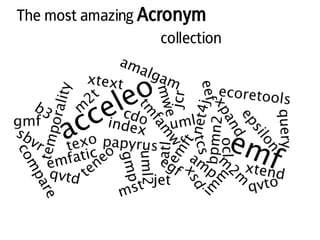
The most amazing Acronym
collection
The Eclipse Modeling Project
Structure
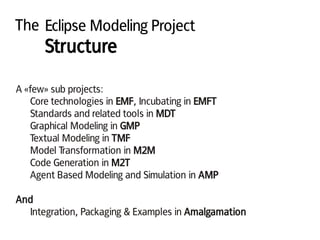
A «few» sub projects:
Core technologies in EMF, Incubating in EMFT
Standards and related tools in MDT
Graphical Modeling in GMP
Textual Modeling in TMF
Model Transformation in M2M
Code Generation in M2T
Agent Based Modeling and Simulation in AMP
And
Integration, Packaging & Examples in Amalgamation
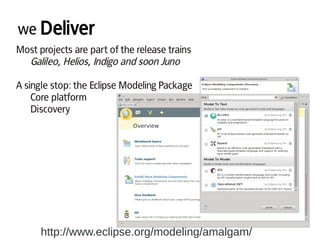
we Deliver
Most projects are part of the release trains
Galileo, Helios, Indigo and soon Juno
A single stop: the Eclipse Modeling Package
Core platform
Discovery
http://www.eclipse.org/modeling/amalgam/
What
is Modeling ?
Capturing information to
represent a system enabling:
Validation
Prototyping
Automation
Documentation
...
What
makes a good model ?
1. It is answering a question
2. It is used
Two Faces
Technologies to build
applications
Technologies to build
dedicated tools
Using EMF «as is»
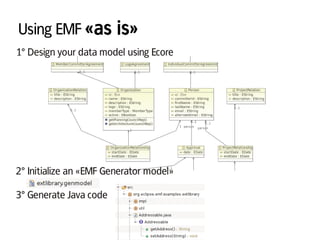
1° Design your data model using Ecore
2° Initialize an «EMF Generator model»
3° Generate Java code
Using EMF «as is»
You are getting:
✔ Domain model independent of serialization (XMI, XML, Binary ...)
✔ Efficient Java API
✔ Referenceable model elements through URI + fragments
✔ Common API to listen and react to changes.
✔ Resources and REST api for documents
✔ Rich and efficient reflective API.
✔ Commands and free undo/redo
✔ ...
At a cost:
✔You'll depend on EMF (which is standalone, but still...)
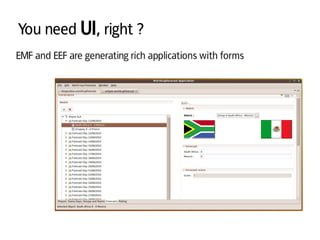
You need UI, right ?
EMF and EEF are generating rich applications with forms
Generated web apps
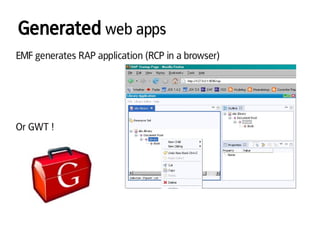
EMF generates RAP application (RCP in a browser)
Or GWT !
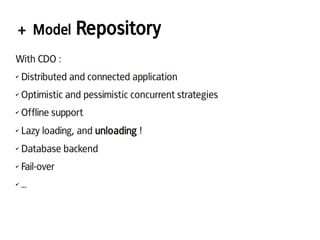
+ Model Repository
With CDO :
✔ Distributed and connected application
✔ Optimistic and pessimistic concurrent strategies
✔ Offline support
✔ Lazy loading, and unloading !
✔ Database backend
✔ Fail-over
✔ ...
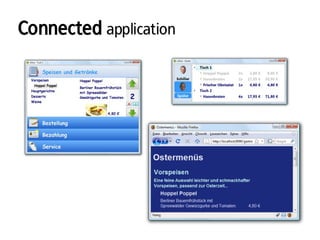
Connected application
You don't need
anything else,
do you ?
Two Faces
Technologies to build
applications
Technologies to build
dedicated tools
Building your own Tools
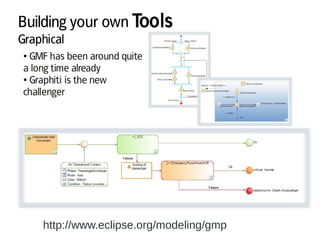
Graphical
● GMF has been around quite
a long time already
● Graphiti is the new
challenger
http://www.eclipse.org/modeling/gmp
Building your own Tools
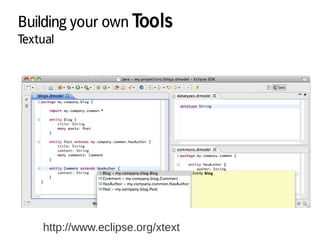
Textual
http://www.eclipse.org/xtext
Building your own Tools
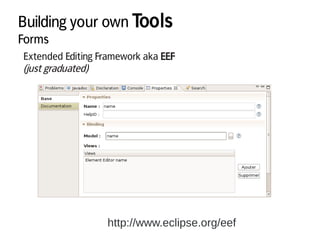
Forms
http://www.eclipse.org/eef
Extended Editing Framework aka EEF
(just graduated)
Building your own Tools
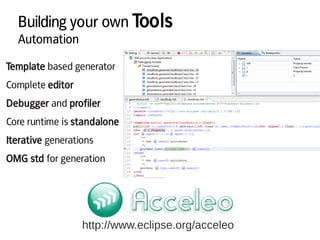
Automation
http://www.eclipse.org/acceleo
Template based generator
Complete editor
Debugger and profiler
Core runtime is standalone
Iterative generations
OMG std for generation
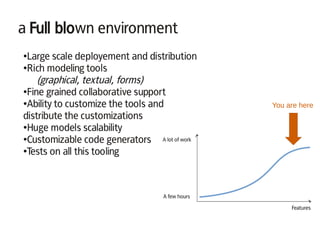
a Full blown environment
●Large scale deployement and distribution
●Rich modeling tools
(graphical, textual, forms)
●Fine grained collaborative support
●Ability to customize the tools and
distribute the customizations
●Huge models scalability
●Customizable code generators
●Tests on all this tooling
A few hours
A lot of work
Features
You are here
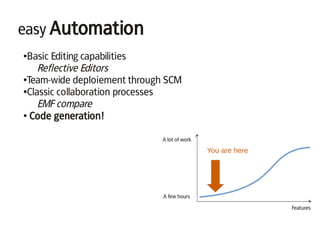
easy Automation
●Basic Editing capabilities
Reflective Editors
●Team-wide deploiement through SCM
●Classic collaboration processes
EMF compare
● Code generation!
A few hours
A lot of work
Features
You are here
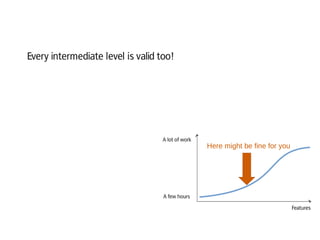
Every intermediate level is valid too!
A few hours
A lot of work
Features
Here might be fine for you
Let's Try ...
You need (*)
● Eclipse
● EMF
● Acceleo
We will build:
A model to keep track of our app features among n versions
(*) Two clicks to install from the Eclipse Marketplace
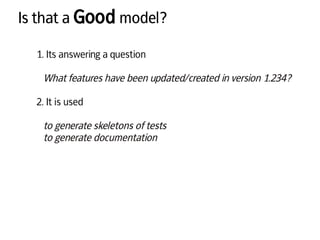
Is that a Good model?
1. Its answering a question
What features have been updated/created in version 1.234?
2. It is used
to generate skeletons of tests
to generate documentation
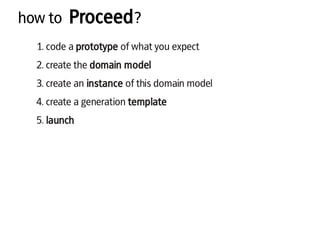
how to Proceed?
1. code a prototype of what you expect
2. create the domain model
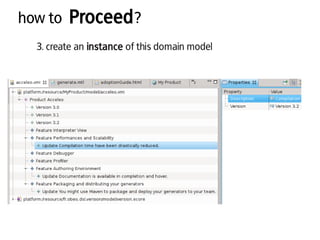
3. create an instance of this domain model
4. create a generation template
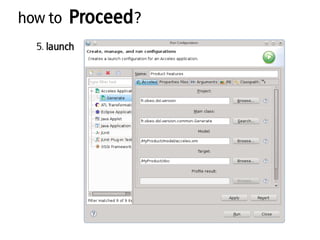
5. launch
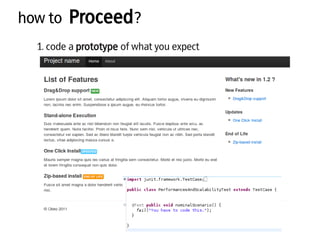
how to Proceed?
1. code a prototype of what you expect
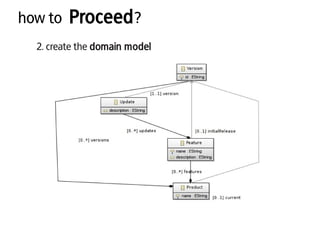
how to Proceed?
2. create the domain model
how to Proceed?
3. create an instance of this domain model
how to Proceed?
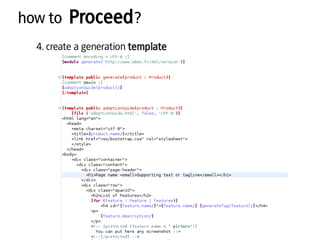
4. create a generation template
how to Proceed?
5. launch
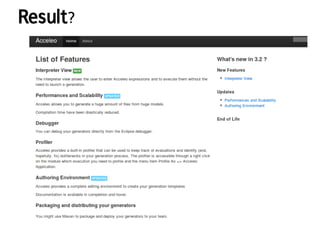
Result?
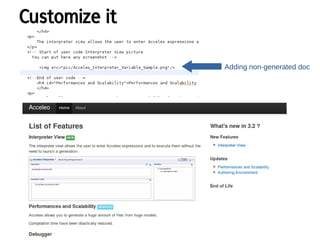
Customize it
Adding non-generated doc
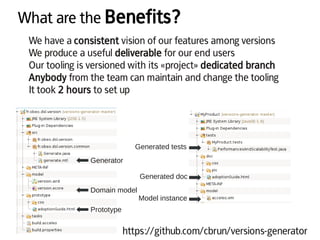
What are the Benefits?
We have a consistent vision of our features among versions
We produce a useful deliverable for our end users
Our tooling is versioned with its «project» dedicated branch
Anybody from the team can maintain and change the tooling
It took 2 hours to set up
https://github.com/cbrun/versions-generator
Domain model
Generator
Prototype
Generated tests
Generated doc
Model instance
Rich and diverse Ecosystem
You can build
applications
dedicated tools
You can try at a very low cost
Try it !
References
« Alice in Wonderland » pictures are from John Tenniel in public domain since 1964
The Eclipse Modeling Package
http://www.eclipse.org/modeling/amalgam/
The Eclipse Forum
http://www.eclipse.org/forums/
The Eclipse Modeling Cross Projects Example
http://goo.gl/51RuK
The versions generator example:
https://github.com/cbrun/versions-generator
Obeo Network
http://www.obeonetwork.org/
Me
@bruncedric on twitter
http://model-driven-blogging.blogspot.com/

What the heck is Eclipse Modeling and why should you care !

  • 1.
    What the heckis Eclipse Modeling and why should you care !
  • 2.
    me CTO at Obeo– cedric.brun@obeo.fr Strategic Member of the Eclipse Foundation Projet lead of: ● EMF Compare ● Modeling Amalgamation Commiter: ● Acceleo ● Mylyn Intent ● Eclipse Packaging Project Eclipse Architecture and Planning Council
  • 3.
    Rich and diverseEcosystem Mature technologies and frameworks to build applications dedicated tools You can try at a very low cost
  • 4.
  • 5.
  • 6.
  • 7.
  • 8.
  • 9.
  • 10.
    The Eclipse Modeling Project Oneof the most diverse top-level project in Eclipse Tool vendors Service providers Individuals Academics
  • 11.
    The Eclipse Modeling Project Widerange of public Wide range of maturity level Ask for help on the forum Check for activity Mind the Incubation status
  • 12.
    The most amazingAcronym collection
  • 13.
    The Eclipse ModelingProject Structure A «few» sub projects: Core technologies in EMF, Incubating in EMFT Standards and related tools in MDT Graphical Modeling in GMP Textual Modeling in TMF Model Transformation in M2M Code Generation in M2T Agent Based Modeling and Simulation in AMP And Integration, Packaging & Examples in Amalgamation
  • 14.
    we Deliver Most projectsare part of the release trains Galileo, Helios, Indigo and soon Juno A single stop: the Eclipse Modeling Package Core platform Discovery http://www.eclipse.org/modeling/amalgam/
  • 15.
    What is Modeling ? Capturinginformation to represent a system enabling: Validation Prototyping Automation Documentation ...
  • 16.
    What makes a goodmodel ? 1. It is answering a question 2. It is used
  • 17.
    Two Faces Technologies tobuild applications Technologies to build dedicated tools
  • 18.
    Using EMF «asis» 1° Design your data model using Ecore 2° Initialize an «EMF Generator model» 3° Generate Java code
  • 19.
    Using EMF «asis» You are getting: ✔ Domain model independent of serialization (XMI, XML, Binary ...) ✔ Efficient Java API ✔ Referenceable model elements through URI + fragments ✔ Common API to listen and react to changes. ✔ Resources and REST api for documents ✔ Rich and efficient reflective API. ✔ Commands and free undo/redo ✔ ... At a cost: ✔You'll depend on EMF (which is standalone, but still...)
  • 20.
    You need UI,right ? EMF and EEF are generating rich applications with forms
  • 21.
    Generated web apps EMFgenerates RAP application (RCP in a browser) Or GWT !
  • 22.
    + Model Repository WithCDO : ✔ Distributed and connected application ✔ Optimistic and pessimistic concurrent strategies ✔ Offline support ✔ Lazy loading, and unloading ! ✔ Database backend ✔ Fail-over ✔ ...
  • 23.
  • 24.
  • 25.
    Two Faces Technologies tobuild applications Technologies to build dedicated tools
  • 26.
    Building your ownTools Graphical ● GMF has been around quite a long time already ● Graphiti is the new challenger http://www.eclipse.org/modeling/gmp
  • 27.
    Building your ownTools Textual http://www.eclipse.org/xtext
  • 28.
    Building your ownTools Forms http://www.eclipse.org/eef Extended Editing Framework aka EEF (just graduated)
  • 29.
    Building your ownTools Automation http://www.eclipse.org/acceleo Template based generator Complete editor Debugger and profiler Core runtime is standalone Iterative generations OMG std for generation
  • 30.
    a Full blownenvironment ●Large scale deployement and distribution ●Rich modeling tools (graphical, textual, forms) ●Fine grained collaborative support ●Ability to customize the tools and distribute the customizations ●Huge models scalability ●Customizable code generators ●Tests on all this tooling A few hours A lot of work Features You are here
  • 31.
    easy Automation ●Basic Editingcapabilities Reflective Editors ●Team-wide deploiement through SCM ●Classic collaboration processes EMF compare ● Code generation! A few hours A lot of work Features You are here
  • 32.
    Every intermediate levelis valid too! A few hours A lot of work Features Here might be fine for you
  • 33.
    Let's Try ... Youneed (*) ● Eclipse ● EMF ● Acceleo We will build: A model to keep track of our app features among n versions (*) Two clicks to install from the Eclipse Marketplace
  • 34.
    Is that aGood model? 1. Its answering a question What features have been updated/created in version 1.234? 2. It is used to generate skeletons of tests to generate documentation
  • 35.
    how to Proceed? 1.code a prototype of what you expect 2. create the domain model 3. create an instance of this domain model 4. create a generation template 5. launch
  • 36.
    how to Proceed? 1.code a prototype of what you expect
  • 37.
    how to Proceed? 2.create the domain model
  • 38.
    how to Proceed? 3.create an instance of this domain model
  • 39.
    how to Proceed? 4.create a generation template
  • 40.
  • 41.
  • 42.
  • 43.
    What are theBenefits? We have a consistent vision of our features among versions We produce a useful deliverable for our end users Our tooling is versioned with its «project» dedicated branch Anybody from the team can maintain and change the tooling It took 2 hours to set up https://github.com/cbrun/versions-generator Domain model Generator Prototype Generated tests Generated doc Model instance
  • 44.
    Rich and diverseEcosystem You can build applications dedicated tools You can try at a very low cost Try it !
  • 45.
    References « Alice in Wonderland » pictures are from John Tenniel in public domain since 1964 The Eclipse ModelingPackage http://www.eclipse.org/modeling/amalgam/ The Eclipse Forum http://www.eclipse.org/forums/ The Eclipse Modeling Cross Projects Example http://goo.gl/51RuK The versions generator example: https://github.com/cbrun/versions-generator Obeo Network http://www.obeonetwork.org/ Me @bruncedric on twitter http://model-driven-blogging.blogspot.com/