What is the World Wide
Web, how does it work?
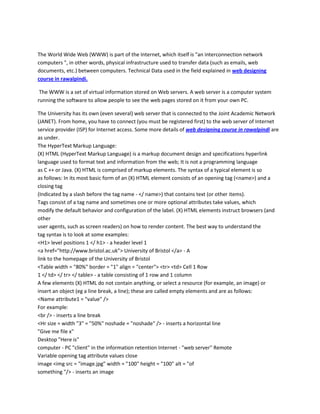
The World Wide Web (WWW) is part of the Internet, which itself is "an interconnection network
computers ", in other words, physical infrastructure used to transfer data (such as emails, web
documents, etc.) between computers. Technical Data used in the field explained in web designing
course in rawalpindi.
The WWW is a set of virtual information stored on Web servers. A web server is a computer system
running the software to allow people to see the web pages stored on it from your own PC.
The University has its own (even several) web server that is connected to the Joint Academic Network
(JANET). From home, you have to connect (you must be registered first) to the web server of Internet
service provider (ISP) for Internet access. Some more details of web designing course in rawalpindi are
as under.
The HyperText Markup Language:
(X) HTML (HyperText Markup Language) is a markup document design and specifications hyperlink
language used to format text and information from the web; It is not a programming language
as C ++ or Java. (X) HTML is comprised of markup elements. The syntax of a typical element is so
as follows: In its most basic form of an (X) HTML element consists of an opening tag (<name>) and a
closing tag
(Indicated by a slash before the tag name - </ name>) that contains text (or other items).
Tags consist of a tag name and sometimes one or more optional attributes take values, which
modify the default behavior and configuration of the label. (X) HTML elements instruct browsers (and
other
user agents, such as screen readers) on how to render content. The best way to understand the
tag syntax is to look at some examples:
<H1> level positions 1 </ h1> - a header level 1
<a href="http://www.bristol.ac.uk"> University of Bristol </a> - A
link to the homepage of the University of Bristol
<Table width = "80%" border = "1" align = "center"> <tr> <td> Cell 1 Row
1 </ td> </ tr> </ table> - a table consisting of 1 row and 1 column
A few elements (X) HTML do not contain anything, or select a resource (for example, an image) or
insert an object (eg a line break, a line); these are called empty elements and are as follows:
<Name attribute1 = "value" />
For example:
<br /> - inserts a line break
<Hr size = width "3" = "50%" noshade = "noshade" /> - inserts a horizontal line
"Give me file x"
Desktop "Here is"
computer - PC "client" in the information retention Internet - "web server" Remote
Variable opening tag attribute values close
image <img src = "image.jpg" width = "100" height = "100" alt = "of
something "/> - inserts an image
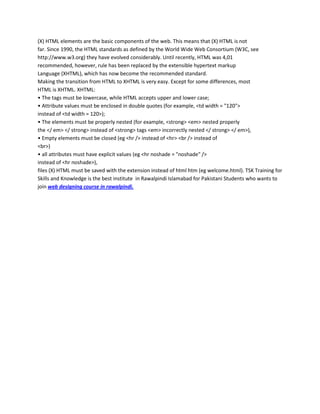
(X) HTML elements are the basic components of the web. This means that (X) HTML is not
far. Since 1990, the HTML standards as defined by the World Wide Web Consortium (W3C, see
http://www.w3.org) they have evolved considerably. Until recently, HTML was 4,01
recommended, however, rule has been replaced by the extensible hypertext markup
Language (XHTML), which has now become the recommended standard.
Making the transition from HTML to XHTML is very easy. Except for some differences, most
HTML is XHTML. XHTML:
• The tags must be lowercase, while HTML accepts upper and lower case;
• Attribute values must be enclosed in double quotes (for example, <td width = "120">
instead of <td width = 120>);
• The elements must be properly nested (for example, <strong> <em> nested properly
the </ em> </ strong> instead of <strong> tags <em> incorrectly nested </ strong> </ em>),
• Empty elements must be closed (eg <hr /> instead of <hr> <br /> instead of
<br>)
• all attributes must have explicit values (eg <hr noshade = "noshade" />
instead of <hr noshade>),
files (X) HTML must be saved with the extension instead of html htm (eg welcome.html). TSK Training for
Skills and Knowledge is the best institute in Rawalpindi Islamabad for Pakistani Students who wants to
join web designing course in rawalpindi.

What is the world wide web how does it work.docx

  • 1.
    What is theWorld Wide Web, how does it work?
  • 2.
    The World WideWeb (WWW) is part of the Internet, which itself is "an interconnection network computers ", in other words, physical infrastructure used to transfer data (such as emails, web documents, etc.) between computers. Technical Data used in the field explained in web designing course in rawalpindi. The WWW is a set of virtual information stored on Web servers. A web server is a computer system running the software to allow people to see the web pages stored on it from your own PC. The University has its own (even several) web server that is connected to the Joint Academic Network (JANET). From home, you have to connect (you must be registered first) to the web server of Internet service provider (ISP) for Internet access. Some more details of web designing course in rawalpindi are as under. The HyperText Markup Language: (X) HTML (HyperText Markup Language) is a markup document design and specifications hyperlink language used to format text and information from the web; It is not a programming language as C ++ or Java. (X) HTML is comprised of markup elements. The syntax of a typical element is so as follows: In its most basic form of an (X) HTML element consists of an opening tag (<name>) and a closing tag (Indicated by a slash before the tag name - </ name>) that contains text (or other items). Tags consist of a tag name and sometimes one or more optional attributes take values, which modify the default behavior and configuration of the label. (X) HTML elements instruct browsers (and other user agents, such as screen readers) on how to render content. The best way to understand the tag syntax is to look at some examples: <H1> level positions 1 </ h1> - a header level 1 <a href="http://www.bristol.ac.uk"> University of Bristol </a> - A link to the homepage of the University of Bristol <Table width = "80%" border = "1" align = "center"> <tr> <td> Cell 1 Row 1 </ td> </ tr> </ table> - a table consisting of 1 row and 1 column A few elements (X) HTML do not contain anything, or select a resource (for example, an image) or insert an object (eg a line break, a line); these are called empty elements and are as follows: <Name attribute1 = "value" /> For example: <br /> - inserts a line break <Hr size = width "3" = "50%" noshade = "noshade" /> - inserts a horizontal line "Give me file x" Desktop "Here is" computer - PC "client" in the information retention Internet - "web server" Remote Variable opening tag attribute values close image <img src = "image.jpg" width = "100" height = "100" alt = "of something "/> - inserts an image
  • 3.
    (X) HTML elementsare the basic components of the web. This means that (X) HTML is not far. Since 1990, the HTML standards as defined by the World Wide Web Consortium (W3C, see http://www.w3.org) they have evolved considerably. Until recently, HTML was 4,01 recommended, however, rule has been replaced by the extensible hypertext markup Language (XHTML), which has now become the recommended standard. Making the transition from HTML to XHTML is very easy. Except for some differences, most HTML is XHTML. XHTML: • The tags must be lowercase, while HTML accepts upper and lower case; • Attribute values must be enclosed in double quotes (for example, <td width = "120"> instead of <td width = 120>); • The elements must be properly nested (for example, <strong> <em> nested properly the </ em> </ strong> instead of <strong> tags <em> incorrectly nested </ strong> </ em>), • Empty elements must be closed (eg <hr /> instead of <hr> <br /> instead of <br>) • all attributes must have explicit values (eg <hr noshade = "noshade" /> instead of <hr noshade>), files (X) HTML must be saved with the extension instead of html htm (eg welcome.html). TSK Training for Skills and Knowledge is the best institute in Rawalpindi Islamabad for Pakistani Students who wants to join web designing course in rawalpindi.