Probability
By Dr Chandhini J
Assistant Professor of Mathematics,
Sri Ramakrishna College of Arts & Science,
Coimbatore.
Why Learn Probability?
 Nothing in life is certain. In everything we do, we
gauge the chances of successful outcomes, from
business to medicine to the weather
 A probability provides a quantitative description of
the chances or likelihoods associated with various
outcomes
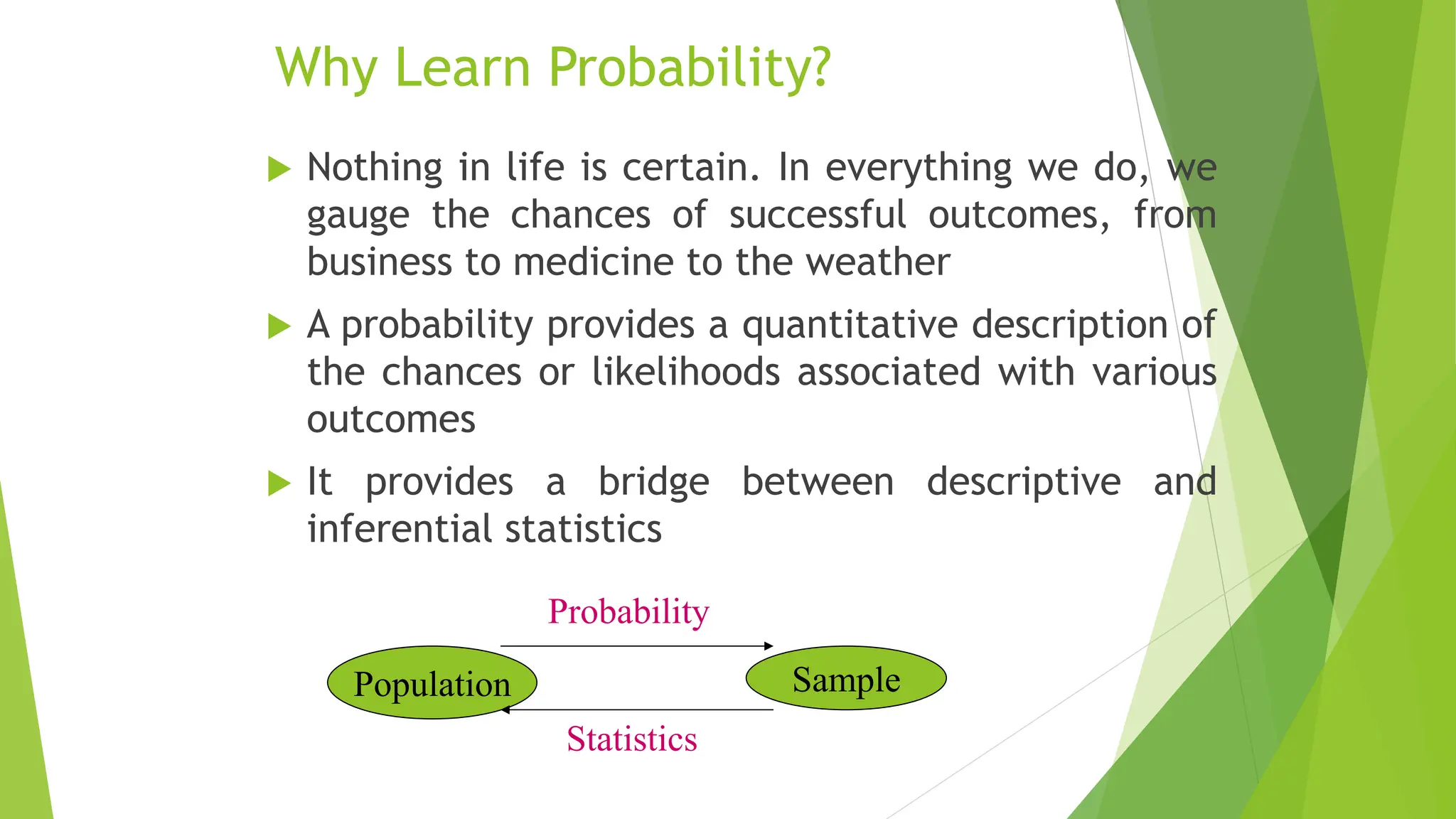
 It provides a bridge between descriptive and
inferential statistics
Population Sample
Probability
Statistics
What is Probability?
 We use graphs and numerical measures to
describe data sets which were usually
samples.
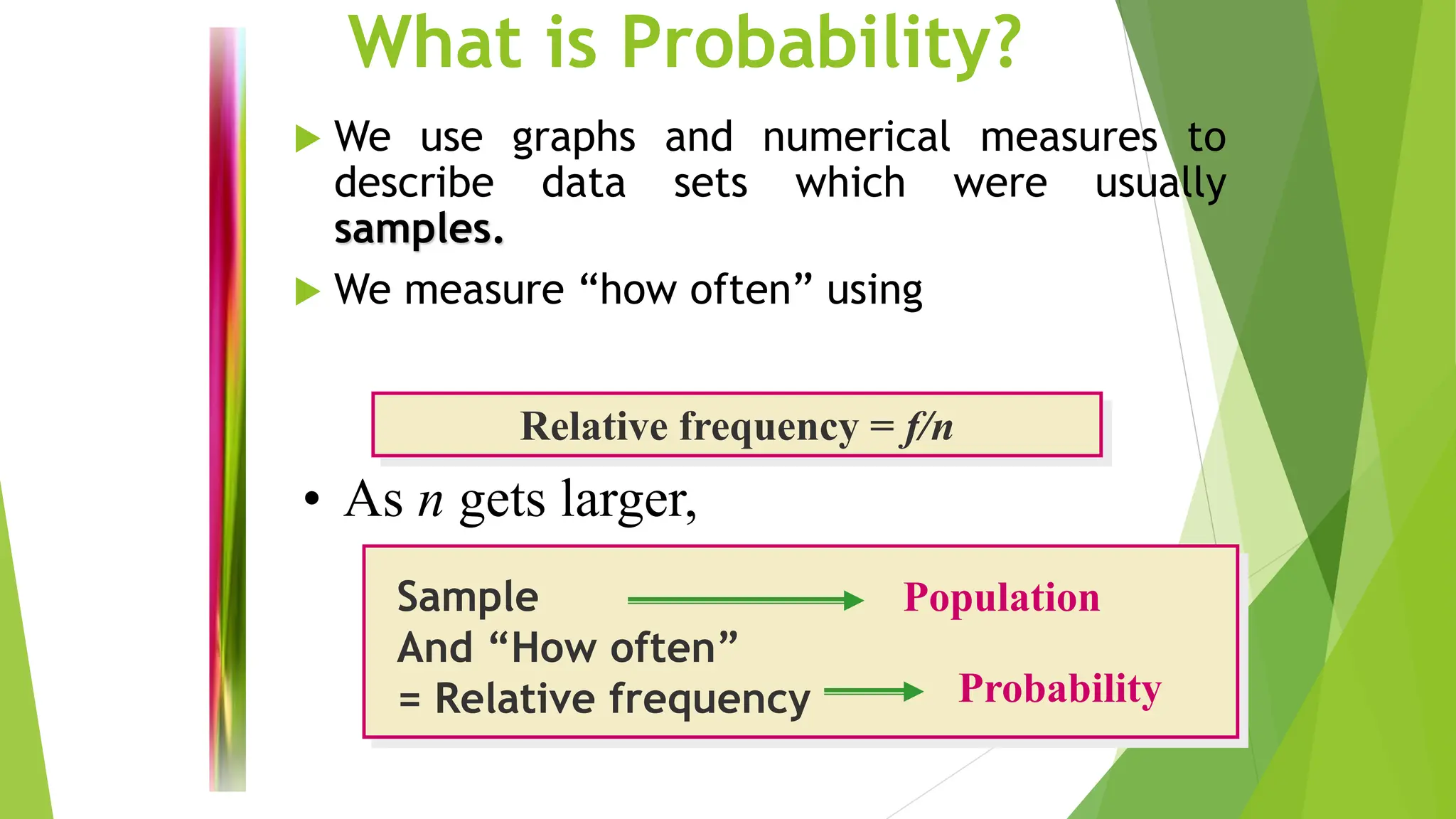
 We measure “how often” using
Relative frequency = f/n
Sample
And “How often”
= Relative frequency
Population
Probability
• As n gets larger,
Basic Concepts
 An experiment is the process by which an
observation (or measurement) is
obtained.
 An event is an outcome of an
experiment, usually denoted by a capital
letter.
The basic element to which probability is
applied
When an experiment is performed, a
particular event either happens, or it
doesn’t!
Experiments and Events
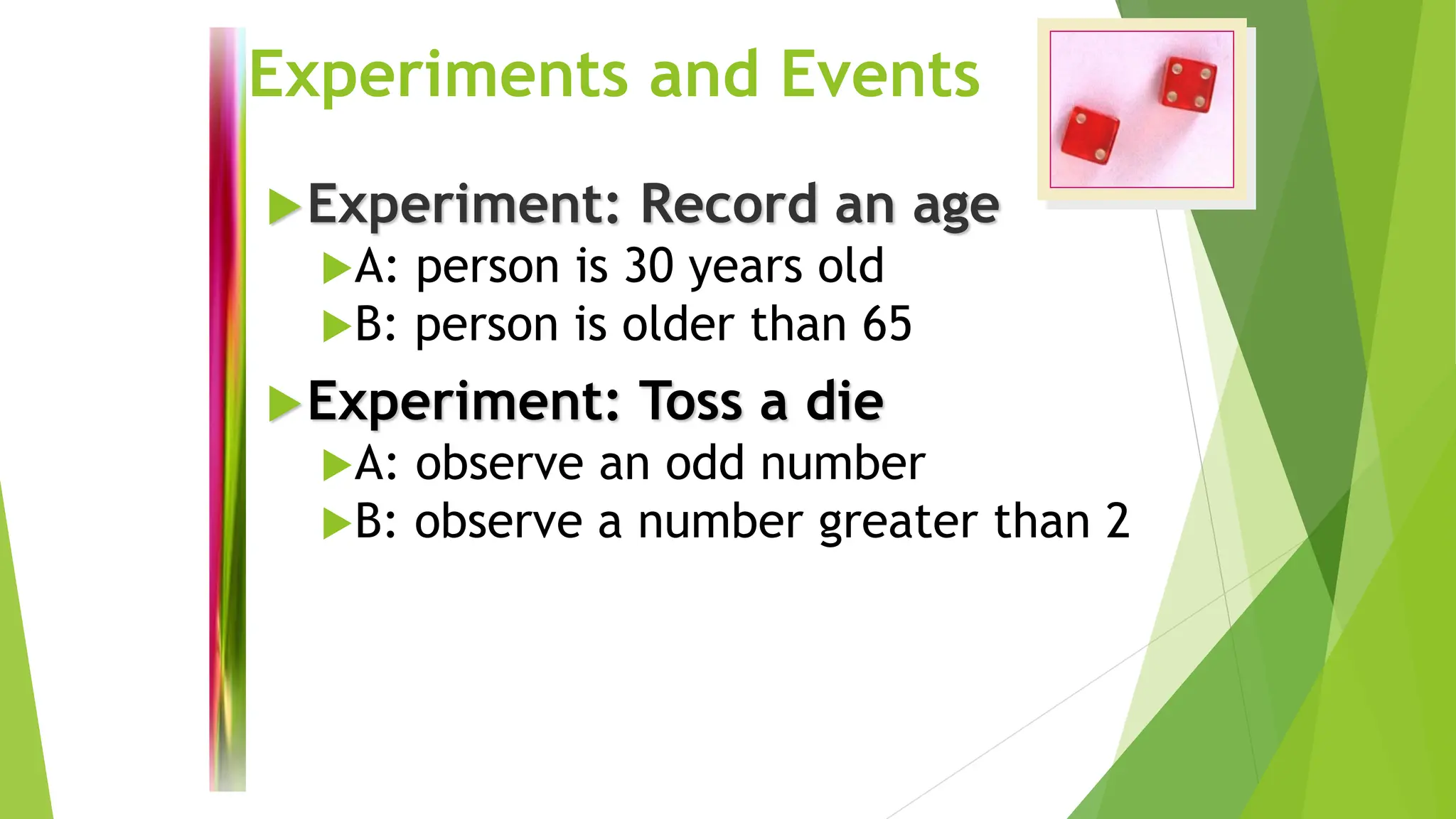
Experiment: Record an age
A: person is 30 years old
B: person is older than 65
Experiment: Toss a die
A: observe an odd number
B: observe a number greater than 2
Basic Concepts
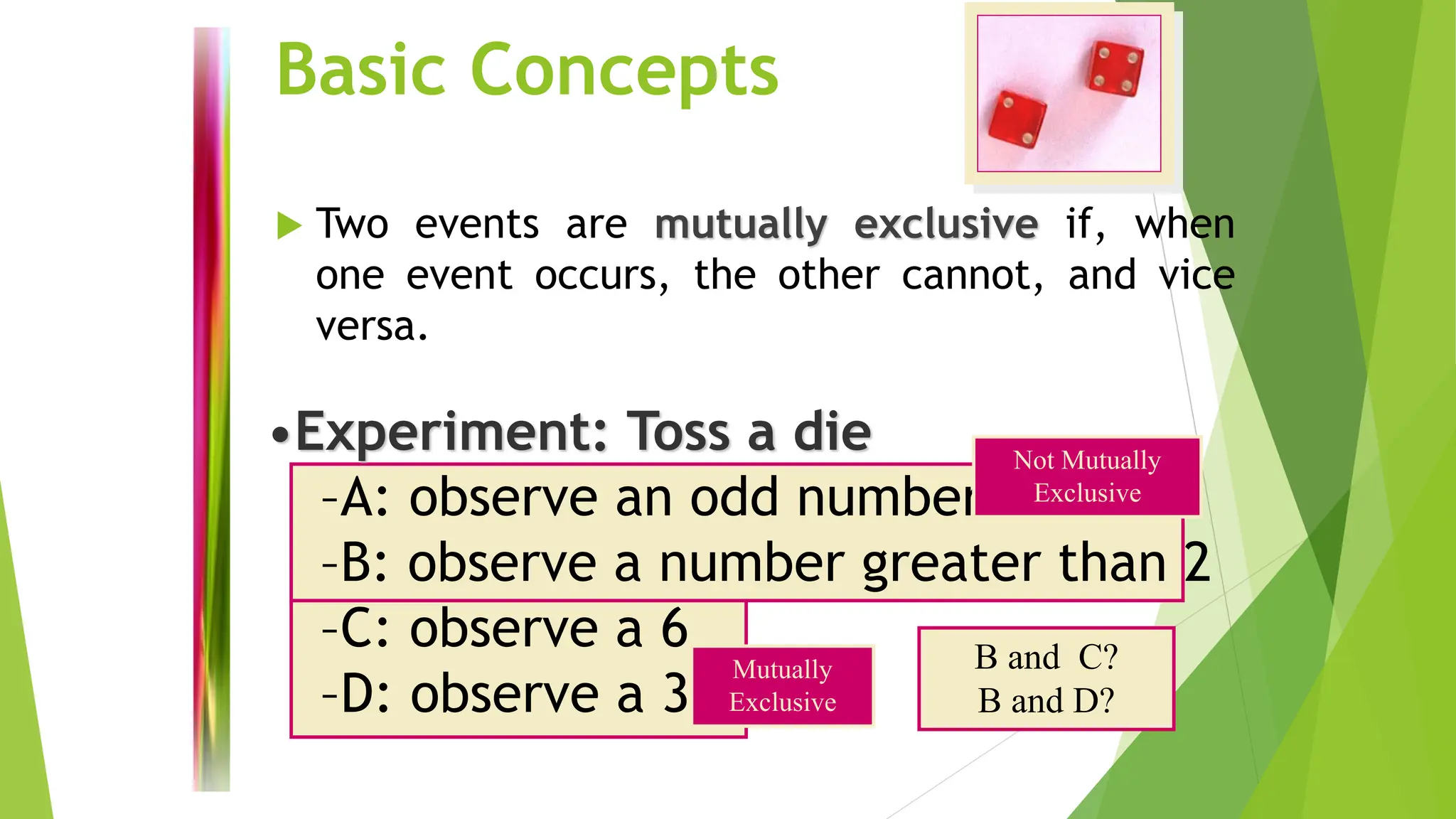
 Two events are mutually exclusive if, when
one event occurs, the other cannot, and vice
versa.
•Experiment: Toss a die
–A: observe an odd number
–B: observe a number greater than 2
–C: observe a 6
–D: observe a 3
Not Mutually
Exclusive
Mutually
Exclusive
B and C?
B and D?
Basic Concepts
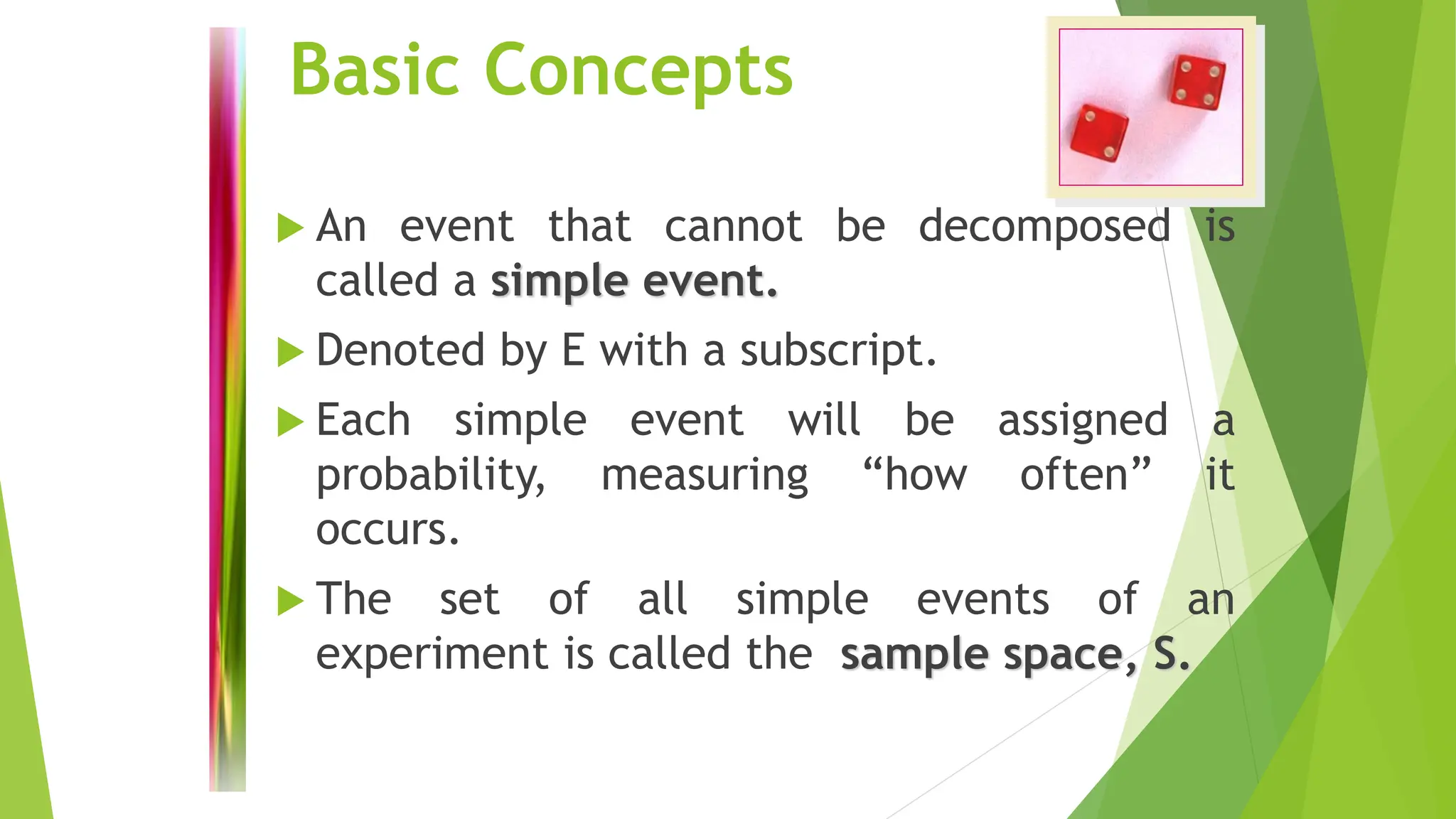
 An event that cannot be decomposed is
called a simple event.
 Denoted by E with a subscript.
 Each simple event will be assigned a
probability, measuring “how often” it
occurs.
 The set of all simple events of an
experiment is called the sample space, S.
Example
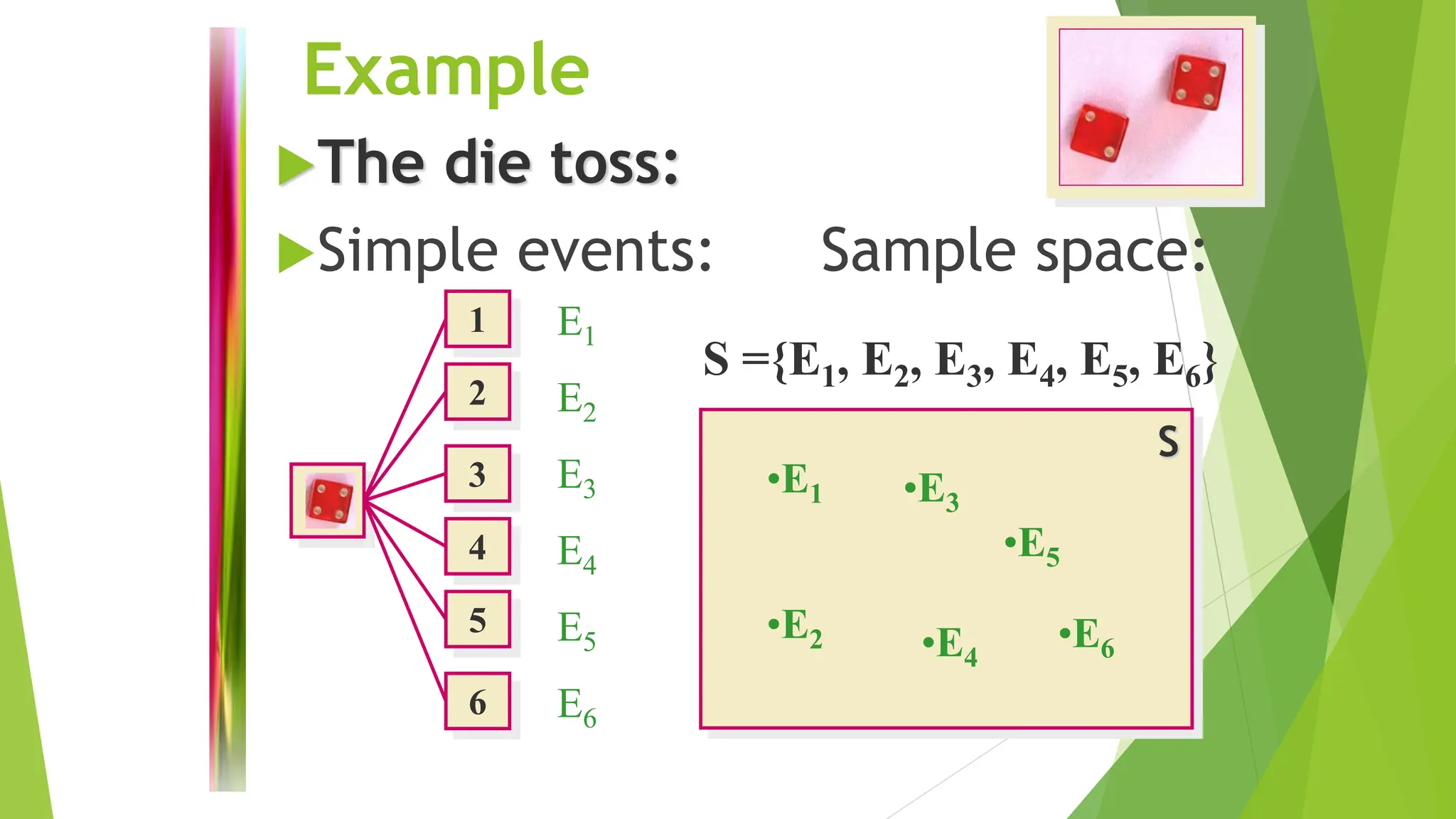
The die toss:
Simple events: Sample space:
1
2
3
4
5
6
E1
E2
E3
E4
E5
E6
S ={E1, E2, E3, E4, E5, E6}
S
•E1
•E6
•E2
•E3
•E4
•E5
Basic Concepts
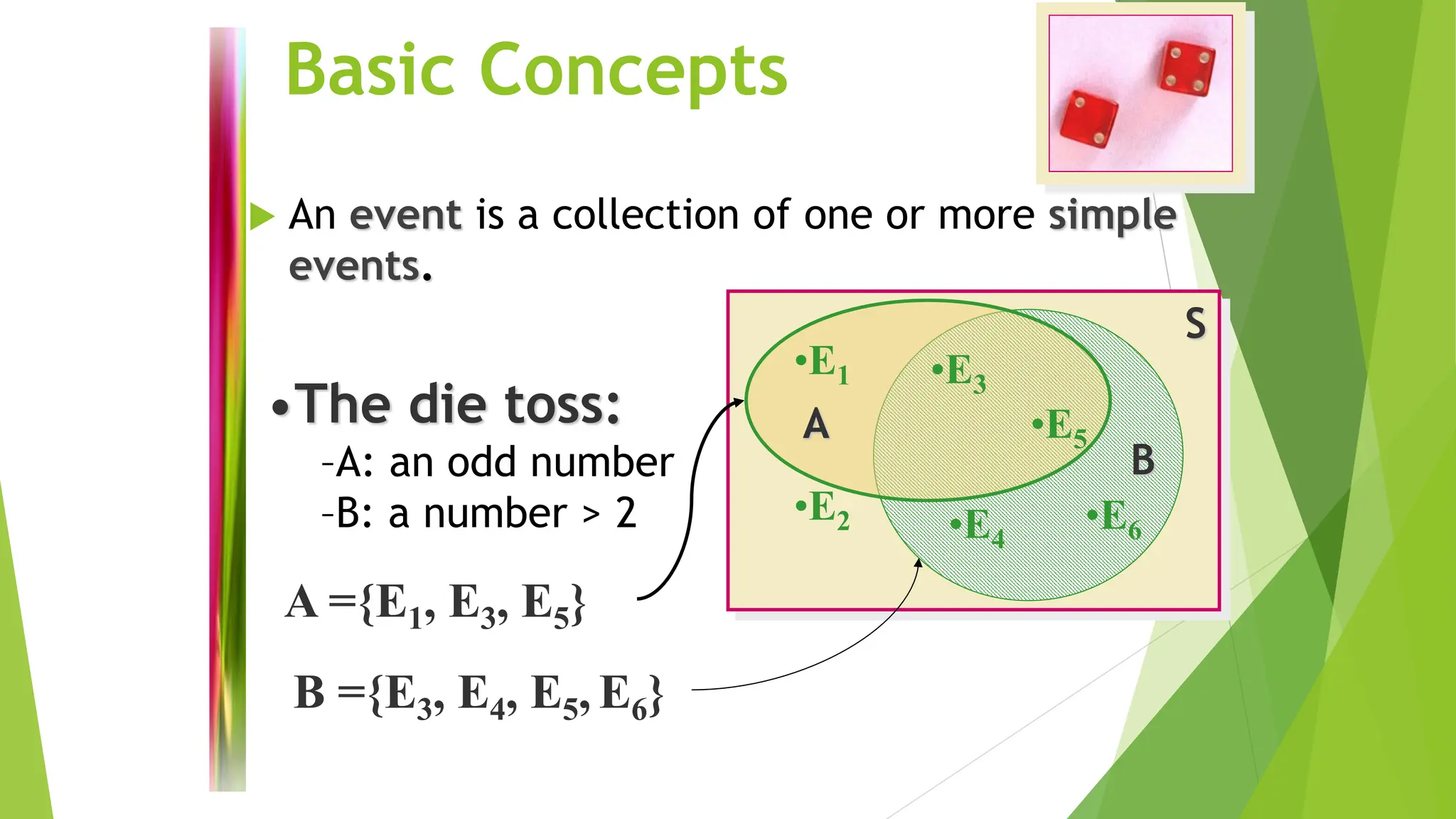
 An event is a collection of one or more simple
events.
•The die toss:
–A: an odd number
–B: a number > 2
S
A ={E1, E3, E5}
B ={E3, E4, E5, E6}
B
A
•E1
•E6
•E2
•E3
•E4
•E5
The Probability
of an Event
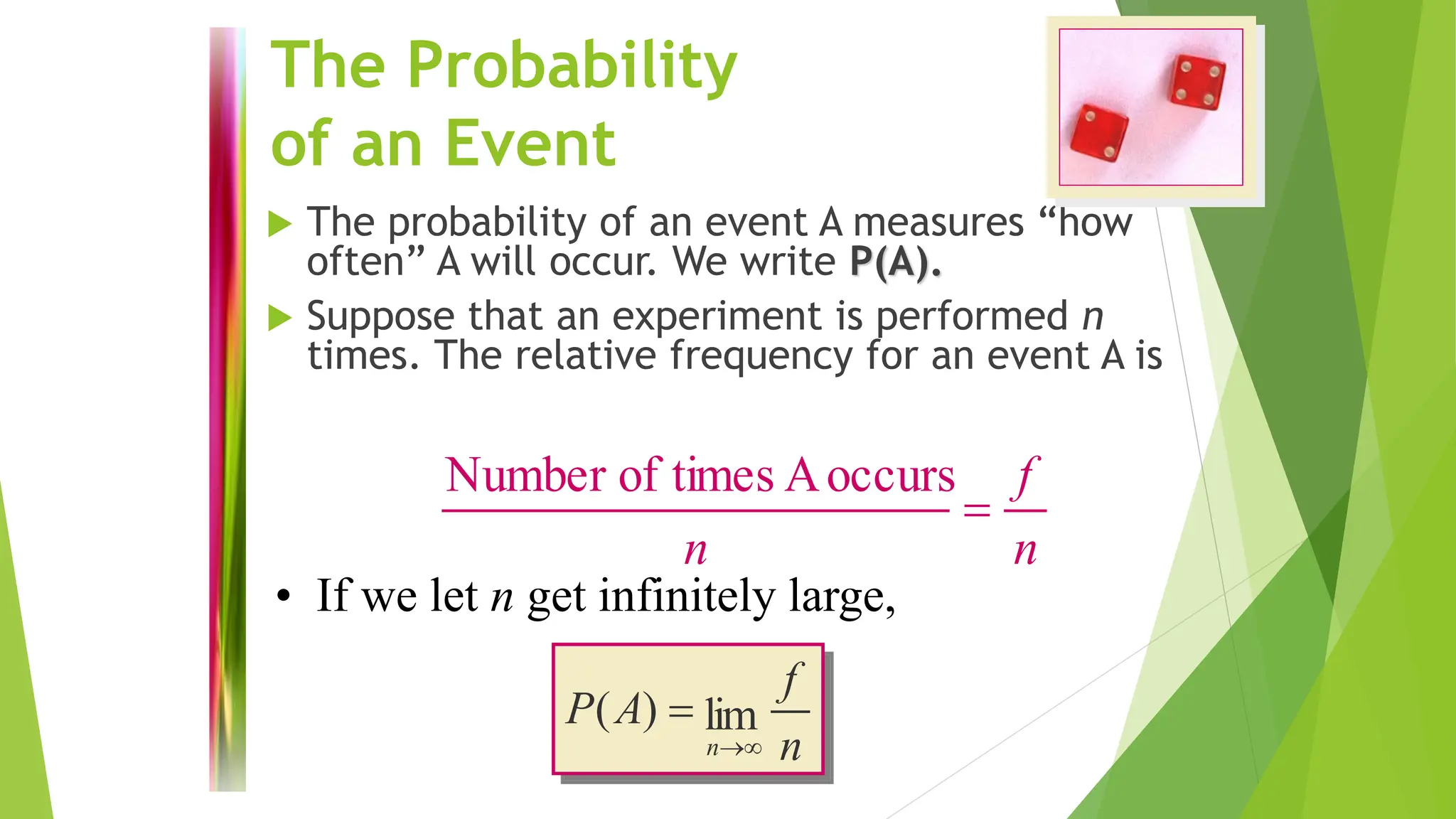
 The probability of an event A measures “how
often” A will occur. We write P(A).
 Suppose that an experiment is performed n
times. The relative frequency for an event A is
n
f
n
=
occurs
A
times
of
Number
n
f
A
P
n
lim
)
(
→
=
• If we let n get infinitely large,
The Probability
of an Event
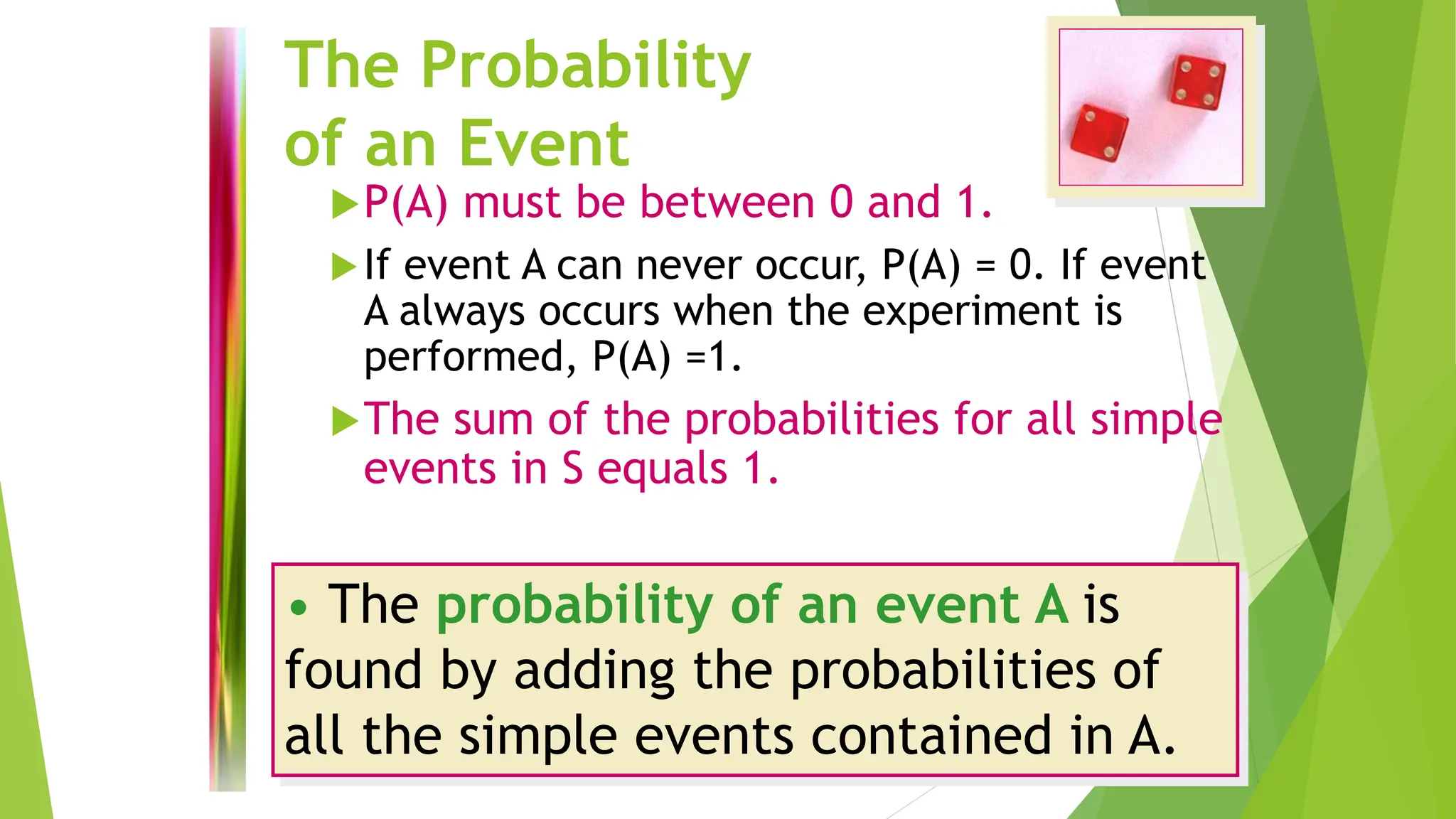
P(A) must be between 0 and 1.
If event A can never occur, P(A) = 0. If event
A always occurs when the experiment is
performed, P(A) =1.
The sum of the probabilities for all simple
events in S equals 1.
• The probability of an event A is
found by adding the probabilities of
all the simple events contained in A.
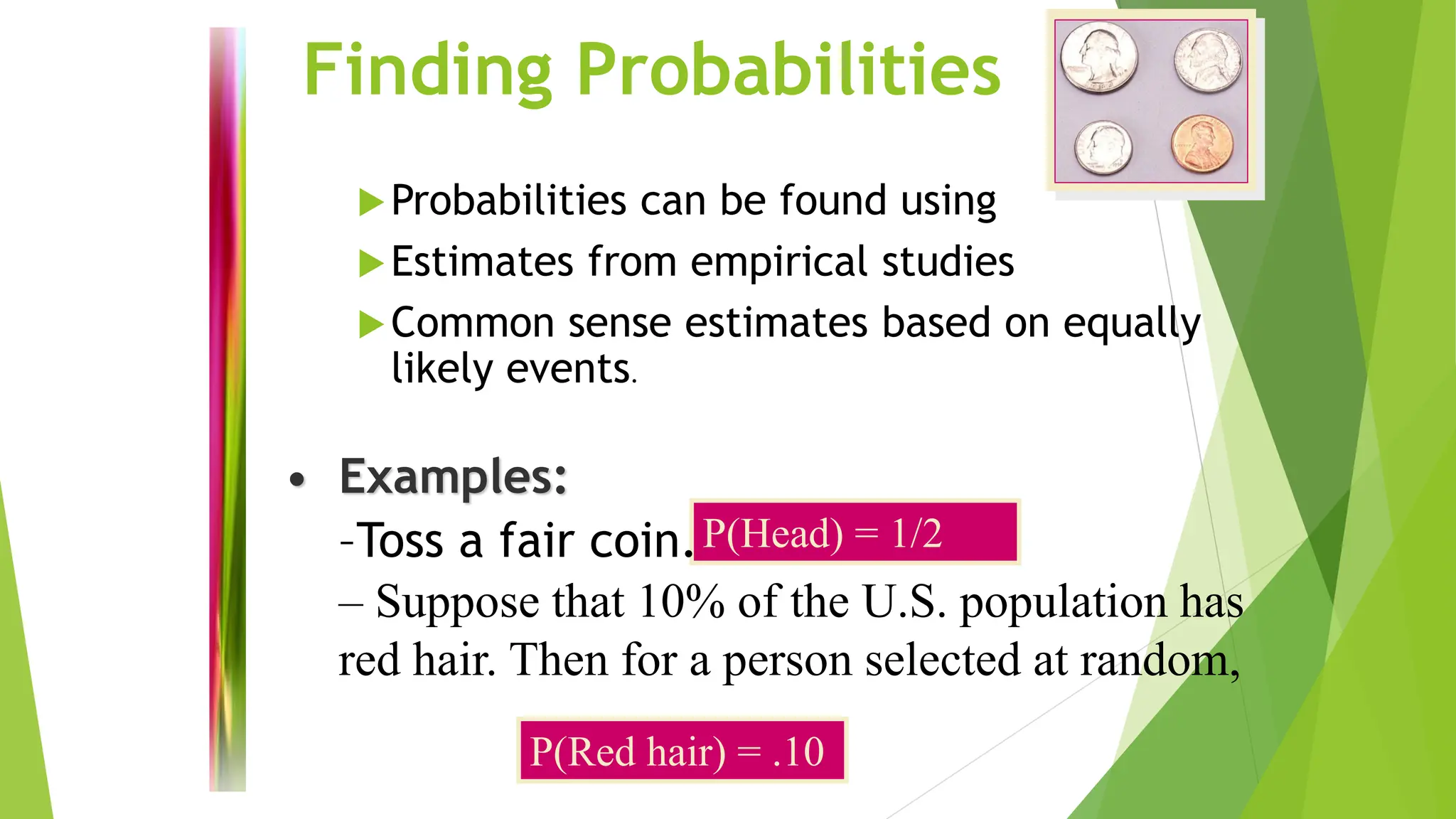
– Suppose that 10% of the U.S. population has
red hair. Then for a person selected at random,
Finding Probabilities
Probabilities can be found using
Estimates from empirical studies
Common sense estimates based on equally
likely events.
P(Head) = 1/2
P(Red hair) = .10
• Examples:
–Toss a fair coin.
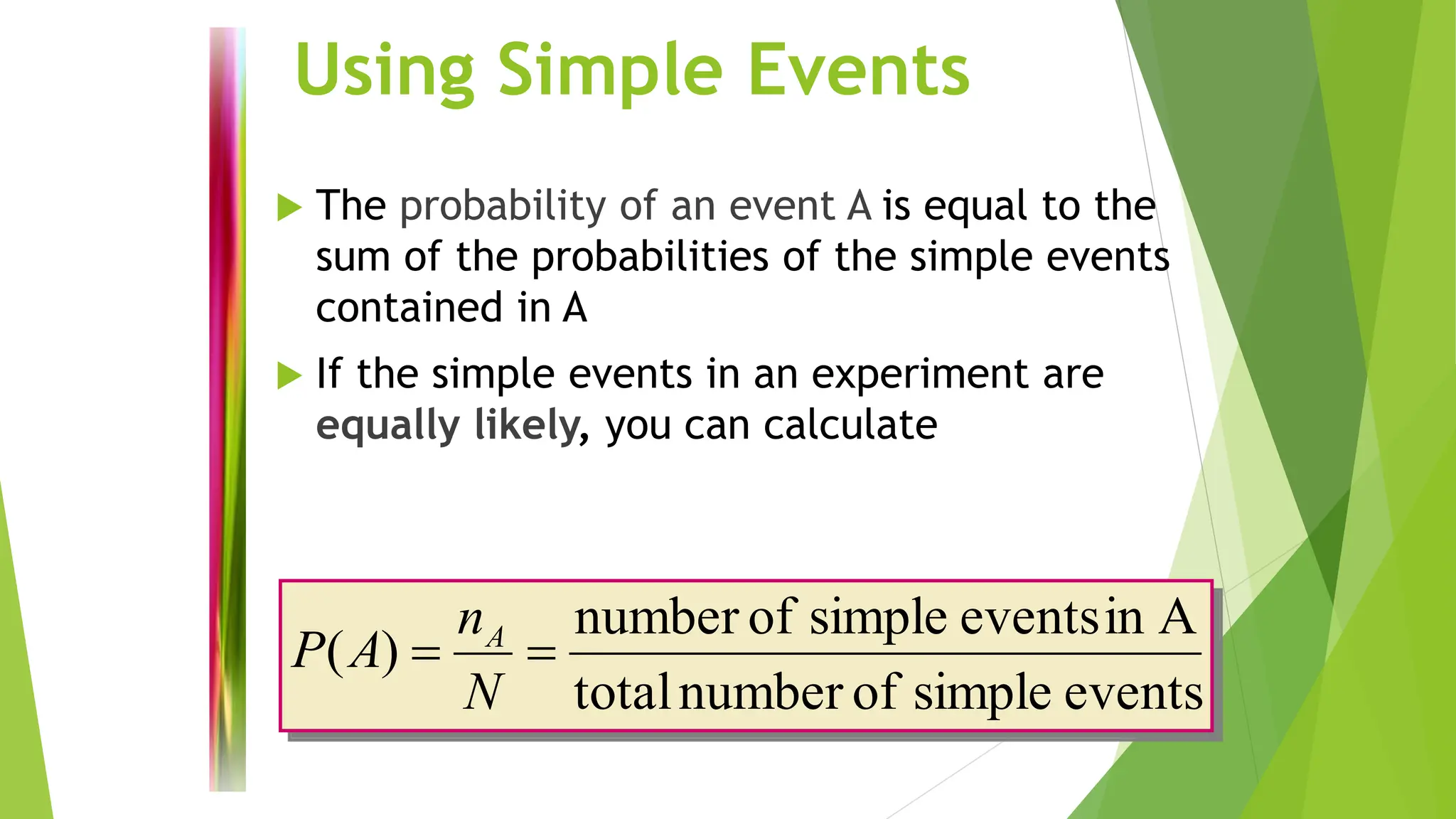
Using Simple Events
 The probability of an event A is equal to the
sum of the probabilities of the simple events
contained in A
 If the simple events in an experiment are
equally likely, you can calculate
events
simple
of
number
total
A
in
events
simple
of
number
)
( =
=
N
n
A
P A
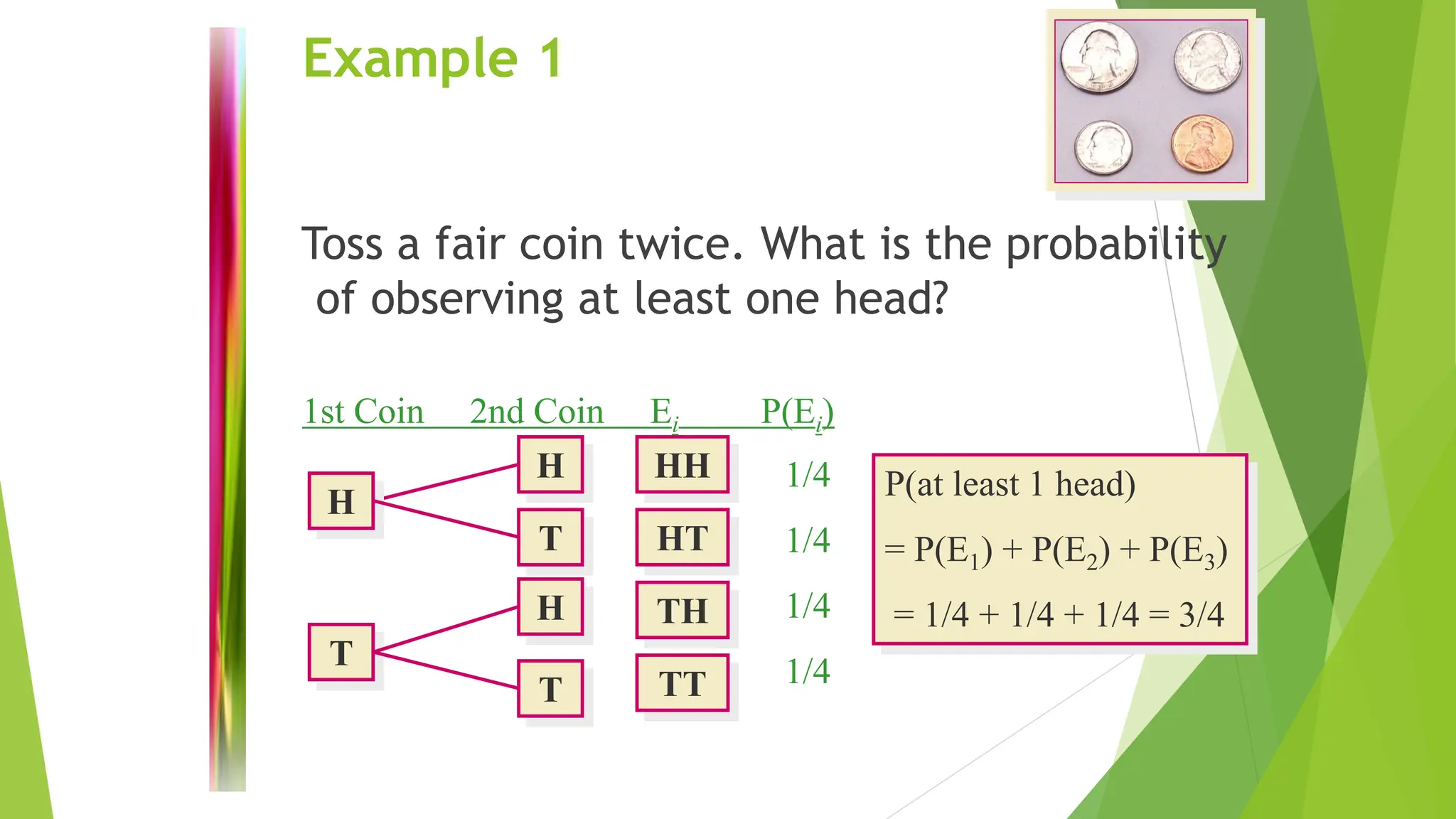
Example 1
Toss a fair coin twice. What is the probability
of observing at least one head?
H
1st Coin 2nd Coin Ei P(Ei)
H
T
T
H
T
HH
HT
TH
TT
1/4
1/4
1/4
1/4
P(at least 1 head)
= P(E1) + P(E2) + P(E3)
= 1/4 + 1/4 + 1/4 = 3/4
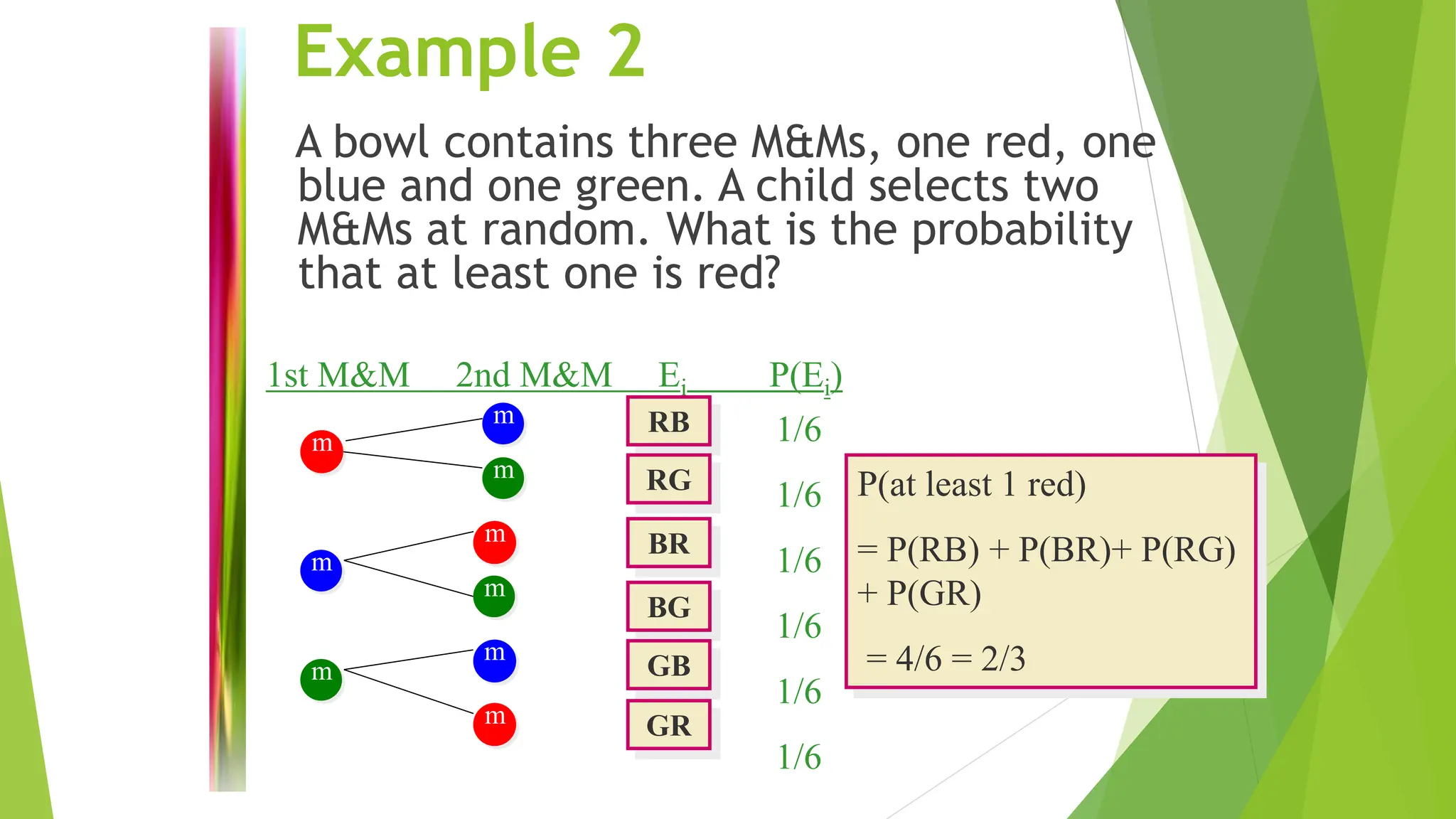
Example 2
A bowl contains three M&Ms, one red, one
blue and one green. A child selects two
M&Ms at random. What is the probability
that at least one is red?
1st M&M 2nd M&M Ei P(Ei)
RB
RG
BR
BG
1/6
1/6
1/6
1/6
1/6
1/6
P(at least 1 red)
= P(RB) + P(BR)+ P(RG)
+ P(GR)
= 4/6 = 2/3
m
m
m
m
m
m
m
m
m
GB
GR
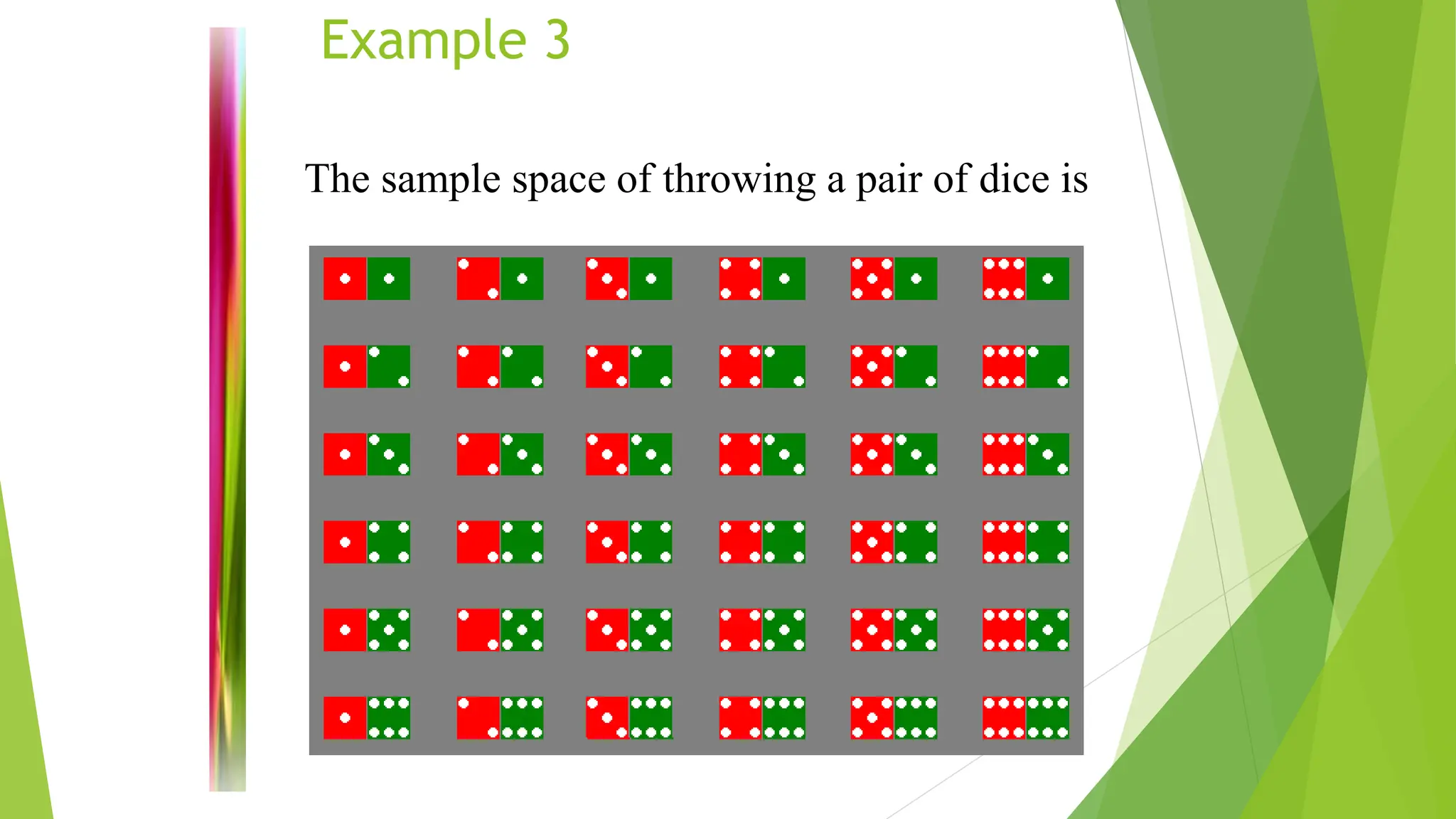
Example 3
The sample space of throwing a pair of dice is
Example 3
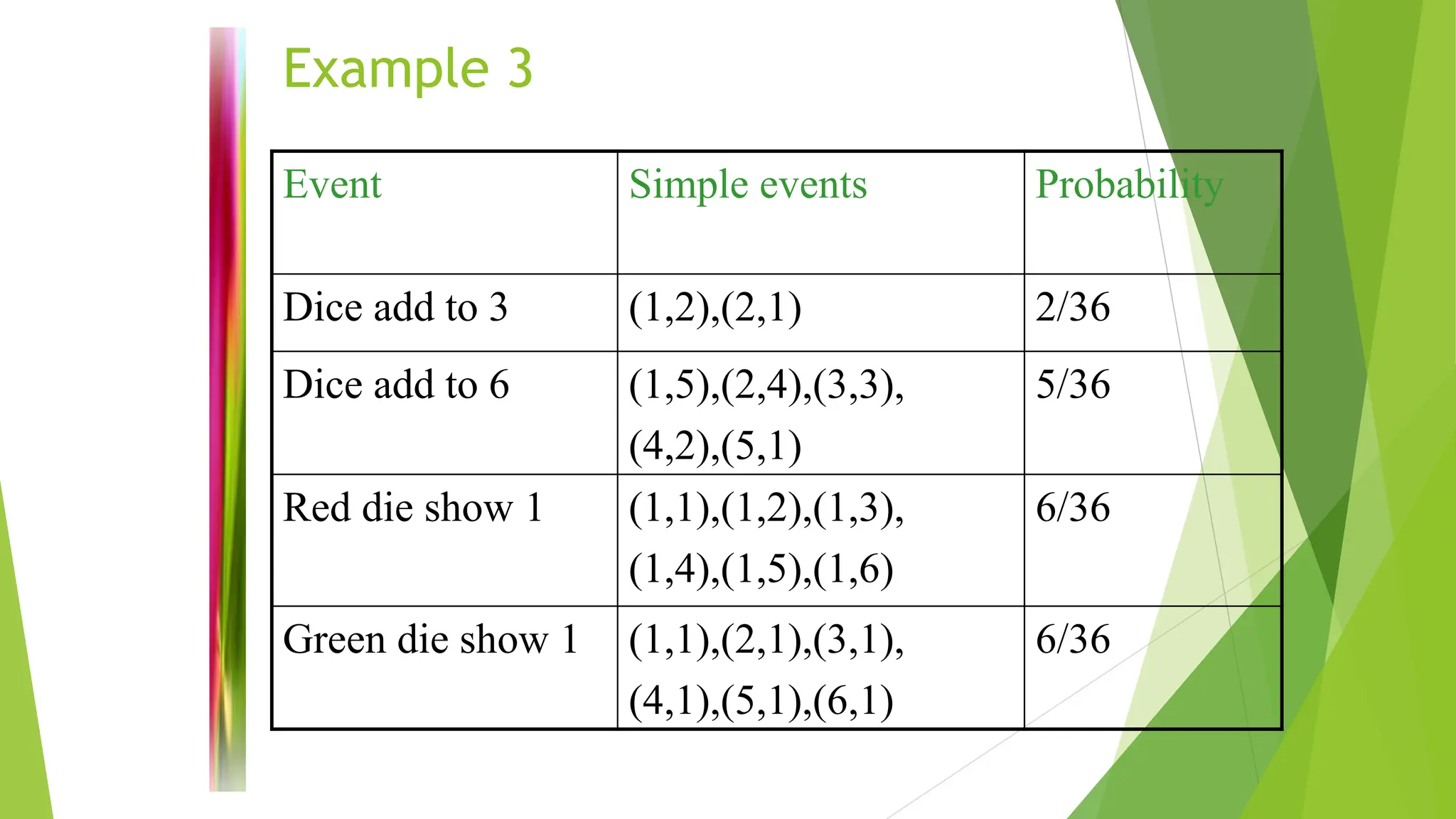
Event Simple events Probability
Dice add to 3 (1,2),(2,1) 2/36
Dice add to 6 (1,5),(2,4),(3,3),
(4,2),(5,1)
5/36
Red die show 1 (1,1),(1,2),(1,3),
(1,4),(1,5),(1,6)
6/36
Green die show 1 (1,1),(2,1),(3,1),
(4,1),(5,1),(6,1)
6/36
Counting Rules
 Sample space of throwing 3 dice has
216 entries, sample space of throwing
4 dice has 1296 entries, …
 At some point, we have to stop listing
and start thinking …
 We need some counting rules
The mn Rule
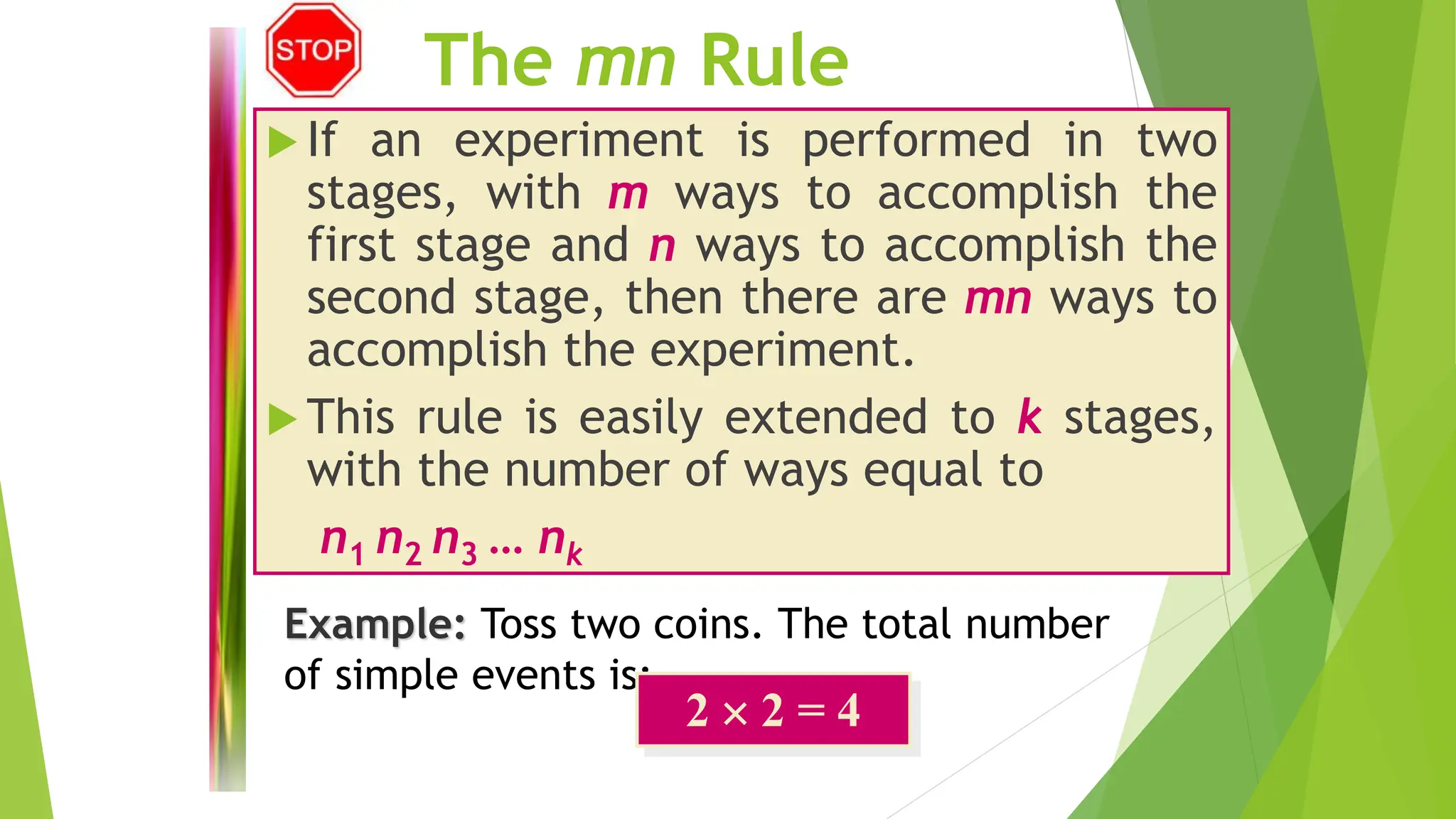
 If an experiment is performed in two
stages, with m ways to accomplish the
first stage and n ways to accomplish the
second stage, then there are mn ways to
accomplish the experiment.
 This rule is easily extended to k stages,
with the number of ways equal to
n1 n2 n3 … nk
Example: Toss two coins. The total number
of simple events is:
2  2 = 4
Examples
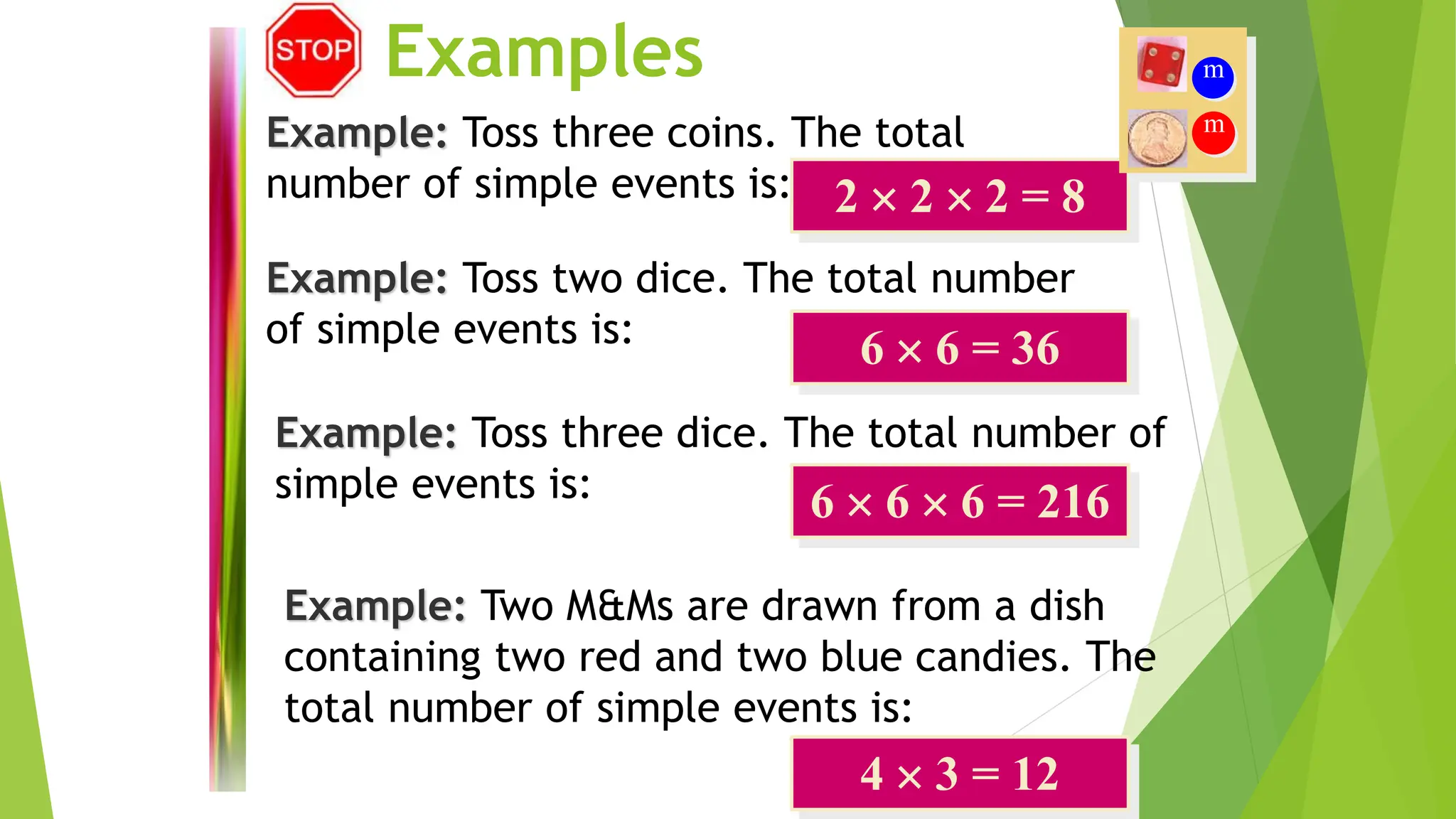
Example: Toss three coins. The total
number of simple events is: 2  2  2 = 8
Example: Two M&Ms are drawn from a dish
containing two red and two blue candies. The
total number of simple events is:
6  6 = 36
Example: Toss two dice. The total number
of simple events is:
m
m
4  3 = 12
Example: Toss three dice. The total number of
simple events is: 6  6  6 = 216

What is Probability and its Basic Definitions

  • 1.
    Probability By Dr ChandhiniJ Assistant Professor of Mathematics, Sri Ramakrishna College of Arts & Science, Coimbatore.
  • 2.
    Why Learn Probability? Nothing in life is certain. In everything we do, we gauge the chances of successful outcomes, from business to medicine to the weather  A probability provides a quantitative description of the chances or likelihoods associated with various outcomes  It provides a bridge between descriptive and inferential statistics Population Sample Probability Statistics
  • 3.
    What is Probability? We use graphs and numerical measures to describe data sets which were usually samples.  We measure “how often” using Relative frequency = f/n Sample And “How often” = Relative frequency Population Probability • As n gets larger,
  • 4.
    Basic Concepts  Anexperiment is the process by which an observation (or measurement) is obtained.  An event is an outcome of an experiment, usually denoted by a capital letter. The basic element to which probability is applied When an experiment is performed, a particular event either happens, or it doesn’t!
  • 5.
    Experiments and Events Experiment:Record an age A: person is 30 years old B: person is older than 65 Experiment: Toss a die A: observe an odd number B: observe a number greater than 2
  • 6.
    Basic Concepts  Twoevents are mutually exclusive if, when one event occurs, the other cannot, and vice versa. •Experiment: Toss a die –A: observe an odd number –B: observe a number greater than 2 –C: observe a 6 –D: observe a 3 Not Mutually Exclusive Mutually Exclusive B and C? B and D?
  • 7.
    Basic Concepts  Anevent that cannot be decomposed is called a simple event.  Denoted by E with a subscript.  Each simple event will be assigned a probability, measuring “how often” it occurs.  The set of all simple events of an experiment is called the sample space, S.
  • 8.
    Example The die toss: Simpleevents: Sample space: 1 2 3 4 5 6 E1 E2 E3 E4 E5 E6 S ={E1, E2, E3, E4, E5, E6} S •E1 •E6 •E2 •E3 •E4 •E5
  • 9.
    Basic Concepts  Anevent is a collection of one or more simple events. •The die toss: –A: an odd number –B: a number > 2 S A ={E1, E3, E5} B ={E3, E4, E5, E6} B A •E1 •E6 •E2 •E3 •E4 •E5
  • 10.
    The Probability of anEvent  The probability of an event A measures “how often” A will occur. We write P(A).  Suppose that an experiment is performed n times. The relative frequency for an event A is n f n = occurs A times of Number n f A P n lim ) ( → = • If we let n get infinitely large,
  • 11.
    The Probability of anEvent P(A) must be between 0 and 1. If event A can never occur, P(A) = 0. If event A always occurs when the experiment is performed, P(A) =1. The sum of the probabilities for all simple events in S equals 1. • The probability of an event A is found by adding the probabilities of all the simple events contained in A.
  • 12.
    – Suppose that10% of the U.S. population has red hair. Then for a person selected at random, Finding Probabilities Probabilities can be found using Estimates from empirical studies Common sense estimates based on equally likely events. P(Head) = 1/2 P(Red hair) = .10 • Examples: –Toss a fair coin.
  • 13.
    Using Simple Events The probability of an event A is equal to the sum of the probabilities of the simple events contained in A  If the simple events in an experiment are equally likely, you can calculate events simple of number total A in events simple of number ) ( = = N n A P A
  • 14.
    Example 1 Toss afair coin twice. What is the probability of observing at least one head? H 1st Coin 2nd Coin Ei P(Ei) H T T H T HH HT TH TT 1/4 1/4 1/4 1/4 P(at least 1 head) = P(E1) + P(E2) + P(E3) = 1/4 + 1/4 + 1/4 = 3/4
  • 15.
    Example 2 A bowlcontains three M&Ms, one red, one blue and one green. A child selects two M&Ms at random. What is the probability that at least one is red? 1st M&M 2nd M&M Ei P(Ei) RB RG BR BG 1/6 1/6 1/6 1/6 1/6 1/6 P(at least 1 red) = P(RB) + P(BR)+ P(RG) + P(GR) = 4/6 = 2/3 m m m m m m m m m GB GR
  • 16.
    Example 3 The samplespace of throwing a pair of dice is
  • 17.
    Example 3 Event Simpleevents Probability Dice add to 3 (1,2),(2,1) 2/36 Dice add to 6 (1,5),(2,4),(3,3), (4,2),(5,1) 5/36 Red die show 1 (1,1),(1,2),(1,3), (1,4),(1,5),(1,6) 6/36 Green die show 1 (1,1),(2,1),(3,1), (4,1),(5,1),(6,1) 6/36
  • 18.
    Counting Rules  Samplespace of throwing 3 dice has 216 entries, sample space of throwing 4 dice has 1296 entries, …  At some point, we have to stop listing and start thinking …  We need some counting rules
  • 19.
    The mn Rule If an experiment is performed in two stages, with m ways to accomplish the first stage and n ways to accomplish the second stage, then there are mn ways to accomplish the experiment.  This rule is easily extended to k stages, with the number of ways equal to n1 n2 n3 … nk Example: Toss two coins. The total number of simple events is: 2  2 = 4
  • 20.
    Examples Example: Toss threecoins. The total number of simple events is: 2  2  2 = 8 Example: Two M&Ms are drawn from a dish containing two red and two blue candies. The total number of simple events is: 6  6 = 36 Example: Toss two dice. The total number of simple events is: m m 4  3 = 12 Example: Toss three dice. The total number of simple events is: 6  6  6 = 216