FP7-288429-Cassandra
                         Cassandra

A multivariate platform for assessing the impact of
  strategic decisions in electrical power systems


Project Coordinator
Center for Research and Technology –Hellas / Informatics and Telematics Institute
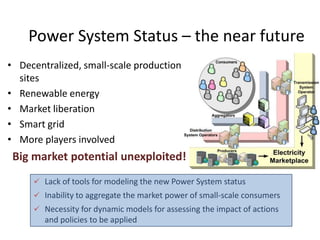
Power System Status – the near future
• Decentralized, small-scale production
  sites
• Renewable energy
• Market liberation
• Smart grid
• More players involved
 Big market potential unexploited!
      Lack of tools for modeling the new Power System status
      Inability to aggregate the market power of small-scale consumers
      Necessity for dynamic models for assessing the impact of actions
        and policies to be applied
Filling in the gap…Cassandra!

 A software platform for modeling the energy
     market from an end user perspective
• Main Cassandra objectives:
   Theoretical and software modeling of stakeholders in terms of energy
    profiles and consumption patterns, as well as their interactions
   Increase the market power of low level consumers through Consumer
    coalitions (Consumer Social Networks - CSNs)
   A Key Performance Indicator (KPI) methodology, in order to assess
    energy performance and CO2 emissions reduction
   A modular, expandable Software platform to model and benchmark
    scenarios and act as a Decision support tool.
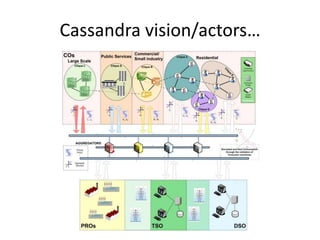
Cassandra vision/actors…
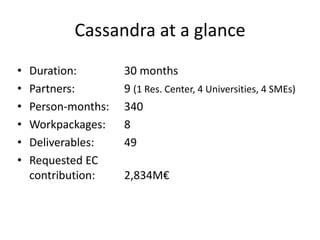
Cassandra at a glance
•   Duration:        30 months
•   Partners:        9 (1 Res. Center, 4 Universities, 4 SMEs)
•   Person-months:   340
•   Workpackages:    8
•   Deliverables:    49
•   Requested EC
    contribution:    2,834M€
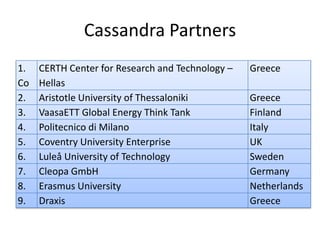
Cassandra Partners
1.   CERTH Center for Research and Technology –   Greece
Co   Hellas
2.   Aristotle University of Thessaloniki         Greece
3.   VaasaETT Global Energy Think Tank            Finland
4.   Politecnico di Milano                        Italy
5.   Coventry University Enterprise               UK
6.   Luleå University of Technology               Sweden
7.   Cleopa GmbH                                  Germany
8.   Erasmus University                           Netherlands
9.   Draxis                                       Greece
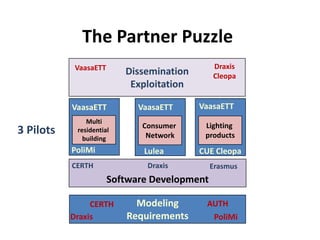
The Partner Puzzle
            VaasaETT                          Draxis
                          Dissemination       Cleopa
                           Exploitation

           VaasaETT          VaasaETT     VaasaETT
               Multi
                              Consumer     Lighting
3 Pilots    residential
                               Network     products
              building
           PoliMi             Lulea       CUE Cleopa
           CERTH               Draxis         Erasmus
                       Software Development

                CERTH       Modeling       AUTH
           Draxis         Requirements      PoliMi
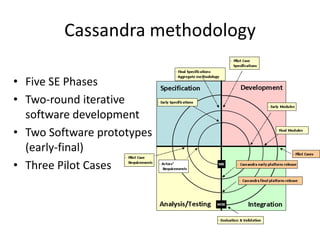
Cassandra methodology

• Five SE Phases
• Two-round iterative
  software development
• Two Software prototypes
  (early-final)
• Three Pilot Cases
Pilot Case 1:
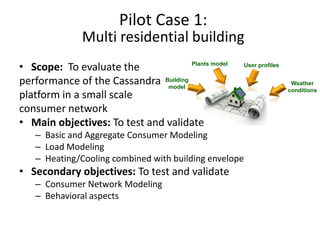
               Multi residential building
• Scope: To evaluate the              Plants model     User profiles

performance of the Cassandra Building
                               model
                                                                        Weather
                                                                       conditions
platform in a small scale
consumer network
• Main objectives: To test and validate
   – Basic and Aggregate Consumer Modeling
   – Load Modeling
   – Heating/Cooling combined with building envelope
• Secondary objectives: To test and validate
   – Consumer Network Modeling
   – Behavioral aspects
Pilot Case 1:
              Multi residential building

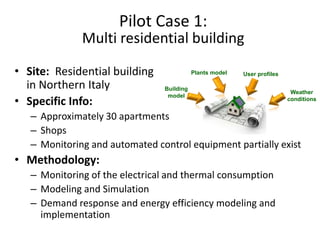
• Site: Residential building               Plants model   User profiles

  in Northern Italy             Building
                                                                           Weather
                                 model
• Specific Info:                                                          conditions


   – Approximately 30 apartments
   – Shops
   – Monitoring and automated control equipment partially exist
• Methodology:
   – Monitoring of the electrical and thermal consumption
   – Modeling and Simulation
   – Demand response and energy efficiency modeling and
     implementation
Pilot Case 2:
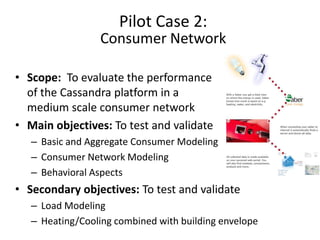
                 Consumer Network

• Scope: To evaluate the performance
  of the Cassandra platform in a
  medium scale consumer network
• Main objectives: To test and validate
   – Basic and Aggregate Consumer Modeling
   – Consumer Network Modeling
   – Behavioral Aspects
• Secondary objectives: To test and validate
   – Load Modeling
   – Heating/Cooling combined with building envelope
Pilot Case 2:
                  Consumer Network
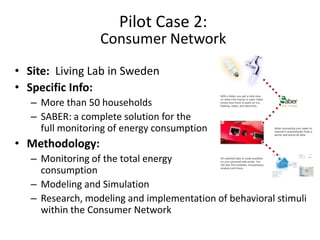
• Site: Living Lab in Sweden
• Specific Info:
   – More than 50 households
   – SABER: a complete solution for the
     full monitoring of energy consumption
• Methodology:
   – Monitoring of the total energy
     consumption
   – Modeling and Simulation
   – Research, modeling and implementation of behavioral stimuli
     within the Consumer Network
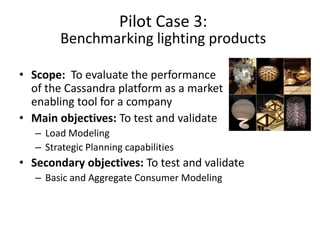
Pilot Case 3:
        Benchmarking lighting products

• Scope: To evaluate the performance
  of the Cassandra platform as a market
  enabling tool for a company
• Main objectives: To test and validate
   – Load Modeling
   – Strategic Planning capabilities
• Secondary objectives: To test and validate
   – Basic and Aggregate Consumer Modeling
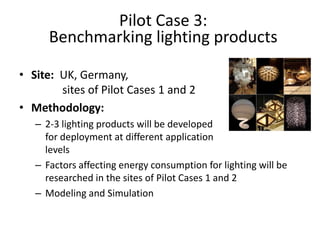
Pilot Case 3:
      Benchmarking lighting products

• Site: UK, Germany,
        sites of Pilot Cases 1 and 2
• Methodology:
   – 2-3 lighting products will be developed
     for deployment at different application
     levels
   – Factors affecting energy consumption for lighting will be
     researched in the sites of Pilot Cases 1 and 2
   – Modeling and Simulation
Assessable Outcome
• Cassandra is essentially a:
              Modeling Software Platform
• To provide:
    Modeling of electrical installations (small or large scale, individual
       or combinations of arbitrary number of installations)
      Knowledge regarding consumption patterns and demand-response
       incentives
      Decision support (analysis of what-if scenarios)
      Open platform for energy companies/communities
        (Global energy think Tank, PowerTAC)
      Empowerment of the end consumer
      Environment for studying change and sustainability
Assessable Outcome
• We expect to:
  – Model accurately individual installations
  – Model accurately the aggregated demand served
    by a utility
  – Offer the capability to understand macroscopically
    the behavior and response of its customers
  – Offer a tool that will either produce realistic
    results with little effort, or dynamically produce
    real results with considerable initial effort.
Assessable Outcome


• We do not expect to:
  – Model accurately all individual customers of a
    power utility
  – Forecast the real response of individual
    customers

Cassandra presentation

  • 1.
    FP7-288429-Cassandra Cassandra A multivariate platform for assessing the impact of strategic decisions in electrical power systems Project Coordinator Center for Research and Technology –Hellas / Informatics and Telematics Institute
  • 2.
    Power System Status– the near future • Decentralized, small-scale production sites • Renewable energy • Market liberation • Smart grid • More players involved Big market potential unexploited!  Lack of tools for modeling the new Power System status  Inability to aggregate the market power of small-scale consumers  Necessity for dynamic models for assessing the impact of actions and policies to be applied
  • 3.
    Filling in thegap…Cassandra! A software platform for modeling the energy market from an end user perspective • Main Cassandra objectives:  Theoretical and software modeling of stakeholders in terms of energy profiles and consumption patterns, as well as their interactions  Increase the market power of low level consumers through Consumer coalitions (Consumer Social Networks - CSNs)  A Key Performance Indicator (KPI) methodology, in order to assess energy performance and CO2 emissions reduction  A modular, expandable Software platform to model and benchmark scenarios and act as a Decision support tool.
  • 4.
  • 5.
    Cassandra at aglance • Duration: 30 months • Partners: 9 (1 Res. Center, 4 Universities, 4 SMEs) • Person-months: 340 • Workpackages: 8 • Deliverables: 49 • Requested EC contribution: 2,834M€
  • 6.
    Cassandra Partners 1. CERTH Center for Research and Technology – Greece Co Hellas 2. Aristotle University of Thessaloniki Greece 3. VaasaETT Global Energy Think Tank Finland 4. Politecnico di Milano Italy 5. Coventry University Enterprise UK 6. Luleå University of Technology Sweden 7. Cleopa GmbH Germany 8. Erasmus University Netherlands 9. Draxis Greece
  • 7.
    The Partner Puzzle VaasaETT Draxis Dissemination Cleopa Exploitation VaasaETT VaasaETT VaasaETT Multi Consumer Lighting 3 Pilots residential Network products building PoliMi Lulea CUE Cleopa CERTH Draxis Erasmus Software Development CERTH Modeling AUTH Draxis Requirements PoliMi
  • 8.
    Cassandra methodology • FiveSE Phases • Two-round iterative software development • Two Software prototypes (early-final) • Three Pilot Cases
  • 9.
    Pilot Case 1: Multi residential building • Scope: To evaluate the Plants model User profiles performance of the Cassandra Building model Weather conditions platform in a small scale consumer network • Main objectives: To test and validate – Basic and Aggregate Consumer Modeling – Load Modeling – Heating/Cooling combined with building envelope • Secondary objectives: To test and validate – Consumer Network Modeling – Behavioral aspects
  • 10.
    Pilot Case 1: Multi residential building • Site: Residential building Plants model User profiles in Northern Italy Building Weather model • Specific Info: conditions – Approximately 30 apartments – Shops – Monitoring and automated control equipment partially exist • Methodology: – Monitoring of the electrical and thermal consumption – Modeling and Simulation – Demand response and energy efficiency modeling and implementation
  • 11.
    Pilot Case 2: Consumer Network • Scope: To evaluate the performance of the Cassandra platform in a medium scale consumer network • Main objectives: To test and validate – Basic and Aggregate Consumer Modeling – Consumer Network Modeling – Behavioral Aspects • Secondary objectives: To test and validate – Load Modeling – Heating/Cooling combined with building envelope
  • 12.
    Pilot Case 2: Consumer Network • Site: Living Lab in Sweden • Specific Info: – More than 50 households – SABER: a complete solution for the full monitoring of energy consumption • Methodology: – Monitoring of the total energy consumption – Modeling and Simulation – Research, modeling and implementation of behavioral stimuli within the Consumer Network
  • 13.
    Pilot Case 3: Benchmarking lighting products • Scope: To evaluate the performance of the Cassandra platform as a market enabling tool for a company • Main objectives: To test and validate – Load Modeling – Strategic Planning capabilities • Secondary objectives: To test and validate – Basic and Aggregate Consumer Modeling
  • 14.
    Pilot Case 3: Benchmarking lighting products • Site: UK, Germany, sites of Pilot Cases 1 and 2 • Methodology: – 2-3 lighting products will be developed for deployment at different application levels – Factors affecting energy consumption for lighting will be researched in the sites of Pilot Cases 1 and 2 – Modeling and Simulation
  • 15.
    Assessable Outcome • Cassandrais essentially a: Modeling Software Platform • To provide:  Modeling of electrical installations (small or large scale, individual or combinations of arbitrary number of installations)  Knowledge regarding consumption patterns and demand-response incentives  Decision support (analysis of what-if scenarios)  Open platform for energy companies/communities (Global energy think Tank, PowerTAC)  Empowerment of the end consumer  Environment for studying change and sustainability
  • 16.
    Assessable Outcome • Weexpect to: – Model accurately individual installations – Model accurately the aggregated demand served by a utility – Offer the capability to understand macroscopically the behavior and response of its customers – Offer a tool that will either produce realistic results with little effort, or dynamically produce real results with considerable initial effort.
  • 17.
    Assessable Outcome • Wedo not expect to: – Model accurately all individual customers of a power utility – Forecast the real response of individual customers