What is Libertarianism?
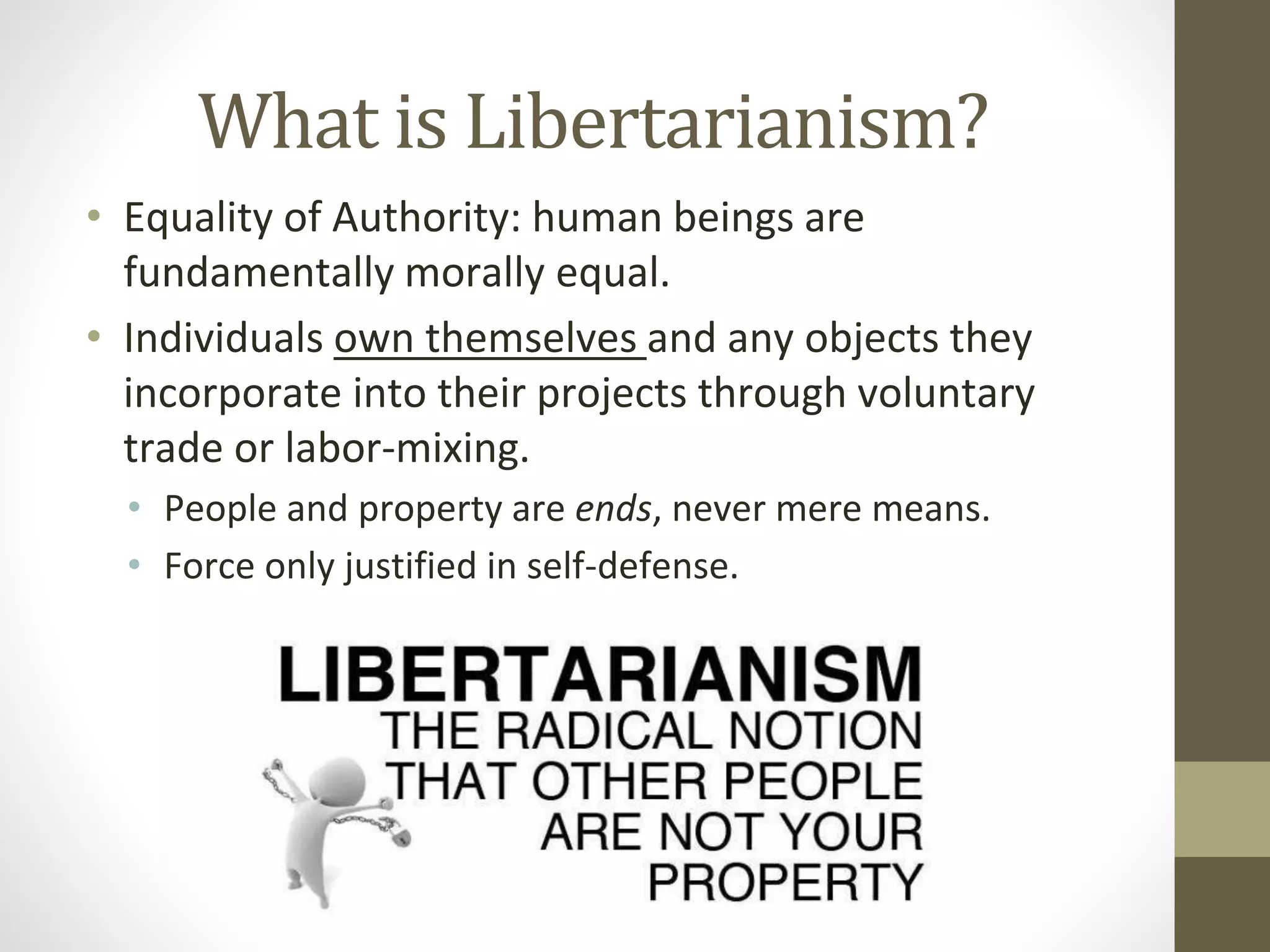
• Equality of Authority: human beings are
fundamentally morally equal.
• Individuals own themselves and any objects they
incorporate into their projects through voluntary
trade or labor-mixing.
• People and property are ends, never mere means.
• Force only justified in self-defense.
Libertarianism and Statism
• The State claims a territorial
monopoly on legitimatizing the
use of force.
• Laws enforced through
threat of violence.
• State authority does not rest
on the explicit consent of the
governed
• Violates individual liberty
• Anarchism: social system based
on free association and
voluntary trade, not state
force.
What is Leftism?
• Ethic of Non-Domination
• Opposition to
authoritarianism, privilege,
exploitation, hierarchy,
exclusion, subordination, and
deprivation.
• Intersectionality
• Systems of oppression and
privilege overlap or
“intersect”
• Dialectics:
• “Art of context keeping”
• Society is a complex nexus of
interrelated institutions and
processes and must be
understood as such.
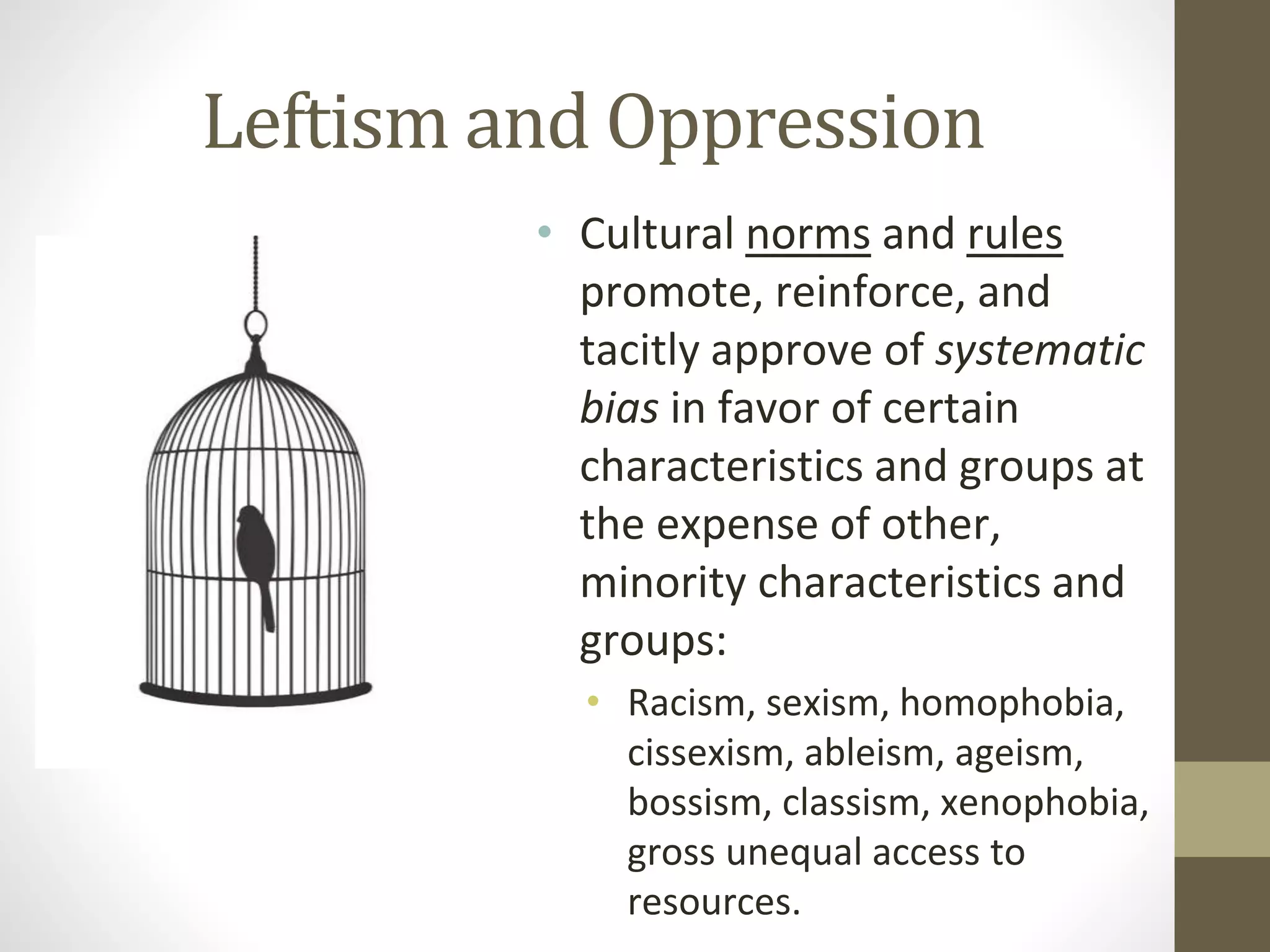
Leftism and Oppression
• Cultural norms and rules
promote, reinforce, and
tacitly approve of systematic
bias in favor of certain
characteristics and groups at
the expense of other,
minority characteristics and
groups:
• Racism, sexism, homophobia,
cissexism, ableism, ageism,
bossism, classism, xenophobia,
gross unequal access to
resources.
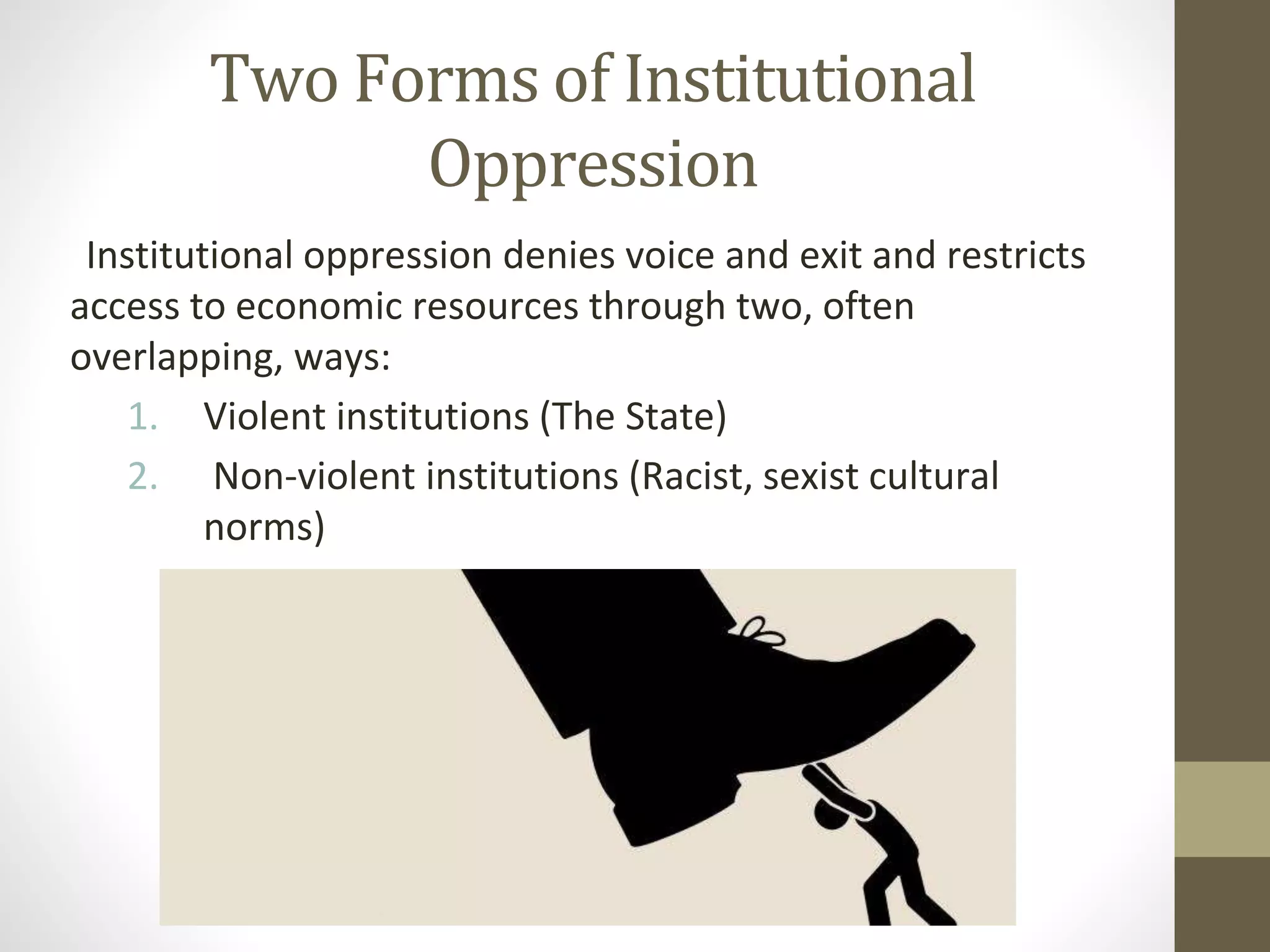
Two Forms of Institutional
Oppression
Institutional oppression denies voice and exit and restricts
access to economic resources through two, often
overlapping, ways:
1. Violent institutions (The State)
2. Non-violent institutions (Racist, sexist cultural
norms)
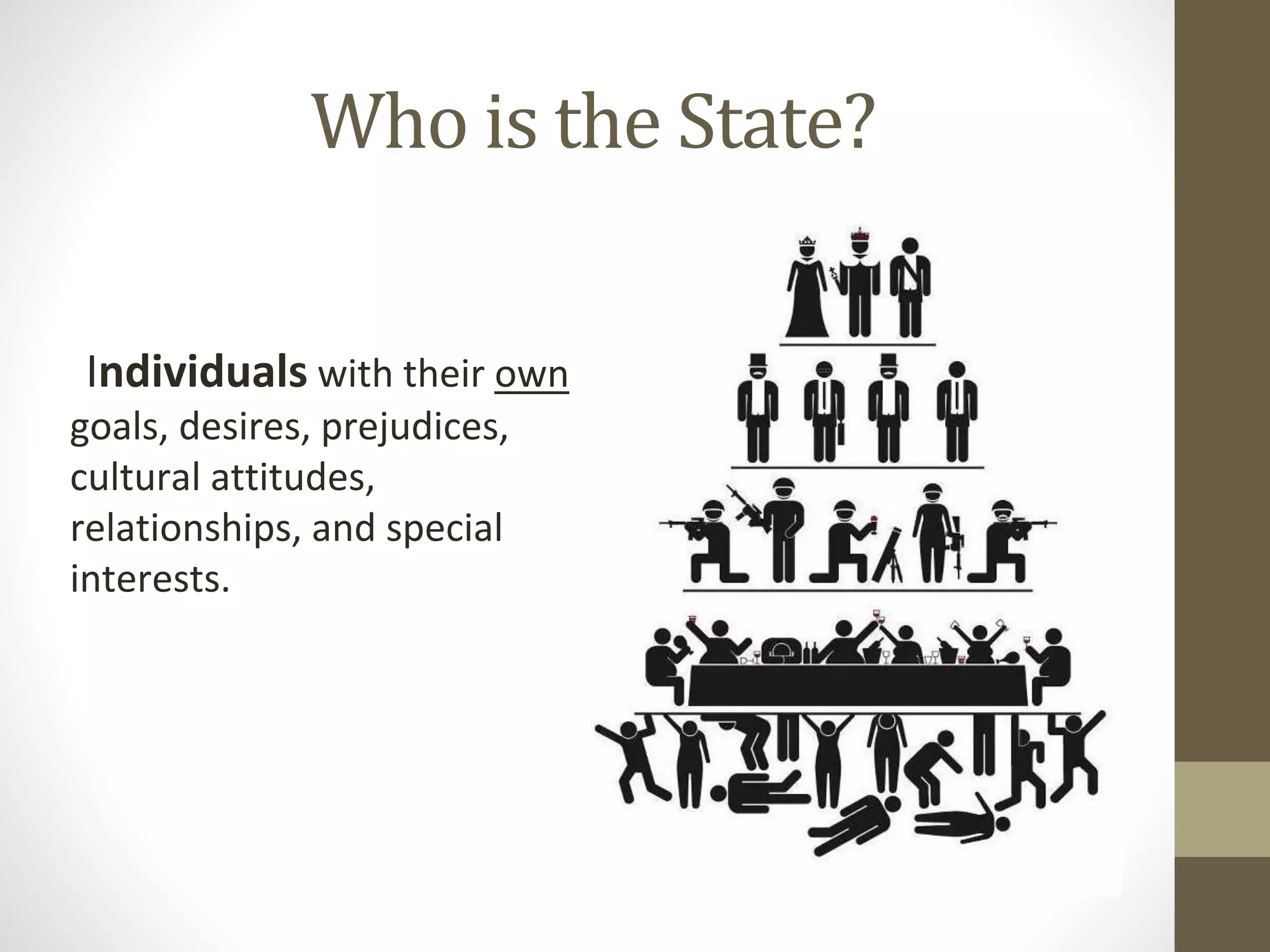
Who is the State?
Individuals with their own
goals, desires, prejudices,
cultural attitudes,
relationships, and special
interests.
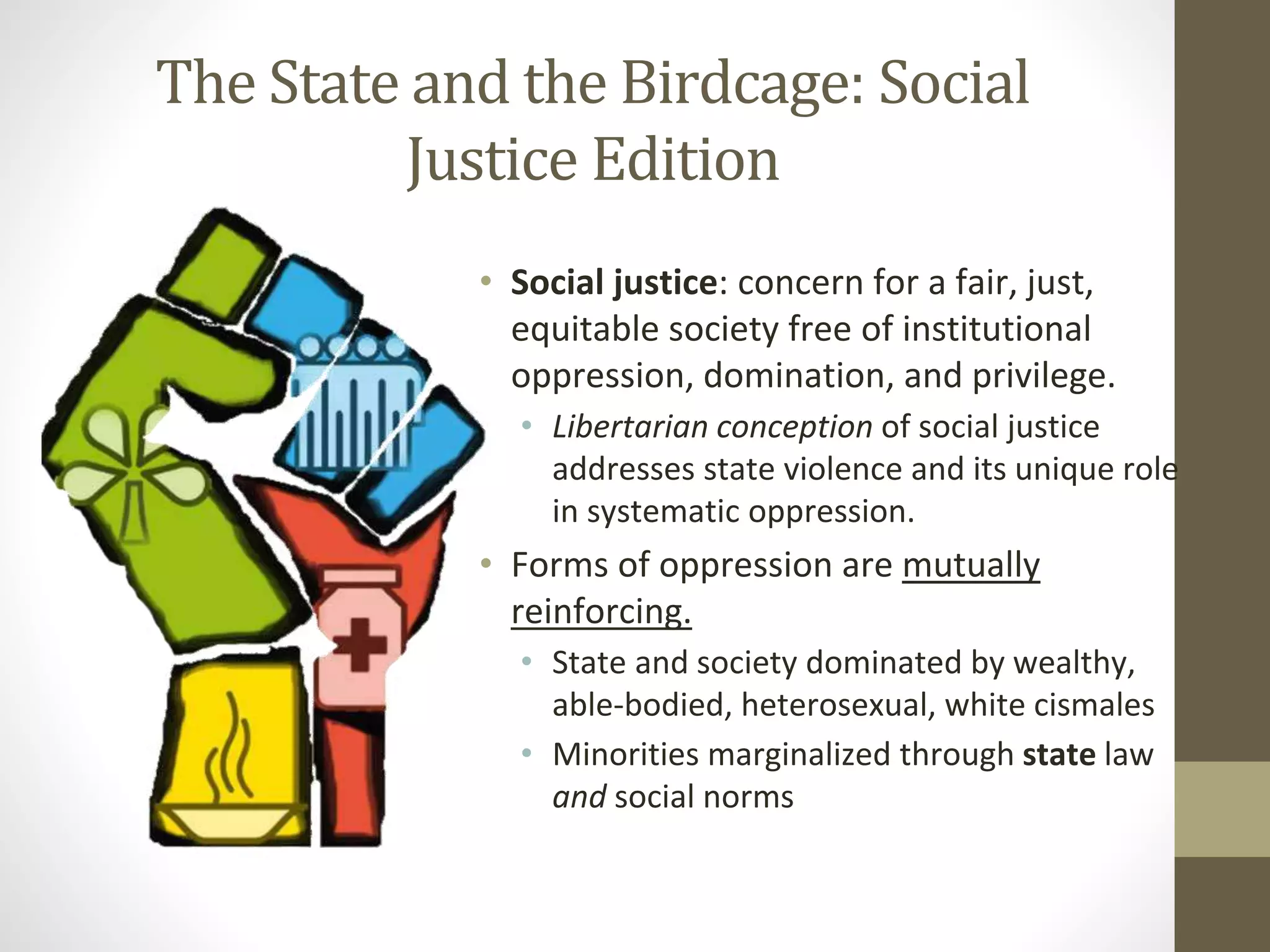
The State and the Birdcage: Social
Justice Edition
• Social justice: concern for a fair, just,
equitable society free of institutional
oppression, domination, and privilege.
• Libertarian conception of social justice
addresses state violence and its unique role
in systematic oppression.
• Forms of oppression are mutually
reinforcing.
• State and society dominated by wealthy,
able-bodied, heterosexual, white cismales
• Minorities marginalized through state law
and social norms
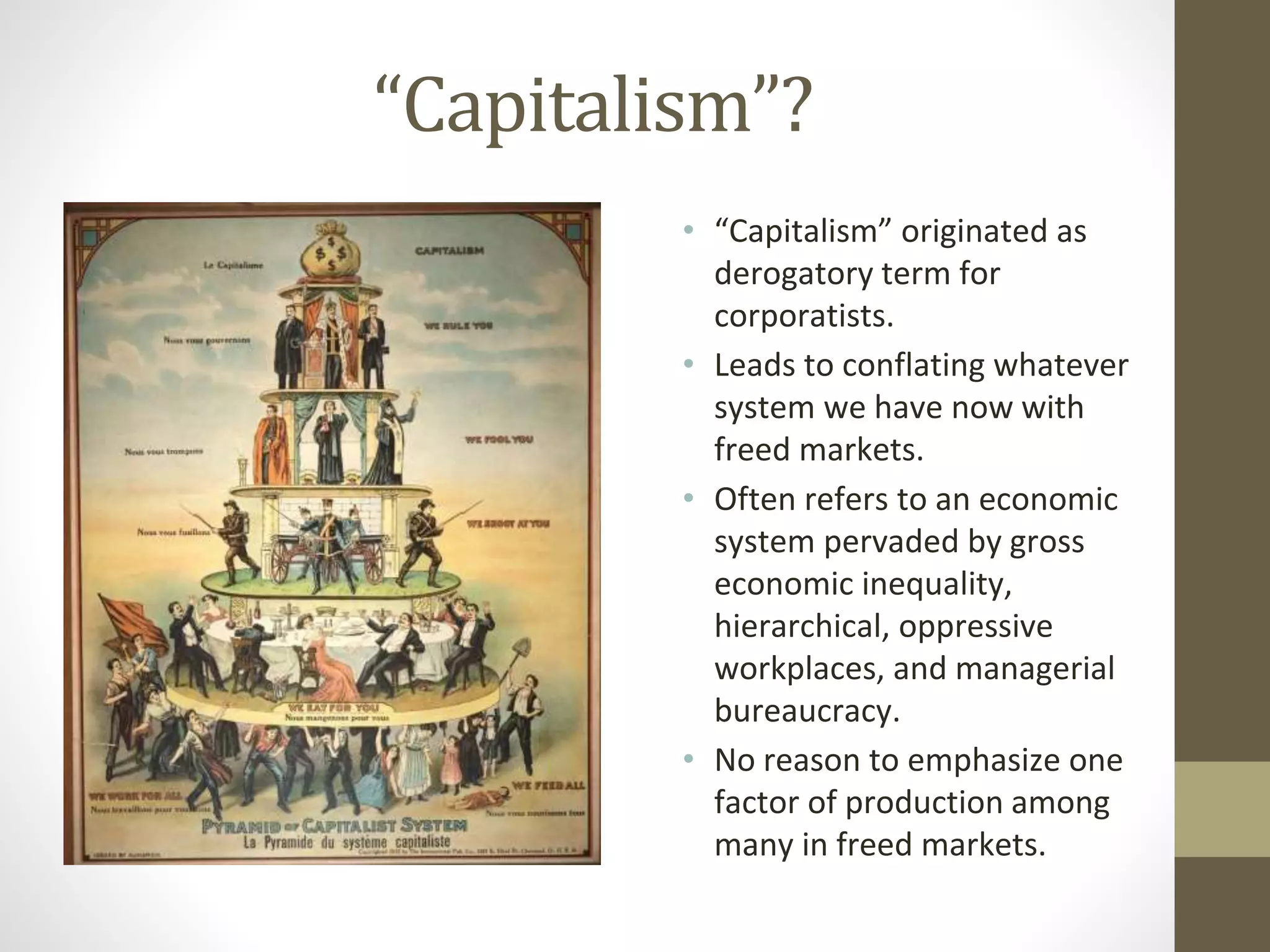
“Capitalism”?
• “Capitalism” originated as
derogatory term for
corporatists.
• Leads to conflating whatever
system we have now with
freed markets.
• Often refers to an economic
system pervaded by gross
economic inequality,
hierarchical, oppressive
workplaces, and managerial
bureaucracy.
• No reason to emphasize one
factor of production among
many in freed markets.
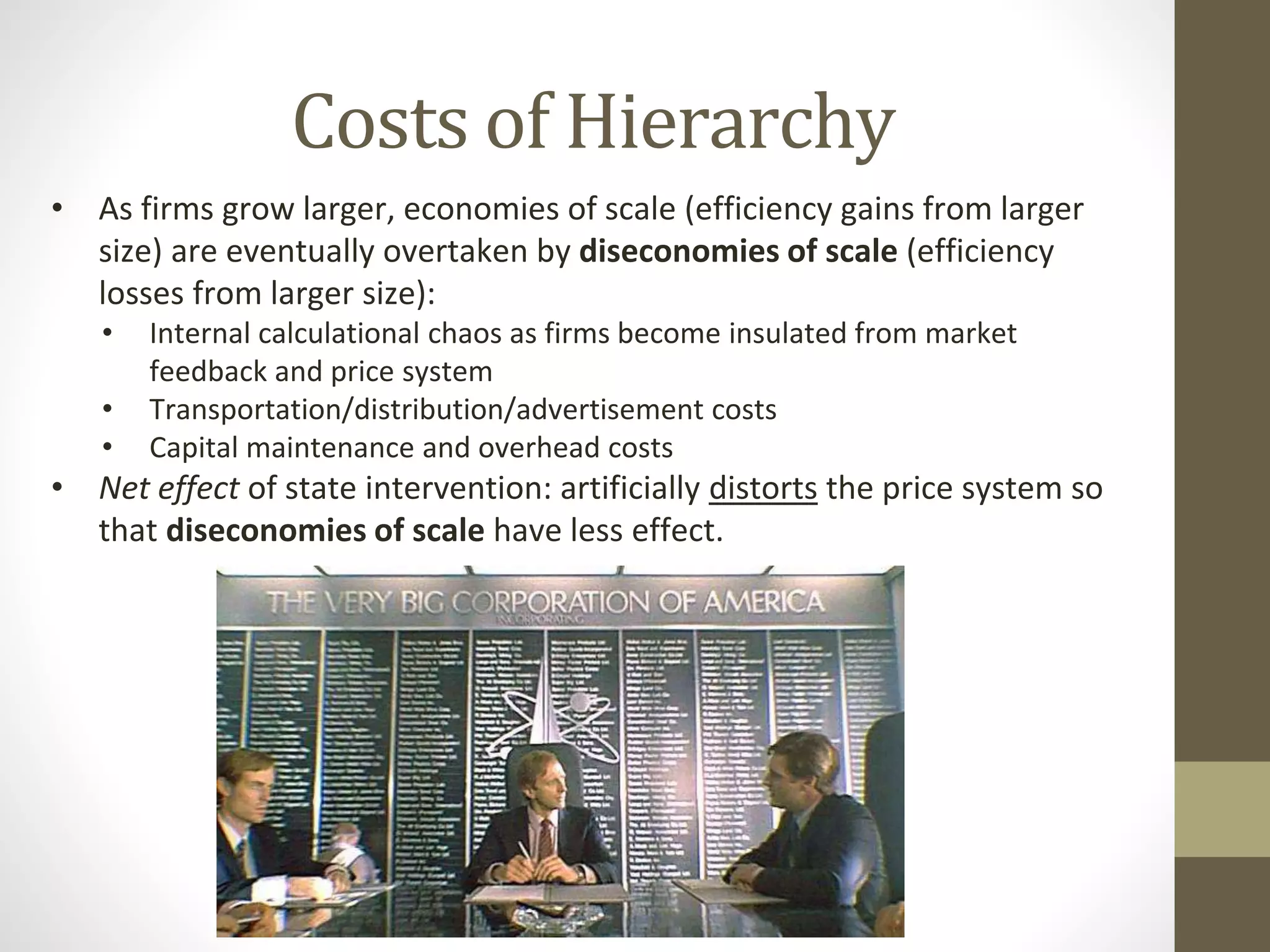
Costs of Hierarchy
• As firms grow larger, economies of scale (efficiency gains from larger
size) are eventually overtaken by diseconomies of scale (efficiency
losses from larger size):
• Internal calculational chaos as firms become insulated from market
feedback and price system
• Transportation/distribution/advertisement costs
• Capital maintenance and overhead costs
• Net effect of state intervention: artificially distorts the price system so
that diseconomies of scale have less effect.
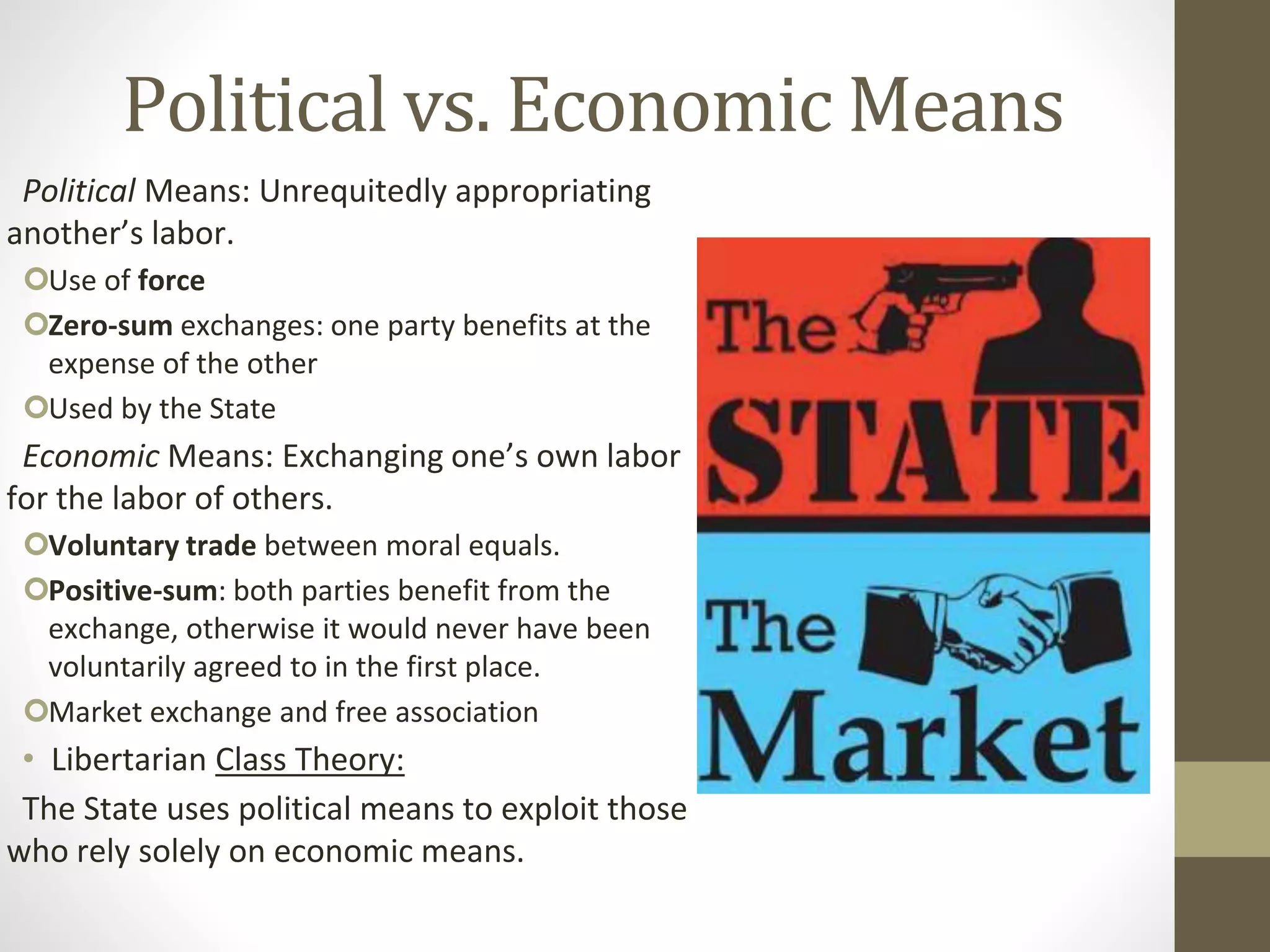
Political vs. Economic Means
Political Means: Unrequitedly appropriating
another’s labor.
Use of force
Zero-sum exchanges: one party benefits at the
expense of the other
Used by the State
Economic Means: Exchanging one’s own labor
for the labor of others.
Voluntary trade between moral equals.
Positive-sum: both parties benefit from the
exchange, otherwise it would never have been
voluntarily agreed to in the first place.
Market exchange and free association
• Libertarian Class Theory:
The State uses political means to exploit those
who rely solely on economic means.
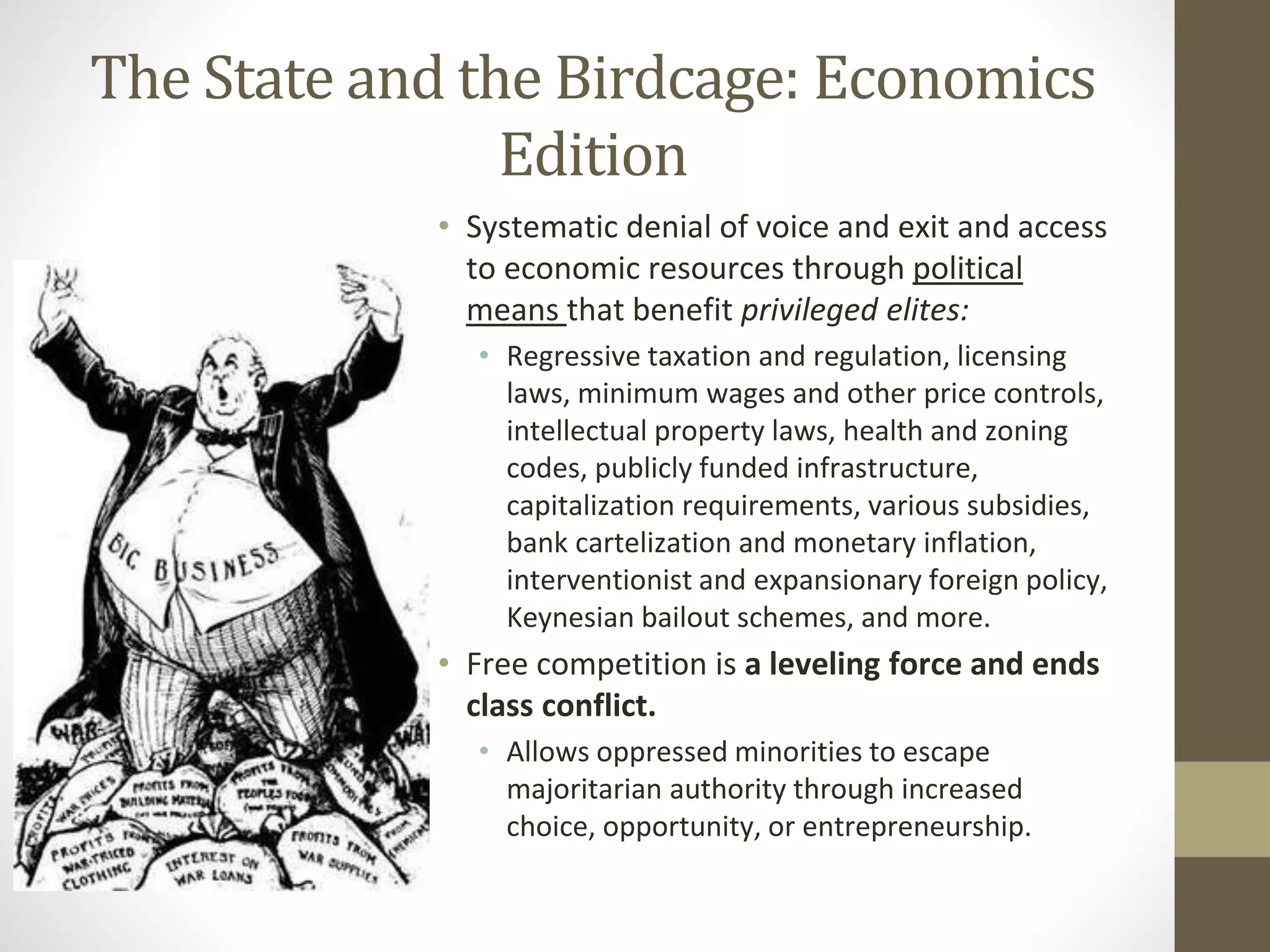
The State and the Birdcage: Economics
Edition
• Systematic denial of voice and exit and access
to economic resources through political
means that benefit privileged elites:
• Regressive taxation and regulation, licensing
laws, minimum wages and other price controls,
intellectual property laws, health and zoning
codes, publicly funded infrastructure,
capitalization requirements, various subsidies,
bank cartelization and monetary inflation,
interventionist and expansionary foreign policy,
Keynesian bailout schemes, and more.
• Free competition is a leveling force and ends
class conflict.
• Allows oppressed minorities to escape
majoritarian authority through increased
choice, opportunity, or entrepreneurship.
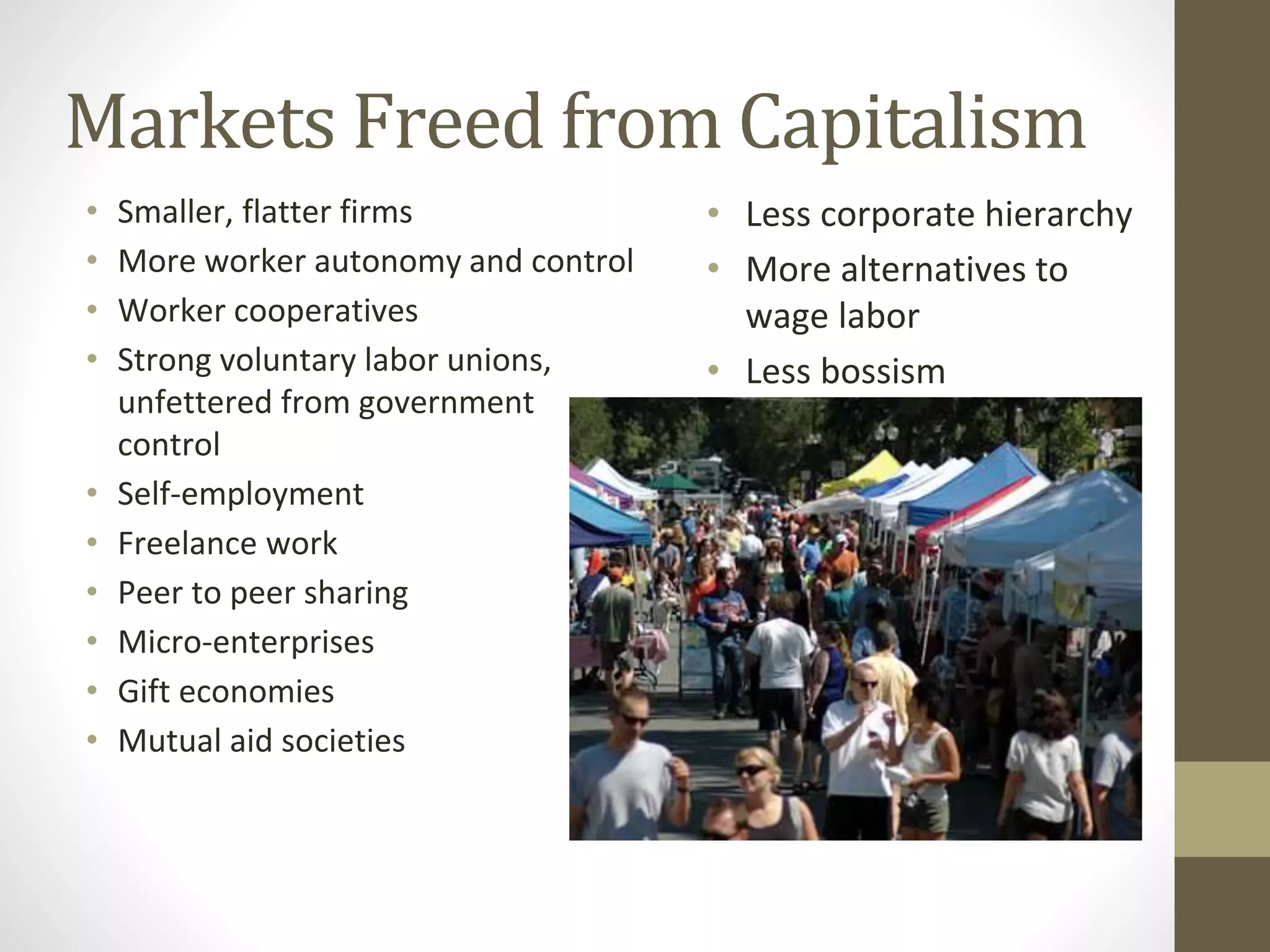
Markets Freed from Capitalism
• Smaller, flatter firms
• More worker autonomy and control
• Worker cooperatives
• Strong voluntary labor unions,
unfettered from government
control
• Self-employment
• Freelance work
• Peer to peer sharing
• Micro-enterprises
• Gift economies
• Mutual aid societies
• Less corporate hierarchy
• More alternatives to
wage labor
• Less bossism
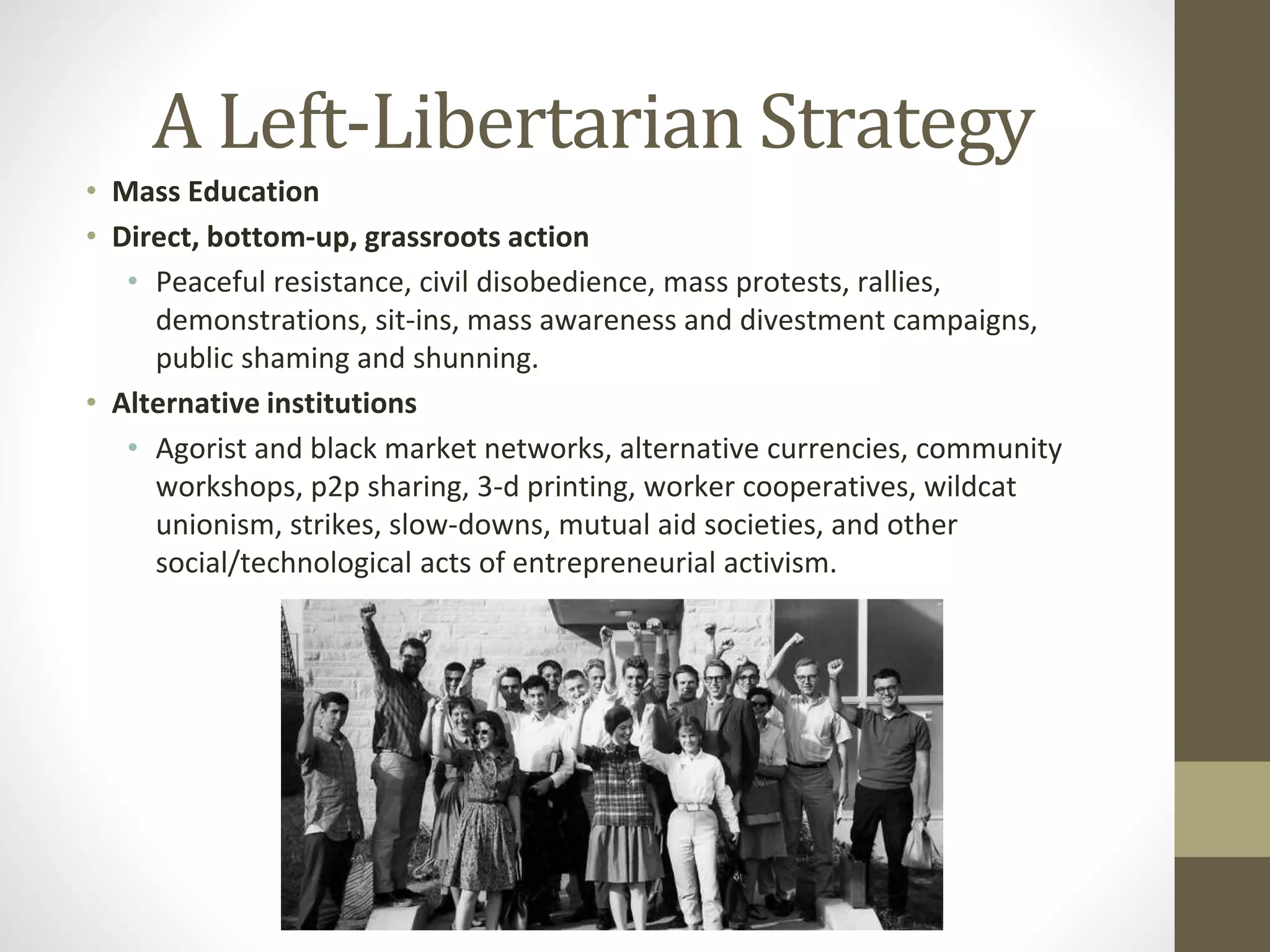
A Left-Libertarian Strategy
• Mass Education
• Direct, bottom-up, grassroots action
• Peaceful resistance, civil disobedience, mass protests, rallies,
demonstrations, sit-ins, mass awareness and divestment campaigns,
public shaming and shunning.
• Alternative institutions
• Agorist and black market networks, alternative currencies, community
workshops, p2p sharing, 3-d printing, worker cooperatives, wildcat
unionism, strikes, slow-downs, mutual aid societies, and other
social/technological acts of entrepreneurial activism.
Where Can I Learn More?
• C4ss.org
• S4ss.org
• All-left.net
• distro.libertarianleft.org
• Molinari.co
• Praxeology.net
• AAEblog.com
• Radgeek.com
• Mutualist.org
• Sheldonrichman.com

What is Left-Libertarianism?

  • 2.
    What is Libertarianism? •Equality of Authority: human beings are fundamentally morally equal. • Individuals own themselves and any objects they incorporate into their projects through voluntary trade or labor-mixing. • People and property are ends, never mere means. • Force only justified in self-defense.
  • 3.
    Libertarianism and Statism •The State claims a territorial monopoly on legitimatizing the use of force. • Laws enforced through threat of violence. • State authority does not rest on the explicit consent of the governed • Violates individual liberty • Anarchism: social system based on free association and voluntary trade, not state force.
  • 4.
    What is Leftism? •Ethic of Non-Domination • Opposition to authoritarianism, privilege, exploitation, hierarchy, exclusion, subordination, and deprivation. • Intersectionality • Systems of oppression and privilege overlap or “intersect” • Dialectics: • “Art of context keeping” • Society is a complex nexus of interrelated institutions and processes and must be understood as such.
  • 5.
    Leftism and Oppression •Cultural norms and rules promote, reinforce, and tacitly approve of systematic bias in favor of certain characteristics and groups at the expense of other, minority characteristics and groups: • Racism, sexism, homophobia, cissexism, ableism, ageism, bossism, classism, xenophobia, gross unequal access to resources.
  • 6.
    Two Forms ofInstitutional Oppression Institutional oppression denies voice and exit and restricts access to economic resources through two, often overlapping, ways: 1. Violent institutions (The State) 2. Non-violent institutions (Racist, sexist cultural norms)
  • 7.
    Who is theState? Individuals with their own goals, desires, prejudices, cultural attitudes, relationships, and special interests.
  • 8.
    The State andthe Birdcage: Social Justice Edition • Social justice: concern for a fair, just, equitable society free of institutional oppression, domination, and privilege. • Libertarian conception of social justice addresses state violence and its unique role in systematic oppression. • Forms of oppression are mutually reinforcing. • State and society dominated by wealthy, able-bodied, heterosexual, white cismales • Minorities marginalized through state law and social norms
  • 9.
    “Capitalism”? • “Capitalism” originatedas derogatory term for corporatists. • Leads to conflating whatever system we have now with freed markets. • Often refers to an economic system pervaded by gross economic inequality, hierarchical, oppressive workplaces, and managerial bureaucracy. • No reason to emphasize one factor of production among many in freed markets.
  • 10.
    Costs of Hierarchy •As firms grow larger, economies of scale (efficiency gains from larger size) are eventually overtaken by diseconomies of scale (efficiency losses from larger size): • Internal calculational chaos as firms become insulated from market feedback and price system • Transportation/distribution/advertisement costs • Capital maintenance and overhead costs • Net effect of state intervention: artificially distorts the price system so that diseconomies of scale have less effect.
  • 11.
    Political vs. EconomicMeans Political Means: Unrequitedly appropriating another’s labor. Use of force Zero-sum exchanges: one party benefits at the expense of the other Used by the State Economic Means: Exchanging one’s own labor for the labor of others. Voluntary trade between moral equals. Positive-sum: both parties benefit from the exchange, otherwise it would never have been voluntarily agreed to in the first place. Market exchange and free association • Libertarian Class Theory: The State uses political means to exploit those who rely solely on economic means.
  • 12.
    The State andthe Birdcage: Economics Edition • Systematic denial of voice and exit and access to economic resources through political means that benefit privileged elites: • Regressive taxation and regulation, licensing laws, minimum wages and other price controls, intellectual property laws, health and zoning codes, publicly funded infrastructure, capitalization requirements, various subsidies, bank cartelization and monetary inflation, interventionist and expansionary foreign policy, Keynesian bailout schemes, and more. • Free competition is a leveling force and ends class conflict. • Allows oppressed minorities to escape majoritarian authority through increased choice, opportunity, or entrepreneurship.
  • 13.
    Markets Freed fromCapitalism • Smaller, flatter firms • More worker autonomy and control • Worker cooperatives • Strong voluntary labor unions, unfettered from government control • Self-employment • Freelance work • Peer to peer sharing • Micro-enterprises • Gift economies • Mutual aid societies • Less corporate hierarchy • More alternatives to wage labor • Less bossism
  • 14.
    A Left-Libertarian Strategy •Mass Education • Direct, bottom-up, grassroots action • Peaceful resistance, civil disobedience, mass protests, rallies, demonstrations, sit-ins, mass awareness and divestment campaigns, public shaming and shunning. • Alternative institutions • Agorist and black market networks, alternative currencies, community workshops, p2p sharing, 3-d printing, worker cooperatives, wildcat unionism, strikes, slow-downs, mutual aid societies, and other social/technological acts of entrepreneurial activism.
  • 15.
    Where Can ILearn More? • C4ss.org • S4ss.org • All-left.net • distro.libertarianleft.org • Molinari.co • Praxeology.net • AAEblog.com • Radgeek.com • Mutualist.org • Sheldonrichman.com

Editor's Notes

  • #6 Like the wires of a birdcage (I owe this analogy to Marilyn Frye), forms of institutionalized oppression are not always inherently dominating, but taken together, they deny the ability for voice and exit and form a widespread, multi-faceted, complex system of interlocking and mutually reinforcing norms and rules that create relationships pervaded by privilege and domination, instead of respect and autonomy.
  • #8 The State is not some disembodied, exogenous force that merely imposes its will on the rest of society. Dialectical View: The cultural norms and rules that make up the birdcage of oppression, then, are in mutual support with Statism because they pervade the relationships and attitudes of state actors who are part of that very same culture and who are influenced by majority opinion and special (privileged) interests.
  • #9 Consider the U.S. criminal justice system and the industrial prison complex and how it disproportionately targets people of color.
  • #12 Franz Oppenheimer identified the two fundamental means to acquire wealth.
  • #13 The institutional concentration of economic resources and artificial ratcheting up of alternative ways of living through the use of “political means” by politically entrenched, wealthy elites plays a significant part in the overall system of oppression that marginalizes minority groups. The ability to freely enter or exit markets disperses and decentralizes economic resources and decision-making, as well as continuously eats away at profits with increasing quality and decreasing prices.
  • #15 Mass Education: While not everyone must be convinced of all the nuanced views of left libertarians to ever a free society, some form of a cultural and intellectual shift towards generally libertarian and leftists values must be achieved to make any lasting institutional change. Direct, bottom-up, grassroots activism: put the power for social change in the hands of any one, while also creating a clear message to the rest of society, especially the ruling elite. Alternative institutions: provide ways for people to withdraw their support for the ruling elite and create independent and autonomous spheres of cooperation.